


If your partner once looked at you like you were the only person in the room, and now looks past you at a screen, a hobby or a work problem, you are not imagining the change. Hyperfocus can pour attention onto one person, then pull it away without warning. In most couples we see, the shift is an attention pattern, not proof that someone stopped caring. It still hurts, and it still needs a plan.
This article is for both sides of that experience: the partner with ADHD who is baffled that they are being told they don’t care, and the partner who feels like they became a to-do item. It is education, not assessment. Only a qualified clinician can evaluate whether ADHD is part of your picture.
Key takeaways
- Hyperfocus is intense, long-lasting concentration, and it can cut awareness of time, chores, shared plans and a partner’s emotional needs.
- Withdrawal from a shared activity often reads as lost interest. It is usually a shift in attention that is hard to control without structure.
- The painful loop is usually symptom, reaction, counter-reaction. You can interrupt it with pre-agreed plans rather than in-the-moment willpower.
- Generic couples work often stalls when executive function problems go unaddressed, so ADHD-informed support matters.
- Nothing here promises a particular outcome. It gives you an honest next step.
Table of Contents
- What hyperfocus actually is
- The pattern many couples describe: spotlight, then drift
- Why it feels like love left
- The symptom, response, response loop
- What helps the partner with ADHD
- What helps the partner who feels left behind
- Why generic couples counseling can stall
- How we see it
- A next step that matches where you are
- FAQ
- Sources
What hyperfocus actually is
Hyperfocus is long-lasting, intense concentration. Research on adult ADHD links it with reduced awareness of time and surroundings, and finds it can cause conflict when it leads to neglect of daily tasks, shared commitments or a partner’s emotional needs. The same research notes hyperfocus is not exclusive to ADHD, but it shows up more often, and across more settings (hobbies, screens, work), in people with higher ADHD symptom levels.
That last point matters. Hyperfocus is not the same as choosing what matters most. The brain locks onto what is novel, stimulating or urgent, and the rest of life goes quiet. Some people describe it as a tunnel. Others say it feels like being pulled under by something they enjoy.
It is also not a diagnosis by itself. If you recognize yourself here, a conversation with a licensed clinician is the way to find out what is going on. An article cannot tell you.
The pattern many couples describe: spotlight, then drift
The early stage of a relationship is novel, intense and rewarding, which is exactly what an ADHD brain can lock onto. Simply Psychology’s overview describes partners feeling like the center of the world early on, then feeling ignored once that intensity eases and baseline inattention returns. One commonly quoted experience is going from being adored to reminding someone you exist.
CHADD’s guidance for couples describes how the relationship often begins with excitement and energy before the disorder’s effects on daily life become visible to the non-ADHD spouse. Neither person did anything wrong at the start. The beginning was real. So is what comes after.
Here is how the spotlight can move through a week:
- Early weeks. Attention is high. Texts are immediate, surprises are planned, the partner feels seen.
- A new interest arrives. A work launch, a project, a game, a training plan. The spotlight swings.
- The partner reaches out and gets a distracted answer. Not cruelty. The mind is elsewhere.
- The partner feels neglected. Hurt turns into reminders, then criticism, then micromanaging.
- The person with ADHD feels attacked. Shame, defensiveness, or shutdown follow.
- Distance grows. Both feel misunderstood, and both are right.
Why it feels like love left
Many couples read withdrawal from a shared activity as a loss of love. CHADD’s article on couples living with ADHD frames it differently: a shift in attention that the ADHD partner cannot easily control without external structure or deliberate cues to re-engage.
That does not erase the impact. If you are the partner on the receiving end, your loneliness is a legitimate experience whatever the cause. If you are the one with ADHD, your intention to love well can be sincere and your follow-through can still fall short. Both things can be true, and holding both is where repair starts.
A 2025 exploratory study of adults with ADHD in romantic relationships named two themes that capture it: feeling “Too Much and Never Enough,” and a battle between passion and distraction. The same paper notes adults with ADHD are more likely to have discordant or short-lived relationships, and points to inattention and impulsive responses during conflict as contributors. That is a pattern across groups, not a verdict on your marriage.
The symptom, response, response loop
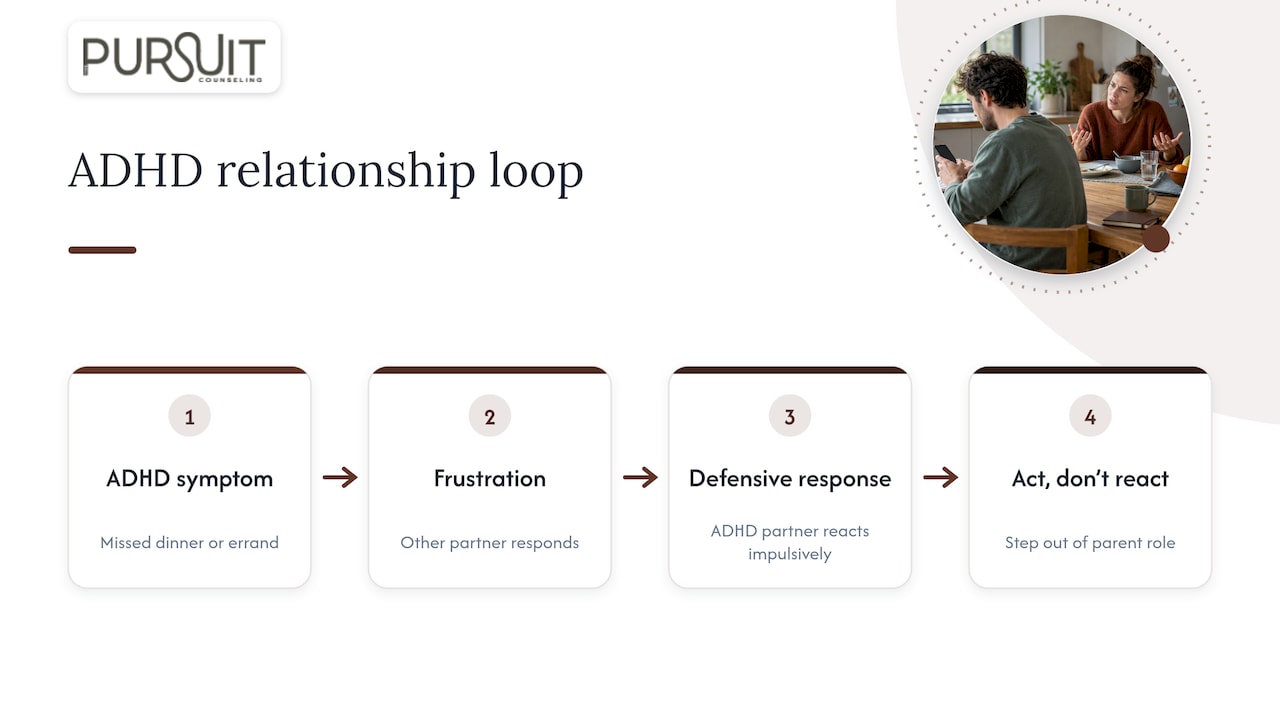
Therapists who work with ADHD couples often describe a three-step loop. The ADHD symptom shows up (a missed dinner, a forgotten errand, hours lost to a project). The other partner responds with frustration. Then the ADHD partner responds to that frustration, often impulsively or defensively. CHADD material on this cycle puts the way out as acting rather than reacting, which includes the non-ADHD partner stepping out of the manager or parent role.
The parent-child dynamic is one of the most corrosive. It wears down desire for the partner who is being managed and exhausts the partner doing the managing. Neither person signed up for it.
What the Four Horsemen look like here
Therapists using the Gottman framework note that criticism and stonewalling can emerge from rapid emotional escalation tied to weaker working memory and verbal impulse control. That is why planning ahead, such as pre-set breaks during heated moments, tends to work better than trying to stay calm in the middle of a fight. If you want exercises for these patterns, we outline them in our clinician’s plan for the Gottman four horsemen.
What helps the partner with ADHD
You do not need to become a different person. You need structure that does the remembering for you.
- Build re-entry cues. A phone alarm labeled with your partner’s name, a shared calendar block, a physical object on the desk. Hyperfocus rarely ends on its own, so something external has to end it.
- Announce the dive. “I am starting this project and I will surface at 7:30” turns an apparent disappearance into a plan.
- Make your return count. Two minutes of undivided attention when you resurface does more than an hour of distracted presence.
- Reduce friction on routine tasks. Shrinking small recurring chores frees attention for the relationship. Some people use quick-routine tools, such as a 20-second sonic toothbrush approach written up for ADHD families, to make a daily task less of a negotiation. It is a small example, but small tasks are where resentment piles up.
- Treat your executive function as trainable. Our guide to executive function skills for adults and the 10-minute procrastination reset are practical starting points, and missed deadlines often have the same root.
What helps the partner who feels left behind
You are not being needy. You are asking for connection. Still, how you ask matters, because an ADHD brain under criticism tends to protect itself rather than listen.
- Name the pattern, not the person. “I feel alone when we lose the evening to the project” lands differently than “You never care about us.”
- Agree on the plan when you are calm. Pre-negotiated coping steps beat improvised ones. A time-apart break agreed in advance, with a stated return time, keeps a fight from becoming a rupture.
- Hand back what is theirs. If you are the household project manager, say so, then renegotiate. Reminders delivered as a system you both chose feel different from nagging.
- Protect your own life. Friends, movement, your own interests. It lowers the stakes of every missed text.
Why generic couples counseling can stall
An APA-published overview of ADHD-focused couple therapy describes ADHD as a developmental condition whose impact ripples through every area of life, so the therapy places ADHD at the center of every issue. Practitioners in this literature also note that couples work can stall until executive function impairments are addressed through individual therapy, medication or a structured ADHD-focused framework. A companion piece describes a CBT model for ADHD-challenged couples built on executive function.
In plain terms, if one partner cannot reliably hold a plan in mind, a communication exercise that depends on remembering to use it will fail, and both people will conclude therapy does not work. The fix is not more effort. It is a different design.
More context on research: a review of adult ADHD and romantic relationships covers what is known and what clinicians can do to help, and a study of symptoms and relationship maintenance examines how inattention and impulsivity feed relationship difficulties.
How we see it
We work with complicated, capable people: executives, pilots, founders, busy parents. Many have built impressive lives on intensity. Hyperfocus is often part of that story. It is the same capacity that closes the deal and misses the dinner.
What we hear most often is not “I don’t love my partner.” It is “I cannot get my attention to go where I want it, and I am tired of being told that means I don’t care.” On the other side: “I am tired of being the only one who remembers.” Both are stuck in a pain cave, and both are working hard to get out of it.
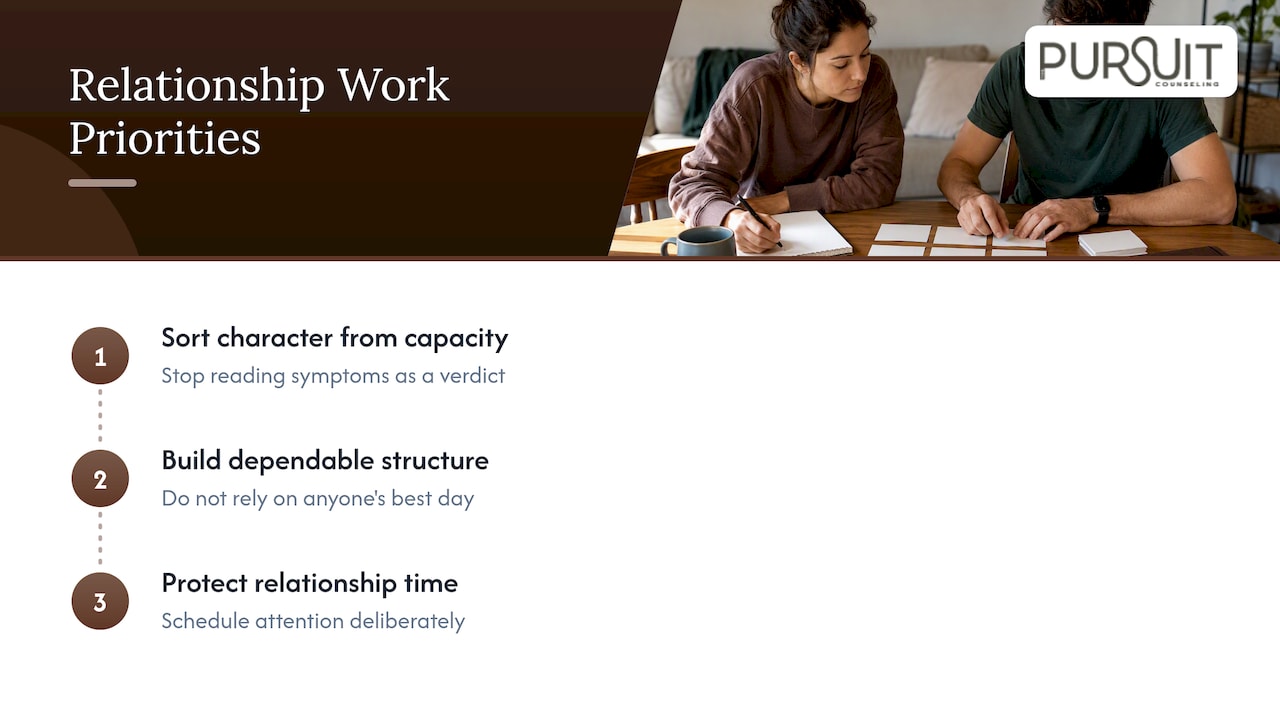
Our view is that the first job is sorting character from capacity, so each person can stop reading the other’s symptoms as a verdict. The second is building structure that does not depend on anyone’s best day. The third is giving the relationship real, protected time, because attention that is scheduled is still attention.
We also think individual work often has to run alongside couples work. That can mean ADHD-focused therapy, skills for executive function, and, for some adults, exploring options like neurofeedback, where we are candid about what the evidence does and does not show. We do not promise outcomes. We promise to be honest and to adapt to the two people in the room.
— Adam Glendye LPC, CPCS
A next step that matches where you are
If you are not sure yet, start with a conversation, not a diagnosis. Try this in the next week:
- Each of you writes down one moment this month when you felt disconnected, and one thing you needed.
- Share them without rebuttal. Listening only.
- Choose one re-entry cue and one agreed break plan.
- Review in a week. Keep what worked, drop what did not.
If that stalls, or if the same fight keeps returning, outside help is reasonable. Our ADHD therapy in Fayetteville is a starting point for the partner with ADHD. For the relationship itself, we offer couples counseling and a couples intensive, a focused block of time for couples who cannot make progress in a weekly hour. Individual therapy is published at 125-500 USD per hour, and a Couples Intensive is 1500 USD for a 3 hour intensive, as listed on our services page. We see clients in person in Fayetteville, Georgia, and online, and serve Peachtree City, Senoia, Brooks, Tyrone and the wider South Atlanta area. We are private-pay.
If you want to understand the individual picture first, our pieces on hidden ADHD in women and hormone windows may help you recognize what you have been carrying.
The CDC reports that about 15.5 million U.S. adults (6.0%) have a current ADHD diagnosis, and more than half were diagnosed as adults. If you are one of them, and no one told you why relationships felt this hard, you are in very large company.
FAQ
Does ADHD hyperfocus mean my partner has stopped loving me?
Not necessarily. Withdrawal from a shared activity is often a shift in attention, not a loss of feeling. It can still leave you lonely, and that deserves a direct conversation and a plan, not just reassurance.
Is hyperfocus only an ADHD thing?
No. Research finds hyperfocus occurs outside ADHD, but it appears more often and in more settings in people with higher ADHD symptom levels. A licensed clinician can assess whether ADHD is involved. This article cannot.
Can couples therapy help if one of us has ADHD?
It can, when it accounts for ADHD. Practitioners in the ADHD couples literature note that generic approaches may stall until executive function problems are addressed. Ask any therapist how they work with ADHD before you start.
How do we stop the fight cycle?
Agree on a plan when you are calm, such as a time-apart break with a set return time, and use it before things escalate. Each person’s job is to act on the plan rather than react to the trigger.
Sources
- Couples Living with ADHD: Manage Intense Emotions and Build Deeper Connections, CHADD
- Survival Tips for the Spouse, CHADD
- CHADD
- “I Felt Like a Burden”: Romantic Relationships for People With ADHD, PMC
- Hyperfocus research, PubMed
- Principles of ADHD-focused couple therapy, APA PsycNet
- A CBT model for ADHD-challenged couples, APA PsycNet
- Adult ADHD and romantic relationships, PubMed
- Inattention and Hyperactivity-Impulsivity and Romantic Relationship Maintenance, PubMed
- ADHD diagnosis, treatment and telehealth use in adults, CDC MMWR
- How ADHD Hyperfocus Impacts Relationships, Simply Psychology