


Yes, chronic exhaustion that persists no matter how much you sleep, paired with resentment toward your own life, is working mom burnout, not a bad week. The single most urgent thing to do right now is protect eight hours of sleep tonight and cancel one nonessential obligation this week. That is not indulgence. It is triage.
Working mom burnout is different from ordinary tiredness because it spans two full-time roles at once and never fully switches off. A large-sample study of 2,334 working mothers found that parental burnout and workplace burnout are distinct but related conditions, meaning you can be depleted at home, at work, or both, and the exhaustion compounds. Forbes has reported that depression and burnout rates among working mothers have climbed sharply in recent years, with a significant share of surveyed mothers reporting anxiety or depression symptoms alongside chronic fatigue.
- Right now: Go to bed 30 minutes earlier tonight and say no to one request this week without justifying it.
- This week: Identify one recurring task you can hand off entirely, not just delegate with oversight.
- Red flag: If you’re having thoughts of self-harm, feeling unable to care for your children, or experiencing panic attacks that don’t resolve, that requires immediate professional or emergency care. It is not a self-help checklist.
Statistic to know: Forbes cites survey data showing that a significant share of working mothers report anxiety or depression symptoms in recent surveys, a number that underscores how common this experience is, even though it rarely gets treated with the urgency it deserves.
Key Takeaways
Working mom burnout is a treatable, role-spanning depletion driven by workload, mental load, and insufficient support, not a permanent personal failing.
| Point | Details |
|---|---|
| Burnout is domain-spanning | Home and work burnout compound each other rather than canceling out, so both need addressing. |
| Sleep and boundaries stabilize fast | Protecting sleep and saying no to one obligation can shift symptoms within days. |
| Recovery follows phases | A realistic timeline runs four to twelve weeks, moving from stabilization to redistribution to identity work. |
| Guilt is the biggest barrier | Reframing help as maintenance, not failure, is often the turning point in recovery. |
| Professional support accelerates change | The Pursuit Counseling offers therapy, EMDR, neurofeedback, and coaching tailored to working mothers across Georgia, in person and online. |
Your first three actions:
- Protect seven to eight hours of sleep tonight and cancel one nonessential obligation this week.
- Score yourself on the eight-question checklist and identify your single biggest leverage point.
- If you scored six or higher, or noticed red flag symptoms, schedule a consultation with a therapist or coach this week.
Table of Contents
- Working Mom Burnout Self-Check: 8 Questions to Ask Yourself
- How Burnout Feels Different From Depression or Acute Stress
- What’s Actually Driving Working Mom Burnout
- Short-Term Stabilizers for the Next 24 to 72 Hours
- Your 4 to 12 Week Recovery Plan
- How Therapy and Coaching Speed Recovery
- Talking to Your Partner and Employer About the Load
- Building Habits That Prevent Relapse
- Effects on Kids and Family Life
- Finding Support Beyond Your Household
- Working Through the Guilt of Prioritizing Yourself
- Understanding Your Workplace Rights and Options
- How The Pursuit Counseling Supports Working Mothers Through Burnout
- Sources
- FAQ
Working Mom Burnout Self-Check: 8 Questions to Ask Yourself
You don’t need a clinical intake form to know something is wrong. You need eight honest answers.
Answer yes or no to each item below, thinking about the past two to three weeks rather than a single bad day.
- Do you feel physically exhausted even after a full night’s sleep?
- Have you started dreading Sunday nights or the start of the workweek?
- Do you feel resentful toward your partner, kids, or job more often than not?
- Has your patience with your children shrunk noticeably, even over small things?
- Do you feel like you’re doing everything but accomplishing nothing?
- Is your mental to-do list running constantly, even during moments meant for rest?
- Have you pulled back from friends, hobbies, or anything that isn’t obligation?
- Do you feel like you’re failing at both your job and your parenting, simultaneously?
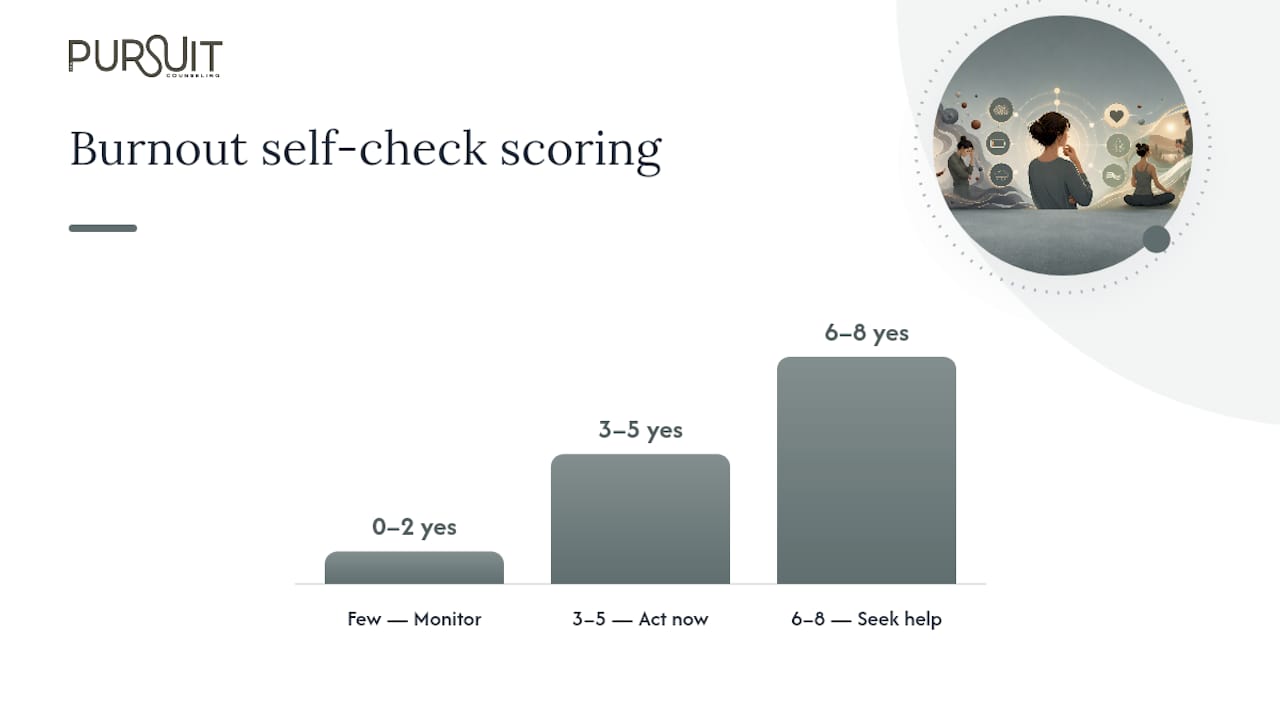
Scoring guidance:
| Yes answers | What it suggests |
|---|---|
| Few | Monitor. Some strain is present; build in recovery habits before it deepens. |
| 3 to 5 | Act now. This pattern matches early to moderate working mom burnout; start short-term stabilizers immediately. |
| 6 to 8 | Seek professional help. This level of depletion usually needs structured support, not just willpower. |
Pro Tip: Score yourself twice, once quickly and once slowly. The fast answer is usually the honest one. Mothers routinely underscore their own exhaustion because admitting the real number feels like admitting failure. It isn’t. It’s data, and data is what gives you permission to act.
How Burnout Feels Different From Depression or Acute Stress
Working mom burnout shows up across four domains, and recognizing the pattern helps you respond correctly instead of guessing.
Physical symptoms include chronic fatigue that doesn’t improve with sleep, frequent headaches or muscle tension, and a weakened immune system that leaves you catching every cold your kids bring home. Emotional symptoms include irritability that surprises even you, a persistent undercurrent of guilt, and a flattened sense of joy in things that used to matter. Cognitive symptoms show up as brain fog, trouble concentrating on work tasks, and forgetting things that used to be automatic. Behavioral symptoms often include withdrawing from friends, snapping at your kids or partner, and a phenomenon many mothers describe as Sunday dread, a creeping anxiety that starts the moment the weekend winds down.
Burnout and depression can look similar from the outside, but they behave differently on the inside. Burnout tends to be situational and reversible once the demand or support imbalance shifts. Depression tends to persist even when the external stressors ease, and it often includes a pervasive sense of hopelessness that burnout alone does not produce.
Five quick distinctions separate the two conditions, and knowing them helps you choose the right next step:
- Burnout usually improves with rest, boundary changes, and reduced demands; depression often does not.
- Burnout tends to feel situation-specific (“I can’t do this job and this house”), while depression tends to feel global (“nothing matters”).
- Burnout rarely includes persistent feelings of worthlessness; depression frequently does.
- Burnout symptoms often ease on vacation or during a lighter week; depression symptoms typically persist regardless of circumstance.
- Burnout is tied to identifiable role strain, while depression can appear without any clear external trigger.
If your symptoms persist for more than two weeks regardless of rest, or include thoughts of hopelessness or self-harm, that crosses into territory requiring a diagnostic evaluation, not a stress-management plan. The Cleveland Clinic’s guidance on depleted mother syndrome is careful to note this isn’t an official diagnosis, but a useful clinical shorthand for the role-spanning exhaustion many mothers describe, and it’s a helpful starting point for conversations with a provider.
What’s Actually Driving Working Mom Burnout
Burnout in mothers rarely comes from one source. It comes from several pressures stacking on top of each other until the system buckles.
The most obvious driver is workload, but the less visible one is the mental load, the constant background tracking of appointments, permission slips, grocery gaps, and emotional temperature-taking that happens even when you’re not physically doing a task. Research on working mothers has found that general, parental, and employee burnout behave as distinct but correlated conditions, meaning the demands of home and the demands of work don’t cancel each other out. They add up.
Other major drivers include:
- Insufficient support, whether that’s an unequal division of household labor, distant extended family, or a partner who helps only when asked.
- Perfectionism, often rooted in socialized expectations about what a “good mother” looks like, which coaching research describes as a ‘have to’ framework that quietly inflates obligations well past what’s actually necessary.
- Schedule instability, including unpredictable work hours, school closures, and childcare gaps that force constant last-minute reshuffling.
- Caregiving collisions, the second-shift phenomenon where the workday ends and the second job, running the household, starts immediately with no recovery window in between.
Pro Tip: Before you try to fix everything at once, identify your single biggest leverage point. For some mothers it’s workload at the office. For others it’s an uneven split at home. For many, it’s simply sleep debt that’s gone unaddressed for months. Fixing the biggest lever first creates momentum that smaller changes can’t.
Short-Term Stabilizers for the Next 24 to 72 Hours
When you’re in the thick of it, you don’t need a five-year plan. You need something that works by tomorrow.
Start with these four moves, in this order:
- Prioritize sleep over everything else non-urgent. Protect at least seven hours tonight, even if it means an undone task sits undone.
- Take one micro-rest today. Ninety seconds of sitting still with your eyes closed counts. It resets your nervous system more than scrolling your phone does.
- Say no to one thing this week. Pick something you’d normally agree to out of guilt, and decline it without over-explaining.
- Delegate one recurring task completely. Not “help with,” hand off entirely, including the mental tracking of it.
Add a simple breathing pattern you can use anywhere: inhale for four counts, hold for four, exhale for six. Repeat four times. This lengthened exhale activates your parasympathetic nervous system and measurably lowers stress response within minutes. Pair it with ten minutes of walking daily, ideally outside; movement metabolizes stress hormones that sitting and stewing does not.
When someone asks you for something you don’t have capacity for, these scripts buy you time without conflict:
- “Let me check my week and get back to you tomorrow.”
- “I can’t take that on right now, but I can help with [smaller, specific piece].”
- “That’s not going to work for me this week.”
Pro Tip: Practice the phrase “let me get back to you” out loud before you need it. In the moment, guilt makes people say yes reflexively. A rehearsed delay phrase interrupts that reflex and gives you room to actually decide.
Your 4 to 12 Week Recovery Plan
Stabilizing gets you out of crisis. Recovery is what keeps you out of it. Full recovery from working mom burnout usually happens in phases, not all at once, and a realistic plan spans four to twelve weeks depending on how deep the depletion runs.
| Weeks | Focus | Measurable actions |
|---|---|---|
| 1 to 2 | Stabilization | Protect sleep nightly, cut one obligation, use daily micro-rests, identify your biggest leverage point. |
| 3 to 6 | Boundaries and redistribution | Delegate two to three recurring tasks, have the partner mental-load conversation, request one workplace adjustment. |
| 7 to 12 | Identity and maintenance | Reintroduce one non-mom, non-work activity weekly, build a weekly triage habit, evaluate whether professional support is needed. |
Use a simple weekly checklist to track progress:
- Did I protect at least seven hours of sleep on most nights this week?
- Did I say no to at least one nonessential request?
- Did I hand off, not just delegate, one task?
- Did I get ten minutes of daily movement most days?
- Did I do one thing purely for myself, unrelated to mom or work identity?
Pro Tip: Pace this like training for a long race, not a sprint. Mothers who try to overhaul everything in week one usually burn out on the recovery plan itself. Small, consistent wins beat dramatic short-lived pushes.
How Therapy and Coaching Speed Recovery
Some working mothers stabilize with the steps above and never need clinical support. Others find the depletion runs deeper than willpower and sleep can fix, and that’s exactly what evidence-based therapy is built for.
The goal of clinical treatment for working mom burnout isn’t just symptom relief. It’s rebuilding emotion regulation, restoring a sense of identity outside of caretaking and productivity, and giving you concrete, skill-based tools to prevent relapse once life gets demanding again.
Therapy for burnout typically targets three things: nervous system regulation, cognitive patterns like perfectionism and guilt, and practical coping skills. At The Pursuit Counseling, that work draws on several evidence-based methods:
- EMDR helps process the accumulated stress and, in some cases, underlying trauma that fuels chronic overfunctioning, even when the original events don’t feel like “big” trauma.
- Neurofeedback trains the brain toward calmer, more regulated patterns, which can be especially useful when burnout has left you feeling wired and exhausted at the same time.
- CBT and DBT-based skills target the perfectionism and all-or-nothing thinking that keep the mental load feeling infinite.
- Executive coaching supports mothers juggling leadership roles at work with the added demands of parenting, focusing on boundary-setting and delegation at a systems level.
A first session typically involves mapping your current stressors across both work and home domains, since research confirms these are distinct but interacting sources of burnout, and setting a treatment focus based on where the depletion runs deepest. For mothers whose burnout has become severe or prolonged, an intensive counseling format that compresses months of weekly sessions into a shorter, focused block can accelerate recovery meaningfully.
Talking to Your Partner and Employer About the Load
Recovery doesn’t happen in isolation. It requires other people to actually change what they’re doing, which means you have to ask, clearly and specifically.
With a partner, avoid vague requests like “I need more help.” Instead, hand off entire categories, not individual tasks. Try:
- “I want you to fully own bedtime and morning drop-off, including remembering what’s needed, not just executing when I remind you.”
- “Can we sit down Sunday and divide the mental tracking, not just the physical chores?”
With an employer, put requests in writing and be specific about what you need:
- State the request plainly: flexible hours, a temporary reduced workload, or protected focus time.
- Frame it around performance, not apology: “This adjustment will help me sustain my output long-term.”
- Ask for a trial period, such as thirty days, so it feels lower-risk to approve.
- Follow up in writing to confirm what was agreed.
If these conversations go nowhere, that’s a signal worth noting. Red flags include a partner who agrees verbally but never follows through, or an employer who dismisses reasonable requests outright. At that point, the next step may be structured coaching to build negotiation skills, or a broader conversation about whether the current job or arrangement is sustainable at all.
Pro Tip: Ask for category ownership, not task lists. “Can you handle school communications?” produces more lasting change than “Can you email the teacher today?” because it removes the ongoing mental tracking, not just one action.
Building Habits That Prevent Relapse
Recovery without a maintenance system tends to slide backward the moment life gets busy again, which it always does.
Build these into your routine permanently, not just during a crisis:
- One protected recovery point daily. Even fifteen to twenty minutes of something restorative gives your nervous system a genuine reset and interrupts the buildup of chronic stress before it compounds.
- A weekly triage session. Fifteen minutes on Sunday to map the week’s demands prevents the daily scramble that fuels overwhelm.
- Buffer blocks between roles. Even ten minutes between clocking off work and walking into parenting duties reduces the jarring transition that wears down your capacity over time.
- Pre-decided household rules. Deciding in advance who handles sick days, school events, or last-minute changes removes the daily negotiation that drains you.
Run a quick systems audit monthly: Is your support network still functioning, or has it quietly eroded? Are your buffer blocks still happening, or have they been the first thing cut when things got busy?
Pro Tip: Protect one identity marker that has nothing to do with being a mother or an employee. It could be a hobby, a friendship, or a weekly class. Burnout thrives when your entire sense of self collapses into two roles, and that one outside anchor is often what keeps the collapse from happening again.
Effects on Kids and Family Life
Burnout doesn’t stay contained to you. Children are remarkably attuned to a parent’s emotional state, and chronic depletion tends to show up as shorter patience, less presence during shared time, and a household tone that feels tense even when nothing overtly bad is happening.

This isn’t a reason for guilt, it’s a reason for urgency. Kids raised by a burned-out parent often learn, without anyone meaning to teach it, that rest is optional and self-sacrifice is the norm. Breaking that cycle by modeling boundaries and recovery isn’t selfish parenting. It’s some of the most important parenting you’ll do, because it teaches your children what sustainable adulthood actually looks like.
Family dynamics also shift under sustained burnout. Partners may unconsciously step back further as one parent takes on more, deepening the imbalance rather than correcting it. Addressing burnout directly, rather than pushing through indefinitely, tends to improve the whole family system, not just your own well-being.
Finding Support Beyond Your Household
Isolation makes burnout worse. Connection is one of the most underused recovery tools available, and it costs nothing but a little vulnerability.
Start small. Reach out to one friend and name what’s actually happening, not the polished version. Look for a local or online support group specifically for working mothers; these groups normalize the experience in a way that generic advice never quite manages. Consider a standing weekly commitment, even a 20 minute phone call, with someone who understands your specific pressures, whether that’s another working parent or a sibling who’s been through it.
Professional support counts as part of this network too. A therapist or coach isn’t a replacement for friendship, but it does provide a consistent, judgment-free space that many mothers simply don’t have anywhere else in their lives.
Working Through the Guilt of Prioritizing Yourself
Guilt is often the single biggest obstacle standing between a working mother and the recovery she needs, more than time or money ever are.
That guilt usually stems from an internalized belief that a good mother sacrifices endlessly and asking for help signals failure. It doesn’t. A mother running on empty has less patience, less presence, and less capacity for the very people she’s sacrificing for. Reframing self-care and professional support as maintenance rather than indulgence, the same way you’d take a car in for service before it breaks down, tends to loosen guilt’s grip more effectively than trying to argue yourself out of feeling it.
Seeking therapy or coaching often triggers a second wave of guilt, the idea that needing outside help means you couldn’t handle it alone. Reframe that too. Athletes have coaches. Executives have executive coaches. Needing structured support for one of the hardest, most demanding roles that exists isn’t a personal failure. It’s a rational response to genuine overload.
Understanding Your Workplace Rights and Options
Many working mothers don’t realize what protections and options are actually available to them, which means they suffer through burnout without ever asking for accommodations they’re entitled to request.
In the United States, the Family and Medical Leave Act provides eligible employees with unpaid, job-protected leave for certain medical and family circumstances, though eligibility depends on employer size and tenure. Beyond formal leave, many employers have flexibility policies around remote work, adjusted hours, or compressed schedules that aren’t advertised but can be requested directly. If your workplace has an employee assistance program, it often includes a set number of free counseling sessions, worth checking before assuming therapy is out of reach financially.
Even where formal policies are limited, framing a request around sustainable performance rather than personal struggle tends to land better with management. It’s worth reviewing your employee handbook or HR policies directly, since specifics vary significantly by employer and state.
A Note From Adam
Burnout in working mothers gets dismissed constantly, sometimes as a phase, sometimes as an inevitable cost of doing everything at once. It’s neither. It’s a predictable physiological and psychological response to sustained, unsupported overload, and it responds to treatment the same way any other stress-related condition does.
What frustrates me most in this work is how long women wait before asking for help, usually because they’ve been taught that needing support means they’ve failed at something. That belief is backwards. The mothers who recover fastest are the ones who treat burnout as a legitimate condition worth addressing early, not a personal shortcoming to push through silently.
If you recognized yourself in the checklist earlier in this piece, that recognition is the first real step. Treat it that way.
How The Pursuit Counseling Supports Working Mothers Through Burnout
Recovering from working mom burnout usually goes faster with structured support instead of trying to white-knuckle it through nights and weekends alone. The Pursuit Counseling works with working mothers, executives, and high performers across Georgia, both in person and online, using approaches matched to how deep the depletion actually runs.

Depending on what you need, that might look like weekly individual therapy to rebuild regulation and boundaries, EMDR to process the accumulated stress underneath the exhaustion, neurofeedback to retrain a chronically overactivated nervous system, or executive coaching if your burnout is tangled up with leadership responsibilities at work. For mothers who need faster movement than weekly sessions allow, counseling intensives compress months of progress into a focused, concentrated block of time.
Every plan is individualized; there’s no single protocol applied to every mother who walks in. Getting started begins with a first appointment focused on understanding your specific stressors across work and home, and mapping a treatment approach from there. If you recognized your own exhaustion in this article, that first conversation is worth scheduling now.
Sources
These resources go deeper into the research and clinical framing behind the guidance in this article, and none of them replace an individual clinical assessment.
- Burnout beyond employment: Correlates of general, parental, and employee burnout among working mothers
- Parental and employee burnout measures and domain-spanning burnout research (peer-reviewed article)
- Depleted mother syndrome and mom burnout — Cleveland Clinic
- Working Moms Are More Depressed And Burned Out Now More Than Ever — Forbes
- Working Mom Burnout: 15 Symptoms Most Moms Miss — RemindHer
This article is general information, not a substitute for advice from a qualified doctor. Consult a qualified healthcare professional about your own circumstances before acting on anything here.
FAQ
What is the 42% rule for burnout recovery?
The figure comes from survey data Forbes cited showing that a significant share of working mothers report anxiety or depression symptoms, reflecting prevalence, not a recovery formula.
Is it normal to feel depleted as a working mother?
It’s common, but common doesn’t mean it should go unaddressed. Studies show parental and employee burnout affect working mothers distinctly but in related ways, and chronic depletion typically responds well to early intervention.
What is depleted mother syndrome?
Depleted mother syndrome is a clinical framing used by providers to describe the role-spanning exhaustion, guilt, and overwhelm many mothers experience. It isn’t an official diagnostic category, but it captures a real and treatable pattern.
What are the five stages of burnout?
Burnout frameworks vary, but many clinical resources describe a progression through honeymoon, onset of stress, chronic stress, burnout, and habitual burnout, with symptoms compounding at each stage if left unaddressed. Working mom burnout specifically tends to follow a three-stage progression from stress to burnout to crash, which is why early self-checks matter.
Can therapy actually help with working mom burnout?
Yes. Evidence-based approaches like EMDR, neurofeedback, and CBT or DBT-based skills work address both the nervous system dysregulation and the cognitive patterns, like perfectionism and guilt, that keep burnout entrenched.
Recommended
- How to Recover From Parental Burnout and Stress (2026) – The Pursuit Counseling
- Why Do Parents Experience Burnout in Modern Life? (2026) – The Pursuit Counseling
- How to Recover From High-Functioning Burnout When You Still Have to Show Up Every Day (2026) – The Pursuit Counseling
- Counseling for Burnout and Workplace Stress – The Pursuit Counseling