


Wise Mind is the DBT skill where your emotions and your logic stop competing and start working together, producing a clear, value-aligned sense of what to do next. The benefit is real: less reactivity, fewer regretted decisions, and a steadier read on hard situations. You can start building access to it right now. Pause. Take three slow breaths. Notice what settles.
TL;DR:
- Wise Mind is most beneficial during high-stakes decisions, interpersonal conflicts, and impulse moments where emotional and logical responses conflict.
- Practicing visualization, breathing exercises, and journaling can help develop consistent access to Wise Mind outside of crises.
- Progress typically occurs over several months through regular low-stakes practice and guided therapy, gradually reducing reactions before initiating responses.
- Overreliance on emotion or logic, high emotional activation, and practicing only in crises hinder access to Wise Mind; deliberate preparation and repetition help overcome these barriers.
- Therapy provides real-time feedback and structured rehearsal, making Wise Mind skills more reliable and deeply integrated into decision-making processes.
Table of Contents
- What Is Wise Mind in DBT, and Where Does It Come From?
- What Are the Three States of Mind in DBT?
- When Should You Use Wise Mind (and When Should You Wait)?
- How Do You Practice Accessing Wise Mind?
- How Do You Use Wise Mind to Actually Make a Decision?
- What Do DBT Clinicians Say About Teaching Wise Mind?
- What Worksheets and Guided Tools Help With Wise Mind Practice?
- Why Does Wise Mind Actually Work? The Psychology Behind It
- How Does Wise Mind Connect to Emotion Regulation and Distress Tolerance?
- What Gets in the Way of Reaching Wise Mind, and How Do You Work Around It?
- How Do Therapists Actually Teach Wise Mind in Sessions?
- What Does Progress With Wise Mind Actually Look Like?
- Ready to Build Wise Mind Into Real, Lasting Skill?
- Where Can You Learn More or Get Immediate Support?
- Sources
- FAQ
What Is Wise Mind in DBT, and Where Does It Come From?
Marsha M. Linehan, the psychologist who developed Dialectical Behavior Therapy, built Wise Mind into the mindfulness module as the “what” skill that everything else orbits around. Before clients learn to regulate emotions or tolerate distress, DBT asks them to practice observing, describing, and participating from a specific vantage point: the place where feeling and thinking overlap instead of fight.
That word choice matters more than most people realize; for caregivers working with youth, understanding this can be crucial in post-crisis recovery in autism. Linehan called it “wise,” not “balanced,” and the distinction is not cosmetic. A balanced mind splits the difference between two positions. A wise mind reads the actual situation in front of you and responds to what it requires, even when that response leans harder toward emotion in one moment and harder toward logic in the next. Wise Mind is the integrative state where Emotion Mind and Reasonable Mind overlap, and DBT treats it as a skill you cultivate through practice rather than a personality trait you either have or don’t.
To observe, describe, and participate skills give you the raw material. The “how” skills, meaning nonjudgmentally and one-mindfully, give you the discipline to stay with what you notice instead of arguing with it. Wise Mind is what happens when those pieces click into place.
What Are the Three States of Mind in DBT?
DBT divides mental experience into three states, and learning to name yours in real time is half the battle.
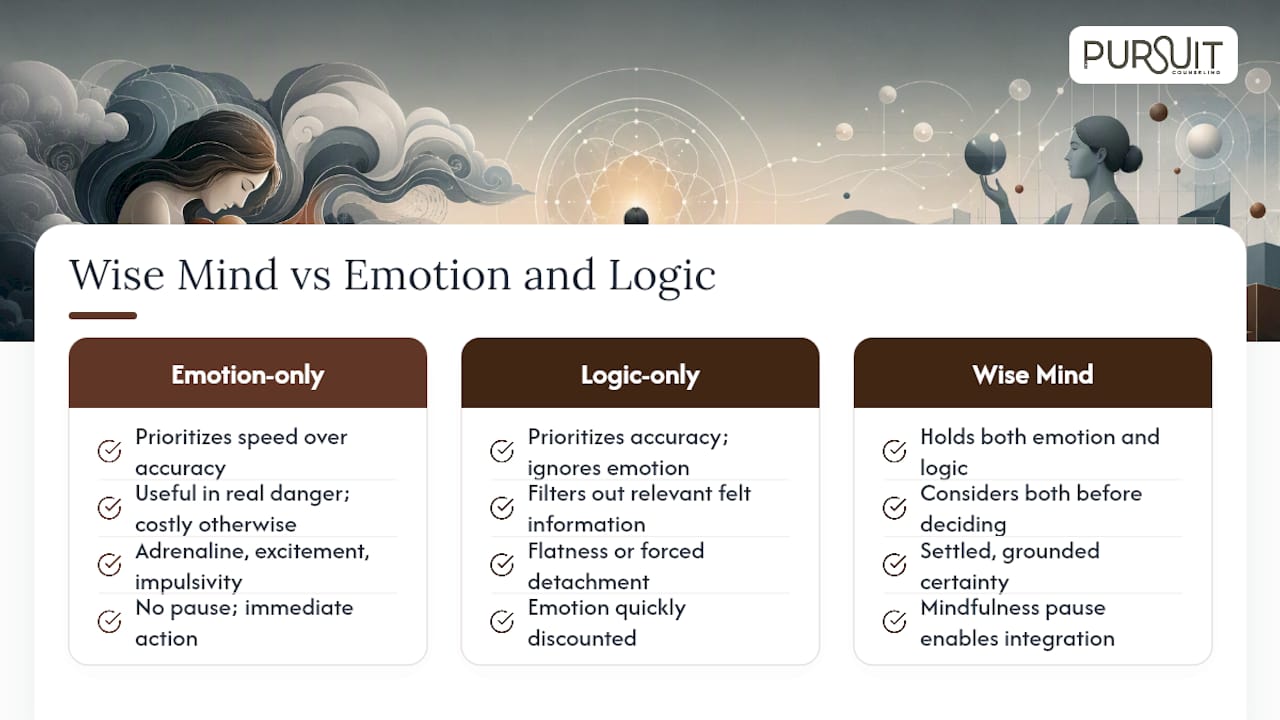
Emotion Mind is when feelings drive the bus. Your chest feels tight or hot, your thoughts move fast and absolute (“always,” “never,” “ruined”), and your urges push toward immediate relief, not long-term good.
Reasonable Mind is the opposite extreme: cool, logical, a little clinical. Your body feels flat or detached, your thinking runs on facts and plans, and you might dismiss a real feeling as “not productive” or “not helpful right now.”
Wise Mind sits where the two overlap. Physically, it often shows up as a settled, grounded certainty, something closer to quiet confidence than excitement or numbness.
Picture the same scenario, a friend cancels plans last minute, through each lens:
- Emotion Mind: “They don’t value me. I’m done trying with them.”
- Reasonable Mind: “Their reason was valid, so my disappointment isn’t worth mentioning.”
- Wise Mind: “I’m disappointed, and their reason makes sense. I can say both are true when we talk next.”
When Should You Use Wise Mind (and When Should You Wait)?
Wise Mind pays off most in moments where the stakes are real and the outcome is hard to undo. Routine choices, what to eat, which route to drive, don’t need this level of processing. Save the practice for situations that actually warrant it.
- High-stakes decisions. Job changes, relationship commitments, financial moves, or anything where the wrong call is expensive to reverse.
- Interpersonal conflict and boundary-setting. Telling someone no, addressing a pattern that hurts you, or deciding how much to share.
- Urge and impulse moments. The instant before you send the angry text, make the impulse purchase, or walk out of a hard conversation.
There’s an important exception. If your emotional intensity is high enough that you’re shaking, dissociating, or flooded, Wise Mind is not accessible yet, and forcing it usually backfires. That’s the moment for distress tolerance skills first, to bring your nervous system down to a workable level. Wise Mind lives on the other side of that regulation, not instead of it.
How Do You Practice Accessing Wise Mind?
Access exercises work because they’re small, repeatable, and rehearsable outside a crisis, so the skill is already familiar when you actually need it.
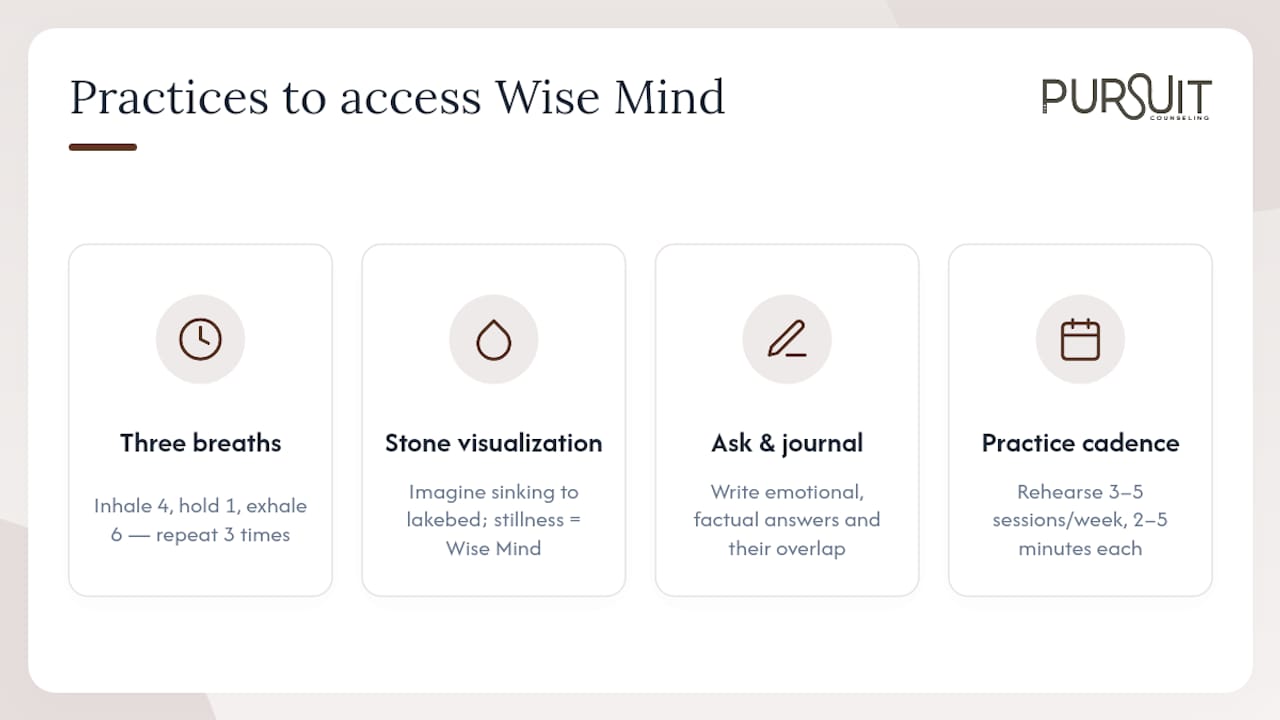
Pause and three breaths. Stop mid-action. Inhale for four counts, hold for one, exhale for six. Do this three times. Then ask: “What does this moment actually need?” This is the fastest on-ramp and the one worth using dozens of times a day in low-stakes moments.
Stone flake on the lake. Close your eyes and picture a still lake. Imagine yourself sinking slowly through the water like a flake of stone, past the surface chatter of Emotion Mind, past the murky middle depths, down to the lakebed where everything settles. That stillness at the bottom is Wise Mind. Some people adapt this to a feather drifting down, or a leaf settling on a forest floor, whatever image lands for you.
Wise Mind ASKS and journaling. Ask yourself: what do I know emotionally right now? What do I know factually? Where do those two things overlap? Write the answers down. The physical act of writing slows the process enough for overlap to surface.
Practice cadence. DBT teaching materials recommend rehearsing three to five short sessions a week, two to five minutes each, in situations that don’t matter much. Practicing while stakes are low is what makes the skill available when stakes are high. In group settings, therapists often lead the stone visualization aloud and then have members share one word describing what settled; solo, the same exercise works fine as a five-minute audio recording you make for yourself.
Pro Tip: Set a recurring phone reminder labeled “Three breaths” at a random time each day. The unpredictability trains you to access Wise Mind on demand, not just when you remember to schedule it.
How Do You Use Wise Mind to Actually Make a Decision?
Build the skill into a repeatable sequence and it stops feeling abstract.
Pause. Gather the facts, plainly, without spin. Name what you’re feeling, out loud or on paper. Ask where the facts and the feelings agree. Choose based on that overlap, then test the choice against your values before you act on it.
Two checks tell you whether you actually landed in Wise Mind or just called your gut reaction something fancier. First, can you name both an emotion and a fact that shaped the decision? If you can only produce one, you’re still in Emotion Mind or Reasonable Mind. Second, does your body feel settled, not amped up, not numb? Practitioners frequently note that gut instinct gets mistaken for Wise Mind; the tell is whether you’ve actually acknowledged both channels or just picked the one that felt easier.
Watch for two counterfeits: forced rationalizing (dressing up a decision you already wanted to make) and suppressed emotion (calling numbness “clarity”). If a decision touches trauma history, safety, or a pattern you can’t shift alone, that’s the point to bring in a DBT-trained clinician rather than working it out solo.
What Do DBT Clinicians Say About Teaching Wise Mind?
Wise Mind looks simple on a worksheet and feels considerably harder in a therapy room, which is exactly why clinical guidance matters here.
Adam Glendye, LPC, CPCS, holds licensure as a Professional Counselor and certification as a Clinical Supervisor, credentials that reflect both direct clinical training and the oversight experience of supervising other counselors’ work. That combination signals a clinician who has seen Wise Mind training succeed and fail across a wide range of presentations, not just theorized about it.
In practice, therapy accelerates what solo practice alone often can’t reach. Skills rehearsal inside sessions, homework between them, and structured intensives give clients repeated, guided reps with real-time feedback, correcting the common trap of confusing calm avoidance for genuine Wise Mind access.
Clients rarely fail at Wise Mind because they don’t understand the concept. They stall because no one is checking whether what they’re calling “clarity” is actually integration or just fatigue dressed up as peace. That’s the gap a trained clinician closes.
Individual practice matters, but trauma history, chronic dysregulation, or high-risk situations usually call for clinical support alongside it.
— Adam Glendye LPC, CPCS
What Worksheets and Guided Tools Help With Wise Mind Practice?
A worksheet works when it forces you to write down both an emotional truth and a factual truth before you’re allowed to reach a conclusion, not when it just asks “what would Wise Mind say?”
- Look for worksheets grounded in DBT language (the three states of mind, not vague “gut check” prompts) and ideally authored or reviewed by a licensed clinician.
- DBT Tools and DBT Self Help both offer accessible worksheets and exercises built specifically around Wise Mind practice.
- Complete one two to three times a week, tied to a real decision, however small, rather than a hypothetical one.
- In group therapy, worksheets double as discussion prompts; solo, they work best as a nightly five-minute journal habit.
Why Does Wise Mind Actually Work? The Psychology Behind It
Wise Mind isn’t a metaphor DBT invented for convenience. It maps onto a real, observable pattern in how people process information under stress.
When emotion runs unchecked, the brain prioritizes speed over accuracy, useful for genuine danger, costly for a heated argument or a tempting impulse purchase. When logic runs unchecked, the brain filters out emotional data that’s actually relevant, like the fact that a technically sound decision still feels wrong for reasons worth examining. Wise Mind asks you to hold both inputs at once instead of defaulting to whichever one is louder.
Mindfulness practice, the mechanism underneath all of DBT’s “what” skills, trains the capacity to notice internal states without immediately acting on them. That gap between noticing and reacting is where integration becomes possible. It’s not that emotion disappears or that logic takes over; it’s that both get a seat at the table before a decision gets made.
The bodily signature many people report, a settled, grounded certainty rather than excitement or numbness, reflects this integration rather than the adrenaline of a “gut call” or the flatness of forced detachment. That distinction is worth learning to feel in your own body, because it’s the most reliable internal signal that you’ve actually reached Wise Mind rather than just landed somewhere that resembles it. Repetition is what builds that felt sense. Each low stakes practice, each three-breath pause, strengthens the pathway between noticing your state and choosing to shift it, the same way any skill sharpens with rehearsal rather than insight alone.
How Does Wise Mind Connect to Emotion Regulation and Distress Tolerance?
Wise Mind doesn’t function alone. DBT builds it as the hub that the other three skill modules, emotion regulation, distress tolerance, and interpersonal effectiveness, all connect back to.
Emotion regulation skills teach you to identify and name what you’re feeling with precision, which is exactly the raw material Wise Mind needs on the emotional side of the ledger. Without that vocabulary, “gathering your feelings” during a decision stays vague and hard to act on.
Distress tolerance comes in when intensity is too high for Wise Mind to be reachable at all. Turning the mind, a distress-tolerance practice, is often taught right alongside Wise Mind because both involve a repeated, active choice to accept reality rather than fight it. The difference is sequencing: turning the mind helps you tolerate an unbearable moment long enough to come back down; Wise Mind is what you use once you’re regulated enough to actually decide something.
Interpersonal effectiveness skills, like scripted approaches to boundary-setting, work far better when they’re chosen from Wise Mind rather than fired off from Emotion Mind. A boundary set in anger tends to overcorrect; one set from Reasonable Mind alone can feel hollow or performative. One set from Wise Mind accounts for both what you need and what the relationship can actually hold.
This is why DBT rarely teaches Wise Mind in isolation. It’s the checkpoint the other modules run through, which is also why clinicians often introduce it early and revisit it constantly, not as a one-time lesson but as a habit that gets reinforced session after session.
What Gets in the Way of Reaching Wise Mind, and How Do You Work Around It?
The most common barrier isn’t lack of effort. It’s trying to force Wise Mind during moments when your nervous system is too activated to access it at all, then concluding the skill “doesn’t work for you.”
A second barrier is confusing familiarity with wisdom. If Reasonable Mind has been your default coping style for years, its conclusions can feel obviously correct, even when they’re steamrolling a real emotional signal. The opposite pattern shows up just as often: people who’ve relied on emotional reactivity mistake intensity for authenticity, assuming the loudest feeling must be the truest one.
A third barrier is environment. Practicing Wise Mind access exclusively during a crisis, rather than rehearsing it in calm moments, means you’re trying to learn a new skill and use it under pressure simultaneously. That rarely works for any skill, and Wise Mind is no exception.
The fix for each barrier is specific. For nervous-system overload, build in a distress tolerance step before attempting Wise Mind, not instead of it. For default-style bias, deliberately name both a feeling and a fact before every decision, even trivial ones, until checking both becomes automatic. For crisis-only practice, schedule low-stakes rehearsal on a calendar, the way you’d schedule a workout, so the skill has already been built before you need it under pressure.
How Do Therapists Actually Teach Wise Mind in Sessions?
Therapists rarely explain Wise Mind once and move on. It gets woven into the structure of treatment itself, introduced early, referenced constantly, and adjusted to fit each client’s starting point.
A typical individual session might open by checking which state of mind a client has been living in that week, using specific moments as evidence rather than a general mood report. From there, the clinician might walk through a recent decision using the pause, gather facts, name emotions, align with values sequence in real time, treating the session itself as rehearsal space.
Homework matters as much as the session. Clients are often asked to log three moments a week where they noticed which mind state they were in, building the self-awareness that makes real-time access possible later. In emotional regulation therapy, Wise Mind training typically sits alongside broader skills work, since the ability to notice and name an emotional state underpins nearly everything else in the treatment plan.
Individualized plans matter because Wise Mind lands differently depending on what a client brings to it. Someone with a trauma history may need distress tolerance work before Wise Mind practice makes sense at all. Someone who intellectualizes under stress may need more emotion-focused exercises to balance the scale. There’s no single script; there’s a skill, and a clinician’s job is figuring out which door into it fits the person in front of them.
What Does Progress With Wise Mind Actually Look Like?
Progress with Wise Mind is rarely a single breakthrough. It’s a gradual shortening of the gap between reacting and responding, often over eight to twelve weeks of consistent practice paired with therapy. Setbacks are normal, especially under new stress. What changes first isn’t the absence of strong emotion; it’s the growing ability to notice a state of mind before acting from it, which is where consistent practice combined with clinician support tends to move things fastest.
Ready to Build Wise Mind Into Real, Lasting Skill?
Reading about Wise Mind gets you the concept. Practicing it under real stress, with feedback from someone trained to spot the difference between genuine integration and a convincing imitation, gets you the skill. The Pursuit Counseling builds Wise Mind training directly into individual therapy sessions rather than treating it as a handout you take home and hope sticks.

If you’re working through anxiety, relationship strain, or patterns that keep pulling you back into Emotion Mind or Reasonable Mind under pressure, individual therapy gives you a structured place to rehearse this skill with real-time correction, not just a worksheet and good intentions. For clients who want faster, more concentrated progress, therapy intensives compress that skills work into focused blocks instead of stretching it across months. A first consultation is a low-pressure way to describe what’s pulling you off center and hear how a therapist would approach building your access to Wise Mind specifically. Reach out through The Pursuit Counseling to schedule that first conversation and find out what a tailored plan actually looks like for you.
Where Can You Learn More or Get Immediate Support?
- Dialecticalbehaviortherapy: step-by-step Wise Mind exercises and worksheets built for independent practice.
- DBT Self Help: accessible summaries and exercises for practicing outside therapy.
- 988 Lifeline: free, confidential crisis support if emotional intensity ever feels unsafe.
- Stopbullying: resources for applying emotional regulation skills in youth and school settings.
This article is general information, not a substitute for advice from a qualified doctor. Consult a qualified healthcare professional about your own circumstances before acting on anything here.
Sources
- Wise Mind DBT — Mental Health Center for Kids
- Dialecticalbehaviortherapy
- Wise Mind in DBT: Three states of mind, exercises, and practice — TherapyExplained
- Wise Mind Skill – DBT Tools
FAQ
What Is the Wise Mind Model in DBT?
Wise Mind is the DBT concept describing the integrative state where Emotion Mind and Reasonable Mind overlap, producing decisions grounded in both feeling and fact rather than either alone.
How Is Wise Mind Taught in DBT?
Therapists introduce it through the mindfulness module, then reinforce it with rehearsal exercises like the three-breath pause and stone-on-the-lake visualization, along with homework logging which mind state a client noticed during the week. Programs like emotional regulation therapy at The Pursuit Counseling build this practice directly into ongoing sessions.
Is Wise Mind CBT or DBT?
Wise Mind is a DBT concept specifically, developed by Marsha M. Linehan as part of the mindfulness module. CBT does not use this three-state framework, though both approaches share roots in behavioral therapy.
Why Is DBT Criticized?
Critics point to the time commitment DBT requires, since full programs often run months and involve individual sessions, skills groups, and between-session coaching, which isn’t accessible or necessary for everyone. Others note that skills like Wise Mind take consistent practice to feel natural, and progress can feel slow without structured support from a trained clinician.
How Much Does DBT-Informed Therapy Cost at The Pursuit Counseling?
Pricing for individual therapy and DBT-informed skills work is not published; current rates are available directly through The Pursuit Counseling.