


A superbill is a detailed, itemized receipt that your healthcare provider gives you after a session. It contains every piece of information your insurance company needs to process a reimbursement claim on your behalf. Think of it as the paper bridge between the care you received and the money you may get back. It is especially common in therapy and counseling, where many skilled providers operate outside insurance networks.
A superbill is not a bill your provider sends to insurance directly. It is a document you receive, and you use it to pursue reimbursement yourself. According to Wikipedia’s entry on superbills, it is the main data source for creating a healthcare claim submitted to payers for reimbursement. That distinction matters practically: you pay the provider first, then submit the superbill to your insurer to recoup some or all of the cost.
Every superbill typically includes:
- Provider information: full name, practice address, National Provider Identifier (NPI), and license details
- Patient information: your name, date of birth, and insurance member ID
- Date and place of service: when and where the appointment occurred
- CPT codes: Current Procedural Terminology codes that identify the specific service performed
- ICD-10 codes: diagnosis codes that explain the clinical reason for the visit
- Fees charged: the full amount billed by the provider
- Amount paid: what you paid out of pocket at the time of service
Table of Contents
- What information does a superbill contain?
- Why superbills matter for your reimbursement
- How to submit a superbill to your insurance company
- Common questions about superbills answered
- How does a superbill differ from an invoice or insurance claim?
- What does a superbill look like, and where can you find templates?
- How to request and use your superbill effectively
- Therapy in Georgia that takes your care seriously
- Key Takeaways
What information does a superbill contain?
Every field on a superbill serves a specific purpose for insurance processing. Missing even one can result in a denial. Here is what you will typically find, broken into three categories.
Provider details:
- Full legal name and practice name
- Office address and phone number
- NPI (National Provider Identifier), which is the unique ID the federal government assigns to every licensed provider
- Tax identification number or license number, depending on the insurer’s requirements
Patient and visit details:
- Patient’s full name and date of birth
- Insurance member ID and group number
- Date of service and place of service code (a two-digit code indicating whether the visit was in an office, via telehealth, etc.)
Clinical and financial details:
- CPT procedure codes identifying each service rendered
- ICD-10 diagnosis codes linking the service to a clinical reason
- Fee charged per service line
- Any payment already collected from the patient
Some providers include their signature; others do not. Signature requirements vary by office policy, and most insurers do not require one as long as the provider’s NPI and credentials are clearly listed.

Why superbills matter for your reimbursement
A superbill is the source document that connects your care to your insurance claim. Without it, you have no standardized way to tell your insurer what service you received, who provided it, or why it was clinically necessary.

For out-of-network therapy, this is where superbills become genuinely powerful. Many excellent therapists and counselors in Georgia choose not to contract with insurance networks, which means you pay them directly. A superbill gives you the documentation to submit for out-of-network reimbursement and recover a portion of that cost, depending on your plan’s out-of-network benefits.
That said, a superbill does not guarantee payment. Your insurer will apply your deductible, coinsurance rate, and their own “allowed amount” for the service, which may be lower than what your provider charged. Reimbursement is real but conditional.
A few important limitations to understand:
- Medicare and Medicaid do not accept superbills. Government programs require providers to submit claims directly; patients cannot use superbills for reimbursement under these programs.
- Insurers apply their own fee schedules, so you may not recover the full amount you paid.
- Inaccurate codes, mismatched CPT and ICD-10 pairings, or missing provider credentials are common reasons claims get denied.
Pro Tip: Before you submit anything, read your superbill line by line. Confirm your name, insurance ID, and the CPT and ICD-10 codes are present and match the service you received. A five-minute review can prevent weeks of back-and-forth with your insurer.
How to submit a superbill to your insurance company
The process is straightforward once you know the steps. Here is how to move from receiving your superbill to getting reimbursed.
- Request the superbill from your provider. Ask at the end of your session or via email. Most therapy practices can generate one quickly. Make sure it includes all the fields listed above.
- Verify your out-of-network benefits. Call the member services number on your insurance card and ask specifically: Do I have out-of-network mental health benefits? What is my out-of-network deductible, and how much have I met? What is the reimbursement percentage after the deductible?
- Check your insurer’s submission requirements. Confirm whether your insurer accepts the superbill directly or requires you to complete a separate claim form with the superbill attached as supporting documentation.
- Gather proof of payment. Include a receipt, bank statement, or credit card record showing you paid the provider. Many insurers require this.
- Submit your claim. Your options:
- Online portal: Usually the fastest method. You will receive a confirmation number immediately.
- Mail: Use certified mail so you have a delivery record. Keep a copy of everything you send.
- Fax: Still accepted by many insurers. Print a confirmation sheet and keep it.
- Track your claim and review the EOB. After processing, your insurer will send an Explanation of Benefits (EOB) showing what they paid, what they applied to your deductible, and what you still owe. If the numbers look wrong, call member services before assuming the decision is final.
Common questions about superbills answered
Do insurance companies actually pay based on a superbill?
Most commercial insurers do, but only if you have out-of-network benefits and meet your deductible. Reimbursement is subject to your plan’s specific terms, and the insurer’s allowed amount may be less than what you paid.
Who signs a superbill?
There is no universal requirement. Provider identification through the NPI number is always present, but a handwritten signature depends on the practice’s internal policy. Most insurers do not require it.
What is the difference between a superbill and an insurance claim?
A superbill is a document your provider gives you. An insurance claim is a formal request for payment submitted to your insurer. Often, a superbill is attached as supporting documentation to a separate claim form your insurer requires you to complete.
How do I know if my insurance accepts superbills?
Call member services and ask directly. Ask whether they accept superbills for out-of-network mental health services, and ask what form or portal they prefer for submission.
What causes superbill claims to get denied?
The most common reasons are missing provider NPI, CPT and ICD-10 code mismatches, no proof of payment, or submitting to a plan that does not include out-of-network benefits. If your claim is denied due to an error on the superbill, go back to your provider and request a corrected version rather than appealing the insurer’s decision directly.
How does a superbill differ from an invoice or insurance claim?
These three documents are often confused, but they serve distinct purposes.
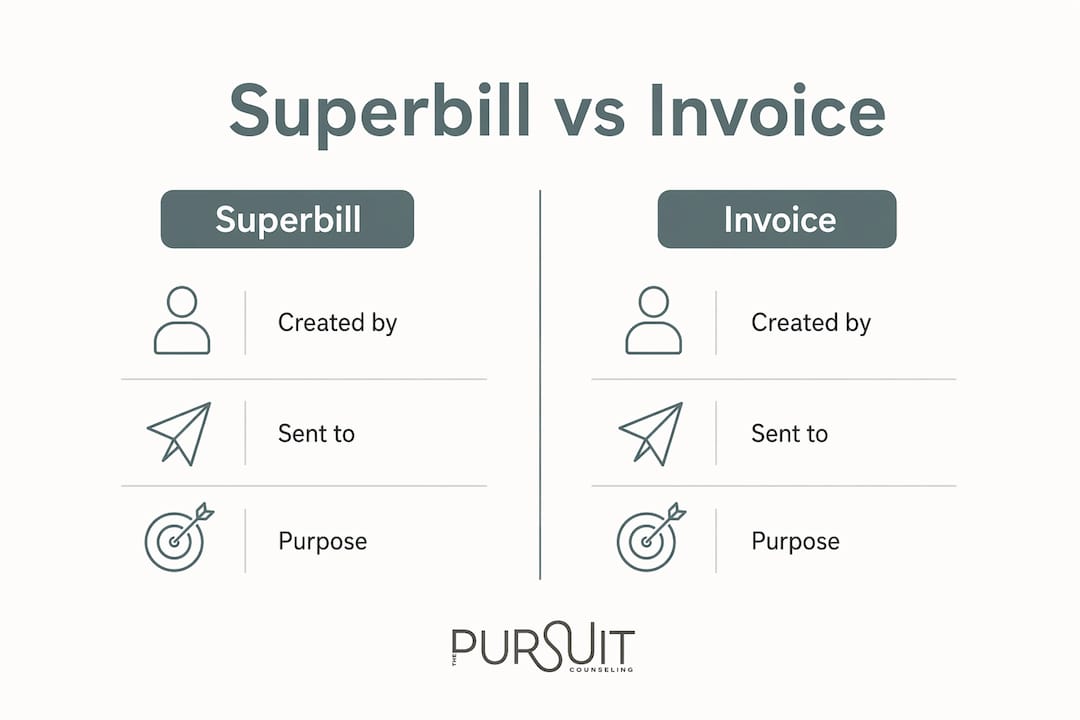
| Document | Created by | Sent to | Purpose |
|---|---|---|---|
| Invoice | Provider | Patient | Requests payment for services rendered |
| Superbill | Provider | Patient (for insurer) | Itemized receipt with clinical codes for reimbursement |
| Insurance claim | Patient or provider | Insurer | Formal request for payment from the insurance company |
An invoice tells you what you owe. A superbill tells your insurer what care you received and why. An insurance claim is the actual request for money. In many out-of-network situations, the superbill and the claim travel together, but they are not the same document.
What does a superbill look like, and where can you find templates?
There is no single federally mandated format for a superbill. Practices design their own, and the layout varies. Most are one page and organized into clear sections: provider info at the top, patient info in the middle, and a service table at the bottom listing CPT codes, ICD-10 codes, fees, and dates.
Therapy practices often use practice management platforms that generate superbills automatically after each session, pulling provider credentials and session codes from the client’s file. This reduces errors significantly compared to manually completed forms.
If your provider does not use such a system, you can find general superbill templates through medical billing resources online. What matters more than the template’s design is whether every required field is complete and accurate.
How to request and use your superbill effectively
Ask for your superbill proactively, not weeks after the fact. Many practices can generate one same-day or within a few business days. If you plan to seek therapy superbill reimbursement regularly, set a rhythm: request the superbill at the end of each month and submit it to your insurer within the same week.
Keep a folder, physical or digital, with every superbill you receive, every claim you submit, and every EOB you get back. If a claim is denied and you need to request a corrected superbill from your provider, having the original on hand makes that conversation faster.
One thing many people miss: your insurer may have a filing deadline, often 90–180 days from the date of service. Submit promptly. Waiting until the end of the year can mean losing reimbursement entirely for early sessions.
Therapy in Georgia that takes your care seriously

If you are reading this because you are trying to figure out how to afford quality therapy, that is a real and valid concern. The Pursuit Counseling works with high-performing adults, executives, pilots, and professionals across Georgia who are ready to do the hard work of growth. We offer individual therapy, couples intensives, EMDR trauma therapy, neurofeedback for ADHD, and more, all grounded in neuroscience and evidence-based methods. We operate as a private-pay practice, which means we provide superbills so you can pursue out-of-network reimbursement through your insurer. You get the quality of care you need, and you have a clear path to recovering some of the cost. Ready to take the next step? Book a session with The Pursuit Counseling today.
Key Takeaways
A superbill is the itemized clinical receipt that makes out-of-network insurance reimbursement possible, but only when it is accurate, complete, and submitted within your insurer’s filing window.
| Point | Details |
|---|---|
| What a superbill is | A detailed receipt from your provider listing CPT codes, ICD-10 codes, fees, and credentials needed for reimbursement. |
| Who can use one | Patients with commercial insurance out-of-network benefits; Medicare and Medicaid do not accept superbills. |
| Biggest submission risk | Missing NPI, code mismatches, or no proof of payment are the most common causes of claim denial. |
| Fastest submission method | Online insurer portals provide immediate confirmation; mail and fax are valid alternatives with their own documentation steps. |
| The Pursuit Counseling | Provides superbills for private-pay clients in Georgia so you can pursue out-of-network reimbursement on your own terms. |