


Yes, coaching can meaningfully reduce physician burnout, particularly when the coach is another physician trained in structured, evidence-based techniques. The strongest trials show real movement on burnout scores, not just anecdote.
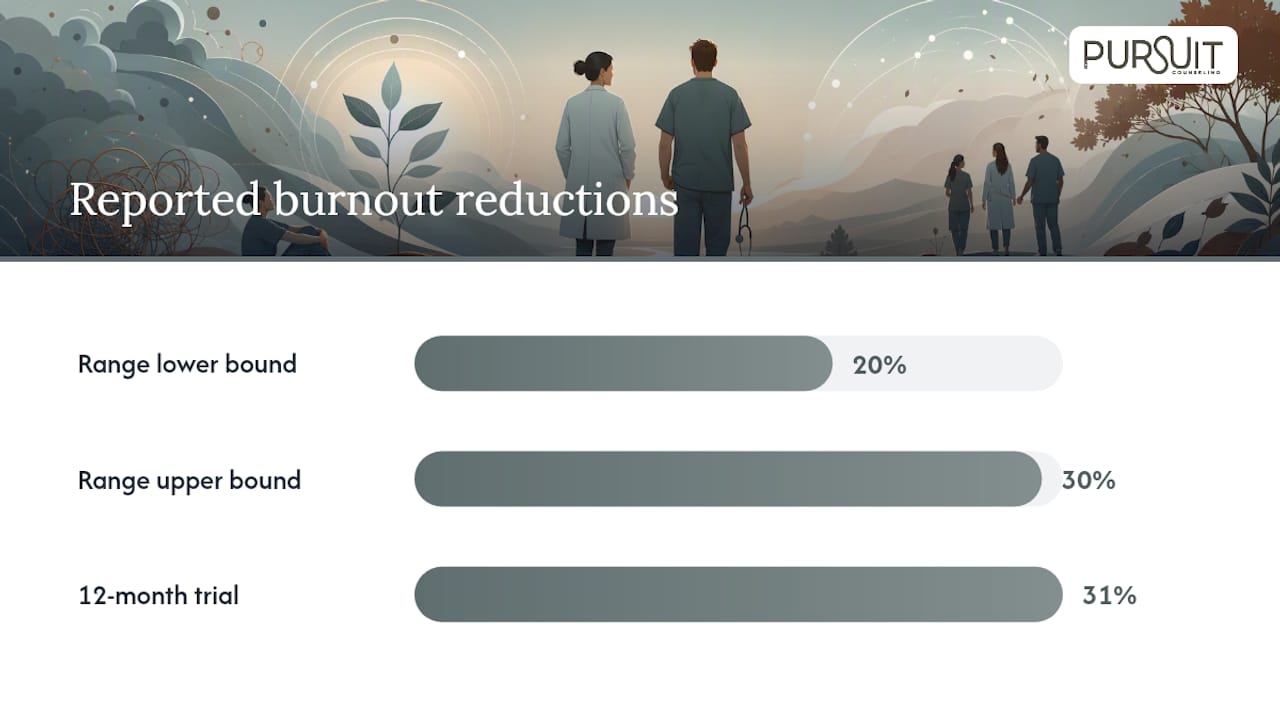
- A 12-month one-on-one wellness coaching program reported roughly a 31% reduction in burnout scores among participating physicians, alongside gains in other wellbeing measures.
- Peer coaching, where physicians coach physicians, shows some of the most consistent benefit because the coach already understands call schedules, EHR fatigue, and the particular grief of clinical work.
- Coaching works best as one piece of a larger picture. It pairs with therapy for physicians carrying clinical depression or trauma, and it works alongside organizational fixes like workload redistribution.
The reported effect sizes cluster in a moderate range, without specifying exact percentages, rather than a dramatic one. Coaching is not a cure. It is a structured, goal-directed support that moves the needle when burnout is rooted in role strain, values misalignment, or eroded autonomy rather than an underlying psychiatric condition.
Key Takeaways
Physician burnout coaching produces measurable reductions in burnout scores, roughly 20% to 30% across published trials, but works best paired with therapy when a psychiatric condition is present.
| Point | Details |
|---|---|
| Coaching is evidence-supported | Trials report burnout score reductions of roughly 20% to 30%, though studies vary in design and follow-up length. |
| Physician-to-physician format performs well | Peer coaches bring contextual credibility that improves engagement and outcomes in trial samples. |
| Coaching is not therapy | Reserve therapy or psychiatric care for suicidal ideation, active depression, or acute substance use. |
| Programs typically run 3 to 6 months | Sessions occur every two to four weeks, lasting 30 to 60 minutes each. |
| Vet coaches like any other provider | Ask about certification, physician-specific experience, and how they measure outcomes. |
| The Pursuit Counseling offers integrated support | Coordinates coaching with clinical treatment, including EMDR and neurofeedback, for physicians and high performers in Georgia. |
This article is general information, not a substitute for advice from a qualified doctor. Consult a qualified healthcare professional about your own circumstances before acting on anything here.
Table of Contents
- What Is Physician Burnout Coaching, and How Is It Different From Therapy?
- What Does the Research Say About Coaching for Physician Burnout?
- How Do Clinical Trials on Physician Coaching Actually Compare?
- How Are Physician Coaching Programs Structured, and What Do They Cost?
- Who Actually Benefits From Coaching, and When Should You Skip It?
- How Do You Evaluate and Choose a Physician Burnout Coach?
- What Should You Do Next If You’re Considering Coaching?
- A Clinician’s View on What Coaching Actually Delivers
- Where The Pursuit Counseling Fits If You’re Ready to Get Support
- Sources
- FAQ
What Is Physician Burnout Coaching, and How Is It Different From Therapy?
Physician burnout coaching is a future-focused, non-diagnostic partnership aimed at helping a doctor rebuild a sense of agency, purpose, and boundaries around clinical work. A coach does not treat depression or trauma. A coach helps a physician clarify what she actually wants from her career, set concrete goals, and build the behavioral scaffolding to get there. The World Health Organization classified burnout as an occupational phenomenon in 2019, not a medical diagnosis, which is exactly why coaching fits as a workplace-oriented intervention rather than a clinical treatment.
Most coaching engagements include a consistent set of activities:
- Values clarification exercises to identify what “success” should look like beyond RVUs and shift counts.
- Structured goal-setting with measurable, time-bound targets.
- Reflective exercises between sessions, often journaling or structured self-assessment.
- Implementation tasks: concrete boundary-setting scripts, calendar changes, or conversations with supervisors.
The literature frames professional coaching as a viable intervention for burnout precisely because it aligns a physician’s values with sustainable behavior change, rather than simply teaching stress-reduction tricks.
| Support type | Primary purpose | When it fits |
|---|---|---|
| Coaching | Goal-setting, values alignment, behavior change | Workplace strain, career uncertainty, boundary struggles |
| Therapy | Diagnosis and treatment of mental health conditions | Depression, anxiety disorders, trauma, suicidal ideation |
| Mentorship | Career guidance from a senior colleague | Navigating promotion, research direction, specialty choice |
Coaching sits in a different lane than counseling for burnout and workplace stress, and knowing which lane you need matters more than picking whichever one your hospital happens to offer.
What Does the Research Say About Coaching for Physician Burnout?
The evidence base is younger than most physicians would like, but it is not thin. Several controlled trials now show coaching produces measurable change, and the pattern holds across different coaching formats.
Key findings worth knowing before you commit time and money to a program:
- A 12-month individual wellness coaching trial reported a 31% reduction in burnout scores, with parallel improvements in secondary wellbeing measures.
- Randomized trials of physician peer coaching, where trained physician peers deliver the coaching, have found statistically significant reductions in burnout and improved wellbeing in physician samples.
- A recent review of professional coaching interventions for clinicians found consistent decreases in burnout and improvements in work life across multiple trial designs, even though sample sizes and methods vary widely.
- Authors publishing in this space consistently recommend coaching as one component of a multi-pronged strategy, not a standalone fix, pairing it with system-level changes like scheduling reform or documentation support.
Reported burnout score reductions across published trials generally fall in the 20% to 30% range, though this should be read as an approximate band rather than a guaranteed outcome. That range is respectable for a behavioral intervention, on par with what you’d expect from many structured psychotherapy protocols delivered over a similar timeframe.
Here’s where the caution comes in. Systematic reviews note significant heterogeneity across these studies: different burnout instruments (Maslach Burnout Inventory versus single-item measures), different coaching doses (six sessions versus twelve), and different follow-up windows (three months versus a full year). That heterogeneity means you cannot stack these effect sizes and treat them as one unified number.
Smaller trials and single-site studies dominate this literature, and the authors themselves are the first to call for larger, multi-center trials with longer follow-up before anyone declares coaching a settled matter. Active research is still underway. Clinicaltrials continue testing coaching formats and outcome measures, which tells you the evidence base is still being built, not finished.
Pro Tip: *When you read a coaching study’s “burnout reduction” statistic, check the sample size and duration before you weigh it against your own decision.
How Do Clinical Trials on Physician Coaching Actually Compare?
Seeing the studies side by side makes the pattern, and the limitations, much clearer than any single citation can.
| Study focus | Sample / format | Primary outcome | Key result | Main limitation |
|---|---|---|---|---|
| 12-month individual wellness coaching | Physicians, one-on-one, monthly sessions | Burnout score, wellbeing index | ~31% reduction in burnout scores | Single-arm design limits causal certainty |
| Physician peer coaching (randomized) | Physicians, peer-delivered format | Burnout, wellbeing measures | Statistically significant reduction in burnout | Peer-coach training intensity varied |
| Professional coaching review across clinician trials | Multiple studies, mixed designs | Burnout, work-life measures | Consistent decreases in burnout reported | Wide variation in coaching dose and format |
| Registered coaching trials (ongoing) | Clinicians, various formats | Burnout, retention, satisfaction | Evidence still accumulating | Trials remain in progress, full results pending |
A few patterns repeat across nearly every study in this space. First, burnout and wellbeing almost always move together. When burnout scores drop, wellbeing and job satisfaction measures tend to improve in parallel, which suggests coaching is not just numbing a symptom but shifting something more fundamental in how physicians relate to their work.

Second, peer-delivered coaching performs surprisingly well against professionally trained external coaches. A physician coaching another physician brings contextual credibility that a general executive coach simply cannot replicate.
Third, nearly every study author flags the same limitation: short follow-up windows. Twelve months is the longest common tracking period, which leaves an open question about whether these gains hold at the two or three year mark.
How Are Physician Coaching Programs Structured, and What Do They Cost?
Coaching programs come in a handful of recognizable formats, and picking the wrong one for your situation wastes both time and money.
- Physician-to-physician coaching: one-on-one sessions with a coach who is also a licensed physician, often the highest-credibility option for clinical context.
- Peer coaching: structured programs, often institution-sponsored, where trained physician colleagues coach each other using standardized techniques. ACP’s physician peer coaching program is a well-documented example of this model.
- Wellness coaching: broader coaching, sometimes delivered by non-physician certified coaches, focused on lifestyle and stress-management skills.
- Group coaching: cohort-based programs where several physicians work through similar challenges together, often more affordable per participant.
Session cadence typically runs 30 to 60 minutes, scheduled every two to four weeks. Program length varies, but clinical trial registrations document durations ranging from brief multi-session series up to full 12-month engagements, with three to six months being the most commonly used window for structured, goal-oriented work.
Cost structures fall into three broad categories: private pay (typically billed per session or as a package), employer-sponsored programs (often built into wellness or retention budgets), and CME-linked coaching, where continuing education credit offsets part of the cost. Pricing varies significantly by region, coach credentialing, and program length, so ask for a full breakdown before committing.
Pro Tip: Block coaching sessions the same way you block a recurring clinical commitment. Physicians who treat coaching as an appointment with a patient, non-negotiable and calendar-protected, finish programs at far higher rates than those who try to squeeze it into whatever thirty minutes happens to be free that week.
Who Actually Benefits From Coaching, and When Should You Skip It?
Coaching tends to help physicians dealing with role strain rather than a diagnosable mental health condition. If your burnout traces back to boundary problems, career direction uncertainty, or a mismatch between your values and your daily clinical reality, coaching is a strong fit.
Coaching works particularly well for:
- Physicians experiencing workplace stress tied to workload, scheduling, or administrative burden.
- Doctors facing career transitions or uncertainty about specialty, practice setting, or leadership roles.
- Clinicians struggling to set boundaries around call, documentation, or patient volume.
Certain signs mean coaching alone is not enough, and you should prioritize therapy or psychiatric care instead:
- Suicidal ideation or thoughts of self-harm.
- Active major depressive disorder or another diagnosable psychiatric condition.
- Acute substance use as a coping mechanism.
- Severe functional impairment affecting your ability to practice safely.
Coaching and therapy are not mutually exclusive. Many physicians benefit from both running in parallel, especially when rest itself feels physiologically difficult and the nervous system needs clinical support alongside behavioral coaching. If any red flag above applies to you right now, seek urgent professional help before scheduling a coaching consult.
How Do You Evaluate and Choose a Physician Burnout Coach?
Not every “burnout coach” advertising on LinkedIn has the training to back the claim. Vetting matters here as much as it does when you’re choosing any other provider for something that affects your career and your health.
Prioritize these credentials and experience markers:
- Formal coach training through an accredited program (ICF certification or equivalent).
- Direct clinical background as a physician, or documented experience coaching physicians specifically.
- Familiarity with healthcare system pressures: EHR burden, RVU targets, malpractice anxiety, call structures.
Ask these ten questions on a discovery call before signing anything:
- What is your coach training and certification background?
- Have you worked specifically with physicians, and in which specialties?
- What does a typical program structure and timeline look like?
- How do you measure progress or outcomes during the engagement?
- What is your confidentiality policy, and is anything shared with my employer?
- What is explicitly outside your scope, and when would you refer me elsewhere?
- What are your fees, and what payment models do you offer?
- Can you share de-identified outcome data or general results from past clients?
- How many sessions, and over what timeframe, do most engagements run?
- What happens if I need to pause or end the engagement early?
Watch for these red flags:
- Overpromising specific outcomes (“guaranteed to eliminate burnout”).
- Any language suggesting they diagnose or treat mental health conditions.
- Vague or shifting scope of practice.
- No willingness to discuss outcomes, methodology, or references.
Testimonials alone are not proof. Ask instead for de-identified outcome patterns or a description of how the coach tracks progress across clients, and treat a coach’s refusal to answer as information in itself.
How Does Integrated Coaching and Clinical Care Work in Practice?
A well-designed integrated pathway typically includes:
- An initial assessment separating coaching-appropriate goals from clinical treatment needs.
- Structured coaching modules focused on boundaries, values, and career clarity.
- Coordination with a therapist when trauma, depression, or anxiety are also present.
- Ongoing outcome tracking to confirm the plan is actually working, not just feeling productive.
Pro Tip: Blended care works best when the coach and therapist know they’re both on your team. Ask whether your provider network allows brief coordination between a coach and a treating therapist. That kind of communication prevents contradictory advice and keeps both interventions pulling in the same direction.
The Pursuit Counseling structures this kind of integrated approach for high-performing professionals, combining coaching and counseling for leaders so that goal-directed coaching work and clinical treatment, including EMDR and neurofeedback when trauma or attention difficulties are part of the picture, run in coordination rather than in separate silos.
What Should You Do Next If You’re Considering Coaching?
Start small and specific rather than overhauling your entire life this week.
- Shortlist two or three coaches with physician-specific experience and schedule discovery calls with each.
- Use the ten questions above to compare scope, measurement approach, and fees before choosing.
- If any red flag from the earlier checklist applies to you, loop in a therapist or psychiatrist before or alongside starting coaching.
If you are experiencing suicidal thoughts, severe depression, or an acute safety concern, seek urgent professional care immediately. Coaching is not designed to manage a crisis.
A Clinician’s View on What Coaching Actually Delivers
Coaching earns its place in burnout recovery when it stays in its lane. The physicians who get the most out of it are not the ones in crisis. They’re the ones who are functioning, showing up, seeing patients competently, but who feel like a stranger to their own career choices. Coaching gives that person structure: a place to name what’s not working and build a concrete plan to change it.
What I’ve seen work in practice tracks closely with what these trials suggest. Coaching complements therapy; it does not replace it. A physician working through unresolved trauma or a mood disorder needs clinical treatment first, coaching second, if at all. The realistic expectation is incremental, values-driven change over months, not a dramatic turnaround after a handful of sessions. That’s not a weakness of the approach. It’s simply what durable behavior change looks like.
Where The Pursuit Counseling Fits If You’re Ready to Get Support
The Pursuit Counseling works with physicians, executives, and other high performers across Georgia who need more than a generic wellness webinar, whether that means structured coaching, clinical treatment, or both running together. Sessions are private-pay, available in-person or online, and built around evidence-based methods including EMDR, neurofeedback, and coaching frameworks tailored to people whose jobs demand constant high performance.
Getting started is straightforward: book an initial consult, complete an intake assessment that separates coaching goals from clinical treatment needs, and settle into a recommended program length, often three to six months for coaching-focused work, based on what that assessment reveals. The program prioritizes practical outcomes: rebuilding boundaries around clinical demands, clarifying career direction, and restoring a sense of agency that burnout tends to erode first. If you’re ready to find out what a coordinated coaching and clinical approach looks like for your specific situation, start with a consult and let the intake process guide the right next step.
Sources
FAQ
Does Physician Coaching Actually Reduce Burnout?
Published trials report burnout score reductions in the range of roughly 20% to 30%, though effect sizes vary by study design and follow-up length.
Is Coaching the Same as Therapy for Burnout?
No. Coaching is future-focused and goal-oriented, while therapy diagnoses and treats mental health conditions like depression or trauma; The Pursuit Counseling offers both, coordinated together when needed.
How Long Does Physician Burnout Coaching Take?
Most structured programs run three to six months, with sessions every two to four weeks, though some trials have tracked engagements up to 12 months.
When Should I Choose Therapy Instead of Coaching?
Prioritize therapy or psychiatric care over coaching if you’re experiencing suicidal ideation, active major depression, acute substance use, or severe functional impairment.
What Should I Ask a Prospective Physician Coach?
Ask about their coach certification, physician-specific experience, how they measure progress, confidentiality policies, and fees before starting any program.