
Georgia offers four main paths to mental health workshops: state and nonprofit trainings like Mental Health First Aid, school district programs through GaDOE, professional conferences with continuing education credit, and local provider-led workshops built for teams or specific needs. If you want a broad public course, start with the state catalog. If you want something built around your team or your specific goals, a local provider such as The Pursuit Counseling can design that directly.
TL;DR:
- The majority of Georgia’s mental health workshops are delivered through state agencies like DBHDD and GaDOE, with free or low-cost options often requiring participants to cover their own travel and lodging expenses.
- Workshops vary from Mental Health First Aid courses to trauma-informed training and workplace resilience sessions, each designed for different audiences and with distinct formats.
- Choosing the right training depends on clearly defining whether you need basic awareness, practical skills, clinical CEUs, or team development, and verifying instructor certification and follow-up support.
- Provider-led workshops are customized for specific groups, focusing on their unique challenges and including cohort-based delivery and ongoing follow-up, often at a flat fee per session.
- Always confirm registration status, review CEU or certification requirements in advance, and request accommodations early to ensure the workshop aligns with your goals and needs.
Table of Contents
- Where to find scheduled mental health workshops and statewide training catalogs in Georgia
- Common workshop formats and topics you’ll see in Georgia
- Registration, continuing education credit, costs, and logistics
- How to evaluate and choose the right workshop for your needs
- How provider-run workshops differ from state catalog events
- What the research actually tells you about picking a workshop
- Booking a workshop directly with The Pursuit Counseling
- Sources
- FAQ
Where to find scheduled mental health workshops and statewide training catalogs in Georgia
Georgia’s largest source of public mental health training runs through the Department of Behavioral Health and Developmental Disabilities. DBHDD posts Mental Health First Aid trainings on a rolling schedule, and the same agency hosts larger professional gatherings such as the 2026 Co-Responder Conference, which draws law enforcement and clinical staff together for multi-track sessions.
Schools and districts work from a separate system. The GaDOE Mental Health Awareness Training catalog lists curated courses, including Mental Health First Aid and trauma-informed sessions, though most must be scheduled through a Regional Educational Service Agency or a district contact rather than booked directly online.
For deeper professional development, university and association-hosted conferences fill the gap. Georgia State University’s 2026 GA-AIMH Conference centers on reflective practice and early childhood mental health, drawing practitioners from across the state.
A few other places worth checking:
- State agency pages: DBHDD’s events calendar and the GaDOE MHAT catalog cover most publicly funded training.
- Nonprofit program listings: Mental Health America of Georgia and NAMI Georgia post community-facing workshops throughout the year.
- Hospital and university continuing education pages: Many health systems run their own CEU-bearing sessions for clinical staff.
- Professional association calendars: Groups like the Georgia Psychological Association list advanced sessions aimed at licensed practitioners.
Before you commit, check the registration status closely. Some state listings mark seats as pending approval rather than confirmed.
Common workshop formats and topics you’ll see in Georgia
Most Georgia workshops fall into a handful of recognizable formats, and knowing which one you’re signing up for saves you from a mismatch between expectation and content.
- Mental Health First Aid (MHFA): an 8-hour course teaching a 5-step action plan for recognizing and responding to depression, anxiety, trauma, psychosis, and substance use disorders, offered widely through DBHDD’s MHFA program.
- Gatekeeper trainings: shorter programs like QPR and ASIST, built for educators and community members who need to recognize warning signs without full clinical training.
- Trauma-informed and caregiver support sessions: workshops that address the specific stress of caregiving, often paired with practical coping tools rather than lecture-only formats.
- Workplace and leadership resilience trainings: sessions aimed at managers and teams navigating burnout, conflict, or sustained pressure.
- Advanced CEU conferences: symposia covering contemporary clinical issues, including ethics around new technology and evolving treatment models.
Reflective practice has become a defining theme at Georgia’s professional gatherings. GA-AIMH’s 2026 conference is built around this framing, giving practitioners structured time to examine their own reactions to client work rather than only absorbing new material. That shift matters because it treats the practitioner’s own reactions as part of the clinical skill set, not a side note to it.
Caregiver-specific programming has also grown. The 2026 SHBP Virtual Mental Health Workshop, titled “Caring for Others, Caring for Yourself,” runs across two half-day sessions and pairs practical navigation tools with strategies for caregiver stress itself.
Registration, continuing education credit, costs, and logistics
Before you register for anything, get clear on what the workshop actually requires and what it costs you beyond the sign-up fee.
- Confirm CEU requirements up front. Many events require full attendance, and some add a follow-up step before issuing a certificate; DBHDD’s event pages note this explicitly for their conference offerings.
- Budget for logistics, not just registration. State and nonprofit trainings are frequently free to attend, but attendees typically cover their own travel, lodging, and meals.
- Decide between virtual and in-person early. Virtual formats like the SHBP caregiver workshop remove travel costs but shift the accessibility question toward technology access and scheduling flexibility.
- Request accommodations as soon as you register. ADA accommodations, including interpreters or captioning, take time to arrange, so flag the need at sign-up rather than the week of the event.
- Watch your inbox for confirmation. A pending status is not a confirmed seat. If you haven’t heard back within a reasonable window, follow up directly with the organizer.
Pro Tip: Save your registration confirmation email the moment it arrives; it’s often the only proof you’ll have if a CEU certificate goes missing later.
Provider-run workshops work differently. Fees are set up front, and a session built for a specific team or group, such as Organizational Workshops for Teams & Leadership, runs at a flat rate per session rather than a per-seat conference fee.
How to evaluate and choose the right workshop for your needs
The workshop that’s right for a school counselor chasing CEUs looks nothing like the one that’s right for a leadership team trying to rebuild trust after a rough year. Start by naming your actual goal before you start comparing options.
- Name your goal first: basic awareness, hands-on crisis response skills, clinical CEUs, or team and leadership development each point toward a different kind of session.
- Check who’s teaching it: certified instructors, such as those trained to deliver Mental Health First Aid, bring a different rigor than a general speaker covering the same topic.
- Ask about format: a lecture-style overview builds awareness, while an experiential or cohort-based session builds actual skill, and the two are not interchangeable.
- Look past the event itself: ask what happens after the workshop ends. A one-time session with no follow-up resources rarely changes behavior on its own.
A few direct questions to ask an organizer before you register: Who is leading this session, and what’s their certification? What happens if I miss part of the day? Is there a follow-up resource or contact after the workshop ends? Vague answers to any of these are worth treating as a caution sign.
How provider-run workshops differ from state catalog events
State and nonprofit catalogs are built for scale: broad curricula, fixed content, and a wide audience. A provider-run workshop starts from the opposite direction, built around a specific group’s actual problem.
- Content is shaped around the group, not a standard syllabus, so a leadership team gets sessions on decision fatigue and team trust rather than a general overview.
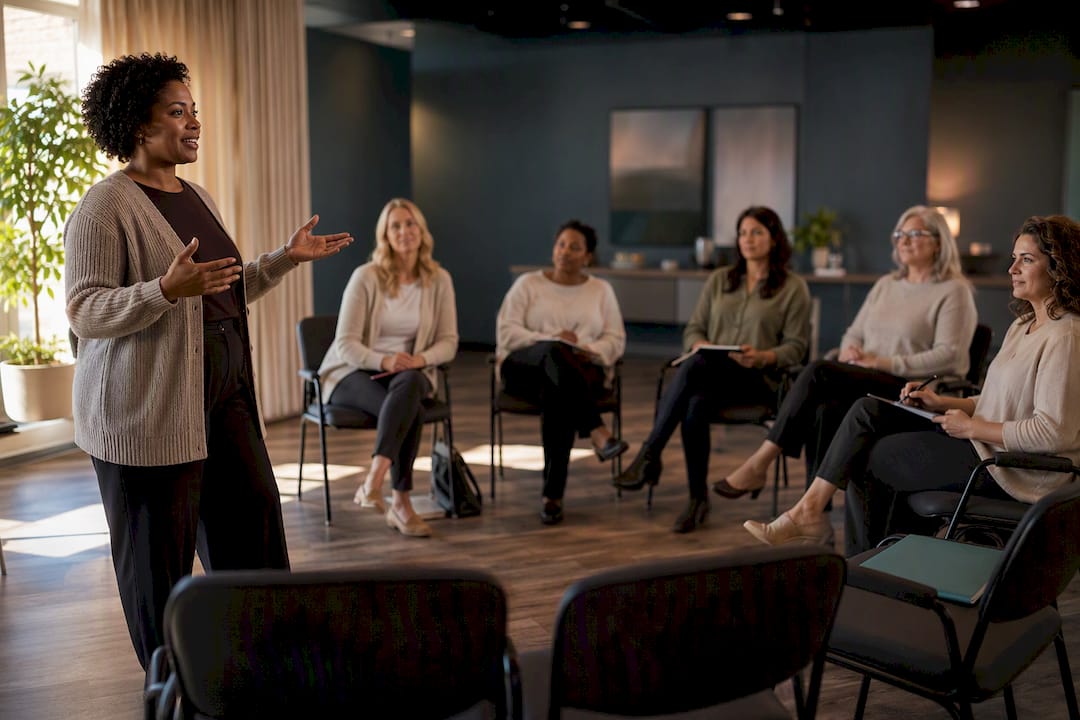
- Delivery is cohort-based, which tends to surface more of the real dynamics in a room than a lecture format built for strangers.
- Follow-up is part of the design, not an afterthought bolted onto a certificate.
Workshops of this kind are available from a local provider that serves Fayetteville, Peachtree City, Senoia, Brooks, Tyrone, and the surrounding South Atlanta area. A team dealing with sustained burnout, a group of caregivers looking for something more specific than a general session, or leadership wanting a leadership resilience workshop built around their own pressure points are all better served by this route than a general catalog listing.
What the research actually tells you about picking a workshop
Here’s what the landscape doesn’t advertise well: most people default to whatever workshop shows up first in a search, not the one that matches their actual need. A school counselor chasing a certificate and a manager trying to rebuild a fractured team should not be sitting in the same room, but they often end up there because state catalogs are built for volume, not fit.

The overrated piece of advice is “just take any Mental Health First Aid course.” MHFA is a solid foundation, genuinely useful for recognizing warning signs. But it was never built to address a specific team’s burnout pattern or a caregiver’s particular exhaustion, and treating it as a cure-all sets people up to leave disappointed.
What matters more than the certificate on the wall is whether the format matches the problem. A lecture fixes a knowledge gap. A cohort-based, facilitated session fixes a relational one. Know which problem you actually have before you register, and don’t confuse attendance with change. Education gives you language and awareness; it is not the same as an assessment of your specific situation, and no single workshop, however well designed, replaces that distinction.
— Adam Glendye LPC, CPCS
Booking a workshop directly with The Pursuit Counseling
If your team, school, or caregiver group needs something built around your actual situation rather than a general catalog session, workshops are available to groups in Fayetteville, Peachtree City, Senoia, Brooks, Tyrone, and South Atlanta, delivered in person or online.

Current formats include Organizational Workshops for Teams & Leadership, a 3-hour session priced at ,500 per workshop, along with caregiver resilience sessions and reflective-practice discussions for clinicians who want something more focused than a large conference track. To request one, reach out with your group size, preferred dates, and whether you need CEU documentation, and expect a direct response about fit and scheduling rather than a generic intake form. If you’d rather explore individual support first, our group workshop options in Fayetteville and Peachtree City outline who these sessions typically serve. Contact us to start the conversation.
This article is general information, not a substitute for advice from a qualified doctor. Consult a qualified healthcare professional about your own circumstances before acting on anything here.
Sources
- Mental Health First Aid (MHFA) training — DBHDD
- 2026 GA-AIMH Conference — Georgia State University
- 2026 SHBP Virtual Mental Health Workshop — SHBP
- Mental Health Awareness Training (MHAT) — GaDOE catalog
FAQ
What is Mental Health First Aid and who is it for?
Mental Health First Aid is an 8-hour course that teaches a 5-step action plan for recognizing and responding to depression, anxiety, trauma, psychosis, and substance use disorders. It’s offered through DBHDD and is open to educators, community members, and professionals alike, with no clinical background required.
Are Georgia mental health workshops free to attend?
Many state and nonprofit-hosted workshops, including several DBHDD conferences, are free to register for, but attendees typically cover their own travel, lodging, and meals. Provider-led workshops built for a specific team or group generally charge a set fee for the session.
How do I get continuing education credit for a mental health workshop?
Most CEU-bearing events require full attendance and sometimes a follow-up step before a certificate is issued. Check the specific event’s requirements at registration, since rules vary between state-hosted trainings and professional conferences.
What’s the difference between a state training and a workshop from a local counseling practice?
State and nonprofit catalogs, like the GaDOE MHAT program, offer standardized curricula built for broad audiences. A local provider such as The Pursuit Counseling designs sessions around a specific group’s needs, such as leadership resilience or caregiver support, with cohort-based delivery and follow-up built in.
How do I request accommodations for a mental health workshop in Georgia?
Contact the event organizer as early as possible, ideally at the time of registration, to request accommodations like interpreters or captioning. State-hosted events through DBHDD and its partners generally need advance notice to arrange these services.