


If you’re a Georgia lawyer or law student running on empty, call the State Bar of Georgia’s Lawyer Assistance Program at 800-327-9631 for confidential, prepaid clinical sessions, or call 988 if you’re in crisis right now. For ongoing, specialized care, The Pursuit Counseling offers in-person sessions in Fayetteville and telehealth across South Atlanta, with therapists who work specifically with burnout, anxiety, and the sleep and focus problems that come with it.
TL;DR:
- Georgia lawyers can access up to six prepaid clinical sessions annually through the Lawyer Assistance Program, with confidentiality protected by law and third-party administration.
- Teletherapy offers flexible scheduling suitable for busy schedules, while in-person care may be more effective for trauma processing, and therapy intensives can compress months into days around trial calendars.
- Significant signs of burnout include persistent exhaustion, spiraling cynicism, declining work quality, and sleep or focus issues, with urgent help needed for suicidal thoughts or substance abuse.
- Untreated mental health issues in lawyers lead to double the sick days and productivity loss, making early intervention crucial for sustained work performance.
- Besides LAP, ongoing support can come from private therapists, peer programs, employer EAPs, campus centers for students, or the crisis line at 988 for immediate safety concerns.
Table of Contents
- Georgia-Specific Resources for Lawyer Burnout Therapy
- Which Therapy Approaches Actually Help With Burnout?
- How Do You Access LAP and Confidential Support?
- When Does Stress Cross Into Something That Needs Therapy?
- Does Therapy Actually Improve Work Performance?
- Your Next 72 Hours: A Practical Checklist
- Why Credentials and Local Fit Both Matter
- What the Standard Advice Gets Wrong
- How The Pursuit Counseling Fits Into Your Recovery
- Sources
- FAQ
Georgia-Specific Resources for Lawyer Burnout Therapy
Georgia lawyers have more support built into their profession than most people realize. The problem is rarely a lack of resources. It’s not knowing which one applies to your situation right now.
The State Bar of Georgia’s Lawyer Assistance Program (LAP) is the anchor resource. It runs a 24/7 confidential hotline and gives Bar members six prepaid clinical sessions per calendar year, administered independently through SupportLinc/CuraLinc so the Bar’s disciplinary arm never sees who calls or why.
Beyond LAP, here’s what else is available:
- Lawyers Helping Lawyers, a peer-to-peer program where volunteers use anonymized code numbers, so your identity stays protected until a volunteer accepts the match, according to Georgialhl.
- 988, the national crisis line, for any moment that feels acute or unsafe, available around the clock per SAMHSA.
- Employer EAP programs, often underused because lawyers assume firm-sponsored care isn’t private (worth confirming directly with HR).
- Campus counseling centers for law students, typically free or low-cost, though session limits vary by school.
Lawyers report anxiety and depression at rates well above the general population, and stigma remains one of the biggest barriers to actually using any of this. Knowing the resource exists and feeling safe enough to use it are two different problems.
Which Therapy Approaches Actually Help With Burnout?
Not all therapy addresses burnout the same way, and the format matters almost as much as the method for someone billing 2,200 hours a year.
Cognitive behavioral therapy (CBT) targets the thought patterns that keep you cycling through dread before depositions or replaying mistakes at 2 a.m. Trauma-focused approaches like EMDR help when burnout is tangled up with something sharper, like a bad verdict, a client’s death, or years of adversarial conflict that never got processed. Psychotherapy in general reduces symptoms of stress, anxiety, and depression, whether delivered in person or over video. Neurofeedback is sometimes used alongside talk therapy for lawyers whose main complaint is scattered focus or a brain that won’t power down at night.
Delivery format matters:
- Teletherapy fits a docket that changes hourly and lets you take a session from your car between hearings.
- In-person care works better for some trauma processing and for people who need to physically leave the office to feel the shift.
- Therapy intensives, concentrated multi-hour blocks over a day or two, can compress months of weekly sessions into a format that fits around trial schedules rather than around a nine-to-five.
Pro Tip: If sleep is the symptom bothering you most, say that specifically in your first call. Sleep disruption often responds faster to targeted intervention than the vaguer complaint of “stress,” and it gives your therapist a concrete marker to track.
How Do You Access LAP and Confidential Support?
Getting help shouldn’t require a research project. Here’s the actual sequence:
- Call 800-327-9631 or set up a SupportLinc account online. Intake is brief, usually a short conversation about what’s going on and what kind of support fits, followed by scheduling within days, not weeks.
- Understand why it’s independent. LAP is run through a third-party administrator, not the Bar itself, specifically so assistance stays separate from any disciplinary process. That structure exists because Bar Rule 7-302 protects the confidentiality of what you disclose.
- Know your legal protections. Under Georgia law, clinical records are generally shielded from public disclosure and require your consent before release. Your notes stay yours.
- If you’re not a Bar member, or you’ve used your six sessions, your alternatives are 988 for crisis moments, your firm’s EAP, a private teletherapy or in-person provider, or campus counseling if you’re still in school.
When Does Stress Cross Into Something That Needs Therapy?
Everyone in litigation has bad months. The question is whether what you’re feeling has become a pattern instead of a phase.
Watch for these signs that burnout has moved past normal fatigue:
- Exhaustion that a weekend doesn’t touch, week after week.
- A creeping cynicism about clients, colleagues, or the work itself that didn’t used to be there.
- Noticeable slippage in work quality: missed deadlines, sloppier drafting, decisions you wouldn’t have made a year ago.
- Sleep that won’t settle, or a focus that fractures no matter how much coffee or willpower you throw at it.
Some signs demand action today, not a scheduled appointment next month. If you’re having thoughts of suicide, you’re misusing substances in a way that scares you, or you don’t feel safe, call 988 immediately. That line exists for exactly this, and it works: it’s built to de-escalate and connect callers to local resources fast. Everything short of that threshold, the chronic exhaustion and the quiet erosion of your own standards, is what ongoing therapy is built to address.
Does Therapy Actually Improve Work Performance?
The workplace case for therapy isn’t speculative. Employees with untreated mental health concerns take significantly more sick days and lose substantially more productive time than colleagues who get care, according to the American Bar Association’s review of attorney well-being.
Employees managing untreated stress and anxiety miss roughly twice as many workdays as those receiving treatment, a gap that shows up directly in billable hours and case coverage.
Psychotherapy, including CBT and trauma-focused modalities, measurably reduces symptoms of anxiety, depression, and stress, which is the mechanism behind that productivity gap closing. Fast access matters too: a hotline call or an early session tends to stop a bad stretch from becoming a crisis, which is part of why LAP built rapid, no-cost entry into its model instead of a waitlist.
Your Next 72 Hours: A Practical Checklist
Deciding to get help and actually doing it are separated by friction. Remove it with this sequence:
- If you’re a Bar member, call LAP at 800-327-9631 today, not next week.
- If you’re in crisis, call 988 right now. This isn’t the moment to wait for a callback.
- If you want peer support first, request an anonymized match through Lawyers Helping Lawyers.
- If you’d rather start with a private therapist, book a consultation and ask about telehealth, evening slots, and how session notes are stored.
Before your first appointment, ask directly: how is confidentiality handled, is the platform HIPAA compliant, do you offer sliding-scale or flexible billing, and can sessions happen outside standard business hours? Bring a short, honest account of how burnout is showing up in your work, specific sleep or focus problems, and one goal for the first month.
Pro Tip: Write down two or three specific moments from the last month where exhaustion affected your work, a missed deadline, a snapped reply to a colleague, a night you couldn’t sleep before a filing. Vague complaints get vague treatment plans; specifics get targeted ones.
Why Credentials and Local Fit Both Matter
This guide is written by Adam Glendye, LPC, CPCS, a Licensed Professional Counselor and Certified Professional Counselor Supervisor who works with high-performing professionals navigating burnout, anxiety, and the toll of adversarial, high-stakes work.
For lawyers weighing a local option beyond LAP’s six sessions, The Pursuit Counseling offers anxiety and stress therapy, EMDR for trauma, neurofeedback for focus and sleep disruption, and concentrated intensives, delivered in person in Fayetteville or by telehealth across South Atlanta. When you’re evaluating any provider, ask about their experience with high-performing professionals specifically, their scheduling flexibility around trial calendars, and exactly how they handle confidentiality and record storage. Fit matters more than credentials alone.
What the Standard Advice Gets Wrong
Most burnout guides for professionals treat “get therapy” as the whole answer, as if the hard part is convincing you it’s worth doing. It isn’t. The hard part is knowing which door to knock on first, and most lawyers I’d expect to read this already know something is wrong. What they lack is a map.
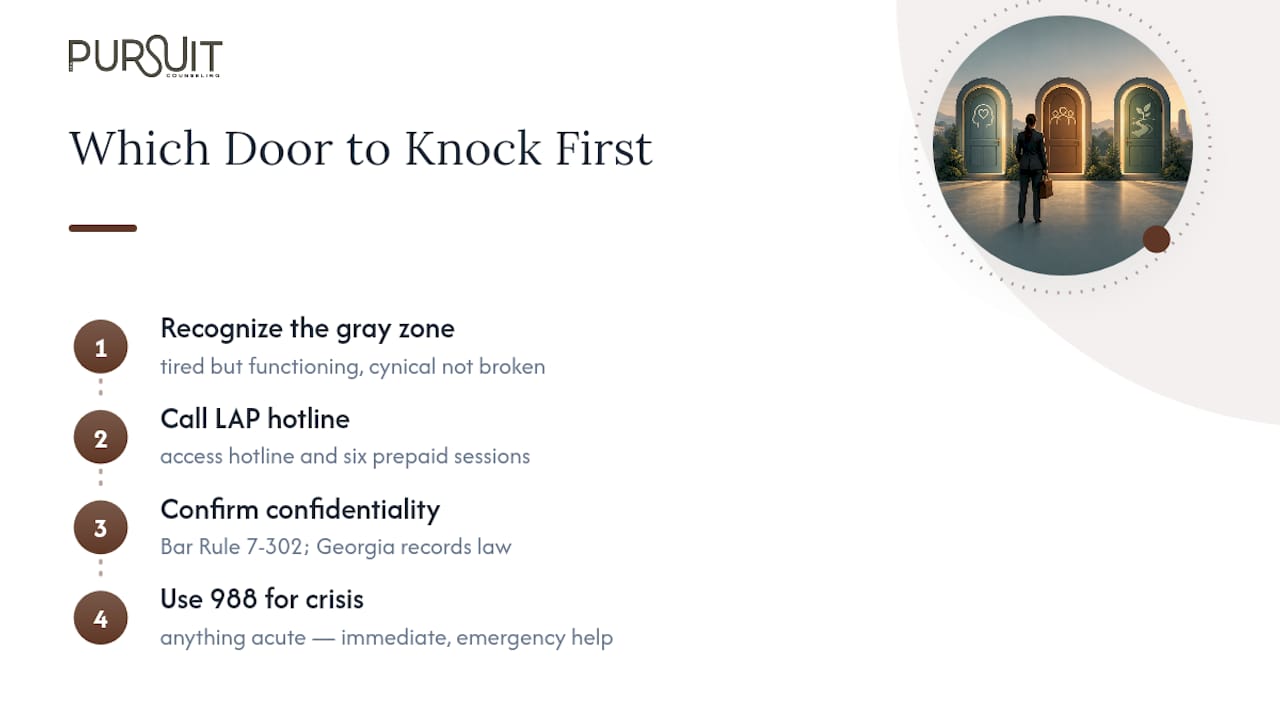
The conventional wisdom oversells generic self-care and undersells structure, as detailed in how Black criminal defense lawyers drive justice and change, highlighting profession-specific pressures and diverse experiences. Meditation apps and vague advice to “set boundaries” ignore what actually drives lawyer burnout: adversarial pressure, billable-hour math, and a professional culture that still treats needing help as a liability. What works better is naming the exact entry points (LAP’s hotline, six prepaid sessions, 988 for anything acute) and pairing that with confidentiality protections that are real, not aspirational. Bar Rule 7-302 and Georgia’s clinical-records statute exist precisely because lawyers need proof, not reassurance, that this stays private.
If there’s one thing I’d tell a burned-out attorney reading this: don’t wait for a crisis to justify the call. LAP’s prepaid sessions exist for exactly the gray zone you’re probably in right now, tired but functioning, cynical but not broken. Use them before you need 988 instead.
— Adam Glendye LPC, CPCS
How The Pursuit Counseling Fits Into Your Recovery
State-run resources like LAP are a strong first stop, but they’re capped at six sessions a year, and not every case resolves in six visits. That’s the gap The Pursuit Counseling fills for Georgia lawyers who need ongoing or more specialized care once those prepaid sessions run out or before you’ve used them at all.

The practice offers anxiety and stress therapy, trauma therapy with EMDR, and neurofeedback for the focus and sleep disruption that so often ride alongside burnout, along with concentrated therapy intensives built for people who can’t commit to weekly sessions around a trial calendar. Sessions happen in person or by telehealth for clients in the Georgia area. Individual therapy fees vary depending on the specialty and clinician.
If you’re carrying a caseload that’s quietly wearing you down, check availability and book a session through The Pursuit Counseling’s services page. And if what you’re feeling right now is more urgent than a scheduled appointment, call 988 first. That line comes before any of this.
This article is general information, not a substitute for advice from a qualified doctor. Consult a qualified healthcare professional about your own circumstances before acting on anything here.
Sources
- Lawyer Assistance Program
- 988 Frequently Asked Questions | SAMHSA
- The Legal Burnout Solution: The business case for attorney well-being
- Psychotherapies | NIMH
FAQ
What Is the Fastest Way to Get Confidential Help as a Georgia Lawyer?
Call the State Bar of Georgia’s LAP hotline at 800-327-9631, available 24/7 with six prepaid clinical sessions for Bar members. For anything urgent or unsafe, call 988 instead.
Is Calling the Lawyer Assistance Program Actually Confidential?
Yes. LAP is administered independently through SupportLinc/CuraLinc rather than the Bar itself, and Bar Rule 7-302 protects what you disclose. Georgia law also generally shields clinical records from disclosure without your consent.
How Much Does Therapy Cost for Lawyers in Georgia?
At The Pursuit Counseling, individual therapy runs 5 to 0 per hour depending on specialty and clinician, with intensives and programs priced separately on the services page. LAP’s six annual sessions are prepaid for Bar members at no direct cost.
What Therapy Approach Works Best for Lawyer Burnout?
CBT and trauma-focused approaches like EMDR both have evidence behind reducing anxiety, stress, and depressive symptoms, and the right fit depends on whether your burnout is tied to a specific incident or a general accumulation of stress. Neurofeedback is sometimes added when focus and sleep are the primary complaints.
Can Law Students Access These Same Resources?
Law students typically use campus counseling centers rather than LAP, which is reserved for Bar members, though 988 and Lawyers Helping Lawyers’ peer support remain available regardless of Bar status. Check with your school’s counseling office for session limits and cost.
When Should I Call 988 Instead of Scheduling Therapy?
Call 988 immediately if you’re having thoughts of suicide, feel unsafe, or are in an active substance-use crisis. Scheduled therapy, whether through LAP or a private provider, fits ongoing exhaustion, cynicism, or performance decline that hasn’t reached that level of urgency.