


Founder anxiety coaching helps reduce decision friction and improve how leaders function when anxiety starts clouding clear, values-guided choices. Coaching tends to fit performance-linked anxiety tied to specific business pressures, while therapy addresses clinical symptoms that interfere with daily life. If you are in crisis right now, call or text 988 for free, confidential support before reading further.
TL;DR:
- Founder anxiety fluctuates with specific entrepreneurial milestones like fundraising, cashflow gaps, hiring, and product feedback, not just general stress.
- Running decision loops in writing helps founders slow down and distinguish fears from facts, reducing impulsive choices driven by anxiety.
- Clinical intervention is necessary if anxiety becomes uncontrollable, persists across situations, disrupts sleep or concentration, or involves thoughts of self-harm.
- Effective coaching focuses on addressing decision-related anxiety and building routines, while a licensed clinician handles clinical symptoms beyond performance.
- Addressing founder anxiety improves team communication, decision clarity, and reduces downstream avoidance behaviors that can impair business progress.
Table of Contents
- Why Founder Anxiety Is Different From Everyday Stress
- Strategies You Can Use Between Sessions
- What a First Founder-Anxiety Consultation Should Cover
- When Coaching Is Enough and When You Need a Clinical Assessment
- How We Work With Founders Facing This
- Spotting the Signs Before They Cost You a Decision
- Building a Long-Term Plan Instead of Riding Out Each Crisis
- Choosing the Right Coach or Therapist for This Specific Problem
- Bringing Coaching Insight Into Actual Business Decisions
- What Changes on the Team When the Founder’s Anxiety Is Addressed
- A Clinician’s View on What Founders Actually Carry
- Working Directly With Us if You’re Ready to Take the Next Step
- FAQ
- Sources
Why Founder Anxiety Is Different From Everyday Stress
Founder anxiety does not behave like generic workplace stress. A qualitative study of 77 entrepreneurs found that anxiety moves with the entrepreneurship process itself: it rises and falls with goals, how progress is appraised, and the coping response a founder reaches for in the moment. The anxiety is not random. It is dynamic, tied to whether you believe you are closing the gap between where the business is and where you need it to be.
That dynamic shows up around familiar pressure points:
- Fundraising cycles, where silence from investors gets read as rejection before any answer arrives.
- Cashflow gaps, where a thin runway turns every expense into a threat.
- Hiring decisions, where a wrong pick feels like it could sink months of work.
- Product uncertainty, where ambiguous customer feedback triggers rumination instead of a decision.
Workload and emotional demands compound this over time. Research on self-employed entrepreneurs found a connection between job demands, mental exhaustion, and burnout. Autonomy can soften the effect, but it does not guarantee protection, and the samples studied were limited, so the pattern describes a tendency rather than a universal outcome.
Strategies You Can Use Between Sessions
Founders rarely need another motivational slogan. They need a way to interrupt the loop between a trigger and a reaction that cost them a clear decision. The entrepreneurial anxiety study indexed under PubMed ID 32226405 points coaching work toward exactly that loop: what happened, what you feared, what you did, and whether the action actually moved the company toward its stated goal.
Research on entrepreneurs describes four broad coping categories. Each one maps to practices you can try now.
- Directly address the issue. Run the three-question decision loop on a recent hard moment: What happened and what did I fear? What did I do and why? What evidence shows that action moved us toward the goal? Then set a short experiment, testing an alternate response over a defined window, like two weeks.
- Change how you perceive the situation. Use a brief values-clarification prompt: name the value behind the decision you are avoiding (honesty, growth of the team, financial stewardship), then name one committed action this week that serves it regardless of how anxious you feel doing it.
- Adapt the goal itself. Sometimes the anxiety is a signal that the goal, not the founder, needs adjusting. A CBT thought record works here: write the automatic thought (“If this raise fails, the company is done”), the evidence for and against it, and a more accurate, balanced thought to act from.
- Increase your capacity to cope. Protect sleep with a fixed shutdown time for screens and inbox, build one boundary script you can say out loud (“I need until Friday to answer that”), and treat recovery as part of the job, not a luxury that comes after it.
Pro Tip: Run the decision loop in writing, not in your head: the act of writing slows the spiral and makes the gap between fear and evidence visible.
A few patterns look like coping but function as avoidance:
- Using alcohol or other substances to blunt the anxiety instead of addressing its source.
- Repeatedly postponing a hard conversation or decision while calling it “waiting for more data.”
- Overworking as a way to avoid sitting with uncertainty rather than to actually move the business forward.
These are stopgaps. They can buy a day, but they tend to add a second problem on top of the first.
What a First Founder-Anxiety Consultation Should Cover
A good first session is not a diagnosis. It is a structured conversation that tells you whether the fit is right.
Expect the provider to walk through:
- The presenting problem, in your words, and what outcome you actually want.
- Session format: frequency, length, and whether it is in-person, telehealth, or both.
- Fees, cancellation policy, and how billing works.
- Confidentiality limits, especially if a co-founder, board member, or investor is involved in any way.
- Referral boundaries: what happens if your needs exceed the provider’s scope.
Bring direct questions of your own:
- What are your credentials, and have you worked with founders or executives before?
- What methods do you use, and why those for anxiety specifically?
- What is outside your scope, and who would you refer me to if we hit that line?
- What is your plan if I tell you I am in crisis between sessions?
Fit shows up fast. You should leave the first conversation with a straight answer on confidentiality, a clear sense of what happens next, and a provider who did not dodge any of the above.
When Coaching Is Enough and When You Need a Clinical Assessment
Coaching fits anxiety that is tied to specific decisions and still lets you function. Some signs point toward something that needs a licensed clinician instead:
- Worry that feels uncontrollable and follows you across unrelated parts of life, not just the business.
- Sleep or concentration disruption that has gone on for weeks.
- Impairment severe enough that basic tasks, meetings, or relationships are suffering.
- Any thoughts of suicide or self-harm.
- Escalating use of alcohol or other substances to manage the anxiety.
NIMH guidance describes anxiety as clinically significant when it persists, shows up across situations, worsens over time, or interferes with functioning, and names cognitive behavioral therapy and acceptance and commitment therapy as common, evidence-based approaches, sometimes paired with medication depending on the individual.
If there is any danger right now, call emergency services. For immediate, non-emergency crisis support, 988 provides free, confidential, 24/7 help by call, text, or chat, and it covers emotional distress, not only suicidal crisis.
How We Work With Founders Facing This
We built our practice around people whose job does not pause for their mental health, which is exactly the position most founders are in. Adam Glendye brings clinical licensure and supervision credentials, indicating the work is grounded in recognized professional standards.
Depending on where you are, different pieces of what we offer apply:
- Our Executive Experience Program suits leaders who need concentrated, structured work rather than an open-ended weekly commitment.
- Neurofeedback is an option we discuss when it is a reasonable fit for how someone’s nervous system is responding, not a default add-on.
- Our intensives work well for founders who need high-impact progress in a short, defined window instead of months of weekly sessions.
Pro Tip: Ask directly about session cadence options and confidentiality policy before your first appointment, so there are no surprises once the work starts.
Spotting the Signs Before They Cost You a Decision
Founder anxiety rarely announces itself. It shows up first in sleep, slipping a little each week until a full night’s rest feels unfamiliar. It shows up in concentration, where a founder reads the same email three times without absorbing it, or starts a task and drifts to another within minutes.
Avoidance is the quieter signal. A founder who used to answer hard emails within the hour starts leaving them unread for days. Board updates get pushed. A difficult conversation with a co-founder gets rescheduled twice, then quietly dropped.
The most consequential sign is impaired judgment: decisions that would normally take an hour of clear thinking stretch into days of circling, or get made impulsively just to escape the discomfort of deciding at all. Neither extreme serves the business.
None of these signs, alone, means something is clinically wrong. A rough fundraising week can produce all four for a few days. The distinction is duration and spread: when the sleep loss, the avoidance, and the judgment slips start compounding across weeks rather than easing after the triggering event passes, that is the point worth naming out loud, to yourself or to someone qualified to help you look at it clearly.
Building a Long-Term Plan Instead of Riding Out Each Crisis
Coping with one bad fundraising week is different from building a plan that holds across a multi-year runway. A workable long-term plan has a few fixed elements rather than relying on willpower alone.
Set a recovery routine that does not depend on the business calming down first: a consistent sleep window, a hard stop on work communication at a set hour, and at least one recurring activity that has nothing to do with the company. Protecting recovery on a fixed schedule matters more than protecting it only when things feel manageable, because things rarely feel manageable on schedule.
Build in regular follow-ups, not just crisis-triggered ones. A monthly check-in with a coach or therapist, even during calm stretches, catches drift before it becomes a pattern. Founders who only show up when something is on fire tend to miss the early signs described above.
Decide in advance what your own red flags are, written down while you are thinking clearly, not while you are anxious. That might be two consecutive nights of poor sleep, or catching yourself avoiding a specific person’s calls. Naming the threshold ahead of time removes the guesswork later.
Finally, treat the plan as something to revisit, not something to perfect once. Business conditions change quarter to quarter, and a routine built for a fundraising push will not fit a scaling phase. A plan that gets reviewed every few months stays useful longer than one left untouched.
Choosing the Right Coach or Therapist for This Specific Problem
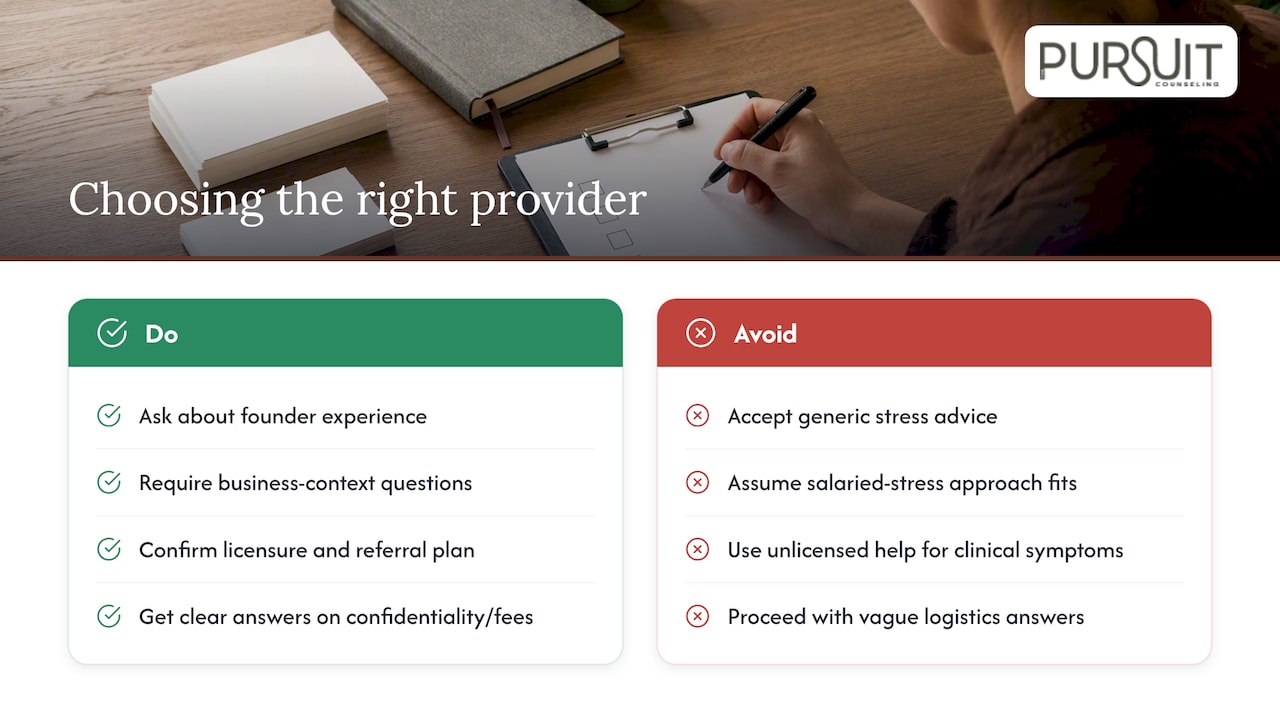
Not every provider who says they work with executives actually understands the particular shape of founder anxiety, where personal identity, financial risk, and other people’s livelihoods are tangled together in a single decision.
Look for someone who asks about the business context before jumping to generic stress-management advice. A provider who treats your anxiety the same way they would treat a salaried employee’s work stress is missing the goal-striving dynamic that research on entrepreneurs consistently finds: the anxiety tracks progress toward specific, self-defined goals, not just workload.
Ask directly whether they have worked with founders, executives, or other high-autonomy roles before. Experience with that population changes how a provider reads your symptoms. Avoidance in a founder can look like a strategic pause to an untrained eye, when it is actually a coping pattern worth naming.
Confirm scope early. A coach without clinical licensure can be excellent for performance-linked anxiety tied to specific decisions, but is not the right fit if symptoms have crossed into clinically significant territory. A licensed clinician should be able to tell you plainly where their scope ends and when they would refer you elsewhere.
Trust the first conversation. If a provider cannot give you a straight answer about confidentiality, fees, or what happens if a co-founder or investor becomes relevant to the work, that uncertainty will not improve later.
Bringing Coaching Insight Into Actual Business Decisions
The point of this work is not to feel calmer in the abstract. It is to make the next fundraising call, hiring decision, or pivot without the anxiety quietly steering the outcome.
The three-question decision loop from earlier in this piece doubles as a bridge between the coaching room and the boardroom. When a real decision comes up, founders can run it through the same structure before acting: what is actually happening, what specifically am I afraid of, what would a clear-headed version of me do, and what measurable outcome would tell me whether that action worked.
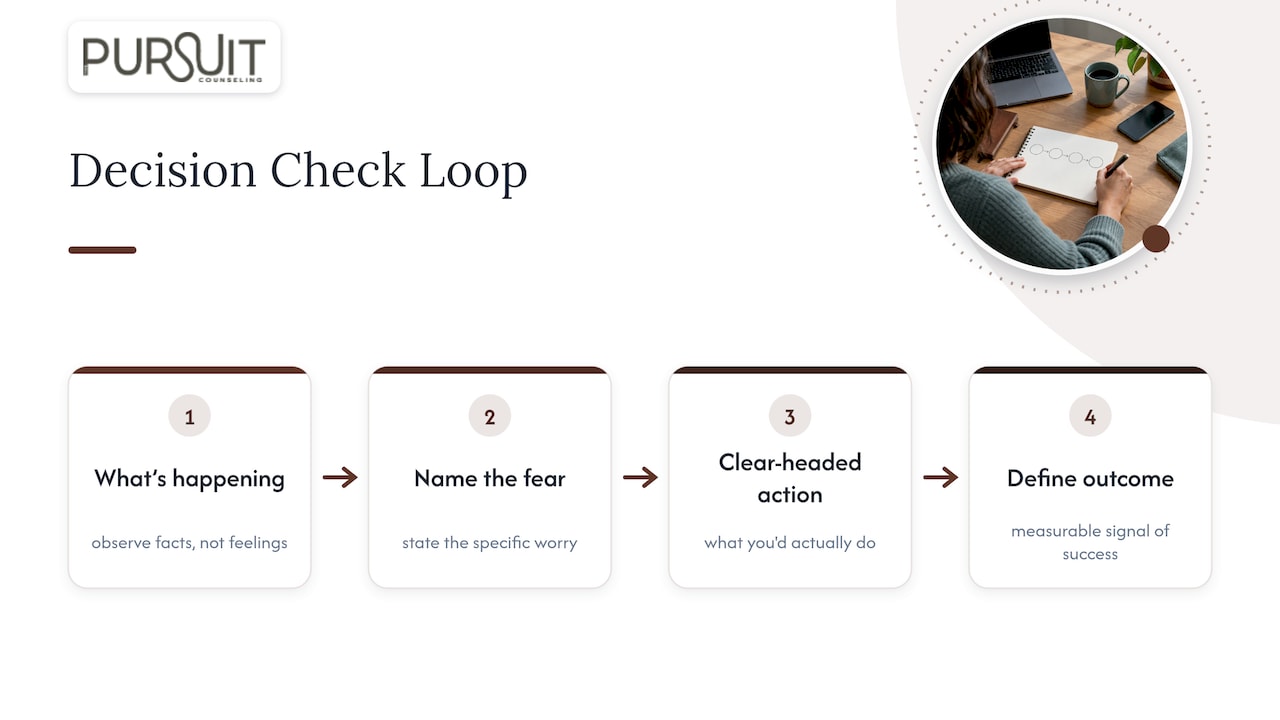
This turns anxiety into information instead of static. A founder who feels a spike of dread before a board meeting can ask whether that dread is pointing at a real, addressable risk in the numbers, or whether it is an old pattern showing up regardless of how solid the numbers actually are. Both answers are useful. Only one requires changing the plan.
Over time, founders who practice this start building it into standing habits: a pre-decision pause before anything irreversible, a post-decision review that separates “it worked” from “it felt better,” and a willingness to name when a decision was driven by fear rather than evidence. None of this requires abandoning instinct. It requires checking instinct against something other than the anxiety itself.
What Changes on the Team When the Founder’s Anxiety Is Addressed
Founder anxiety rarely stays contained to the founder. It shows up downstream in how decisions get communicated, how feedback lands, and how much psychological safety a team actually has, regardless of what the culture deck says.
A founder stuck in avoidance tends to produce a team that is also avoidant: unclear priorities get passed down as ambiguity, unresolved conflicts linger because no one above them modeled resolving one, and people start reading the founder’s mood instead of the actual state of the business.
When a founder works through the decision loop and values-based practices described earlier, the shift is usually visible in smaller things first: faster, clearer answers to hard questions, fewer reversed decisions, and more direct communication about what is actually uncertain versus what is settled. Teams tend to calibrate to the founder’s baseline, so a founder who can sit with uncertainty without spiraling or avoiding tends to produce a team that does the same.
This is not about projecting constant confidence. Founders do not need to hide anxiety from their teams to lead well. What changes is whether the anxiety drives the decision or simply accompanies it, and teams generally notice the difference even if they could not name it directly.
A Clinician’s View on What Founders Actually Carry
Founders often live inside a specific conflict: the same risk tolerance that built the company also threatens to protect it badly, and identity gets fused to outcomes in a way few other roles allow. One shift worth testing is acting on your stated values even while the anxious signal is still firing, rather than waiting for it to quiet down first. When functioning is genuinely impaired, a clinical assessment is a reasonable next step, and that kind of help exists and is accessible.
— Adam Glendye LPC, CPCS
Working Directly With Us if You’re Ready to Take the Next Step

If what you read here sounds familiar, we offer a few direct paths depending on where you are. Our Executive Experience Program suits founders who want concentrated, structured work rather than an indefinite weekly commitment. Anxiety therapy fits when symptoms have moved past a rough stretch and into something interfering with daily functioning. Our intensives work for founders who need meaningful progress inside a short, defined window, and neurofeedback is something we discuss case by case when it fits how your nervous system is responding.
A first call with us covers the same ground outlined earlier: what you are dealing with, what outcome you want, fees, format, and confidentiality, with no pressure to commit beyond that conversation.
- Review our full services and specialties page for details on formats and fees.
- Sessions are available both in person and remotely, depending on your schedule.
- Contact us when you are ready; no prior preparation is needed.
This article is general information, not a substitute for advice from a qualified doctor. Consult a qualified healthcare professional about your own circumstances before acting on anything here.
FAQ
Is founder anxiety coaching the same as therapy?
No. Coaching generally targets performance-linked anxiety tied to specific business decisions, while therapy addresses clinical symptoms that interfere with daily functioning across settings. NIMH guidance notes that anxiety becomes clinically significant when it persists, worsens, or disrupts functioning, which is the point where licensed care becomes the better fit.
What should I bring to a first consultation?
Bring a specific recent example of the anxiety affecting a decision, along with questions about the provider’s credentials, experience with founders or executives, and confidentiality boundaries. A direct conversation about fees, format, and scope in that first session tells you most of what you need to know about fit.
Can coaching actually change how I make decisions?
Research on entrepreneurs suggests coaching that targets the decision loop, what happened, what you feared, what you did, and whether it moved you toward your goal, can reduce the friction anxiety adds to decisions over time, according to research tied to PubMed ID 32226405. It is not a guarantee of a particular outcome, but a structured way to separate fear from evidence.
What if I’m not sure whether I need coaching or a clinical assessment?
If anxiety is tied to specific decisions and you are still functioning day to day, coaching is a reasonable starting point. If you notice uncontrollable worry, disrupted sleep or concentration, or any thoughts of self-harm, a licensed clinician should be the first call, and immediate crisis support is available through 988.
Does The Pursuit Counseling work specifically with founders?
Yes. We offer services designed for founders and executives, including therapy, programs, and intensives that provide concentrated, confidential work instead of an open-ended commitment.
Sources
- No Need to Worry? Anxiety and Coping in the Entrepreneurship Process – PMC
- PubMed ID 32226405 — entrepreneurial anxiety study
- NIMH — Generalized anxiety and treatment guidance
- 988 suicide crisis lifeline information (state DOH page)