


EMDR intensives are an available, evidence-based option in Georgia for adults who need concentrated trauma processing, though they are not the right fit for everyone. They tend to suit people with scheduling barriers to weekly therapy or a clear desire to work through a specific memory faster than a standard caseload allows. A licensed Georgia clinician should confirm appropriateness through an intake before you commit to a full program.
TL;DR:
- EMDR intensives suit clients with stable routines, specific memories, and prior therapy experience, but are unsuitable for those with unstable housing or severe dissociation.
- Typically, intensives involve one to several days of consecutive sessions, focusing on desensitization, history-taking, and reevaluation, with minimal homework.
- Costs vary by provider, usually as private-pay packages, and require planning for transportation, childcare, and emergency contacts before booking.
- Ensuring the clinician has EMDRIA certification and Georgia licensure is critical, especially for remote intensives, to confirm proper training and legal authority.
- Outcomes are comparable to weekly therapy, with some individuals noticing symptom reduction within a few sessions, but the evidence is still evolving.
Table of Contents
- What makes an EMDR intensive different from weekly sessions
- Who tends to benefit, and who should slow down first
- What an intensive day or week actually looks like
- What the research and guidelines actually say
- How to vet an EMDR provider before booking in Georgia
- What an EMDR intensive costs and how scheduling works in Georgia
- Local credibility: what to expect from The Pursuit Counseling
- How EMDR intensive programs in Georgia differ from one another
- Clinician perspective: when we recommend an intensive versus weekly EMDR
- Booking an EMDR intensive with The Pursuit Counseling
- Sources
- FAQ
What makes an EMDR intensive different from weekly sessions
Weekly EMDR spreads trauma processing across many 50-minute sessions, often over months. An intensive compresses that same clinical work into longer, consecutive blocks, sometimes a single extended day, sometimes several days in a row, so the nervous system can move through target memories without long gaps between sessions.
EMDR itself follows an eight-phase structure, and intensives typically lean hardest on three of those phases:
- History-taking and preparation, where the clinician builds safety and identifies target memories.
- Desensitization and reprocessing, the active work of processing distressing material.
- Reevaluation, where the clinician checks what shifted and what still needs attention.
One detail surprises a lot of people considering this work: EMDR generally does not require traditional homework between sessions, and you are not typically asked to narrate your trauma in detail. The processing happens through guided attention to the memory itself, not through retelling the story out loud. For a fuller walkthrough of each phase, see the eight phases of EMDR.
Who tends to benefit, and who should slow down first
An intensive format often fits adults who cannot carve out a weekly hour for months on end, pilots, executives, parents juggling shift work, or anyone whose schedule makes consistency the real obstacle. It also suits people who already have some therapy experience, a clear sense of which memories are driving current distress, and a stable enough daily life to absorb several hours of processing work in a short window.
- You travel frequently or work irregular hours that make weekly attendance unreliable.
- You have identified specific, discrete memories rather than a diffuse, ongoing crisis.
- You have done some preparatory therapy and have basic coping skills in place.
Caution flags include unstable housing, active severe substance use, unmanaged suicidal ideation, or significant dissociation. For those situations, a slower pace or a stabilization period usually comes first, sometimes alongside integrated support like the substance use treatment resources in Atlanta.
Pro Tip: Book a preparatory intake before an intensive, not instead of one. It is where readiness actually gets assessed, not assumed.
What an intensive day or week actually looks like
Formats vary more than people expect, and Georgia providers structure them differently depending on the clinical picture and the client’s goals.
- A single extended day, often several hours, for a narrowly defined issue.
- Three to five consecutive days, blending safety work, active processing, and integration time.
- A full week or a series of intensive weekends, used for more complex or layered trauma histories.
Clinicians generally divide the time with safety and preparation first, active reprocessing in the middle stretch, and integration or reevaluation toward the end. Aftercare matters as much as the sessions themselves: most programs build in rest periods, ask you to arrange transportation since processing can leave you fatigued, and confirm an emergency plan and a follow-up session before you leave. For a broader look at how concentrated formats work across therapy types, see therapy intensives explained.
What the research and guidelines actually say
EMDR is one of the most studied treatments for PTSD and appears across multiple clinical practice guidelines, though the American Psychological Association gave it a conditional rating rather than a strong one. That distinction matters: conditional means the evidence supports it as a reasonable option, not that it works identically for every person or every trauma type.
The intensive delivery format itself is younger as a research area. A VA-published review of massed therapy formats found initial promise, with symptom reductions in several studies comparable to standard weekly therapy, particularly in veteran samples, though the authors are clear that the literature is still developing.
EMDR shows measurable symptom improvement for many people with PTSD, according to the National Center for PTSD’s decision aid, which also notes that some people notice change within a few sessions rather than months.
How to vet an EMDR provider before booking in Georgia
Credentials matter more in an intensive than in a single weekly session, because you are committing hours and money upfront. Start with a Georgia license and confirm the clinician has formal EMDR training, ideally through EMDRIA-approved basic training. Ask whether they hold EMDRIA Certified Therapist status, which requires documented sessions with multiple clients, consultation hours, and ongoing continuing education, a higher bar than basic training alone.
If you are considering a remote intensive, Georgia’s telehealth rules require informed consent, specific continuing education for telehealth delivery, and a clinician assessment of whether telehealth is appropriate for your situation. Out-of-state clinicians generally cannot treat you in Georgia without separate authorization.
- Ask how many supervised EMDR sessions the clinician has logged.
- Ask how many intensives they have personally run, not just weekly EMDR cases.
- Ask what their safety and stabilization procedure looks like if distress spikes mid-session.
- Ask about cancellation and refund terms before paying for a multi-day block.
| What to check | Why it matters |
|---|---|
| Georgia license status | Confirms legal authority to treat you in this state |
| EMDRIA basic training | Baseline competency in the EMDR protocol |
| EMDRIA Certified Therapist status | Documented advanced experience and supervision |
| Telehealth informed consent process | Required under Georgia Board rules for remote sessions |
What an EMDR intensive costs and how scheduling works in Georgia
Pricing shapes vary: some providers bill hourly, others package a multi-day block, and a few add adjuncts like neurofeedback brain mapping, which raises the total. Most intensives in Georgia run private-pay rather than through insurance, since the condensed format does not map cleanly onto standard session-based billing.
- Ask upfront whether the practice issues a superbill for out-of-network reimbursement.
- Plan transportation, since processing days can leave you drained.
- Arrange childcare or time off work for the full block, not just the session hours.
- Confirm an emergency contact plan before the intensive begins.
Local credibility: what to expect from The Pursuit Counseling
The Pursuit Counseling is led clinically by Adam Glendye, LPC, CPCS, and offers EMDR therapy alongside neurofeedback brain mapping, available both in-person in Fayetteville and via telehealth across Georgia. Readiness assessment happens at intake, not assumed from a phone call: the clinician reviews your history, current stability, and target memories before recommending an intensive over weekly care.
- EMDR trauma therapy is offered as a standalone service and within various therapeutic formats.
- Neurofeedback brain mapping is available as an adjunct approach.
- Intake includes a review of safety and stabilization before scheduling intensives.
- Both in-person and telehealth sessions are available for Georgia residents.
How EMDR intensive programs in Georgia differ from one another
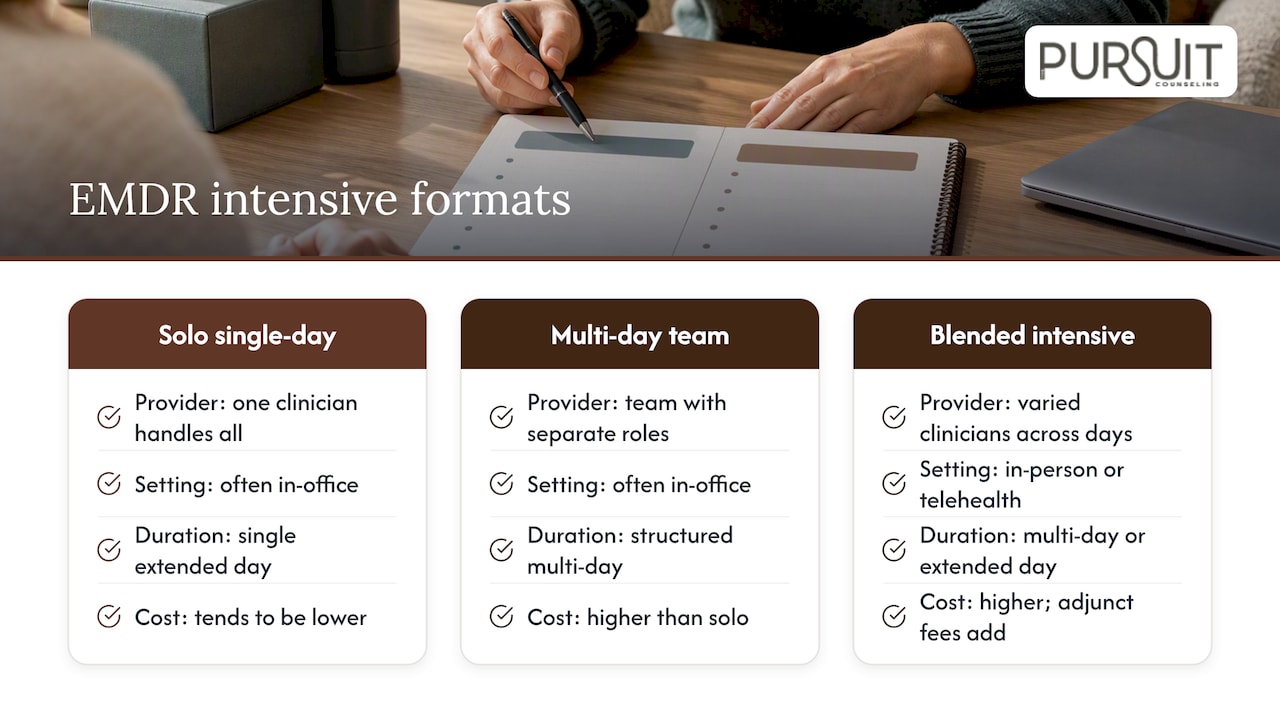
Not every intensive looks the same, and the differences usually come down to who is running it and where. Solo-practice clinicians often run smaller, more personalized intensives, sometimes a single extended day built around one or two specific memories, with the same person handling intake, processing, and follow-up. Group practices and larger counseling centers may offer more structured multi-day formats with a team approach, where one clinician manages intake and another runs the active processing days.
Setting matters too. Some Georgia providers run intensives strictly in-office, which can matter for clients who dissociate easily or need a controlled environment. Others offer telehealth intensives, which widen access for rural Georgia residents or those with mobility or transportation barriers, but come with the telehealth assessment requirements noted earlier. A smaller number of practices, including ones offering adjuncts like neurofeedback or adventure-based work, blend EMDR with other modalities across the intensive window rather than running EMDR alone.

Cost structures track these differences: a solo-practice single-day intensive tends to cost less than a multi-day program with a full clinical team, and adjunct services add to the total. Before booking, ask directly whether the program is EMDR-only or blended, who you will work with across the days, and whether the setting (in-person versus telehealth) fits your comfort level and any stabilization needs identified at intake.
Clinician perspective: when we recommend an intensive versus weekly EMDR
We recommend an intensive when someone has a defined target memory, reasonable stability, and a scheduling reality that weekly care cannot accommodate. We recommend weekly EMDR instead when someone needs more time to build coping skills first, or when the clinical picture is still unclear. Either way, the first step is the same: a preparatory intake to assess fit and build a safety plan, not a promise of a particular outcome.
— Adam Glendye LPC, CPCS
Booking an EMDR intensive with The Pursuit Counseling
The Pursuit Counseling runs a consultation-first process for intensives: a brief consultation, a clinical intake to assess readiness and build a safety plan, then scheduling for the intensive itself. Sessions run private-pay, and the practice can discuss superbills for clients seeking out-of-network reimbursement.

- Review intensive formats and pricing on the Couples Intensive, Next Chapter Intensive, and Executive Experience page.
- Explore standalone EMDR and trauma therapy services if an intensive is not yet the right step.
- Request a consultation to start the intake and readiness conversation before any program is scheduled.
This article is general information, not a substitute for advice from a qualified doctor. Consult a qualified healthcare professional about your own circumstances before acting on anything here.
Sources
- Eye Movement Desensitization & Reprocessing (EMDR) – PTSD: National Center for PTSD decision aid
- GA R&R – GAC – Chapter 135-11 TeleMental Health
FAQ
Are EMDR intensives worth it?
For adults with a defined target memory and reasonable stability, intensives can offer a faster path through processing than months of weekly sessions, though outcomes vary by person. Worth depends on fit, which is why a preparatory intake matters more than the format itself.
How much do EMDR intensives cost?
Pricing varies by provider and format, with hourly and multi-day package structures both common across Georgia practices. Most programs are private-pay, so ask directly about superbills if you want to seek reimbursement through your insurance.
Can you do intensive EMDR?
Many adults can, particularly those with a clear target memory, some prior therapy experience, and stable daily functioning, but active severe substance use, unmanaged suicidal ideation, or significant dissociation usually call for stabilization first. A licensed clinician determines fit during intake, not before.
Why is there a controversy with EMDR?
The debate centers on evidence strength rather than safety: the American Psychological Association gave EMDR a conditional rating rather than a strong one, and some researchers question exactly how the eye-movement component contributes to outcomes. EMDR still appears across multiple clinical practice guidelines as a studied, recognized option for PTSD.