


You do not have to have a formal ADHD diagnosis to get help for focus and attention in Georgia. Therapy, skills coaching, and structured routines can start the moment you decide you want them, no label required. The two exceptions worth knowing: you will need a diagnosis for ADHD medication, and you will need documented proof for formal school or workplace accommodations. For everything else, including how insurance may treat symptom-focused care, keep reading.
TL;DR:
- You can access therapy, skills coaching, and structured routines for attention issues in Georgia without needing an ADHD diagnosis, except for medication and formal accommodations.
- Providers like LPCs, LCSWs, and psychologists can start symptom-focused therapy immediately without a diagnosis, while medication requires documented diagnosis approval.
- Insurance typically asks for a diagnosis code to reimburse, but private-pay, out-of-network, or community services can bypass this requirement for symptom management.
- Telehealth offers convenient, accessible ADHD support in Georgia, but in-office testing or neurofeedback may still need in-person visits.
- A full diagnostic assessment is necessary mainly if medication or formal workplace or school accommodations are required, not for initial symptom relief or therapy goals.
Table of Contents
- What the question is really asking: diagnosis versus treatment goals
- Who can actually help you, with or without a diagnosis
- Insurance, parity rules, and what they mean for symptom-first care in Georgia
- Telehealth: a real access route, with a few things to check first
- Deciding whether to pursue a full diagnostic evaluation
- How the Pursuit Counseling approaches symptom-first care
- What symptom-first ADHD therapy actually costs in Georgia
- How insurance actually treats ADHD-related therapy here
- Why the price of ADHD-focused therapy varies so much
- In-person versus telehealth: does the format change the price
- How to check your insurance benefits before you book
- A clinician’s note on starting without a label
- Getting started with The Pursuit Counseling
- Sources
- FAQ
What the question is really asking: diagnosis versus treatment goals
When someone asks whether they need a diagnosis to get help, they are usually not asking about paperwork. They are asking whether their scattered focus, missed deadlines, and mental fatigue count as “real enough” to deserve support. They do.
A formal diagnostic evaluation is a structured process: a clinical history, standardized rating scales, and rule-outs for conditions that mimic ADHD, like anxiety, sleep deprivation, or depression, according to the CDC’s guidance on ADHD in adults. Functional therapy asks a narrower, more immediate question: what is getting in your way this week, and what can we do about it?
Several evidence-based approaches target attention and executive function directly, without requiring a diagnostic label first:
- Cognitive behavioral therapy (CBT) for procrastination, time blindness, and task avoidance.
- DBT-based skills work for emotional regulation that often accompanies attention struggles.
- Executive-function coaching for planning systems, prioritization, and follow-through.
- Neurofeedback, a brain-training approach some clients pursue alongside talk therapy.
You do not need a written diagnosis to start psychotherapy focused on these outcomes, according to the CDC’s overview of ADHD treatment, which notes that many clinicians prioritize functional progress over labeling.
Who can actually help you, with or without a diagnosis
Different providers have different scopes, and knowing which one fits your situation saves time.
- Licensed Professional Counselors (LPCs) and Licensed Clinical Social Workers (LCSWs) can begin talk therapy, teach executive-function skills, and use CBT or DBT-based interventions without a diagnosis on file.
- Psychologists can do everything an LPC or LCSW can do, and they are also qualified to conduct the standardized testing involved in a full diagnostic evaluation, per the CDC.
- Psychiatric nurse practitioners and psychiatrists can prescribe medication, but prescribing almost always requires a documented diagnosis first.
- Primary care providers can sometimes screen for ADHD or refer out, though many prefer to send attention concerns to a specialist for a fuller picture.
The medication distinction matters because prescribing carries legal and clinical documentation requirements that talk therapy does not. A therapist helping you build a planning system or manage distractibility is not making a medical claim about your brain chemistry, so the bar to start is lower and the work can begin immediately.
In practice, this means a first session might focus on building an external memory system for deadlines, working through the emotional weight of chronic lateness, or trying a neurofeedback protocol to see how your nervous system responds. None of that requires a diagnostic code. If you later decide you want medication or need documentation for a workplace accommodation, that conversation can happen alongside the work you have already started, not instead of it.
Insurance, parity rules, and what they mean for symptom-first care in Georgia
Federal parity law requires that mental health and substance use benefits be treated comparably to medical and surgical benefits, covering things like copays, deductibles, and visit limits, under MHPAEA guidance from CMS. Marketplace plans are also required to include mental health and substance use treatment as an essential health benefit, though the specifics vary by plan, according to Healthcare.
Georgia’s insurance commissioner has issued significant fines to insurers for mental health parity violations as of January 2026, a sign that enforcement here is not theoretical, according to the Georgia Office of Commissioner of Insurance and Safety Fire. That matters if your claim gets denied or delayed: you have somewhere to escalate the complaint.
Insurers typically ask for a diagnosis code to establish “medical necessity” before they reimburse therapy, which is one reason symptom-first care sometimes runs into friction with coverage. Your options if you are not pursuing a diagnosis right away:
- In-network therapy, if your plan covers a diagnosis-adjacent code your provider can document.
- Out-of-network reimbursement, where you pay upfront and submit a claim afterward.
- Private-pay sessions, which sidestep the documentation requirement entirely.
- FSA or HSA funds, which can often be applied to therapy costs.
- Sliding-scale fees through community mental health clinics.
For a deeper look at how out-of-network claims work in this state, this Georgia guide to out-of-network reimbursement walks through the process.
Telehealth: a real access route, with a few things to check first
Telehealth has changed who can get help and how fast. A substantial portion of adults with ADHD have used telehealth for ADHD-related services, according to MMWR data from the CDC, and it has lowered barriers for people whose schedules do not accommodate a weekly commute to an office. For a busy professional in South Atlanta juggling a demanding job, that flexibility is not a small thing.
Telehealth is not without limits. Diagnostic accuracy can be harder to establish over video, and some states or practices restrict medication prescribing through telehealth alone. Before you commit to a provider, check a few things:
- The clinician is licensed in Georgia, not just “licensed somewhere.”
- They specialize in adult attention or executive-function work, not general medication management.
- The platform is HIPAA-compliant and does not route your data through unsecured tools.
- There is a plan for continuity if you eventually need in-person testing or documentation.
Pro Tip: Ask a prospective telehealth provider how they would document progress if you later decided to pursue a formal evaluation. Their answer tells you a lot about how organized the practice is.
Deciding whether to pursue a full diagnostic evaluation
Not everyone needs a formal workup right away, and not everyone should wait. A few questions can help you sort out where you land.
- Do you think you might want medication? If so, a diagnosis is the necessary first step.
- Do you need documented accommodations at work or school? Formal paperwork requires a formal evaluation.
- Has this pattern shaped your life since childhood, across multiple settings? That history often points toward a fuller assessment.
- Do you mainly want language and clarity for what you are experiencing, separate from any practical requirement? Therapy can address the symptoms while you decide.
A full evaluation typically involves a clinical interview, standardized rating scales, and a review of your history across home, school, and work settings, according to the CDC. It is a process, not a single appointment.
When you make first contact with a clinician, a few questions clarify your path fast:
| Question to ask | What it tells you |
|---|---|
| “Can we start with therapy goals before any formal testing?” | Whether the provider supports symptom-first work |
| “If I later want a diagnosis, do you provide that or refer out?” | Whether you would need to switch providers |
| “What would documentation for accommodations require?” | The gap between where you are and formal paperwork |
| “How do you track progress without a diagnostic code?” | Whether the practice has a real functional framework |
Red flags that should push you toward a full workup sooner: attention struggles that have never let up since childhood, a pattern that is costing you your job or your closest relationships, or a family member who has pushed for testing because they see something you cannot name.
How the Pursuit Counseling approaches symptom-first care
We built our approach around a simple premise: you should not have to wait for a diagnosis to get relief. Adam Glendye, LPC, CPCS, leads a practice that treats attention and executive-function struggles as clinical priorities in their own right, whether or not a formal diagnosis is ever pursued.
For clients who want to start with function rather than labeling, a few services tend to fit well:
- Individual therapy focused on executive-function skills, planning systems, and the emotional toll of chronic distractibility.
- Neurofeedback, offered as a non-medication option for clients curious about training attention and regulation directly.
- The Executive Experience Program, a structured intensive for high performers who want concentrated, fast-moving work.
Psychotherapy notes are typically kept separate from standard medical records, which gives private-pay clients more control over who sees what. If you later decide a formal diagnostic referral makes sense, that conversation happens without disrupting the work already underway. A first booking usually starts with a consult call to talk through what “help with focus” means for you specifically, in-person in Fayetteville or by telehealth across South Atlanta.
What symptom-first ADHD therapy actually costs in Georgia
Costs vary by service type more than by diagnosis status, since private-pay pricing is typically set by session type and provider, not by whether a diagnostic code is attached. Individual therapy sessions at The Pursuit Counseling run 5 to 0 per hour, depending on the clinician and format. Neurofeedback is priced through a Brain Map assessment, available on request. For readers who want a concentrated, faster path, the Executive Experience Program is a one-time ,950 structured intensive built for high performers who want to move quickly rather than spread work over months of weekly sessions.
Couples work, life-transition counseling, and other adjacent services carry their own rates, generally in the same 5 to 0 per hour range depending on specialty and provider. None of these figures require a diagnosis to access. What changes the price is the format (individual session versus intensive), the provider’s experience level, and whether you are paying privately or working through insurance reimbursement.
The absence of a diagnosis does not typically raise or lower private-pay rates. It mainly affects whether insurance will reimburse you, which is a separate question from what the service itself costs.
How insurance actually treats ADHD-related therapy here
Coverage for ADHD-related therapy in Georgia depends heavily on whether your provider is in-network, whether a diagnosis code is on file, and what your specific plan defines as a covered behavioral health service. Marketplace plans are required to treat mental health and substance use care as essential health benefits, though the details of what counts and at what cost-share vary by plan, according to HealthCare.gov.
Insurers generally require a diagnosis to establish medical necessity before they will reimburse sessions, which is the main place symptom-first therapy runs into friction with coverage. If you are not ready to pursue a formal diagnosis, private-pay or out-of-network reimbursement often becomes the more realistic path, at least until you decide whether an evaluation makes sense.
Georgia’s parity enforcement gives you leverage if an insurer denies a claim that should be covered under mental health parity rules. The state’s 2022 Mental Health Parity Act strengthened consumer protections, and active fines against insurers show that complaints filed with the OCI can produce results. If your claim is denied and you believe it should not have been, that agency is where the appeal goes.
Why the price of ADHD-focused therapy varies so much
Three factors drive most of the variation you will see in what ADHD-related therapy costs in Georgia: who provides it, where you live relative to metro Atlanta, and whether you choose in-person or virtual sessions.
Provider type matters most. A licensed counselor typically charges less per hour than a psychologist conducting testing, and a structured intensive program is priced differently than a standard weekly session because it compresses months of work into days. Location matters too: practices serving metro Atlanta and its southern suburbs, including Fayetteville, Peachtree City, and Senoia, often reflect the cost of operating in a higher-demand market compared to more rural parts of the state.
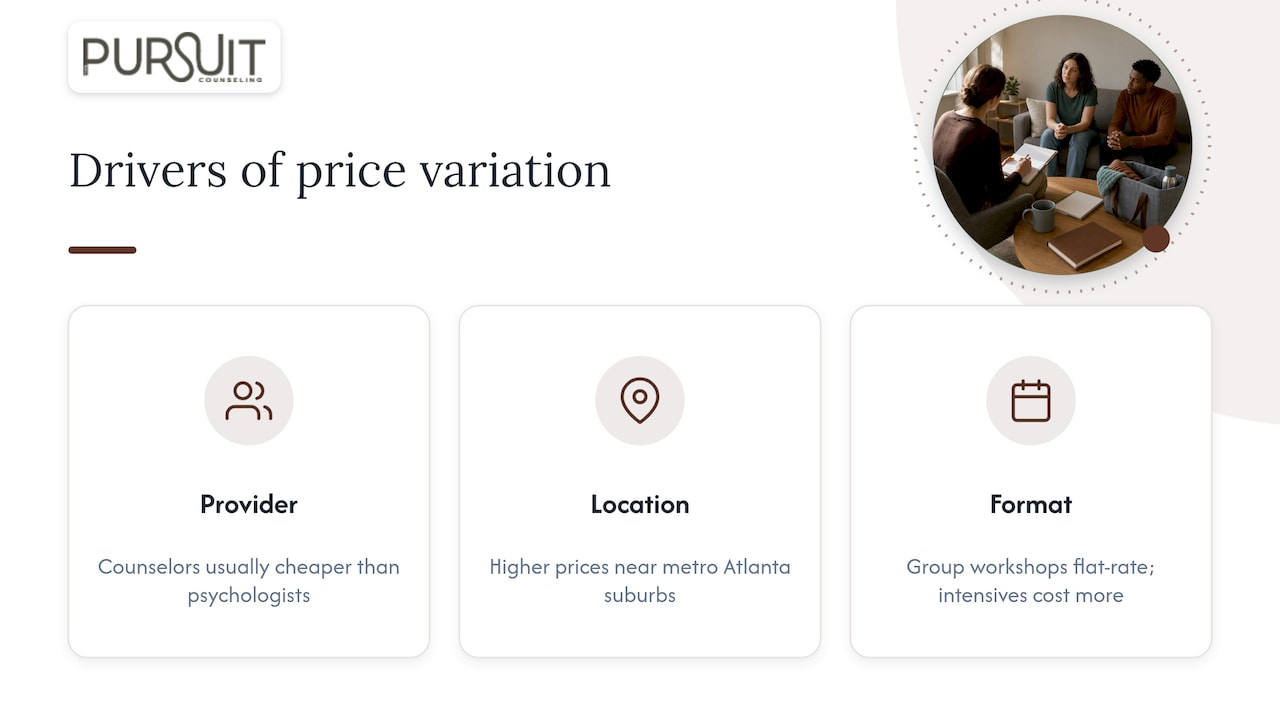
Format is the third lever. Group workshops, like organizational sessions built for teams and leadership, spread cost across participants and land at a flat rate rather than an hourly one. Individual intensives, by contrast, concentrate a provider’s full attention into a short window, which is part of why programs like a multi-day executive intensive carry a higher one-time price than a single session would.
None of these variables are about diagnosis status. A client working on executive-function skills without any diagnostic paperwork pays the same rate as a client using the exact same service post-diagnosis. What changes the number is the format and the provider, not the label.
In-person versus telehealth: does the format change the price
For many practices, including ours, the hourly rate for individual therapy does not change based on whether the session happens in person or over video. What changes is what you are paying for beyond the session itself: travel time, scheduling flexibility, and in some cases, access to services like neurofeedback that require in-office equipment.
Telehealth removes the commute, which matters if you are choosing between a session and a missed hour of work. It also expands your options beyond your immediate zip code, since a clinician licensed in Georgia can see you by video whether you live in Fayetteville or somewhere without a local specialist in adult attention work. About half of adults with ADHD have used telehealth for ADHD-related care, according to CDC MMWR data, reflecting how normalized this format has become.
The tradeoff is that some services simply are not available remotely. Neurofeedback requires in-office equipment, and if you are weighing a full diagnostic evaluation with standardized testing, some of that work is better done in person. For talk therapy and skills coaching, though, the format is largely a matter of preference and logistics rather than cost.
How to check your insurance benefits before you book
Before you assume therapy is out of reach financially, call the number on the back of your insurance card and ask a specific set of questions. Ask whether outpatient mental health services are covered, what your copay or coinsurance is for a licensed counselor versus a psychologist, and whether you need a referral. Ask directly whether a diagnosis is required for reimbursement, since some plans reimburse general “adjustment” or “unspecified” codes without a full ADHD diagnosis on file.
If you are on a Marketplace plan, mental health coverage is required as an essential health benefit, but the deductible, copay, and network rules still vary by plan, according to HealthCare.gov. Ask your insurer for their specific behavioral health provider directory rather than relying on a general search, since directories are not always current.
If a provider you want to see is out-of-network, ask your insurer what percentage of out-of-network mental health claims they typically reimburse, and request that answer in writing or via the online portal. This guide to out-of-network reimbursement in Georgia breaks down the claim submission process step by step. If a claim is denied and you believe it should have been covered under parity rules, Georgia’s OCI is the agency to contact.
A clinician’s note on starting without a label
Most of the people who come to me worried about focus are not looking for a diagnosis. They are looking for relief from the low hum of feeling behind. We can start there. Bring me the specific ways it shows up, missed deadlines, the meeting you zoned out of, the project you keep circling. We build from what is actually happening, and we watch what changes.
— Adam Glendye LPC, CPCS
Getting started with The Pursuit Counseling
If you want to work on focus and attention without committing to a diagnostic process first, that is exactly the kind of care we built around. At The Pursuit Counseling, sessions start with what is actually happening in your week, not with a diagnostic checklist, and private-pay scheduling means you can begin without waiting on insurance authorization.

A few ways to start:
- Book an individual therapy session focused on executive-function skills and planning systems.
- Ask about a Neurofeedback Brain Map if you are curious about a non-medication approach.
- Consider the Executive Experience Program if you want concentrated, fast-moving work rather than months of weekly sessions.
Pro Tip: Bring a specific recent example, a missed deadline, a conversation you lost track of mid-sentence, to your first consult. It gives your clinician something concrete to build a plan around.
If a full diagnostic evaluation later makes sense, for medication or formal accommodations, we support that step without abandoning the work you have already started. Visit The Pursuit Counseling’s services page to see current offerings and book a first consult.
This article is general information, not a substitute for advice from a qualified doctor. Consult a qualified healthcare professional about your own circumstances before acting on anything here.
Sources
- ADHD in adults — CDC
- Mental Health Parity and Addiction Equity Act (MHPAEA) guidance — CMS
- Commissioner King issues nearly million fines — Georgia OCI
FAQ
Is ADHD considered a disability in Georgia?
ADHD can qualify as a disability under federal law when it substantially limits a major life activity, which determines eligibility for workplace or school accommodations. Whether a specific case qualifies depends on documentation from a formal evaluation, not on symptoms alone.
What is the least expensive way to get an ADHD diagnosis?
Starting with your primary care provider or a community mental health clinic that offers sliding-scale fees is typically the most affordable route to an initial screening. From there, you may be referred to a psychologist for more complete testing if a fuller evaluation is warranted.
Is paying out of pocket for a private ADHD assessment worth it?
A private assessment often means faster scheduling and a clinician who specializes in adult attention concerns, compared to longer waits through some insurance networks. Whether it is worth the cost depends on how urgently you need documentation, for medication or accommodations, versus wanting to start with therapy first.
How effective is therapy for ADHD symptoms?
Therapy approaches like CBT and DBT-based skills work are commonly used to help adults manage procrastination, time management, and emotional regulation tied to attention difficulties. Results vary by individual, and therapy is often most useful when paired with a clear, functional goal rather than treated as a stand-alone fix.