


Yes, women can and do have ADHD, and in many females it looks nothing like the stereotype. It shows up as persistent inattention, chronic disorganization, time blindness, and emotional swings that get written off as anxiety or “just being sensitive.” If these patterns run through your whole life, not just a bad month, an evaluation with a clinician experienced in adult female ADHD is worth pursuing.
TL;DR:
- Women with ADHD often exhibit inattentive symptoms like forgetfulness and disorganization, which are mistaken for laziness or lack of care.
- Diagnosis is challenging because female ADHD presents as inward hyperactivity and emotional dysregulation, often masked by perfectionism and overwork.
- Long-term masking and societal bias delay diagnosis, especially when symptoms emerge during life changes like postpartum or menopause.
- Effective treatment involves personalized medication, therapy, and daily strategies, with adjunctive options like neurofeedback considered for comprehensive care.
- Evaluation should be sought when symptoms impair functioning at work or relationships, particularly if mood treatments do not fully address focus issues.
Table of Contents
- What Are the Signs of ADHD in Women?
- Why Is ADHD in Women So Often Missed?
- How Is ADHD Diagnosed in Women?
- Could It Be Something Else? Sorting ADHD From Look-Alike Conditions
- What Treatments Actually Help Women With ADHD?
- When Should You Seek Help, and What Happens Next?
- A Clinical Perspective on Female ADHD
- Ready to Get Evaluated? Here’s Where to Start
- Where to Learn More
- Sources
- FAQ
What Are the Signs of ADHD in Women?
The signs of ADHD in women rarely announce themselves the way they do in a hyperactive eight-year-old boy who cannot sit through a movie. Instead, they hide inside habits you have probably apologized for a hundred times. Understanding the four symptom clusters clinicians actually look for gives you language for what has felt, until now, like a personal failing.
Inattentive signs tend to be the most common female ADHD symptoms, and they are also the easiest to mistake for laziness or lack of care. You forget appointments not because you don’t value them, but because your brain doesn’t reliably flag “future event” until it’s suddenly the present. You lose your keys, your phone, your train of thought mid-sentence. You start a work project with real enthusiasm and stall three tasks in, not from boredom but because the follow-through wiring keeps dropping the signal.
Hyperactivity looks different in women. Rather than bouncing off the walls, it often turns inward. That’s the internal hyperactivity clinicians describe: a mind that races even when the body sits still. What looks like “daydreaming” or a blank stare is frequently a torrent of task-unrelated thoughts firing in the background, not an empty mind at all. You may talk fast, interrupt without meaning to, or feel a low hum of restlessness you’ve never had a name for.
Emotional dysregulation is one of the most underdiscussed female ADHD signs, and one of the most disruptive. It can look like intense irritability, a hair-trigger temper you’re not proud of, or crashing mood swings that seem disproportionate to what triggered them. Many women with ADHD also experience rejection sensitivity, a sharp, almost physical sting from perceived criticism or exclusion that can quietly reshape how you show up in relationships and at work.
Executive function failures round out the picture, and they’re often what finally drags a woman into an evaluation. This is the cluster clinicians link most directly to real-world impairment:
- Chronic lateness, even when you leave “early enough” by every calculation you can make
- Time blindness: an hour feels like fifteen minutes, or fifteen minutes feels like an hour, with no reliable internal clock
- Trouble prioritizing, so an urgent client email and a load of laundry can carry equal weight in your head
- Missed deadlines despite genuine effort, a pattern covered in more depth in why ADHD makes deadlines so hard to meet
- Parenting friction, like forgetting permission slips or losing track of school pickup times, that triggers disproportionate guilt
Women more commonly show the inattentive presentation, poor focus, forgetfulness, disorganization, though hyperactivity and impulsivity can absolutely still be part of the picture.
Why Is ADHD in Women So Often Missed?
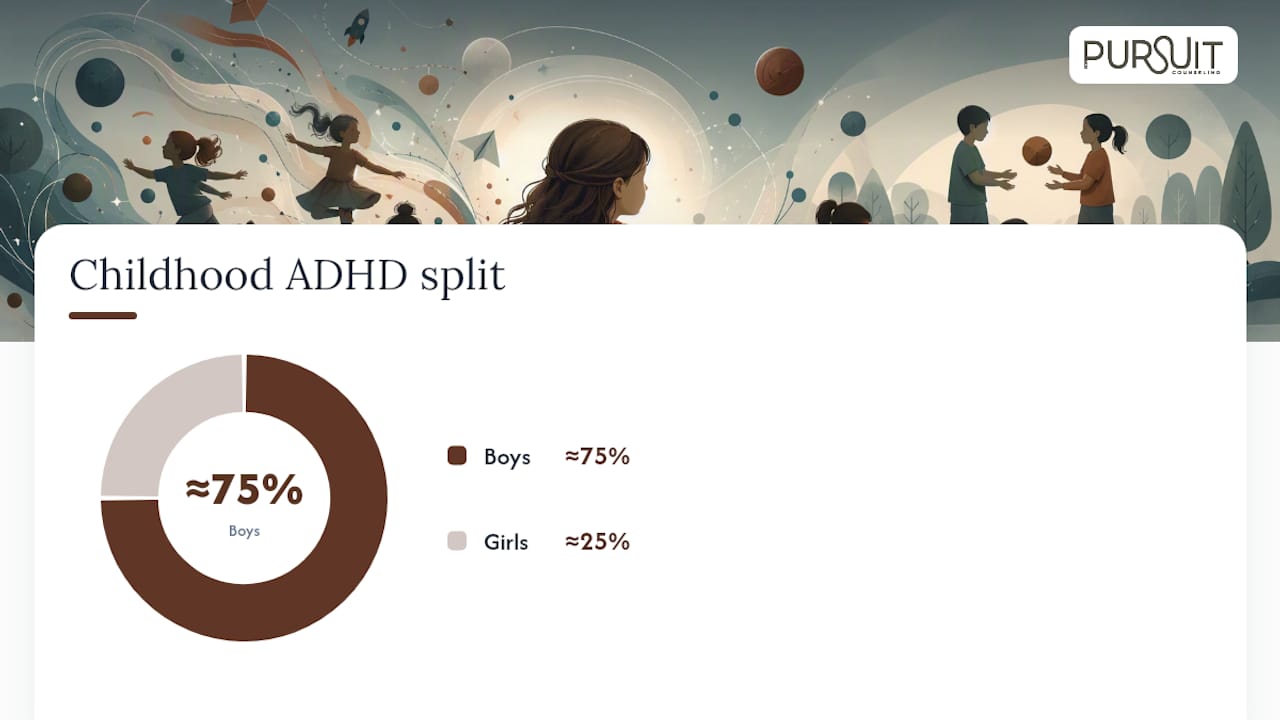
ADHD research and diagnostic criteria were built largely on studies of hyperactive young boys. That “male model” still shapes who get referred for testing, and boys are diagnosed in childhood at roughly three times the rate of girls. A quiet girl who daydreams and turns in her homework late doesn’t disrupt a classroom the way a boy climbing the bookshelves does, so nobody flags her.
Left unflagged, many women build what experts call master masking: elaborate compensatory systems of overwork, perfectionism, and color-coded planners that hide executive dysfunction until life simply asks for more than the system can hold.
That collapse tends to arrive at predictable turning points:
- The jump from structured high school to unstructured college life
- New motherhood, when sleep deprivation and constant demands overwhelm every old coping trick
- A promotion or career change that adds complexity faster than compensations can keep up
- Perimenopause, when hormonal shifts erode focus that masking used to manage
Anxiety and depression frequently ride alongside ADHD in women, and clinicians who treat only the mood symptoms can miss the attention disorder underneath entirely.
Pro Tip: If you’ve been treated for anxiety or depression for years but still struggle with focus and follow-through even when your mood improves, mention that gap explicitly to your provider. It’s one of the clearest signals that ADHD deserves its own evaluation.
How Is ADHD Diagnosed in Women?
There’s no blood test or brain scan for ADHD. Diagnosis rests on a structured clinical evaluation, and the process usually unfolds in a predictable sequence.
- DSM-5 criteria review. A clinician checks for a persistent pattern of inattentive and/or hyperactive-impulsive symptoms present before age 12, showing up in at least two settings (home, work, school), and causing real functional impairment, not just mild annoyance.
- Rating scales and screening tools. Standardized adult ADHD questionnaires help quantify symptom frequency and severity, and give the clinician a baseline to track against treatment response later.
- History gathering. Bring whatever you can: old report cards mentioning “doesn’t apply herself” or “talks too much,” a rough timeline of when struggles started, and specific workplace or parenting examples rather than vague impressions.
- Informant input when available. A parent, partner, or old friend who can speak to childhood or long-term patterns strengthens the picture considerably, since combining developmental history with informant reports and validated scales improves diagnostic accuracy in adult women specifically.
- Ruling out medical causes. Thyroid issues, sleep disorders, and other conditions can mimic ADHD symptoms, so a thorough evaluation checks for those before settling on a diagnosis.
A comprehensive assessment combines the clinical interview, that history, and the rating scales into one coherent picture rather than relying on any single piece alone.
Could It Be Something Else? Sorting ADHD From Look-Alike Conditions
ADHD rarely travels alone, and untangling it from its most common companions matters for getting the right treatment plan.
- Anxiety can produce racing thoughts and poor concentration that mimic ADHD, but anxiety-driven inattention usually centers on worry, while ADHD inattention persists even when nothing is stressing you.
- Depression slows focus and motivation, but it tends to arrive with a clear onset, while ADHD inattention has usually been there since childhood.
- Eating disorders and sleep problems co-occur with ADHD often enough that both deserve direct screening, not assumption.
- Perimenopause and menopause bring genuine brain fog from shifting estrogen levels, which can amplify existing ADHD symptoms or mimic them outright, sometimes warranting an endocrine evaluation alongside the psychiatric one.
Consensus guidance from BMC Psychiatry’s expert panel points to emotion dysregulation and social impairment as especially telling in women, and that dysregulation predicts real drops in life satisfaction when it goes unscreened. When symptoms span mood, focus, and hormonal timing all at once, an integrated evaluation covering all three domains beats treating each in isolation.
What Treatments Actually Help Women With ADHD?
Treatment for ADHD in women works best as a layered approach, not a single fix. Medication, therapy, and daily-life strategies each pull a different lever, and most women need more than one.
Medication remains the most researched option. Stimulants are the first-line choice for most adults, and nonstimulants are available for those who can’t tolerate them or have contraindications. Dosing and choice are individualized, and hormonal fluctuations across the menstrual cycle can affect how well a medication works, so this conversation belongs with a prescriber who treats adult women regularly, not a one-size-fits-all script.
Therapy and coaching address the parts medication doesn’t touch. CBT adapted for adult ADHD helps challenge the shame spirals that build up over years of missed deadlines. ADHD coaching and structured executive function skill-building work on the planning and prioritizing muscles directly.
Adjunctive supports are gaining attention, with cautious optimism. Neurofeedback is one option some clinics offer alongside core treatment, and consistent sleep hygiene, regular exercise, and nutrition support can measurably affect symptom severity even though they’re not a replacement for clinical care.
Daily strategies matter as much as anything in a prescription:
- Set timers for tasks that feel like they’ll “only take a minute”
- Use external reminders (alarms, sticky notes, shared calendars) instead of relying on memory
- Break large tasks into pieces small enough that starting doesn’t feel impossible
- Build financial safeguards, like autopay for bills, since impulsivity can hit budgets hard
- Redesign your environment so the default action is the right one (keys by the door, meds by the toothbrush)
Pro Tip: When trauma sits alongside ADHD, and it often does after years of being told you’re “not trying hard enough,” addressing both matters. Trauma-informed therapy like EMDR paired with ADHD-focused treatment tends to produce better outcomes than treating either alone.
When Should You Seek Help, and What Happens Next?
Consider an evaluation when these symptoms are affecting your job, your relationships, or your sense of safety, not just your mood on a hard day. The CDC’s ADHD guidance frames functional impairment, not symptom severity alone, as the threshold that matters most.
- Decide who to see. Psychiatrists can diagnose and prescribe medication. Psychologists and licensed counselors can diagnose and provide therapy. ADHD coaches don’t diagnose but help build daily systems once you have a plan.
- Search smart. Ask directly whether a provider has specific experience with adult women, not just childhood ADHD, and confirm whether telehealth is available if in-person visits are hard to fit in.
- Prepare your notes. Bring your symptom timeline, any old school records, and concrete workplace examples before the first appointment.
- Ask about logistics early. Confirm payment structure, whether the practice works with insurance or operates private-pay, and what a first session actually covers.
A Clinical Perspective on Female ADHD
Too many women spend a decade in therapy for “just anxiety” before anyone asks about attention. The Pursuit Counseling’s ADHD program treats ADHD as its own diagnosis worth investigating directly, alongside neurofeedback and, when trauma has compounded the picture, EMDR. The right move is rarely one intervention. It’s an honest, layered evaluation that treats the whole person, not just the symptom that showed up first.
— Adam
Ready to Get Evaluated? Here’s Where to Start
If you’ve read this far and recognized yourself in it, the next move is a real evaluation, not another year of workarounds. The Pursuit Counseling’s ADHD program is built specifically around how ADHD actually shows up in adult women, not the childhood-hyperactivity model most screening tools were designed around.

For women whose focus struggles trace back to a specific hard event or years of being dismissed, EMDR addresses the trauma layer that often compounds ADHD symptoms. And if brain-based training interests you, neurofeedback for ADHD is worth a conversation with your provider. Medication decisions always belong with a licensed prescriber who knows your full history, and The Pursuit Counseling’s team can help connect that piece to your broader care plan. The most direct next step is visiting the getting started page to book an intake and get a real answer instead of another guess.
Looking for a therapist or counselor in Fayetteville or Peachtree City, GA? The Pursuit Counseling provides personalized therapy, couples counseling, anxiety treatment, trauma therapy, EMDR, ADHD support, and neurofeedback Brain Mapping for adults, teens, couples, professionals, and families throughout Fayette County and South Atlanta. With a convenient office in Fayetteville, GA, near Peachtree City, Trilith, Tyrone, Senoia, and Newnan, our experienced counselors help clients improve mental health, strengthen relationships, manage stress, and pursue meaningful growth. Schedule a counseling consultation with The Pursuit Counseling today and find the right therapist for you in Fayetteville or Peachtree City, Georgia.
Where to Learn More
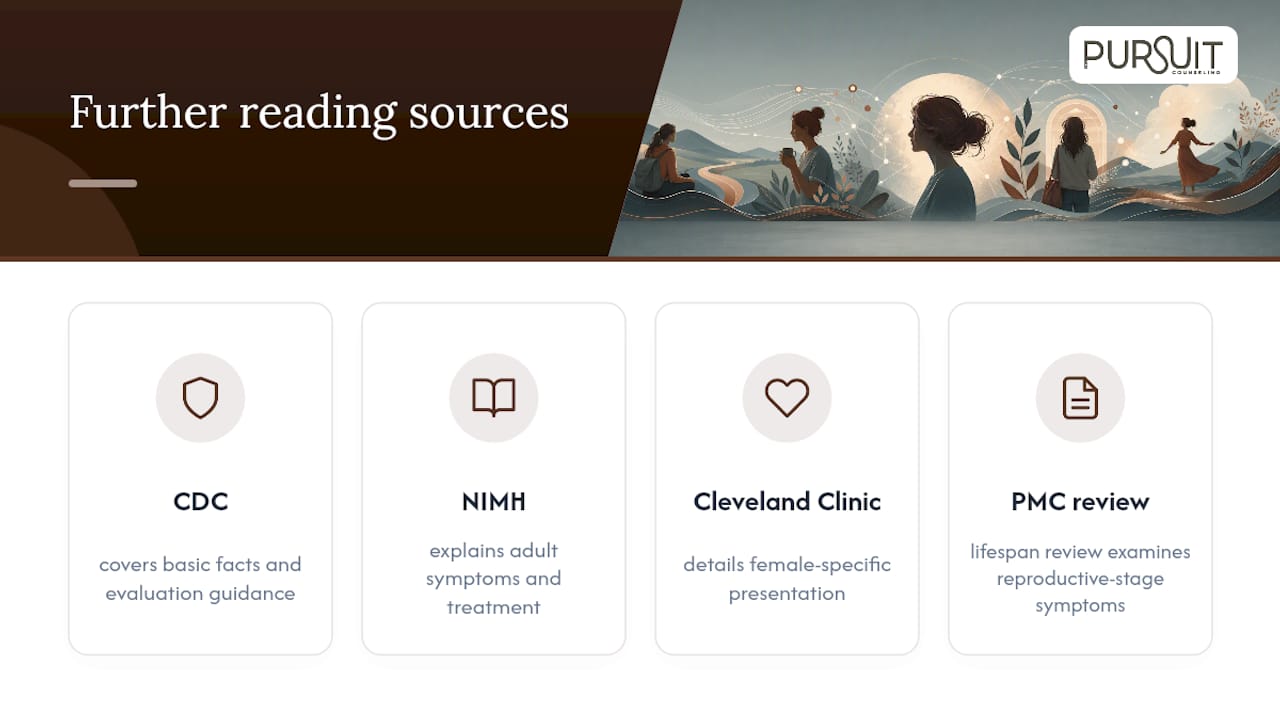
For deeper reading beyond this guide: the CDC covers basic facts and evaluation guidance, NIMH explains adult symptoms and treatment, Cleveland Clinic details female-specific presentation, and the PMC lifespan review examines symptoms across reproductive stages.
This article is general information, not a substitute for advice from a qualified doctor. Consult a qualified healthcare professional about your own circumstances before acting on anything here.
Sources
- ADHD in girls and women: key facts | Duke Department of Psychiatry & Behavioral Sciences
- ADHD symptoms in females of childhood, adolescent, reproductive and menopause period (PMC)
- ADHD in Women: Symptoms, Diagnosis & Treatment | Cleveland Clinic
- Attention-deficit/hyperactivity disorder — What you need to know | NIMH
FAQ
What are the characteristics of high-functioning ADHD in women?
High-functioning ADHD in women often hides behind strong performance at work paired with private chaos, like meeting every deadline but only by working until midnight, or holding a career together while home life falls apart. The outward success masks the same inattentive and executive-function struggles other women with ADHD experience.
What are common ADHD symptoms in women over 50?
Symptoms in women frequently intensify or become newly noticeable during perimenopause and menopause, when declining estrogen worsens focus, memory, and organization enough that old masking strategies stop working. This overlap with hormonal brain fog is why an evaluation at this life stage sometimes needs to consider both endocrine and psychiatric causes.
What are the effects of ADHD masking on women?
Masking lets women hide symptoms through overwork, perfectionism, and rigid compensatory systems, but it typically leads to burnout once life adds more demands than the system can absorb. Long-term masking is also linked to delayed diagnosis, since it convinces both the woman and the people around her that nothing is actually wrong.
What are the treatment options for ADHD symptoms in women?
Treatment usually combines individualized medication (stimulant or nonstimulant), therapy or coaching for executive function and emotional regulation, and daily strategies like timers and external reminders. Some clinics, including The Pursuit Counseling’s ADHD program, also offer adjunctive supports like neurofeedback alongside core treatment.
How is ADHD different from anxiety in women?
Anxiety-driven distraction usually centers on active worry, while ADHD-related inattention persists even in calm, low-stress moments and traces back to childhood rather than a specific onset. Because the two frequently co-occur, a careful evaluation is often needed to tell them apart.