
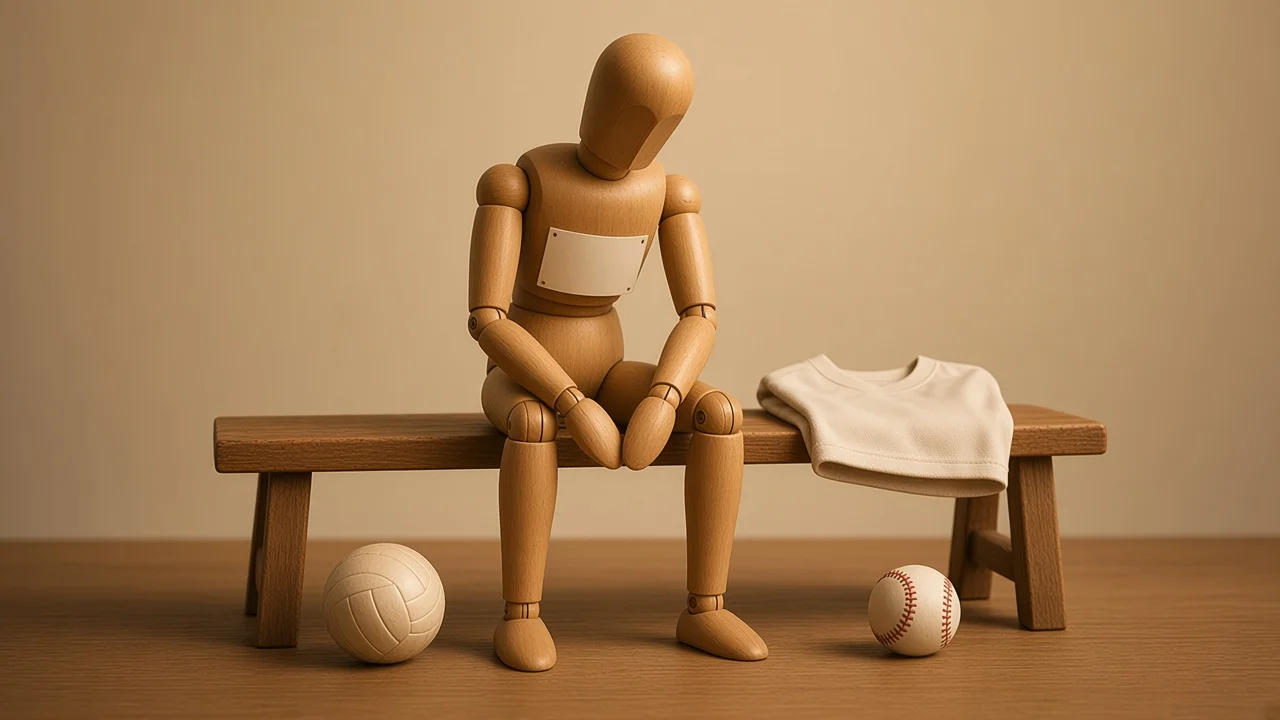
For a lot of high achievers, the hardest part of an injury isn’t the pain. It’s the 5:00 AM alarm that no longer has a reason to go off.
No long run. No brick workout. No WOD. No group text about who’s showing up.
If you’re a surgeon, attorney, founder, or executive who also trains for Ironman, HYROX, CrossFit, marathons, or ultras, you probably built your life around two arenas: the work and the training. Each one feeds the other. Then a torn calf, a stress fracture, a shoulder that won’t cooperate, or a doctor’s “no running for twelve weeks” knocks out one of them, and suddenly the other doesn’t feel as steady as you thought.
If you’ve found yourself thinking, Who am I if I can’t train?, you’re not being dramatic. You’re running into something real. Researchers call it athletic identity, and for adults who stack it on top of a high-achieving career, losing it can feel a lot like grief.
This article is education, not a diagnosis. If you’re struggling, a conversation with a licensed counselor is the best next step.
Key takeaways
- Athletic identity is how much of your sense of self is built around being an athlete. In high achievers, it often sits right next to a professional identity, and both run on the same fuel: achievement.
- For many professionals, training is the main way they manage stress. When an injury takes it away, the stress doesn’t leave. It just loses its exit.
- Identity loss after injury or stepping back from racing often looks like grief: irritability, restlessness, low mood, or working even harder to fill the gap.
- Counseling can help you grieve what changed, keep what still belongs to you, and build an identity that doesn’t depend on your next race or your next promotion.
The high achiever who is also an athlete
Here’s a pattern I see often: the people who push hardest at work are often the same people who push hardest at the gym and on the roads. You probably know a few of them. The anesthesiologist building toward another Ironman. The trial attorney who does CrossFit at 5:30 before court. The founder who signed up for a 50K because a marathon stopped feeling hard enough.
That’s not a coincidence. Endurance sports draw a high-earning, high-achieving crowd. A 2015 survey conducted for the World Triathlon Corporation, the company behind Ironman, found that the average household income of Ironman participants was $247,000, according to CNN’s 2025 reporting. Ironman told CNN it doesn’t have more recent figures. USA Triathlon has described its members as having a median household income of $134,000, with 67% viewed as business leaders in their communities.
The same traits that build a career build a training block: discipline, delayed gratification, a high pain tolerance, and a tendency to measure everything. I know those traits well. I played football, basketball, and baseball as a kid, spent years as a bodybuilder, came back to running near 40, and in 2025 ran three ultras in fifteen weeks.
When one identity holds up the other
Many high achievers have two load-bearing walls: who I am at work and who I am when I train. On a bad day at the hospital or the office, the long ride on Saturday proves you’re still capable. On a bad training day, the work wins remind you you’re still competent.
That system works, until one wall comes down. When an injury, a surgery, or a family change takes training away, a lot of people don’t just lose a hobby. They lose:
- Their main stress outlet. The thing that burned off the pressure of the job.
- Their sense of progress. Work progress is slow and political. Training progress is clear and measurable.
- Their community. The running group, the box, the tri club, the people who get it.
- Their structure. The early alarm, the plan, the reason to go to bed on time.
The International Olympic Committee’s consensus statement on mental health in elite athletes names injury and career transition as times when athletes are more vulnerable to mental health symptoms. You don’t have to be an Olympian for that to apply. A 45-year-old surgeon told to stop running for three months can feel the same floor drop out.
Injury takes away the main coping tool
This is the part high achievers often miss. If training is how you regulate stress, an injury doesn’t just remove a workout. It removes the pressure valve, right when you may need it most.
What often happens next:
- You work more, because work is the only place left to feel competent.
- You get shorter with your partner and kids, and you’re not sure why.
- You rush rehab, or train through pain, because sitting still feels unbearable.
- You drink more, scroll more, or sleep worse.
- You avoid the group, the gym, or race results because it hurts to watch.
About 16 miles into a 33.5-mile mountain ultra, I broke my toe on a rock. There was no quick way off the mountain, so I hobbled the last 18 miles and dropped from 15th place to 75th. What I remember most isn’t the pain. It’s the runners who slowed down and ran with me. The lesson I bring into the counseling room is simple: let someone see the limp.
Practical ways to rebuild identity during injury or a step back
1. Name what training gave you, specifically
Was it stress relief? A sense of progress? Time alone? Your friends? Each of those needs can be met in different ways while you heal, and some of them can be met right now.
2. Follow the medical plan like it’s a training plan
You already know how to execute a program. Treat rehab the same way, and let your physician and physical therapist set the load. We don’t diagnose or treat physical injuries, but we can help with the impatience and fear that make people rush back.
3. Find a temporary stress outlet
If the main valve is closed, open a smaller one. Walking, mobility work, breathing practice, or whatever movement your medical team approves. The goal is regulation, not performance.
4. Separate your worth from your output
High achievers often believe they’re only as good as their last case, their last quarter, or their last split. Notice how often you measure yourself, and practice the radical idea that you still matter in a week with no PRs.
5. Let your people in
Tell your partner what this injury is really costing you. Stay connected to your training group even if you can’t train. Isolation makes identity loss heavier.
6. Rewrite the story
I’ve had to practice this one myself. In 2026 I lined up for a 12-hour 50-mile race and dropped out after mile 31 because of cramping. The old story would file that under failure. It taught me so much that I still count it as a win.
Many athletes carry a story like “If I’m not training, I’m falling behind.” In narrative therapy, we look for the moments that don’t fit that story: the times you adapted, led, or kept going when it would have been easier to quit. Those moments are evidence of who you are beyond the box score.
How counseling helps high-achieving athletes
Counseling for athletes at The Pursuit is a confidential place to work through what changed and what comes next. It works alongside your physician, physical therapist, and coach. Depending on what you bring in, that may include space to grieve, narrative therapy, skills for restlessness and low mood, support with fear of re-injury, EMDR with me or Erika Stoll, LPC, when an injury or crash keeps replaying, and career and vocational transition work.
I can’t promise counseling will make the frustration disappear. What it can offer is a steady place to sort it out with someone who understands both the start line and the counseling room. Learn more about our counseling for athletes in Fayetteville, GA, our work with high performers, burnout, and identity, and, if the injury is putting strain on your relationship, our couples counseling.
Start with a free consult
In person in Fayetteville, GA. Our office is at 205 Brandywine Blvd, Suite A, a short drive from Peachtree City, Tyrone, Newnan, Senoia, and Sharpsburg. Early-morning appointments start at 7:00 AM, before clinic, court, or the office.
Telehealth anywhere in Georgia. When you can’t make the drive, secure online sessions are available for clients located in Georgia. We’re licensed in Georgia only.
Counseling at The Pursuit is for adults and teens 14 and up. Book a free 15-minute consult or call (404) 666-6721.
If you’re in crisis: if you’re having thoughts of suicide or feel unable to stay safe, call or text 988 (the Suicide & Crisis Lifeline) any time, day or night. If you’re in immediate danger, call 911.
Frequently asked questions
Is it normal to feel depressed when an injury stops my training?
Many athletes notice low mood, irritability, or restlessness when injury takes training away, especially when training was their main way to manage stress. It’s common and worth taking seriously. If it lasts more than a couple of weeks or affects work, sleep, or relationships, talk with a licensed counselor or your physician.
Do you work with athletes who aren’t competitive?
Yes. You don’t need to be on a podium. We work with adults who train seriously while juggling demanding careers, families, and recovery, from first-time marathoners to multi-time Ironman finishers.
Sources
- The amateur athletes spending thousands on endurance sport | CNN, December 2025
- USA Triathlon partnership announcement (member demographics) | Endurance Sportswire, March 2023
- Mental health in elite athletes: International Olympic Committee consensus statement (2019) | Reardon et al., British Journal of Sports Medicine
- 988 Suicide & Crisis Lifeline