


Your heart is pounding, your hands are numb, and a meeting is still going on around you. If you are having a panic attack at work, the most useful thing to know is that it will crest and pass, usually within minutes, and you are allowed to step out. This guide covers what to do in the next ten minutes, what to say to your manager, what the law says about your job, and what to do if it keeps happening.
We work with executives, pilots, founders, and parents who run on competence. Many of them have told us the same thing: the panic itself is bad, but the fear of it happening in front of colleagues is worse. We wrote this for you.
Key takeaways
- A panic attack is a sudden surge of fear that, according to NIMH, typically peaks within about 10 minutes. Leaving the room is a reasonable response, not a failure.
- In the moment, the goal is not to win an argument with your body. Reduce input, slow your exhale, and anchor to what you can see and touch.
- One attack does not equal a disorder, and an article cannot diagnose you. Repeated attacks, or dreading the next one, are a good reason to see a licensed clinician.
- You usually do not need to share your full medical history with your employer. The EEOC explains what you may need to disclose to request an accommodation.
- Pilots and other safety-sensitive professionals have specific rules to check before deciding anything. Treatment is not automatically a career-ender.
Table of Contents
- What a panic attack at work actually feels like
- What to do in the first ten minutes
- The one thing that makes panic worse
- Should you tell your manager?
- Can your job fire you for panic attacks?
- Should you quit your job because of panic attacks?
- If you fly, command, or hold a license
- When it is time to see a therapist
- Our perspective: panic is information, not a verdict
- Working with us in Fayetteville and online
- A practical plan for the next two weeks
- If you manage someone who has panic attacks
- FAQ
- Sources
What a panic attack at work actually feels like
Panic does not look the same for everyone. NIMH lists symptoms that include a racing or pounding heart, shortness of breath or choking sensations, sweating or chills, trembling, dizziness, nausea, and a sense of losing control or impending doom. At a desk, that can read as a heart attack, a stroke, or the moment you finally lose it in front of the team.
The cruelty of panic at work is the audience. You are expected to keep your face still while your body is sounding every alarm. So you freeze, you smile, you say you need water, and you walk to the bathroom with your pulse in your ears.
If this is you, a few things are worth naming:
- You are not weak. Many of the people who get these episodes are the ones who have carried the most for the longest.
- Panic often arrives after a long stretch of pushing through. The signal gets loud when the quieter ones have been ignored.
- A first attack can be frightening enough to send people to an emergency room. If you have chest pain, have never had an attack before, or something feels wrong in a way you cannot explain, get medically evaluated. Panic and cardiac problems can feel alike, and only a medical professional can tell them apart.
What to do in the first ten minutes
Think of the first ten minutes as a short, hard climb. You do not need to eliminate the feeling. You need to get through the crest without adding fuel.
Step 1: Get out of the stimulus
Say a simple line and go: “I need a minute, I’ll be right back.” You owe no explanation. Walk to a bathroom, a stairwell, an empty conference room, or your car. Fewer eyes and less noise lowers the load on your nervous system. The Stress First Aid model used in high-stress professions treats calm as often a matter of quieting the environment and settling the body rather than talking it through.
Step 2: Lengthen the exhale
Breathe in through your nose for about four counts and out slowly for about six. The point is a longer exhale than inhale. If counting makes you more anxious, skip the numbers and simply let the breath out slowly, as if fogging a window.
Step 3: Anchor to the room
Grounding works by pulling attention away from the catastrophic loop in your head and toward what is in front of you. The VA’s patient handout on panic describes the pattern of avoidance and fear that can build around places where escape feels hard, which is why practicing anchoring early matters. Try the classic version: name five things you see, four you can touch, three you hear, two you smell, one you taste. Press your feet into the floor. Hold something cold.

Do not try to reason with the thoughts. “I’m going to faint” and “everyone knows” are part of the attack. Let them be loud and keep your eyes on the room.
Step 4: Stay with it until it crests
The urge is to flee the building, call someone, and replay everything. If you can, stay put for the ten minutes. Sip water. When the wave drops, walk slowly back or take a short break outside.
Step 5: Do one small, manageable task
Afterward, you are likely drained. Pick one task that takes little judgment: filing, answering a simple email, tidying a document. Competence is part of recovery, and small tasks rebuild it.
The one thing that makes panic worse
Avoidance. If you skip the conference room, the commute, the presentation, or the open office after an attack, you feel relief. Relief teaches your brain that the avoidance was necessary, and the territory gets smaller. NIMH notes that people with panic disorder may significantly change their behavior to avoid the places or situations where attacks happened.
That does not mean forcing yourself into the worst situation immediately. It means being honest when your world is quietly shrinking, and getting support before it does.
Should you tell your manager?
There is no single right answer. A few honest considerations:
- You can say less than you think. “I had a medical episode and I’m okay” is a complete sentence for a one-time event.
- A trusted manager can be an asset. The Surgeon General’s framework and NIOSH’s work on workplace mental health point out that managers have a large influence on worker well-being, through workload, autonomy, and support.
- If it is recurring, a plan helps. A short script: “I’m working with a provider on a health issue. If I step out suddenly, it is not about the work in front of me. I’ll catch up on whatever I miss.”
- Sort out HR separately. If you need a formal accommodation, that process goes through HR, not casual conversation.
Many of our clients are leaders who hide struggle because everyone leans on them. If that is you, our piece on why high-achieving professionals hide their anxiety may feel familiar.
Can your job fire you for panic attacks?
This is one of the most common questions people ask, and the answer depends on facts. This is general information, not legal advice. For your specific situation, talk with an employment attorney or contact the EEOC.
The EEOC’s guidance says people with conditions such as depression, PTSD, and other mental health conditions are protected from discrimination and harassment at work, have privacy rights, and may be entitled to reasonable accommodations under the Americans with Disabilities Act. Examples of accommodations can include schedule changes for therapy, a quieter workspace, or remote work, as long as they do not impose undue hardship on the employer. Employers are not required to eliminate essential job duties.
A few practical points:
- Disclosure can be narrow. Generally the employer needs to know that you have a condition and how it affects your work, and may ask for documentation from your provider. You are not required to hand over your full history.
- Your provider can help. The EEOC publishes a page on the mental health provider’s role in an accommodation request, which is useful to share with your clinician.
- Employers can ask questions in limited circumstances. Medical inquiries must be job-related and consistent with business necessity.
- Coverage varies. The ADA applies to employers of a certain size, and leave rules such as the FMLA have their own eligibility requirements. Ask HR or an attorney whether they apply to you.
Should you quit your job because of panic attacks?
Usually not as a first move. Panic is a nervous system pattern, and it can follow you to the next job if the underlying load has not changed. But there are two different questions hiding here.
- Is the job creating the panic? Chronic overload, unpredictable schedules, a volatile boss, or a culture where you cannot slow down can all contribute. The CDC reports that serious psychological distress was higher among workers with uncertain conditions like shift work, unstable earnings, or little schedule flexibility.
- Is panic the thing that is bothering you, regardless of the job? If the attacks started in a calm period or show up in other places, the job may be the stage rather than the cause.
Before making a big decision from inside a spike, get a few sessions of support to separate the two. A decision made at the peak of dread rarely matches the one you would make at a steadier moment. If workload is a major piece, our page on counseling for burnout and workplace stress describes how we approach it.
If you fly, command, or hold a license
Pilots and others in safety-sensitive roles often avoid care because they fear the paperwork. That fear is understandable, and it can also keep a manageable problem untreated.
The FAA’s FAQ on therapy, psychotherapy, and counseling for pilots and air traffic controllers addresses when mental health care affects medical certification. Read it before you decide anything, and talk to an aviation medical examiner about your specifics. The FAA’s IMSAFE-style checklist also asks pilots to check for unusual stress before flying, which means taking yourself out of the cockpit on a bad day is part of good judgment, not a character flaw.
When it is time to see a therapist
An isolated attack during a brutal quarter is common. Consider professional help when:
- Attacks keep coming, or you spend your days dreading the next one.
- You are changing your routine to avoid triggers: skipping meetings, declining promotions, driving different routes.
- You are leaning on alcohol, sleep aids, or other substances to get through the day.
- Panic is bleeding into your sleep, your relationships, or your performance.
- You feel ashamed, and secrecy is taking more energy than the work itself.
NIMH describes cognitive behavioral therapy as a main evidence-based treatment for panic disorder, one that helps you change how you respond to the physical sensations of fear. A good clinician will also look at what sits underneath: chronic stress, unprocessed trauma, perfectionism, a body that has been running too hot for years.
A note on education versus assessment. This article is education. It cannot tell you whether you have panic disorder, generalized anxiety, a medical condition, or something else. That takes a licensed professional and, sometimes, a physician’s exam.
Our perspective: panic is information, not a verdict
We see a pattern in the people who come to us after a panic attack at work. They are rarely fragile. They are people who have held a lot, for a long time, without a place to set any of it down.
We think of panic the way endurance athletes think of the pain cave: a place you can learn to enter on purpose, with the right preparation, rather than one that ambushes you. The attack is loud, but it is carrying a message. Sometimes the message is about workload. Sometimes it is about something older that never got attention, and work is simply where the pressure finally found a crack.
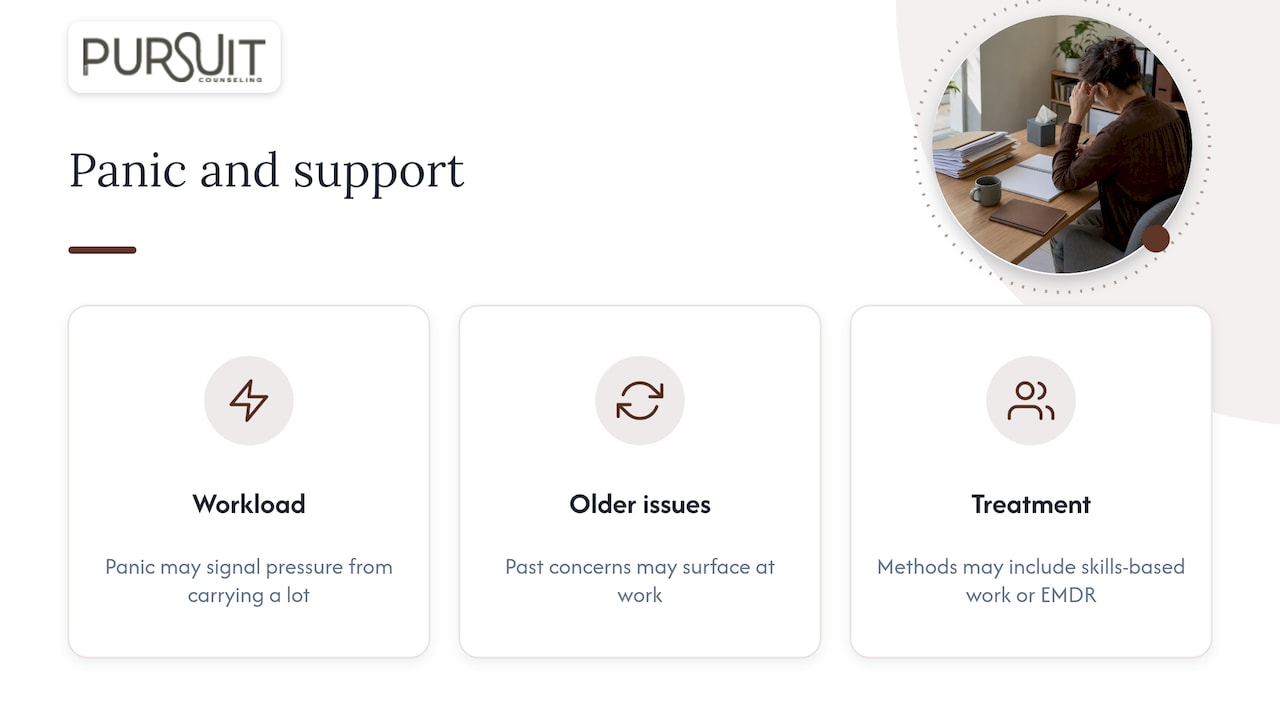
Our approach is collaborative. We do not hand you a script and send you off. We start by understanding how your life is structured, what you are protecting, and what the panic is costing you. Then we match the method to you, whether that is skills-based work for anxiety, EMDR for trauma that may be underneath, or something experiential. We do not promise outcomes, and we do not diagnose from a blog post. We promise to take you seriously.
If you are the person everyone leans on, you are allowed to be the one who gets support.
— Adam Glendye LPC, CPCS
Working with us in Fayetteville and online
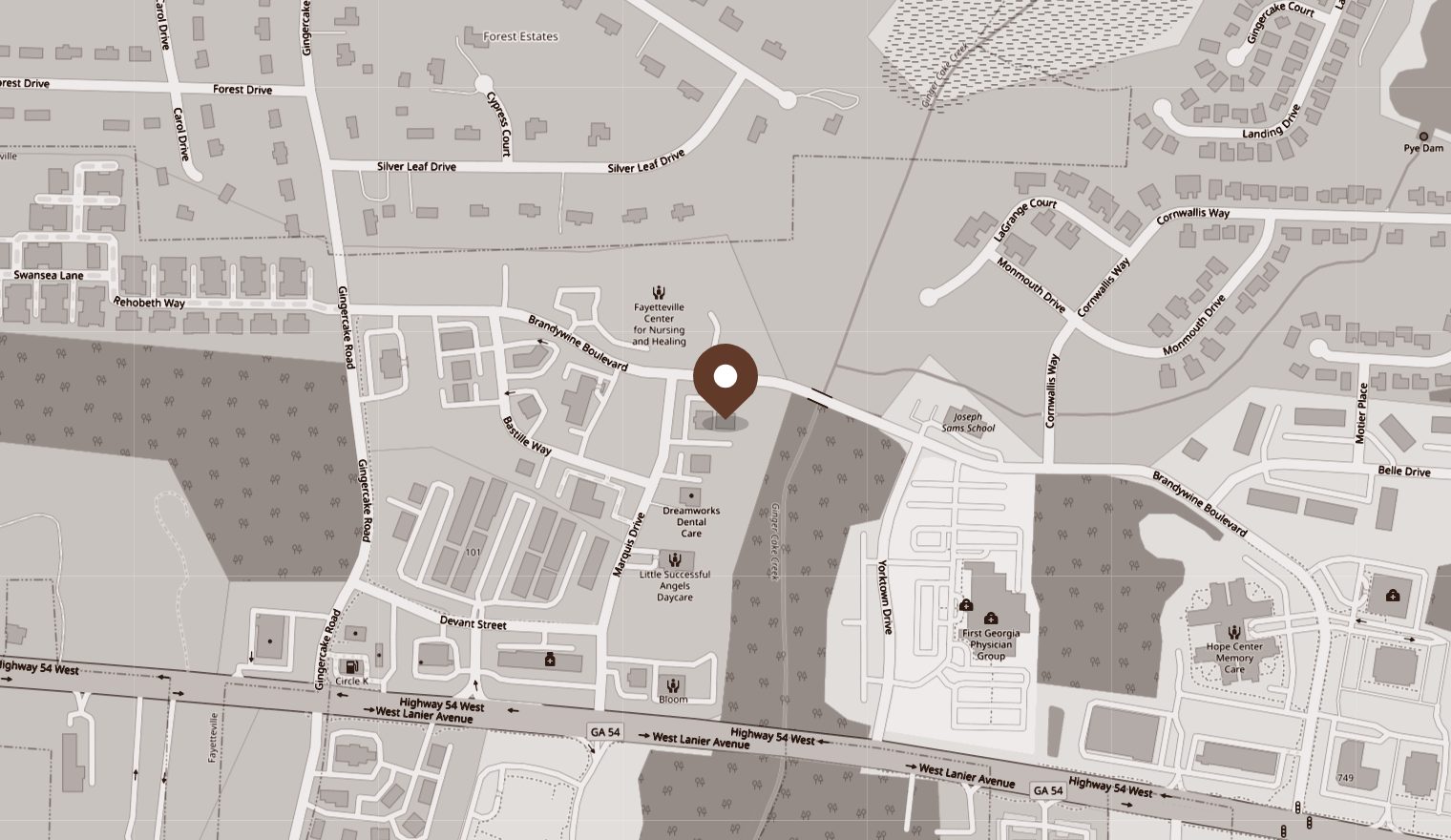
The Pursuit Counseling is based in Fayetteville, Georgia, and serves Peachtree City, Senoia, Brooks, Tyrone, and the South Atlanta area, with in-person and online sessions. Our panic attack treatment page for Fayette County explains how we work with it. You can also read about our anxiety and stress management therapy.
Our published rates on the services and specialties page are 125 USD per hour for anxiety therapy and 275 USD per hour for trauma therapy with EMDR. We are private-pay. If you want something more concentrated than weekly sessions, we also offer intensives.
A good first step is small: reach out through the site, tell us what is happening at work, and we will tell you honestly whether we are the right fit.
A practical plan for the next two weeks
If you had an attack this week, here is something doable:
- Write down the facts. When, where, what you were doing, what you had eaten and slept, what had been going on. Patterns show up quickly.
- Rehearse your exit line. Choose a sentence and use it.
- Pick a grounding practice and use it when you are calm. Skills you only try during panic rarely work. Practice during an ordinary commute.
- Schedule a medical check-up if you have not had one, especially if the symptoms involve your chest or heart.
- Book a consult with a clinician if attacks repeat or avoidance is creeping in.
- Protect sleep and reduce stimulants for a couple of weeks and notice what changes. Do not make big career decisions during this window.
If you are ever in crisis or thinking of harming yourself, call or text 988 for the Suicide & Crisis Lifeline, which NAMI Georgia describes as free, confidential, and available 24/7. If you are in immediate danger, call 911.
If you manage someone who has panic attacks
Quietly guide, do not crowd. Offer a private space, speak slowly, and do not demand explanations in the moment. Afterward, ask what would help and follow through on what is reasonable. Predictable workloads, flexibility, and supportive check-ins matter more than any single gesture. If you lead a team and want to build that culture, we run workshops for teams and leadership.
FAQ
Should I quit my job if it gives me panic attacks?
Usually not as a first step. Work on separating whether the job is driving the panic or simply where it shows up. A few sessions with a licensed therapist can clarify that before you make an irreversible decision. If the environment is truly harmful, leaving may be right, but plan it rather than flee from a spike.
What should I do when work gives me panic attacks?
Step out, lengthen your exhale, and anchor to what you can see and touch until the wave passes, which NIMH says typically takes about 10 minutes. Afterward, do one simple task and rest. If it happens more than once, book an evaluation with a clinician.
Can my job fire me for panic attacks?
In many cases, no: the ADA protects eligible employees from discrimination based on a mental health condition and may entitle you to reasonable accommodations. Protection depends on your employer’s size, your role, and the facts, so talk to HR, the EEOC, or an employment attorney about your situation.
How do I make panic attacks go away?
There is no switch, and we do not promise outcomes. In the moment, slow breathing and grounding help the wave pass. Over time, therapy such as CBT, which NIMH describes as a main treatment for panic disorder, helps change how your body and mind react to the sensations of fear.
Sources
- NIMH: Panic Disorder, What You Need to Know
- NIMH: Panic Disorder, The Symptoms
- EEOC: Depression, PTSD, and Other Mental Health Conditions in the Workplace
- EEOC: The Mental Health Provider’s Role in a Reasonable Accommodation Request
- EEOC: Medical Inquiries, Leave and Telework
- CDC NIOSH: Mental Health at Work
- CDC NCHS Data Brief 467
- VA: Panic Attacks patient handout
- VA: Stress First Aid toolkit
- FAA: Therapy, Psychotherapy, and Counseling FAQs for Pilots and ATCS
- FAA: Are You Fit to Fly?
- NAMI Georgia: Crisis Resources