

Three moves calm symptoms fastest: slow diaphragmatic breathing, a 30 to 60 second physical reset, and a keyword outline you can hold onstage. For anxiety that keeps returning, structured psychological treatments such as exposure-based CBT, virtual reality exposure, and acceptance-based exposure show the largest effects. Use the quick tactics for your next talk, and consider professional support when fear starts limiting your work, school, or relationships.
Key Takeaways
Structured exposure, skill practice, and quick grounding techniques effectively reduce public speaking anxiety and build confidence over time.
| Point | Details |
|---|---|
| Use quick tactics | Practice slow diaphragmatic breathing, physical resets, and keyword outlines to calm nerves before and during talks. |
| Gradual rehearsal | Staged practice, from writing scripts to presenting in larger groups, helps reduce anxiety gradually. |
| Evidence-backed therapy | Exposure-based treatments, including virtual reality and cognitive therapy, show large effects in lowering speech anxiety. |
| Build a personal plan | Combine techniques into a tailored strategy covering preparation, practice, and post-talk reflection. |
| We can support you | The Pursuit Counseling offers tailored therapy, workshops, and neurofeedback to help manage speech anxiety effectively. |
Table of Contents
- What can you do in the minutes before and during a talk?
- How should you rehearse so the fear loosens over time?
- What does the evidence say about therapy for public speaking anxiety?
- Quick research snapshot: which studies back these approaches?
- Can biofeedback or neurofeedback help with speaking anxiety?
- How do you challenge negative self-talk before a presentation?
- What role do mindfulness and meditation play in speaking anxiety?
- How can you manage the physical symptoms of anxiety?
- How do you build lasting confidence through gradual skill development?
- How do you build a personalized anxiety management plan?
- When should you try self-help, and when should you get support?
- How can we help if public speaking anxiety is holding you back?
- FAQ
- Sources
What can you do in the minutes before and during a talk?
If your heart is pounding and your mouth is dry, nothing is wrong with you. Your body is treating an audience like a threat. The goal is not to erase that response. You can try ways to steady yourself enough to think.
Start with your breath. Breathe in through your nose for four counts, letting your belly rise, then sigh out slowly through your mouth for six to eight. Repeat five or six times. Breathwork for anxiety has evidence-backed techniques worth practicing well before the day itself.
Then ground yourself with the 3-3-3 rule: name three things you see, three sounds you hear, and move three parts of your body. It pulls attention out of the spiral and into the room.
- Roll your shoulders, loosen your jaw, and pace a few steps before you walk up.
- Plant a friendly face in the audience and return to it when you lose your place.
- Picture the first minute going well, not the whole talk.
- Treat the buzz as readiness. Coaches commonly teach reframing arousal as excitement so nervous energy works for you.
- Build a keyword outline, test your tech, and check the room once so fewer surprises remain.
Pro Tip: Visit the speaking space early and say your opening line aloud from the spot where you will stand.
Campus communication centers teach the same sequence: prepare, practice standing, visit the room, plant a friendly face, and use breath and movement.
Across 2,253 participants, a meta-analysis of public speaking anxiety interventions found an overall effect size of g = 1.17. That is why we treat these quick tactics as a starting point, not the ceiling of what help can do.
How should you rehearse so the fear loosens over time?
Rehearsal works best when it is staged. Each step exposes you to a little more pressure than the last, which teaches your nervous system that the situation is survivable.
- Write out your full script once, so every idea is on the page.
- Reduce it to a keyword outline, one phrase per point.
- Stand and deliver it aloud to an empty room.
- Record yourself, watch it once, and note two things that worked before noting one to change.
- Present to one trusted person, then a small group.
- Add Q&A, a larger room, or a more formal setting.
Here is a gentle staged approach. Start with the first steps, then record and review, rehearse with a listener, add a small group and practice impromptu questions, and eventually simulate the real room, including the clothes and the timing.
- Ask reviewers for one strength and one adjustment, not a verdict.
- Separate feedback about the talk from feedback about your worth.
- Sleep consistently the week before, and avoid trying new caffeine on talk day.
- Build a pre-speech routine: breathing, movement, outline in hand.
University programs echo this staged approach, recommending impromptu Q&A practice, listing fears, and gradual exposure tasks. Short guides add practical basics like visiting the venue and getting sleep and food right.
If you are a leader who needs a reset between meetings, our protocol for leadership anxiety is built for that moment.
What does the evidence say about therapy for public speaking anxiety?
When fear persists despite good preparation, structured treatment has the strongest track record. Here is how the main options compare.
- In vivo exposure means practicing with real audiences. It reliably reduces avoidance, but arranging audiences can be logistically hard.
- Virtual reality exposure (VRET) simulates audiences in a controlled setting. A meta-analysis comparing VRET and in vivo exposure found large effects for both. In vivo was marginally stronger, while VRET offers advantages in cost, scalability, and acceptability.
- CBT targets beliefs that inflate what a mistake will cost you. Researchers describe this as lowering the estimated social cost of stumbling in front of others, which strengthens what exposure builds.
- Acceptance-based exposure focuses on willingness to act while anxious. In some trials it led to higher diagnostic remission at six-week follow-up than habituation-based approaches.
- Internet-delivered and guided self-help widen access when in-person care is out of reach.
A meta-analysis of 30 randomized trials with 1,355 participants found an overall effect of g = 0.74, rising to g = 1.11 at follow-up, with technology-assisted delivery comparable to face-to-face.
Exposure, in plain terms, is the deliberate, repeated approach of what you fear. The American Psychological Association explains that avoidance keeps anxiety alive and exposure breaks that cycle.
To choose, weigh severity, access, and your preference for live practice versus technology. Ask any clinician directly how they use exposure, because skill with these methods matters. Education like this is not an assessment, and only a clinician can evaluate your situation.
Quick research snapshot: which studies back these approaches?
Here is the evidence base in one place.
- A 2023 meta-analysis covering 2,253 participants reported an overall effect of g = 1.17 for exposure and cognitive interventions.
- A review of 30 trials reported g = 0.74 overall and effects holding across delivery modes, as noted above.
- VRET trials show reductions comparable to in vivo exposure, with symptom gains maintained at 12-month follow-up.
- An early open trial of CBT using virtual reality exposure showed self-report improvements that held at three months.
- An Internet-based self-help program was effective in self-administered and therapist-applied formats, with gains kept at one year.
Treatment effects in these reviews are large enough to take seriously, and they are not limited to one delivery format.
Can biofeedback or neurofeedback help with speaking anxiety?
Biofeedback gives you a live readout of your body, such as heart rate or breathing pace, so you can see how a technique changes your physiology. Neurofeedback uses brainwave measurements, though what that means for speaking anxiety is not established here. Both are best understood as complementary tools, not replacements for exposure and skills practice.
Think of it as a mirror. Watching your heart rate while you practice a technique may help you notice how your body responds. For people who feel betrayed by their own racing pulse, that experience can be steadying.
We offer a Neurofeedback Brain Map and describe how brain training may support calmer, more focused states in our neurofeedback and anxiety guide. We do not promise outcomes, and we pair this work with the skills above, because practicing in front of people is what changes avoidance.
If you are curious, ask a clinician what they would measure, how many sessions they expect, and how the work connects to your actual speaking goals. A good answer is specific, and it never skips the practice.
How do you challenge negative self-talk before a presentation?
The voice that says “everyone will see I’m a fraud” can feel like fact. It may be a prediction dressed up as a verdict. Learning to spot the pattern is the first move.
Common distortions in speaking anxiety include mind reading (“they’re bored”), catastrophizing (“one stumble ruins my career”), and all-or-nothing thinking (“if it isn’t flawless, it failed”). You may also notice a spotlight effect, the belief that every flicker of nerves is visible to the whole room.
Try a three-column note. In the first, write the thought exactly as it appears. In the second, name the distortion. In the third, write a more accurate version. “I’ll blank and everyone will judge me” becomes “I might lose my place, I have notes, and a pause reads as thoughtful to listeners.”
Then test it. Ask yourself what you would say to a colleague who gave you that thought. Recall a talk that went better than you feared. The CBT idea of lowering the estimated social cost of mistakes is simple: most audiences are far more forgiving than your inner critic.
This is hard to do alone when the thoughts are old and loud. Our anxiety and stress management therapy works on these patterns directly.
What role do mindfulness and meditation play in speaking anxiety?
Mindfulness will not make nerves disappear, and it is not meant to. It trains you to notice anxiety rising without being swept away by it, which is useful when your attention would otherwise fixate on your racing thoughts.
A short, regular practice may be easier to sustain than an occasional long one. Sit comfortably, follow your breath, and when your mind wanders to the upcoming talk, note “planning” or “worrying” and return to the breath. You are rehearsing the skill of coming back.
On the day, a mindful minute means feeling your feet on the floor, noticing your hands, and letting the sensations be there. This echoes the acceptance-based exposure idea: willingness to act despite anxiety, not the absence of it.
Be realistic about what is supported. One doctoral study testing a mindful prayer and breathing practice found no significant effect on self-reported speech anxiety, though it suggested some physiological shifts. Mindfulness can be a useful companion, but we would not lean on it alone for fear that limits your work.
How can you manage the physical symptoms of anxiety?
A pounding heart, shaking hands, and a tight throat are the parts of anxiety people dread most. They are also the most trainable.
For heart rate, you could try extending your exhale. Some people find that breathing out longer than they breathe in helps them feel calmer. Try breathing in gently and making each exhale longer before you speak.
For muscle tension, use progressive relaxation. Tense a muscle group briefly, such as your fists, shoulders, or jaw, then release. You can move from your hands to your face discreetly.
- Press your feet into the floor to steady shaky legs.
- Hold a pen or notes lightly instead of gripping them.
- Sip room-temperature water to ease a dry mouth.
- Keep your pace slower than feels natural, since nerves speed everything up.
Emerging work on embodied strategies such as posture, movement, and breathing treats these body-based tools as adjuncts to cognitive and exposure approaches. A university speech-anxiety guide similarly lists common symptoms and practical coping strategies for students and professionals.
How do you build lasting confidence through gradual skill development?
Confidence rarely arrives first. It tends to follow a pile of small, completed reps. The aim is to collect evidence that you can do this, one low-stakes opportunity at a time.
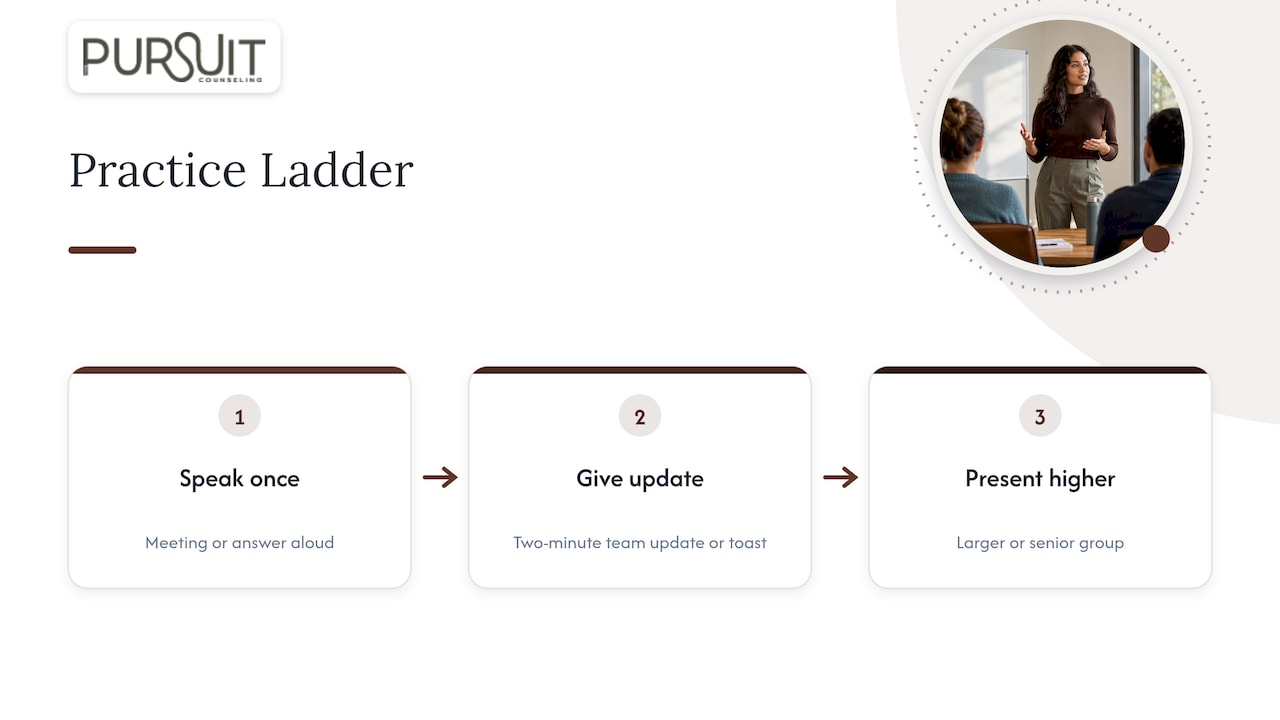
Build a ladder. At the bottom, speak up once in a meeting or answer a question aloud. In the middle, give a two-minute update to your team or lead a toast. At the top, present to a larger or more senior group. Move up only when the current rung feels manageable, not comfortable.
Keep a simple log after each rep: what you did, what you feared, what actually happened. Over weeks, the gap between the prediction and the result becomes hard to ignore.
Skills matter too. Practice pausing, varying your pace, and opening with a story instead of an apology. Join a group built for practice, or use a workplace session. We run organizational workshops for teams and leadership for groups who want to build these skills together.
Avoidance is the thing that keeps fear alive, so the most reliable habit is simply saying yes to one more small opportunity than feels easy. Progress is rarely a straight line, and a rough talk is data, not a verdict.
How do you build a personalized anxiety management plan?
No single technique carries the whole load. A plan stitches several together so you are not improvising when your pulse spikes.
Start with an honest baseline. Note when anxiety shows up (invitation, preparation, the first minute), what it feels like, and what you currently avoid. This is a self-reflection exercise, not a diagnosis.
Then assign tools to each phase:
- Weeks before: rehearsal ladder, cognitive log, five-minute daily mindfulness.
- Day before: sleep, a light run-through, outline check.
- Day of: extended-exhale breathing, 3-3-3 grounding, physical reset.
- During: friendly face, slower pace, permission to pause.
- After: a two-line debrief, one win and one adjustment.
Set a review point. After a few talks, ask whether your avoidance is shrinking and whether symptoms are easing. If you are still turning down opportunities, or the dread is spreading into sleep and daily life, that is a signal to add professional support to the plan rather than tighten your grip on it.
Write the plan down and keep it where you will see it. A plan you can read at a glance is a plan you will use.
When should you try self-help, and when should you get support?
Self-help is a reasonable first step for nerves that rise and then pass. Professional help makes sense when avoidance is steering your choices: you decline promotions, skip presentations, or dread a talk for weeks. It also makes sense when panic or physical symptoms do not ease with practice.
Therapy for this usually includes an assessment, skills such as breathing and cognitive reframes, graded exposure, practice between sessions, and regular progress checks. Clinicians can often offer brief intensives, online sessions, or multi-week plans around a busy schedule. Their skill with exposure methods matters, so ask about it.
Getting help is not an admission that you failed at coping. Plenty of capable, driven people carry this quietly.
— Adam Glendye LPC, CPCS
How can we help if public speaking anxiety is holding you back?
If you decide you want a clinician beside you, we would be glad to help. Our approach is collaborative and tailored, and we offer in-person and online sessions. Options include:
- Anxiety therapy and individual psychotherapy, starting at 5 per hour for anxiety therapy
- Intensives for people who prefer concentrated time to weekly visits
- Neurofeedback as a complementary tool
- Workshops for teams and leaders
Your first step is a consult. Tell us what you are avoiding, ask how we use exposure-based work, and ask whether online sessions fit your schedule. Visit our anxiety page to learn more, then reach out to book an assessment whenever you are ready.
This article is general information, not a substitute for advice from a qualified doctor. Consult a qualified healthcare professional about your own circumstances before acting on anything here.
FAQ
What is the 3-3-3 rule for anxiety?
The 3-3-3 rule is a quick grounding exercise. You name three things you can see, three sounds you can hear, and move three parts of your body. It shifts attention from racing thoughts to the present moment.
What is the root cause of public speaking anxiety?
There is rarely one cause. It often combines a fear of negative evaluation, beliefs that mistakes will be costly, and avoidance that keeps the fear alive. Cognitive approaches work on the estimated social cost of mistakes, while exposure reduces avoidance.
Does therapy work for public speaking anxiety?
Research suggests it often does. A meta-analysis of 30 randomized trials found a meaningful overall effect, with comparable results for technology-assisted and face-to-face delivery. Results vary by person, and a clinician can help you choose a fit.
Is it safe to take Xanax before public speaking?
That is a question for your prescriber, not a blog. Benzodiazepines carry real considerations, including sedation and dependence, and they do not teach your brain that speaking is survivable. Talk with a medical professional before using any medication, and ask about skills-based options too.
Sources
- Review and Analysis of Successful PSA Interventions: An Applied Perspective – PubMed
- Psychological Interventions for the Fear of Public Speaking: A Meta-Analysis – PMC
- Pmc
- An Internet-based self-help treatment for fear of public speaking: a controlled trial
- Cognitive behavioral therapy for public-speaking anxiety using virtual reality for exposure – PubMed