


When parenting disagreements erupt, protect the marriage first. Back each other up in front of the kids, pause the argument, and revisit privately soon after the conflict. If the same fight keeps returning, it’s usually pointing at something deeper than bedtime or screen time. Frequent escalation, contempt, or kids caught in the middle mean it’s time to get outside support.
TL;DR:
- Most parenting disagreements stem from deep-seated attachment wounds and are exacerbated by stressors like fatigue and financial pressure.
- Recognizing and interrupting communication patterns like criticism, defensiveness, contempt, and stonewalling can prevent conflicts from escalating.
- Establishing clear, pre-agreed rules, routines, and a household protocol helps resolve recurring disputes about discipline, schedules, and decisions faster.
- Pausing disputes in front of children, maintaining unity, and revisiting disagreements privately prevents undermining authority and protects kids’ sense of stability.
- Persistent, escalated conflicts or patterns of contempt typically require outside professional support, such as couples therapy or trauma-informed treatment.
Table of Contents
- Why Parenting Disagreements Marriage Conflicts Feel So Intense
- Common Flashpoints in Co-Parenting Disagreements and What Actually Fixes Them
- De-Escalating a Parenting Fight in Front of the Kids
- Building a Household Protocol So the Same Fight Doesn’t Keep Repeating
- Rebuilding Teamwork After a Parenting Fight
- When to Get Outside Help for Parenting Conflicts
- A Clinical View on Parenting Conflict and Marriage
- What Actually Moves the Needle in Parenting Conflicts
- Get Support for Parenting Conflicts That Keep Coming Back
- Useful Resources for Parenting Conflict and Co-Parenting
- Sources
- FAQ
Why Parenting Disagreements Marriage Conflicts Feel So Intense
Parenting disagreements rarely stay about the actual topic for long. You start arguing about a fifteen-minute bedtime extension and suddenly you’re relitigating how your own parents handled discipline thirty years ago. That’s not a coincidence. Attachment history shapes parenting instincts more than most couples realize. The way you were soothed, disciplined, or ignored as a child builds a blueprint your nervous system reaches for automatically, especially under pressure.
Add real-world stress into that mix and the fuse gets shorter. Sleep deprivation, financial strain, and an uneven division of household labor all lower the threshold for conflict. Parenting-related tension is consistently one of the most common reasons couples cite for seeking marriage counseling, and unresolved friction here tends to bleed into every other part of the relationship.
Psychologist John Gottman’s research identified four communication patterns that predict conflicts spiraling out of control rather than resolving: criticism, defensiveness, contempt, and stonewalling. Gottman’s studies on these communication patterns show they show up constantly in parenting disputes:
- Criticism sounds like “You never follow through on consequences.”
- Defensiveness answers with “Well, you’re not exactly consistent either.”
- Contempt adds an eye roll or a sarcastic jab that signals disrespect, not disagreement.
- Stonewalling shuts the conversation down entirely, leaving the real issue unresolved.
Recognizing these patterns in the moment is the first step toward interrupting them. Reframing the fight from “who’s right” to “what is this triggering in me” opens space for curiosity instead of defensiveness, and that shift alone changes the trajectory of most arguments before they start.
Common Flashpoints in Co-Parenting Disagreements and What Actually Fixes Them
Most marital arguments about kids cluster around a short list of recurring issues. The good news: each one responds to a specific, low-effort fix rather than a longer negotiation.
- Discipline. One parent enforces consequences, the other softens them. Agree in advance on three or four non-negotiable consequences for repeat behaviors, so neither of you is improvising in the heat of the moment.
- Screen time. Set a shared daily limit and use a visible timer the child can see, removing you both from the role of constant enforcer.
- Bedtime. Pick one bedtime and one routine, written down, so a tired parent can’t be talked into “just ten more minutes” without the other noticing.
- Food. Decide your household’s non-negotiables (no dessert before dinner, for example) and let smaller choices, like snack brands, go unregulated.
- Homework. Assign one parent as the point person for a given child’s homework routine to avoid duplicate, conflicting instructions.
- Schedules and logistics. Move pickups, appointments, and activity signups into a single shared calendar or app instead of texting details back and forth, which is where most scheduling fights start.
Common co-parenting disagreements cluster around exactly these categories: discipline, schedules, expenses, screen time, education, and medical decisions, and most get resolved faster once couples decide principles ahead of time rather than negotiating each instance live. Choose your values first, not your micro-rules. A couple who agrees “we prioritize consistency over convenience” will resolve ten future arguments before they happen, because the principle already answers the question.
De-Escalating a Parenting Fight in Front of the Kids
The moment your child watches you and your partner disagree about a decision, the goal shifts. It’s no longer about winning the point. It’s about protecting your child’s sense of stability and keeping your own credibility intact as a parenting team.
Start with the no-public-override rule: whatever your partner just told the kids stands, at least for now. You can revisit it privately later, but undermining them in front of the child teaches your kids that your household has two competing authorities instead of one team. A simple script works here: “I hear you, and your dad and I are going to talk about this after dinner.” That single sentence validates the child, signals unity, and buys you the time you need.
If your own reaction is heating up, use a twenty-minute pause before continuing the conversation. Physiological arousal, the flooded, heart-racing feeling that shows up mid-argument, takes roughly that long to subside on its own. Trying to reason through a decision while flooded almost always makes things worse, not better.
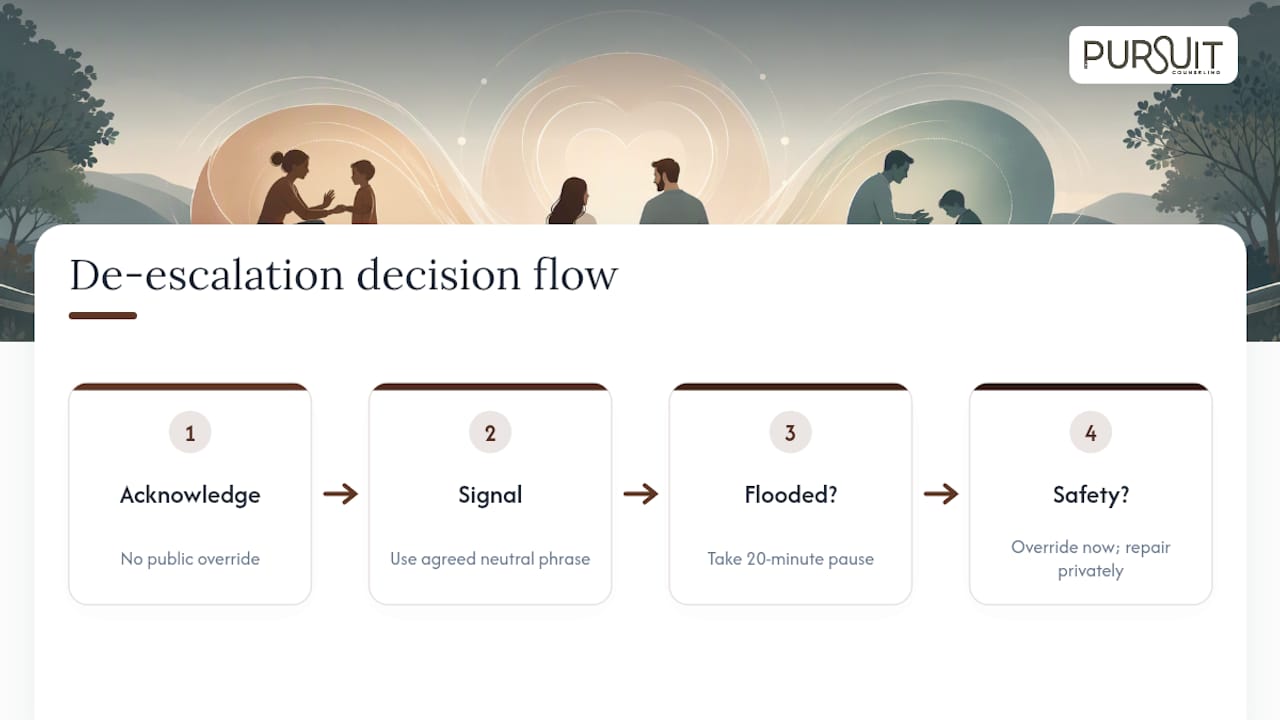
The one exception to the no-override rule is safety. If a child is about to get hurt, override immediately, then repair with your partner afterward, in private, without blame: “I overrode you because I was scared she’d fall. Can we talk about how to handle that next time?”
Pro Tip: Agree on a private, neutral word or phrase ahead of time, something like “let’s regroup,” that either of you can say mid-argument as a signal to pause without it sounding like a jab or an accusation in front of the kids.
Building a Household Protocol So the Same Fight Doesn’t Keep Repeating
Couples who stop having the same argument over and over usually have one thing in common: a repeatable process for handling disagreement, agreed on in a calm moment, not invented mid-crisis.
- Set a pause signal. Choose a word or gesture that either partner can use to stop an in-the-moment disagreement without it becoming its own fight.
- Set a revisit window. Commit to reopening the conversation within 24 to 72 hours, while the memory is fresh but the emotional charge has cooled.
- Use one written channel for logistics. A shared calendar or co-parenting app removes the ambiguity that turns simple scheduling into an argument. Ten essential co-parenting tools can help you find a system that actually gets used, since a single written record prevents the repeated, avoidable fights that come from relying on memory or scattered texts.
- Write down your non-negotiables. A short list, four or five items, of decisions that apply no matter which parent is present.
Within that structure, define roles clearly:
- One parent owns day-to-day calls for routine matters (what’s for dinner, whether homework happens before or after a snack).
- Both parents weigh in on major issues (school choice, medical decisions, significant discipline changes).
- Compromises get written down, even briefly, so neither of you re-litigates a decision you already made.
When you do reach a decision, present it to your kids as a team, using “we” language rather than naming who “won.” Children read united fronts as safety, even when they don’t like the actual answer.
Rebuilding Teamwork After a Parenting Fight
Repair matters more than avoidance. Couples who never disagree about parenting are rare; couples who repair well after disagreeing are the ones with lasting marriages. A short, specific apology does more work than a long explanation: “I shouldn’t have raised my voice. I was frustrated, not with you, but with how stuck we felt.” Follow it with a weekly ten-minute check-in where you review upcoming decisions before they become surprises.
Try this exercise together: each of you writes down the three parenting values that matter most, independently, then compare notes. Most couples find more overlap than they expected. Turn the shared values into a short “parenting mission statement,” even three sentences, and revisit it when a new disagreement surfaces. It becomes your tiebreaker instead of whoever argues louder.
- Name one thing your partner did well as a parent this week, out loud.
- Ask “what did that bring up for you?” instead of “why did you do that?” during a disagreement.
- Schedule the check-in on the calendar, not “whenever we get a chance,” which usually means never.
Pro Tip: If the same argument has resurfaced more than three times in the last two months without resolution, that’s a signal, not a coincidence. Entrenched patterns, contempt, or one parent consistently undermining the other in front of the kids usually need a third party to interrupt the cycle. Marriage counseling for parents of teenagers addresses exactly this kind of stuck pattern.
When to Get Outside Help for Parenting Conflicts
Some patterns don’t resolve with better scripts or a shared calendar. Watch for these signals:
- Arguments escalate almost every time, regardless of the topic.
- One or both of you shows contempt, sarcasm, eye-rolling, name-calling, rather than frustration.
- Your child has started taking sides or reporting on one parent to the other.
- Safety, substance use, or ongoing deception is part of the picture.
Couples therapy addresses the relational patterns underneath the parenting arguments, often improving communication broadly, not just around kids. A parenting coordinator focuses narrowly on implementing already-agreed custody or parenting plans, useful for separated or divorced couples with high conflict. Mediation helps couples negotiate specific disagreements, custody schedules, holiday splits, with a neutral third party, and can work alongside alternative dispute resolution options when legal steps become necessary.
Before a first session, bring a short written list of the recurring flashpoints and roughly how often they happen. It gives a therapist a faster, clearer starting point than trying to reconstruct the pattern from memory in the room.
A Clinical View on Parenting Conflict and Marriage
Parenting disagreements are rarely just logistical. Adam Glendye, LPC, CPCS, works from an attachment-informed lens that treats recurring conflict as a signal worth investigating rather than a problem to be argued into submission.
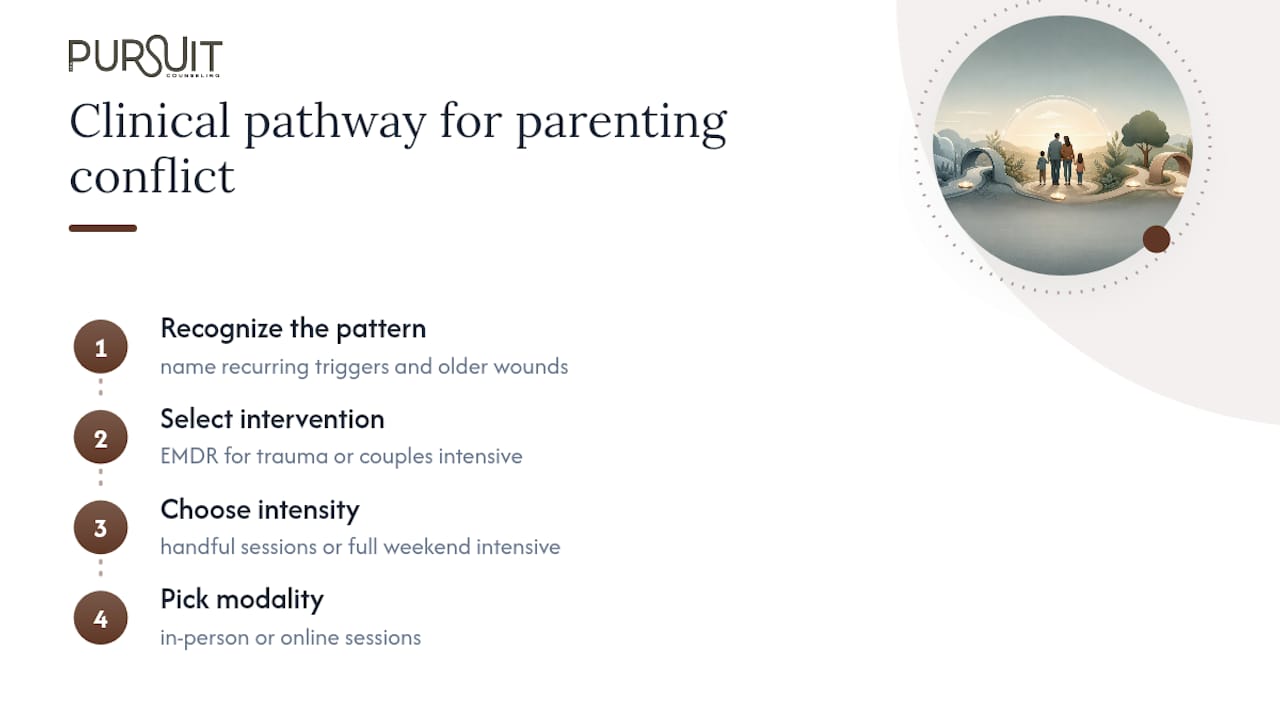
The Pursuit Counseling builds its work around that premise: parenting fights usually trace back to older wounds, mismatched stress responses, or unspoken expectations neither partner has said out loud. Evidence-based methods, including EMDR for unresolved trauma that’s fueling reactivity, and structured couples intensives for couples who need rapid, focused repair rather than months of weekly sessions, give couples more than talk therapy alone. Both in-person and online sessions mean a couple juggling two jobs and a school schedule can still get consistent support.
Every couple’s pattern looks a little different. Some need a handful of sessions to rebuild a shared decision-making process. Others need a full weekend intensive to interrupt years of the same fight. Either path starts with naming the pattern honestly, which is usually the hardest and most useful step.
What Actually Moves the Needle in Parenting Conflicts
Most advice on parenting disagreements treats them like a negotiation problem, solvable with better rules and clearer schedules. Rules help. But the couples who stop fighting long term are the ones who stop trying to win the argument and start asking what it’s protecting.
The conventional wisdom undersells how much of this is physiological. You cannot out logic a flooded nervous system, which is why the twenty-minute pause matters more than the perfect comeback. It also undersells contempt as a marker. A couple bickering about screen time is in a different situation than a couple where one partner rolls their eyes at the other’s parenting in front of the kids. The second pattern predicts real damage if it isn’t interrupted.
Prioritize the marriage, not the parenting scoreboard. A child raised by two parents who disagree respectfully and repair consistently does better than one raised by parents who never disagree but quietly resent each other. Get the repair skills first. Everything else gets easier from there.
— Adam Glendye LPC, CPCS
Get Support for Parenting Conflicts That Keep Coming Back
Rules and calendars fix logistics. They don’t fix the resentment that builds after the fifth fight about bedtime this month. That’s where working directly with a therapist trained in couples dynamics changes the outcome, because the goal isn’t winning the argument, it’s rebuilding the team.

The Pursuit Counseling offers couples therapy for partners who want to break a recurring parenting conflict pattern over time, and a couples intensive for those who need focused, concentrated repair without a months-long weekly commitment. For couples whose fights trace back to unresolved trauma fueling reactivity, EMDR therapy addresses what’s underneath the argument, not just the argument itself. Sessions may be available both in-person in certain locations and online, so a packed family schedule doesn’t have to be the reason you wait to seek help. If your parenting disagreements keep circling back to the same unresolved place, book a consultation and get a plan that actually interrupts the pattern.
Useful Resources for Parenting Conflict and Co-Parenting
- The NIH emotional wellness toolkit offers regulation exercises for managing stress reactions during conflict.
- Utah State University Extension’s guide to navigating parenting disagreements covers scheduled, structured conversation strategies.
- CoParentingGuide’s list of common co-parenting disagreements breaks down typical disputes and fixes.
- Findtreatment helps locate local or remote professional mental health support.
Sources
- 10 Common Co-Parenting Disagreements (and Fixes)
- How to Navigate Parenting Disagreements with Your Partner — Utah State University Extension
- NIH emotional wellness toolkit
- Gottman research on communication patterns (Four Horsemen) — DOI
FAQ
What is the 7-7-7 rule for marriage?
The 7-7-7 rule is an informal guideline some couples use to stay connected, involving regular date nights and getaways. It’s not a clinical framework but serves as a simple reminder to protect couple time amid parenting demands.
What should we do when we disagree about parenting decisions?
Back each other up in front of the kids first, then revisit the disagreement privately within 24 to 72 hours once emotions have settled. Deciding your household’s core values and non-negotiables in advance, rather than negotiating every instance live, resolves most recurring parenting disagreements faster than arguing case by case.
What is the 3-3-3 rule for marriage?
Definitions vary, but one common version suggests checking in with your relationship in three areas, emotional, physical, and logistical connection, roughly every three days, weeks, or months. It’s a loose self-check tool rather than an established clinical standard.
What is the 7-7-7 rule for parenting?
There’s no single, widely recognized clinical rule specific to parenting like the “7-7-7 rule”; if you’ve seen it used differently, it likely reflects an individual family’s own shorthand rather than a standard framework.
When should we consider couples therapy for parenting conflicts?
Consider professional support when the same argument resurfaces repeatedly, when contempt or sarcasm replaces frustration, or when a child starts taking sides. The Pursuit Counseling’s couples therapy and intensive programs are built for exactly this kind of stuck, escalating pattern.