


Yes, hormonal shifts genuinely change ADHD symptoms in women who menstruate, and the pattern is often predictable enough to track. Reviews of the research link drops in estrogen to worse attention, more forgetfulness, and shakier emotional control at specific points in the cycle, pregnancy, and midlife. The practical move isn’t to wait it out. It’s to log your cycle alongside your symptoms so you and your prescriber can see the windows coming before they hit.
TL;DR:
- ADHD symptoms in women often worsen during phases of estrogen decline, such as after ovulation, premenstrual days, postpartum, and perimenopause.
- Tracking cycle phases across two to three full cycles can help identify whether hormonal shifts reliably influence your attention, memory, and mood.
- Medication effectiveness may fluctuate with hormonal levels, and some women notice reduced stimulant response during premenstrual and luteal phases.
- Menstrual cycle-related symptom swings are common, but hormonal adjustments and targeted support can improve functioning during vulnerable windows.
- Differentiating between PMDD and premenstrual ADHD symptoms is crucial, as treatments differ; detailed tracking clarifies the pattern.
Table of Contents
- What ADHD Hormones in Women Actually Do to the Brain
- Menstrual Cycle Phases That Change ADHD Symptoms
- Puberty and Adolescence: When Hormones Reveal ADHD
- Pregnancy and Postpartum: What Changes and Why It’s Risky
- Perimenopause and Menopause: The Midlife Hormone Shift
- PMDD vs. Premenstrual Exacerbation of ADHD: Telling Them Apart
- How to Track Cycles, Adjust Medication, and Support Your Brain
- When to Seek Help and What to Bring to Your Appointment
- How The Pursuit Counseling Approaches Hormone-Related ADHD Care
- A Clinician’s Note on Starting Small
- Get Coordinated ADHD Support That Accounts for Your Hormones
- Sources
- FAQ
What ADHD Hormones in Women Actually Do to the Brain
Estrogen and dopamine are close collaborators, not distant acquaintances. Estrogen boosts dopamine synthesis and slows down how quickly the brain breaks dopamine back down, which means when estrogen is high, your brain has more dopamine circulating and holding onto it longer. For a woman with ADHD, whose dopamine system already runs on a thinner margin, that estrogen support can be the difference between a focused afternoon and a scattered one.
Progesterone tells a different story. Its metabolite, allopregnanolone, acts on GABA receptors, the brain’s primary braking system for anxiety and overstimulation. That’s calming in some doses, but the effect on cognition is not the same as estrogen’s. Where estrogen sharpens attention, progesterone’s byproducts tend to blunt it and shift mood, which is part of why the second half of the cycle can feel foggier even when nothing else in your life has changed.
The real trouble starts with the drop, not the level itself. A systematic review covering 11 studies found suggestive evidence that hormonal life stages, including puberty and the menstrual cycle, correlate with shifts in ADHD symptoms among women, though the researchers were candid about how thin and inconsistent the evidence base still is. What keeps showing up across smaller studies is a pattern tied to timing:
- Post-ovulation, when estrogen falls sharply after its mid-cycle peak
- The premenstrual window, when both estrogen and progesterone crash
- The days immediately after childbirth, when estrogen drops faster than at any other point in a woman’s life
- Perimenopause, when estrogen swings unpredictably before settling lower
Fast fact: ADHD affects millions of American adults and often persists well into adulthood, according to the National Institute of Mental Health. For women, that persistence rarely looks stable month to month. It looks like a rolling series of better and worse windows tied to where you are in your reproductive timeline.
A New Scientist feature on this topic captured what many women already sense intuitively: symptoms don’t drift randomly, they spike in sync with the hormone curve. That’s a useful reframe. If your focus disappears every month around the same days, that isn’t a personal failing. It’s biology doing something fairly specific, and specific problems can be tracked and addressed.
Menstrual Cycle Phases That Change ADHD Symptoms
Your cycle isn’t one flat state. It moves through distinct hormonal phases, and each one leaves a different fingerprint on attention, working memory, and emotional regulation.
- Early follicular (days 1 to 5, roughly): Estrogen and progesterone are both low as your period starts. Many women report a reset feeling here, sometimes mild fatigue, but cognition is often stable.
- Late follicular and ovulation (days 6 to 14): Estrogen climbs to its cycle peak. This is frequently the sharpest window for focus, verbal fluency, and motivation among women with ADHD.
- Early luteal (days 15 to 21): Progesterone rises while estrogen dips from its peak. Some women notice the first signs of slippage here, though it’s usually mild.
- Mid to late luteal and premenstrual (days 22 to 28): Both hormones fall, most sharply right before your period starts. This is where the evidence is most consistent.
A narrative review of 29 studies published between 2015 and 2025 found that women with ADHD most reliably reported worse attention and executive function during the mid-luteal and premenstrual phases. The same review documented cases where stimulant medication seemed to work less well during those same days, which is a significant finding for anyone who has felt like their prescription “stopped working” for no clear reason once a month.
Not every woman experiences the identical pattern. Some feel the dip starting right after ovulation, others don’t notice trouble until the two or three days before their period. What’s consistent is the direction: symptoms tend to worsen as estrogen falls, and they tend to ease again once a new cycle begins and estrogen starts climbing.
Here’s how to know if your cycle is a real driver of your symptoms rather than coincidence:
- Your focus, memory, or irritability follows a rough monthly rhythm you can predict within a few days.
- Medication that usually works well suddenly feels less effective at the same point each month.
- Emotional reactivity spikes alongside the cognitive symptoms, not separately from them.
- The pattern repeats across at least two or three cycles, not just once.
Pro Tip: Track your cycle day next to your symptoms for two full cycles before you draw any conclusions. One rough month could be stress, illness, or bad sleep. A repeating pattern across two or three cycles is data you can actually bring to a prescriber.
Apps built for cycle tracking work fine for this, but a simple notes app or paper log does the job too. What matters is consistency, not the tool.
Puberty and Adolescence: When Hormones Reveal ADHD
Puberty is often the moment ADHD stops being a quiet struggle and starts becoming impossible to ignore, especially for girls whose inattentive symptoms were previously written off as daydreaming or shyness. Rising and fluctuating estrogen and progesterone during adolescence reshape emotional regulation and cognitive load at the exact moment school demands, social pressure, and independence all increase.
Girls are diagnosed with ADHD later than boys on average, frequently because inattentive presentations are quieter and less disruptive in a classroom than hyperactive ones. Puberty tends to expose the gap. A girl who managed reasonably well in elementary school with external structure can start unraveling in middle school once hormonal volatility, social complexity, and academic demands stack on top of an already-strained attention system. Our breakdown of overlooked ADHD signs in women walks through exactly which life moments tend to surface symptoms that were previously masked.
For families and clinicians navigating this stage, a few things matter:
- Watch for new emotional intensity, not just distractibility. Puberty often makes the mood component of ADHD louder than the attention component.
- Menstrual onset can introduce cyclical symptom swings that weren’t present before periods started, which sometimes gets mistaken for a mood disorder alone.
- Medication doses that worked in childhood may need reassessment as body weight and hormonal exposure change.
- A single bad semester isn’t proof of anything. Ask whether the pattern has repeated across several months before assuming it’s permanent decline.
Clinicians who understand this hormonal layer are more likely to catch what’s actually happening instead of treating a teenage girl’s sudden struggles as purely behavioral or purely emotional.
Pregnancy and Postpartum: What Changes and Why It’s Risky
Pregnancy can be a strange reprieve for some women with ADHD. The steady rise of estriol, a form of estrogen produced by the placenta, supports dopamine activity in a way that a portion of women describe as genuinely improved focus during the second and third trimesters. That said, this observation is muddied by the fact that many women discontinue stimulant medication once they know they’re pregnant, out of caution around fetal exposure, so it’s hard to separate “hormones helped” from “quitting caffeine and stress helped” from “lower expectations during pregnancy helped.”
Postpartum is the far more dangerous window, and it deserves direct attention. Estrogen falls faster in the days after delivery than at any other point in a woman’s reproductive life, faster even than the premenstrual drop. That crash is strongly associated with postpartum depression risk, and for women with ADHD, it frequently coincides with a sharp resurgence or worsening of attention and executive-function symptoms right when a newborn demands the most sustained focus a person can offer.
A few things to have in place before delivery, not after:
- A plan with your obstetric provider and psychiatric prescriber about whether and when to resume ADHD medication postpartum.
- Clear communication if you’re breastfeeding, since medication safety profiles shift depending on feeding plans.
- A support system briefed on what postpartum symptom worsening can look like, so it’s caught early rather than dismissed as normal new-parent exhaustion.
- Screening for postpartum depression and anxiety on a schedule, not just if things feel obviously wrong.
Fast fact: ADHD’s persistence into adulthood is well documented by the NIMH, and reviews increasingly point to reproductive hormonal transitions as an underrecognized driver of symptom volatility across a woman’s lifespan. Postpartum is one of the clearest examples of that volatility in action.
If your medication routine gets disrupted during pregnancy, don’t assume you have to white-knuckle it until you wean. Coordinated planning between your prescriber and your obstetric team, made in advance rather than in crisis, changes how manageable this window feels.
Perimenopause and Menopause: The Midlife Hormone Shift
Perimenopause is not a gentle decline. It’s erratic, with estrogen spiking and crashing unpredictably for months or years before eventually settling into a consistently lower range at menopause. For a woman with ADHD, that instability tends to land directly on attention, working memory, and emotional regulation, often at the exact life stage when career demands and caregiving responsibilities peak.
Many women report a real spike in ADHD symptoms during their 40s and early 50s, and clinicians increasingly see new ADHD diagnoses emerge or intensify during this window. Some of that is genuine new-onset difficulty. Some of it is a lifetime of compensatory strategies finally buckling under declining estrogen support for dopamine function. Either way, dismissing midlife focus problems as “just menopause brain” without considering an underlying ADHD component does a disservice to a lot of women.
Treatment conversations at this stage usually touch on more than one system at once:
- Hormone replacement therapy, which some women find stabilizes mood and cognition, though it’s a decision made with an OB/GYN weighing personal risk factors.
- Sleep quality, since perimenopausal insomnia and night sweats compound attention problems independent of hormones themselves.
- Stimulant medication adjustments, since a dose that worked for fifteen years may need revisiting as the underlying hormonal terrain shifts.
- Coordinated care between a prescriber managing ADHD medication and a provider managing menopause symptoms, rather than each treating the other’s territory in isolation.
Pro Tip: If your ADHD medication suddenly feels less effective in your 40s and nothing else has changed, bring up perimenopause explicitly at your next appointment. It’s an easy variable to miss if no one asks about it directly.
PMDD vs. Premenstrual Exacerbation of ADHD: Telling Them Apart
These two conditions get confused constantly, and the confusion matters because the first-line treatments are different. Premenstrual dysphoric disorder (PMDD) is a distinct mood disorder marked by severe irritability, depression, or anxiety that emerges in the luteal phase and resolves within a few days of your period starting, confirmed through prospective daily tracking across at least two cycles. Premenstrual exacerbation (PME) of ADHD is not a separate condition. It’s your existing ADHD symptoms, inattention, impulsivity, executive dysfunction, getting measurably worse during the same premenstrual window without a new mood disorder layered on top.
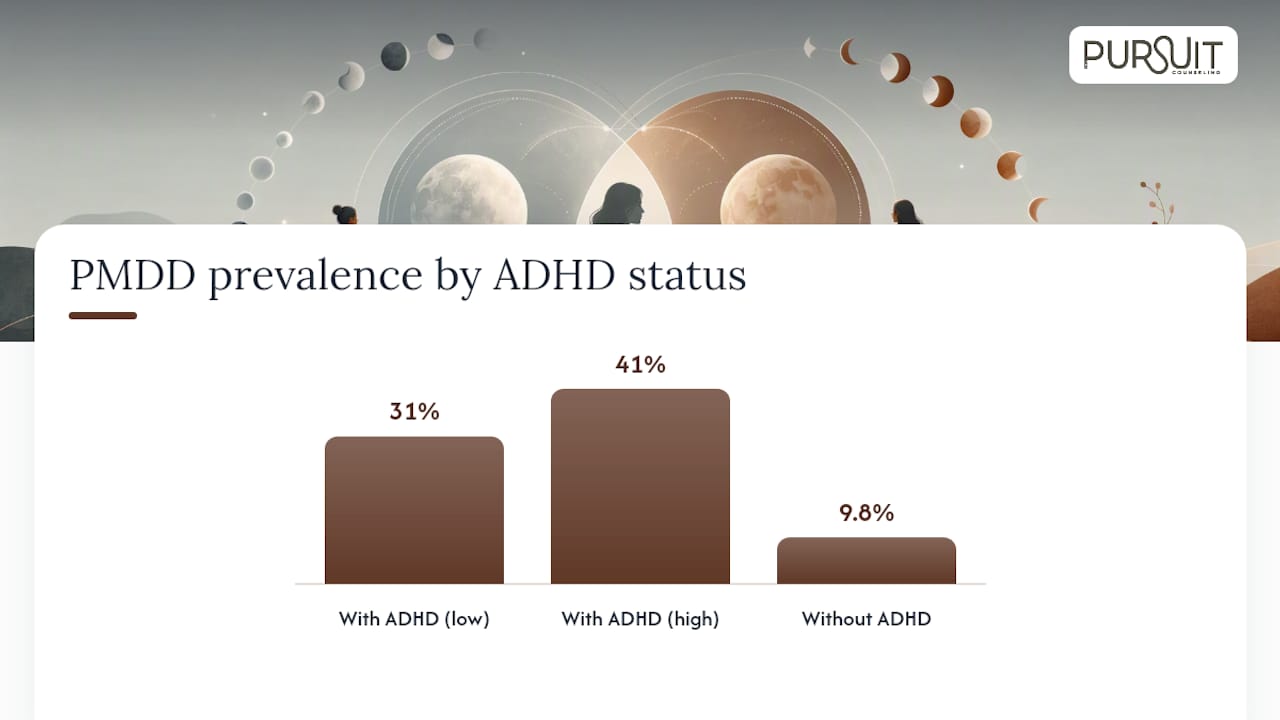
The overlap between the two is real and well documented. A cross-sectional survey study found provisional PMDD prevalence around 31 to 41 percent among women with ADHD, compared to roughly 9.8 percent in women without ADHD. That’s a substantial gap, and it means a lot of women with ADHD are dealing with PMDD, PME, or both stacked on top of each other, which makes accurate identification worth the effort.
Here’s how to start sorting it out:
- Track daily for two full cycles, rating mood, irritability, focus, and physical symptoms on a simple 1 to 10 scale, not just “good day, bad day.”
- Look at what worsens. If it’s primarily mood, anxiety, or despair that appears and vanishes with your period, that points toward PMDD. If it’s mainly focus, forgetfulness, and impulsivity intensifying, that points toward PME.
- Bring the log to your prescriber, since distinguishing PMDD from PME changes the treatment path, SSRIs or hormonal strategies often help PMDD, while PME tends to respond better to stimulant timing adjustments or added behavioral support.
Some women have both conditions running at once, which is exactly why the tracking step isn’t optional. Guessing wastes months that a clear log could save.
How to Track Cycles, Adjust Medication, and Support Your Brain
Good tracking doesn’t need to be complicated, but it does need to be consistent. Here’s what’s worth recording, ideally in the same place every day:
- Cycle day and bleeding status, plus ovulation test results if you use them
- Attention and focus, rated simply on a 1 to 10 scale
- Mood and irritability, rated separately from attention, since they don’t always move together
- Sleep hours and quality, since poor sleep amplifies almost every ADHD symptom regardless of hormones
- Medication taken and timing, including any missed doses
- Stress level, since a hard week at work can mimic or worsen a hormonal dip
After two or three cycles, patterns usually jump off the page. That’s the point where medication conversations become concrete instead of speculative.
Some clinicians have experimented with premenstrual stimulant dose increases, typically in the range of 30 to 50 percent above baseline for a handful of days, based on small case series and clinician-led reports showing symptomatic improvement. This is not a strategy to try on your own. These studies are small, uncontrolled, and involve real risks around side effects, sleep disruption, and cardiovascular strain if a dose climbs too high. Any adjustment like this belongs in a supervised trial with a prescriber who can monitor you closely.
Hormonal interventions carry the same caveat of mixed evidence. Combined oral contraceptives, continuous-cycle regimens that skip the placebo week, and hormone replacement therapy in midlife all show up in patient reports as helpful for some women and unhelpful or even symptom-worsening for others. There isn’t a universal answer here, which is exactly why this decision belongs in conversation with a prescriber who knows your full history, not a forum thread.
On the non-medication side, several supports genuinely help without carrying prescription risk:
- Neurofeedback, a form of brain training that helps regulate attention-related brainwave patterns, can complement medication and therapy rather than replace either. Our neurofeedback explainer covers how brain mapping identifies patterns worth targeting.
- Structured therapy, particularly approaches built for executive-function support, gives you scaffolding on the weeks medication alone isn’t enough.
- Sleep hygiene adjustments during your known symptomatic window, since protecting sleep during a premenstrual dip has an outsized payoff.
Pro Tip: Neurofeedback, medication, and counseling aren’t competing options; they’re different tools solving different parts of the same problem. Brain training can strengthen the underlying attention network while therapy builds coping strategy and medication handles acute symptom control.
When to Seek Help and What to Bring to Your Appointment
Some symptom patterns warrant a call now rather than waiting for your next scheduled visit. Reach out promptly if you notice functional decline that’s affecting your job or relationships, any thoughts of self-harm or suicide, or mood swings severe enough that you don’t feel like yourself for days at a stretch. Postpartum symptom spikes deserve the same urgency, since the depression risk in that window is real and treatable.
For a regular appointment, arrive with material that turns a vague conversation into a specific one:
- Two to three months of cycle and symptom logs, showing the day-by-day pattern rather than your memory of a rough week.
- A full medication history, including doses, timing, and anything that’s changed recently, even changes that seem unrelated.
- Sleep notes, since sleep and hormones interact constantly and a prescriber needs to know which is driving what.
Questions worth asking directly: whether a premenstrual dose adjustment makes sense for your specific pattern, how your contraception choice might be interacting with your symptoms, and if you’re planning a pregnancy, what a coordinated medication plan for pregnancy and postpartum would look like well before you need it. Getting these questions on the table early gives your prescriber room to actually plan instead of react.
How The Pursuit Counseling Approaches Hormone-Related ADHD Care
Hormone-linked ADHD symptoms rarely fit neatly into one specialty’s lane, which is exactly why coordinated care matters more than a single prescription adjustment. At The Pursuit Counseling, ADHD-focused therapy is built around understanding the full pattern of a client’s symptoms, not just the symptoms present in the room that day.
That starts with the same tracking principle covered throughout this guide: understanding when symptoms spike, what’s happening hormonally at that point, and how that intersects with sleep, stress, and existing coping strategies. From there, care typically involves:
- Collaborative planning around medication timing and dose questions, done in coordination with a client’s prescribing physician rather than in isolation
- Neurofeedback as a complementary layer of brain training, used alongside counseling and medication, not as a replacement for either
- Behavioral and executive-function-focused therapy that adjusts to a client’s actual cyclical pattern instead of applying one static plan year-round
- Support for major hormonal transitions specifically, including puberty-related symptom emergence, pregnancy planning, postpartum adjustment, and perimenopausal symptom shifts
The goal isn’t to hand a client a single intervention and hope it holds. It’s to build a plan flexible enough to move with a body that is, itself, constantly moving through hormonal phases. Readers can request this kind of coordinated approach directly, and it starts with the same first step recommended throughout this guide: bring a real symptom log, not just a general sense that something feels off.
A Clinician’s Note on Starting Small
If there’s one thing worth internalizing from all of this, it’s that you don’t need a grand plan to start making progress. Track two full cycles before you consider any medication change. That’s it. Two cycles gives you enough data to see whether a pattern is real, and it protects you from making a decision based on one unusually hard week that might have had nothing to do with hormones at all.
Small, coordinated experiments with a prescriber, a dose adjustment tried for one cycle and reassessed, a sleep intervention tested during a known symptomatic window, consistently produce clearer answers than sweeping changes made in frustration. This isn’t about grinding through it alone. If your symptoms are limiting your work, your relationships, or your sense of yourself, that’s a signal worth bringing to someone who can help you sort hormone-driven patterns from everything else competing for your attention.
You know your own rhythms better than any chart can predict. The work is turning that knowledge into something specific enough to act on.
— Adam Glendye LPC, CPCS
Get Coordinated ADHD Support That Accounts for Your Hormones
Most ADHD treatment plans are built around a single prescription, adjusted once and revisited only when something breaks. The Pursuit Counseling builds around your actual pattern instead, coordinating ADHD-focused therapy, neurofeedback brain training, and prescriber communication so your care moves with your cycle rather than ignoring it.

If you’re navigating symptom shifts tied to your period, a recent pregnancy, or perimenopause, an initial appointment starts with understanding your specific timeline, not a generic ADHD checklist. Sessions are available both in person and through secure teletherapy for clients who need flexible scheduling. The clinic’s approach to functional medicine and mental health counseling is built specifically for this kind of overlap between hormonal health and attention regulation. Bring two cycles of tracking data if you have it, and if you don’t yet, that’s a fine place to start. Reach out to schedule an initial consultation and begin building a plan that actually matches how your body works month to month.
Sources
The clinical picture on ADHD hormones in women is still developing, but a few sources stand out for depth. The systematic review of sex hormones and female ADHD offers the clearest overview of where evidence is strong versus where it’s still suggestive. The narrative review on menstrual cycle cognition is the most detailed resource on phase-by-phase symptom patterns and medication efficacy. For the PMDD and ADHD overlap specifically, the cross-sectional survey study provides the clearest prevalence data available. For an accessible, patient-facing explanation of the estrogen-dopamine connection, New Scientist’s reporting translates the clinical findings into plain language worth sharing with family members trying to understand what you’re experiencing.
This article is general information, not a substitute for advice from a qualified doctor. Consult a qualified healthcare professional about your own circumstances before acting on anything here.
- ADHD and Sex Hormones in Females: A Systematic Review
- Increased risk of provisional premenstrual dysphoric disorder (PMDD) among females with attention-deficit hyperactivity disorder (ADHD): cross-sectional survey study
- Why women with ADHD feel overwhelmingly ‘controlled’ by their hormones | New Scientist
FAQ
What are the symptoms of high-functioning ADHD in women?
High-functioning ADHD in women often looks like chronic overwhelm hidden behind competence: constant mental juggling, perfectionism used to compensate for disorganization, and exhaustion from masking symptoms that colleagues rarely see.
How can I manage ADHD symptoms without medication?
Non-medication strategies include structured sleep routines, neurofeedback brain training, executive-function-focused therapy, and cycle tracking to anticipate symptomatic windows rather than being caught off guard by them.
What are the common symptoms of ADHD in women?
Common patterns include inattention and forgetfulness rather than hyperactivity, emotional sensitivity, chronic disorganization, and symptoms that noticeably fluctuate with the menstrual cycle, pregnancy, or perimenopause.
How do I know if I have undiagnosed ADHD as an adult woman?
Signs include a lifelong pattern of underperforming relative to your effort, being labeled “scattered” or “spacey” since childhood, and noticing that stress, sleep loss, or hormonal shifts make focus dramatically worse than it is for peers.
Is PMDD the same as premenstrual worsening of ADHD?
No. PMDD is a distinct mood disorder involving severe irritability or depression tied to the luteal phase, while premenstrual exacerbation of ADHD is a worsening of existing attention and executive-function symptoms during the same window, and the two require different tracking and treatment approaches.