

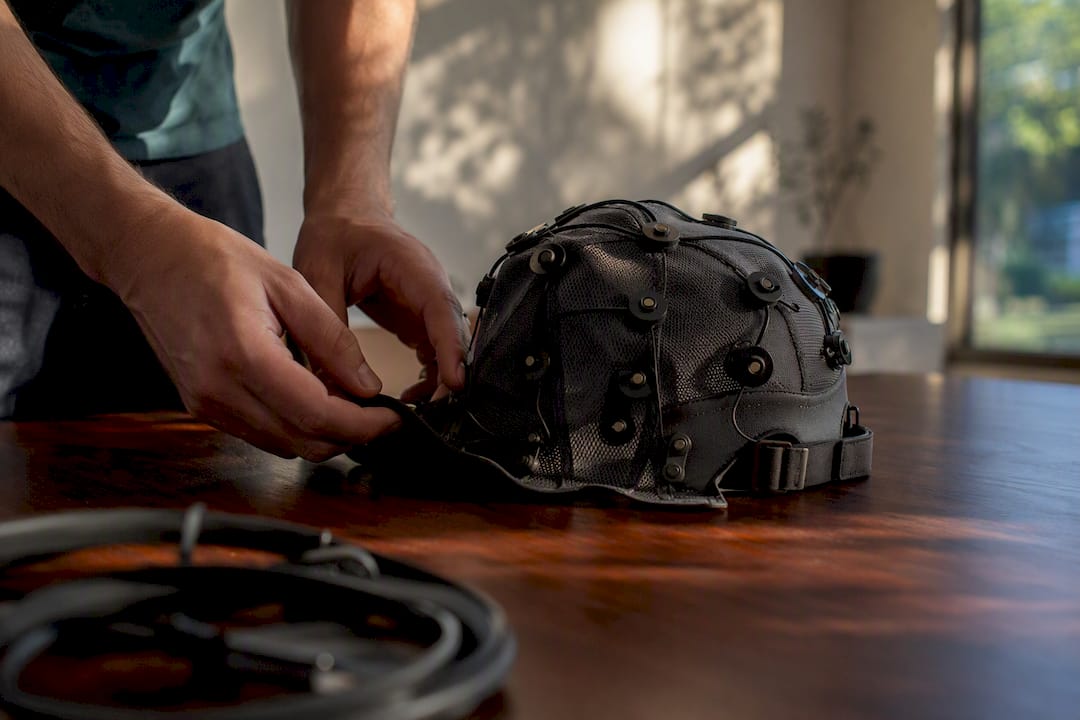
The evidence on neurofeedback for ADHD adults is genuinely mixed. Large blinded meta-analyses find no meaningful group-level benefit, while smaller personalized and open-label studies report real gains for some individuals. The honest answer: it’s not a proven cure, but it can be a reasonable adjunct, especially inside a personalized, multimodal plan built around your actual brain patterns and your actual life, which is exactly how The Pursuit Counseling approaches it.
TL;DR:
- Most rigorous research shows neurofeedback has little to no meaningful effect on adult ADHD symptoms at the group level, with an effect size near zero.
- Personalized protocols based on individual brainwave mapping may offer some benefits, particularly in processing speed, but evidence remains limited and outcomes vary.
- Successful neurofeedback treatment depends heavily on a person’s ability to learn self-regulation skills, which is more strongly linked to long-term gains than session count alone.
- Neurofeedback is best used as an adjunct to other treatments like medication or therapy, not as a replacement for first-line pharmacological approaches.
- Proper assessment, including a baseline qEEG and clear protocol explanation, is essential before starting, as unprofessional or unfounded claims can lead to ineffective or placebo treatments.
Table of Contents
- What the Research Says About Neurofeedback Effectiveness for Adults
- How Neurofeedback Trains Your Brain: TBR, SCP, and SMR Explained
- What Adult-Specific Clinical Trials Actually Found
- Who Is Most Likely to Benefit From Neurofeedback
- Sessions, Cost, Safety, and How It Compares to Medication
- Questions to Ask Before Choosing a Neurofeedback Provider
- How a Personalized Program Actually Works in Practice
- Neurofeedback at The Pursuit Counseling: What a First Consult Looks Like
- Sources
- FAQ
What the Research Says About Neurofeedback Effectiveness for Adults
Here’s the tension you need to sit with before you spend a dollar on this treatment: the biggest, most rigorous study we have says neurofeedback doesn’t move the needle much. Smaller, more personalized studies say otherwise. Both can be true at the same time, and understanding why is the whole game.
The most cited word on ADHD neurofeedback effectiveness comes from a meta-analysis of 38 randomized controlled trials covering 2,472 participants. When researchers restricted their analysis to “probably blinded” outcomes, meaning the person rating symptoms didn’t know who received real neurofeedback versus a sham version, the effect essentially disappeared: a standardized mean difference of 0.04, with a 95% confidence interval running from negative 0.10 to 0.18. That confidence interval matters more than the headline number. It means the true effect could be slightly negative, could be modestly positive, or could be nothing at all. Statistically, the study can’t rule out “this treatment does nothing.”
A 2024 analysis out of the University of Southampton reached the same conclusion independently, reporting an identical SMD of 0.04 (95% CI, −0.10 to 0.18). Two separate research teams landing on the same narrow band of near-zero effect is not a coincidence you can wave away.
So why do so many clinics and patients report improvement? A few structural problems in the evidence base explain the gap:
- Blinding is nearly impossible to do well. Patients often sense whether they’re getting real-time brainwave feedback or a fake signal, which inflates self-reported improvement in unblinded trials.
- Adult sample sizes stay small. Most rigorous trials were built around children and adolescents; adult-specific RCTs number in the dozens of participants, not hundreds.
- Protocols vary wildly between studies. One trial’s “neurofeedback” might be TBR training three times a week for 12 weeks; another’s might be SCP training twice weekly for 20 weeks. Pooling these into one meta-analysis effect size flattens real differences.
- Personalized and multimodal studies get lumped in with generic protocols, even though personalized qEEG-informed approaches report different outcomes than one-size-fits-all training.
Not every signal in the data is null. One of the more consistent findings across RCT analyses is an improvement in processing speed, a specific neuropsychological gain that shows up more reliably than broad symptom reduction. The clinical meaning of that isolated gain, whether it translates into someone actually finishing reports faster or losing their keys less often, remains unclear. It’s a real effect with an uncertain payoff, which is a fair summary of where this field sits overall.
The takeaway that matters for you: if a provider tells you neurofeedback is a proven, guaranteed fix for adult ADHD, that claim outruns the data. If a provider tells you it’s worthless and you should never consider it, that claim also outruns the data. The honest middle ground is where the personalized-protocol section below picks up.
How Neurofeedback Trains Your Brain: TBR, SCP, and SMR Explained
Neurofeedback works on a simple mechanical idea: operant conditioning applied to your own brainwaves. Electrodes on your scalp read your EEG activity in real time, a computer translates specific frequency patterns into a game, sound, or video that plays smoothly when your brain hits the target pattern and stutters when it doesn’t, and over dozens of sessions your brain learns, through trial and reward, to produce more of the pattern associated with focus and less of the pattern associated with drift.
That’s the loop. The protocol determines what pattern you’re training toward, and three approaches dominate ADHD-focused neurofeedback:
- Theta/beta ratio (TBR) training targets the ratio between slow theta waves, associated with drowsy, unfocused mental states, and faster beta waves, associated with alert engagement. Many adults with ADHD show elevated theta relative to beta, so TBR protocols reward the brain for shifting that balance. Sessions typically involve watching a screen where a video plays clearly only when your theta/beta ratio drops.
- Slow cortical potentials (SCP) training targets very slow shifts in cortical electrical activity linked to the brain’s readiness to act. You learn, through feedback like a moving cursor or rising bar, to voluntarily shift these potentials in a direction associated with better self-regulation and sustained attention. SCP protocols were the basis of the first controlled adult study, discussed in the next section.
- Sensorimotor rhythm (SMR) training targets a frequency band associated with calm, physically still alertness. It’s often used when impulsivity or motor restlessness is the dominant complaint rather than pure inattention.
qEEG-informed personalization changes the starting point. Instead of applying a generic TBR protocol to everyone, a clinician maps your individual brainwave profile against normative databases first, then designs a protocol around your specific deviations. That step matters because personalization appears to increase the signal-to-noise ratio for training, which may explain why some open-label, personalized programs report better outcomes than generic-protocol trials.
A less common cousin worth knowing about: fMRI-based neurofeedback, which trains blood-flow patterns in specific brain regions rather than surface EEG activity. It’s used mostly in research settings because of cost and access barriers, not in typical outpatient adult ADHD care.
Pro Tip: Ask any provider which specific protocol they’re recommending and why, based on your own qEEG results, not a generic ADHD template. “We do neurofeedback for ADHD” is not an answer. “Your theta/beta ratio is elevated in your frontal regions, so we’re starting with TBR training there” is.
What Adult-Specific Clinical Trials Actually Found
Most neurofeedback research was built on children. If you’re an adult trying to decide whether this treatment is worth your time and money, you deserve to know that the adult evidence base is thinner and younger than the child literature, and it tells a somewhat different story.
The first controlled trial of SCP neurofeedback in adults enrolled 24 participants through 30 training sessions. The topline result showed medium-to-large pre-post effects on symptom scales, but the more interesting finding was a split within the group itself: participants who successfully learned to self-regulate their slow cortical potentials showed substantially larger, more sustained gains at six-month follow-up than those who didn’t learn the skill. That distinction between “learners” and “non-learners” is one of the more useful concepts in this entire field, because it suggests the treatment’s ceiling depends heavily on whether your brain picks up the skill at all, not just on how many sessions you sit through.
A broader 2025 systematic review of adult EEG neurofeedback studies pulled together seven studies, three randomized and four non-randomized, covering 390 adults total, and the pattern held: naturalistic and personalized studies reported large symptom reductions, while the randomized trials showed small or non-significant effects compared to control conditions. The review’s own conclusion was blunt about limitations: small samples, inconsistent protocols, and real heterogeneity in how “improvement” was measured across studies.
A few things stand out from the adult-specific data:
- Large, well-powered adult RCTs remain scarce. Most of what exists involves samples in the dozens, not the hundreds.
- Open-label and personalized studies consistently outperform blinded RCTs on effect size, a gap that likely reflects both placebo response and genuine benefits of tailored protocols.
- The learner/non-learner distinction from the SCP trial suggests that assessing your capacity to self-regulate early in treatment could predict whether continuing makes sense.
- Follow-up data, where it exists, tends to favor those who demonstrated actual skill acquisition during training, not just those who attended the most sessions.
None of this settles the debate. It does tell you that if you’re evaluating adult ADHD neurofeedback therapy, the child-focused headlines you’ll find elsewhere online aren’t fully transferable to your situation.
Who Is Most Likely to Benefit From Neurofeedback
Not every adult with ADHD is an equally good candidate for neurofeedback, and any clinic that tells you otherwise is glossing over what the research actually shows about who responds.
A few characteristics tend to predict better outcomes. Adults who show a demonstrable, measurable EEG deviation, an elevated theta/beta ratio, atypical SCP regulation, and so on, going into treatment have something concrete to train toward, unlike someone whose baseline qEEG looks unremarkable. Motivation and consistency matter enormously, since the SCP trial’s learner/non-learner split shows the skill has to actually be acquired to produce durable benefit. The capacity to commit to dozens of sessions over several months, without dropping off halfway through, separates people who see gains from people who don’t. And adults who’ve tried medication and found it partially effective, poorly tolerated, or limited by side effects often make the most sense as candidates for adding neurofeedback rather than replacing an already-working treatment.
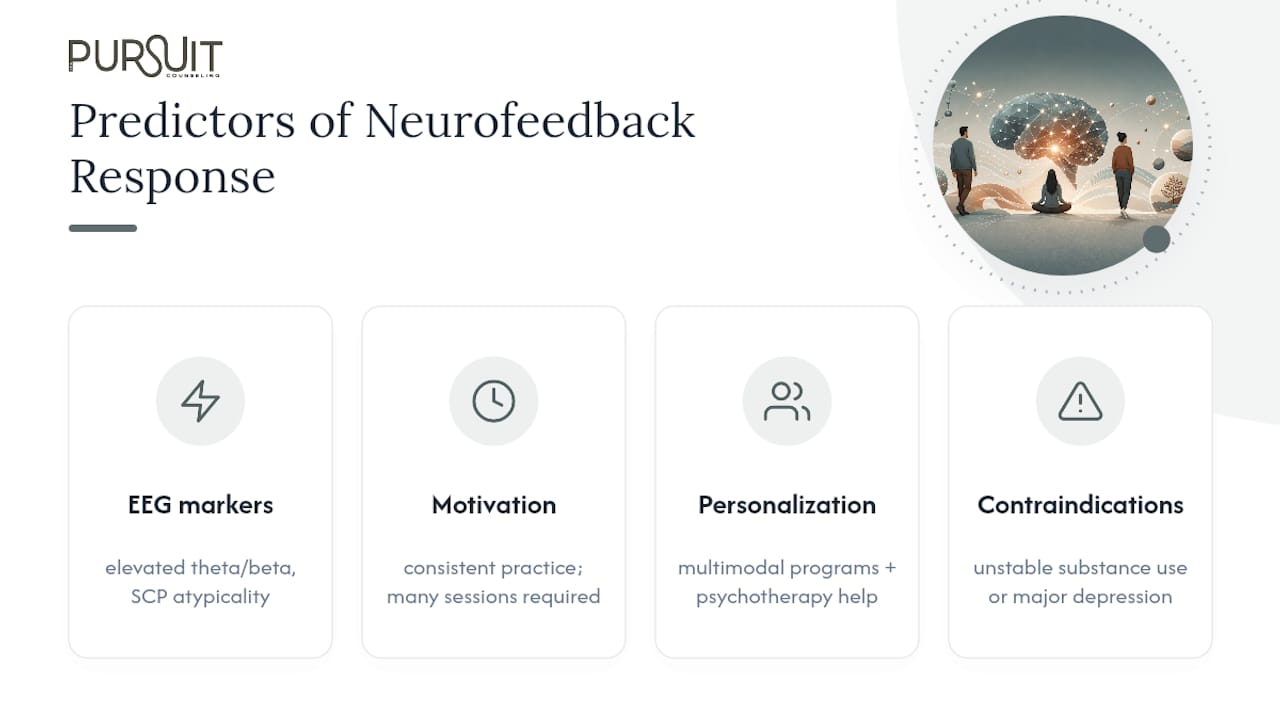
Personalization is where the newer research gets more encouraging. Reviews of multimodal and personalized neurofeedback programs consistently report larger effects than generic, off-the-shelf protocols, and combining neurofeedback with structured executive function strategies, psychotherapy, sleep coaching, and nutritional guidance tends to produce better real-world functioning than neurofeedback delivered alone. The field is also actively evolving. Adjacent research, including ongoing digital cognitive training trials for adults with ADHD, reflects growing interest in combining brain-training approaches with other structured interventions rather than treating any single method as sufficient on its own.
There are real limits too. Adults with severe co-occurring conditions, unmanaged substance use, untreated major depression, or active psychiatric crisis generally need that condition stabilized through other care first. Neurofeedback isn’t designed to be a frontline treatment for those situations.
Pro Tip: Before committing to a full course, ask whether the clinic will run a qEEG assessment first. If your brain shows no measurable deviation in the areas the protocol targets, you’re paying for a treatment with a weaker rationale from the start.
Sessions, Cost, Safety, and How It Compares to Medication
A neurofeedback course is a commitment, not a quick fix. Understanding the real time and money involved before you start prevents the most common source of disappointment: stopping too early to know whether it worked.
- Session count. Most published protocols, including the adult SCP trial, run somewhere between 20 and 40 sessions. Fewer than that rarely gives the brain enough repetition to consolidate the self-regulation skill; clinics offering “results in five sessions” are not working from the evidence base.
- Frequency. One to three sessions per week is typical. Spacing sessions too far apart slows skill acquisition, similar to how physical therapy loses effectiveness with long gaps between visits.
- Progress checkpoints. Reasonable programs reassess symptoms and, where possible, objective EEG metrics every eight to ten sessions, not just at the very end of a course.
- Cost. Neurofeedback is billed privately in most clinics, and insurance reimbursement remains limited and inconsistent across providers. Total cost scales directly with session count, which is part of why an honest upfront estimate of how many sessions your case likely needs is worth asking for before you begin.
- Safety profile. Reported side effects are generally mild: transient fatigue after sessions, occasional headaches, or brief irritability as training intensity builds. Serious adverse events are rare in the published literature, which is one of the more reassuring parts of this treatment’s profile even where efficacy questions remain open.
Where does this leave neurofeedback relative to medication? Standard clinical guidance from NIMH still places pharmacotherapy as the first-line treatment for adult ADHD, and nothing in the neurofeedback literature displaces that position. The 2024 Southampton analysis reinforces exactly why: an SMD of 0.04 doesn’t compete with the effect sizes typically reported for stimulant medication. Neurofeedback makes the most sense as an adjunct alongside medication, or as an alternative when medication is contraindicated, poorly tolerated, or simply not something a person wants to take long-term, not as a stand-alone replacement for adults who respond well to first-line pharmacological care.
Questions to Ask Before Choosing a Neurofeedback Provider
The gap between a rigorous neurofeedback program and an expensive placebo often comes down to what happens before you ever sit down for your first session. A short checklist protects you from the weaker end of this industry.
Ask who actually runs the sessions and what training they hold, since neurofeedback is delivered by everyone from licensed psychologists to technicians with a weekend certification, and that range in qualification is enormous. Ask whether a qEEG baseline assessment happens before treatment starts, and if so, whether the resulting protocol gets explained to you in plain language rather than presented as proprietary. Ask specifically which protocol, TBR, SCP, or SMR, they’re recommending and why that fits your baseline, not a generic ADHD template. Ask how they measure whether you’re actually learning to self-regulate during sessions, since that learner effect is one of the strongest predictors of outcome in the adult data. And ask what standardized symptom scales they use to track progress over the course of treatment, ideally administered by someone other than the person delivering your sessions, to reduce the same blinding problem that plagues the research literature itself.
A few claims should send you looking elsewhere immediately:
- Any guarantee of symptom elimination or a “cure.”
- A promise of dramatic results in five sessions or fewer.
- No qEEG or baseline assessment before treatment begins.
- No standardized outcome tracking, just verbal check-ins.
- Reluctance to explain which specific protocol you’re receiving.
Pro Tip: A well-run clinic will readily tell you that the evidence for neurofeedback is mixed and explain exactly where your case fits into that picture. If a provider only tells you success stories and never mentions the limitations, that’s a signal worth taking seriously.
How a Personalized Program Actually Works in Practice
Responsible neurofeedback starts with data, not a template pulled off a shelf. A workable clinical process begins with a full intake, a qEEG baseline mapped against normative databases, and a conversation about how ADHD is actually showing up in your work, relationships, and daily functioning, not just a symptom checklist.
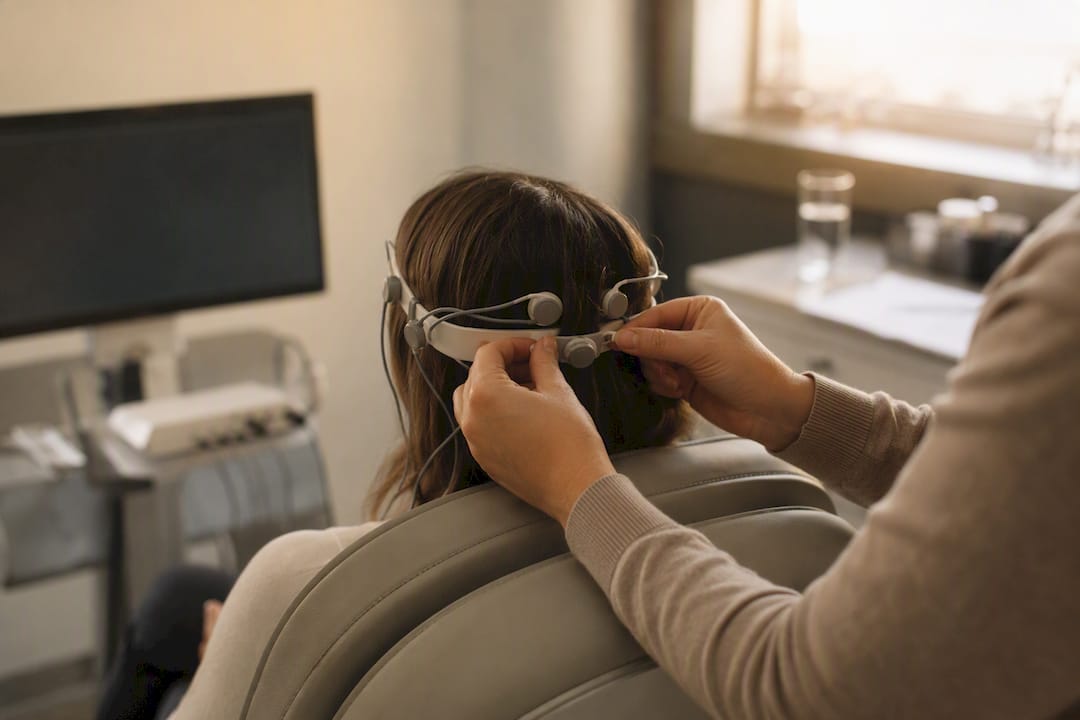
From there, the protocol gets built around what your brain actually shows, whether that’s an elevated theta/beta ratio pointing toward TBR training, or SCP work if self-regulation and impulse control are the dominant issue. Neurofeedback rarely stands alone in a well-run program. It gets paired with the broader counseling and coaching work that addresses the parts of ADHD that brainwave training alone can’t touch: executive function habits, sleep patterns, relationship strain, and the self-criticism that builds up after years of feeling like your brain works against you.
Clients typically move through an assessment phase, an active training phase of twenty to forty sessions, and periodic reassessment to see whether the skill is actually taking hold, the same learner effect the adult research keeps pointing back to. Progress isn’t always a straight line, and that’s normal. It’s why the reassessment checkpoints matter as much as the training itself.
— Adam
Neurofeedback at The Pursuit Counseling: What a First Consult Looks Like
If you’ve read this far, you already know neurofeedback isn’t a magic switch, and you already know it isn’t nothing either. What separates a program worth your time from one that isn’t is whether it’s built around your actual brain data and integrated with the rest of your care, instead of sold as a stand-alone gadget session. That’s the model The Pursuit Counseling uses: qEEG-informed personalization paired with the counseling, coaching, and executive-function work that makes brainwave training actually stick in real life.
A first consult with The Pursuit Counseling typically includes:
- A full intake conversation about how your ADHD shows up day to day, at work, at home, in relationships.
- A qEEG baseline assessment to identify your specific brainwave patterns rather than assuming a generic profile.
- A personalized protocol recommendation, TBR, SCP, or SMR, based on what your data actually shows.
- A realistic timeline and session plan, so you know what commitment you’re making before you start.
If you’re weighing neurofeedback for ADHD as part of your next step, the smartest move is a real assessment before a real commitment. Schedule a consultation with The Pursuit Counseling to find out what your own brain data actually shows and whether a personalized program makes sense for you.
Sources
- Neurofeedback for Attention-Deficit/Hyperactivity Disorder: A Systematic Review and Meta-Analysis | JAMA Psychiatry
- Neurofeedback may not be effective in reducing ADHD symptoms (2024 analysis)
- Neurofeedback as a Treatment Intervention in ADHD: Current Evidence and Practice – PMC
This article is general information, not a substitute for advice from a qualified doctor. Consult a qualified healthcare professional about your own circumstances before acting on anything here.
FAQ
Does neurofeedback really work for ADHD?
The evidence is mixed: a meta-analysis of 38 RCTs found no meaningful benefit on blinded outcomes, while personalized, qEEG-informed programs report larger gains in open-label studies. It may help as part of a tailored, multimodal plan rather than as a stand-alone guaranteed fix.
What are effective alternatives to Adderall for adult ADHD?
Non-stimulant medications, cognitive behavioral therapy, and structured executive-function coaching are common first-line alternatives, and neurofeedback for ADHD may serve as an adjunct when medication isn’t tolerated or fully effective on its own.
How do you calm down ADHD symptoms as an adult?
Consistent sleep, movement breaks, and structured routines reduce symptom intensity for many adults, and some find that SMR-based neurofeedback protocols specifically target the restlessness and impulsivity behind that “can’t settle down” feeling.
What is the best lifestyle for someone with ADHD?
A predictable sleep schedule, regular exercise, and reduced decision fatigue through routines and external structure tend to support better functioning, and pairing those habits with deep therapeutic work and small consistent actions often sustains gains longer than any single intervention alone.
Recommended
- Neurofeedback for ADHD: Can Brain Training Help You Focus, Feel Calmer, and Thrive? – The Pursuit Counseling
- Executive Function Skills for Adults: Practical Strategies – The Pursuit Counseling
- Neurofeedback for Anxiety: Can Brain Training Help You Feel Calmer and More in Control? – The Pursuit Counseling
- ADHD Therapy in Fayetteville, GA: Thrive with The Pursuit Counseling