


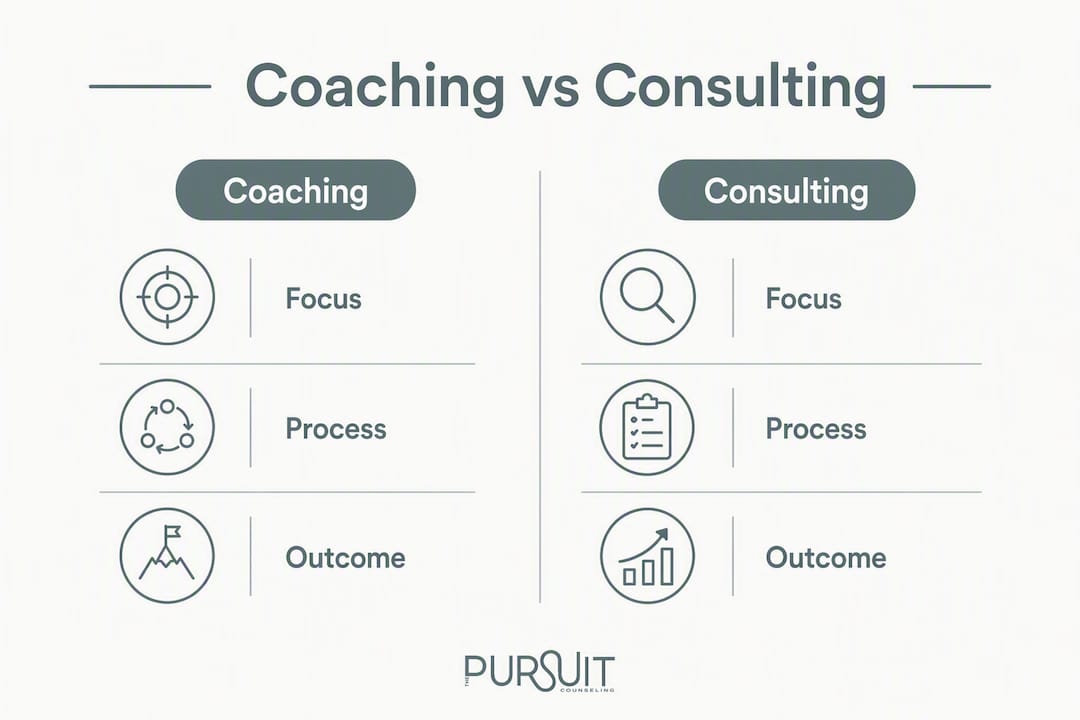
Coaching builds your capability and accountability. Consulting delivers expert solutions and implementation support. Therapy treats clinical mental-health conditions. The difference matters more than most high performers realize — and choosing the wrong one costs time, money, and momentum. Consulting is a roughly 0 billion global market, and coaching has grown to over 71,000 certified practitioners worldwide — yet confusion between the two remains common enough to derail otherwise strong leaders.
Here is the short version of what each role delivers:
- Coach: Builds repeatable leadership habits, decision-making capacity, and execution discipline over time
- Consultant: Diagnoses a defined problem and delivers a concrete solution, plan, or implementation
- Therapist: Provides licensed clinical treatment for mental-health conditions, trauma, or safety concerns
At The Pursuit Counseling, we work with executives, founders, pilots, and high-performing professionals who often need more than one of these — and who deserve clarity about which is which before they book anything.
Table of Contents
- How does coaching vs consulting actually compare?
- When should you choose coaching, consulting, or therapy?
- What should you expect from a coaching or consulting engagement?
- How do you verify a provider’s credentials and evidence base?
- What should you ask on a discovery call?
- Key Takeaways
- How The Pursuit Counseling integrates coaching and counseling
- Ready to find out which support fits you?
- Useful sources and further reading
How does coaching vs consulting actually compare?
The table below maps the core decision dimensions side by side, including when each role should escalate to clinical care.
| Dimension | Coaching | Consulting | Therapy |
|---|---|---|---|
| Primary goal | Build capability, habits, accountability | Solve a defined problem, deliver a plan | Treat mental-health conditions, reduce symptoms |
| Provider role | Guide and mirror; client discovers answers | Expert who diagnoses and recommends | Licensed clinician who assesses and treats |
| Methods | Questions, frameworks, accountability structures | Analysis, research, implementation plans | CBT, EMDR, neurofeedback, Gottman Method |
| Deliverables | Leadership routines, decision frameworks, behavior change | Reports, roadmaps, implemented solutions | Symptom reduction, stabilization, clinical outcomes |
| Cadence | Ongoing sessions, weeks to months | Short-term projects with defined endpoints | Weekly or biweekly, duration varies by condition |
| Credentials | ICF certification (ACC, PCC, MCC); no licensure required | Domain expertise, track record, certifications | PhD, PsyD, LCSW, LPC, LMFT — state-licensed |
| Best for | Execution gaps, leadership growth, accountability | Technical problems, market entry, restructuring | Anxiety, trauma, depression, safety concerns |
| Escalate when | Symptoms emerge, safety concerns arise | Emotional blocks prevent implementation | Always the right call for clinical presentations |
The single most actionable differentiator for executives:
- Urgent tactical need with a defined answer → hire a consultant
- You know what to do but can’t consistently do it → hire a coach
- Clinical symptoms, panic, trauma, or safety concerns → see a licensed therapist
Pro Tip: The most expensive mis-hire is bringing in a consultant when the real gap is execution. If your team has already received the recommendation and still isn’t moving, the problem is accountability and discipline — not more information. A coach closes that gap; another strategy deck won’t.

When should you choose coaching, consulting, or therapy?
Scenarios make this concrete. Here are five situations executives actually face:
- You know your next three priorities but keep defaulting to reactive work. This is a coaching problem. The knowledge exists; the execution structure doesn’t. A coach builds the habits and accountability system that makes follow-through consistent.
- You need a market-entry playbook for a new geography within 90 days. This is a consulting problem. You need specialized research, competitive analysis, and a concrete plan — not a conversation about your decision-making style.
- You’re experiencing panic attacks before board meetings or investor calls. This is a therapy problem, possibly combined with coaching later. High-achieving professionals often hide anxiety until it becomes a performance crisis. Licensed clinical care comes first.
- You want to strengthen your leadership presence and communication with your team. Coaching fits here, especially when combined with evidence-based frameworks from mental fitness and leadership development.
- You’re restructuring your organization and need a financial model and implementation support. Consulting. Defined deliverable, specialized expertise, time-bound project.
Quick decision checklist — run through this before you book:
- Do I know the answer but struggle to execute it consistently? → Coach
- Do I need a specialized expert to diagnose and solve a technical problem? → Consultant
- Am I experiencing symptoms that affect daily functioning (sleep, mood, relationships, concentration)? → Therapist
- Is there a safety concern, substance use issue, or history of trauma affecting my performance? → Licensed clinician immediately
- Do I need both capability building and clinical support? → Integrated model (coach + therapist)
Red flags that require immediate referral to a licensed clinician:
- Suicidal thoughts or self-harm
- Severe anxiety or panic that disrupts daily life
- Substance use as a coping mechanism
- Trauma responses that coaching conversations are surfacing but not resolving
- Any safety concern for yourself or others
Pro Tip: Combining a coach and a therapist works well — but only when roles are clearly separated from day one. The coach owns performance and execution; the therapist owns clinical care. Overlap without clarity creates confusion and, in some cases, harm.
What should you expect from a coaching or consulting engagement?
A typical coaching engagement moves through intake and goal-setting, then into recurring sessions (usually biweekly or monthly) focused on accountability, skill-building, and reflection. Measurement happens through self-reported progress, 360 feedback, or defined behavioral metrics. Engagements commonly run three to twelve months.
Common coaching deliverables include:
- A defined leadership development plan
- Weekly or biweekly accountability check-ins
- Decision-making frameworks tailored to your role
- Behavioral habit tracking and course-correction
A typical consulting project begins with a diagnostic phase, moves into recommendation development, and often includes an implementation or handoff phase. Projects are scoped by deliverable, not by time spent in conversation.
Common consulting deliverables include:
- A written strategy, report, or implementation roadmap
- Process redesigns or financial models
- Vendor evaluations or technology recommendations
- A defined handoff with documentation
On pricing: executive coaching typically runs on a session or package basis, while consulting fees are usually project-scoped or retainer-based. Rates vary widely by provider experience and specialty. The structure matters as much as the number — a coach billing hourly with no defined outcomes is a different product than a structured program with measurement built in.
How do you verify a provider’s credentials and evidence base?
Credentials are not interchangeable. Here is what each signals:
- Licensed therapists (PhD, PsyD, LCSW, LPC, LMFT) are state-regulated, carry malpractice insurance, and are legally authorized to diagnose and treat mental-health conditions. Verify licensure through your state’s licensing board.
- ICF-credentialed coaches (ACC, PCC, MCC) have completed accredited training and supervision hours. The International Coach Federation credential tiers indicate increasing experience and rigor. MCC is the highest level.
- Consultants have no universal licensing body. Evaluate them on domain expertise, track record, client outcomes, and methodology transparency.
For clinical providers, ask specifically about evidence-based treatments. At The Pursuit Counseling, the clinical team uses EMDR therapy for trauma processing, neurofeedback for brain regulation and ADHD, CBT for cognitive restructuring, and the Gottman Method for relationship work. These are not marketing terms — they are validated, researched protocols with documented outcome data. Ask any provider which specific protocols they use and what the evidence base is.
For outcome evaluation: request de-identified case examples, ask how progress is measured, and find out what happens when the engagement isn’t working. A provider who can’t answer those questions clearly is a provider worth reconsidering.
What should you ask on a discovery call?
Discovery calls are your interview. Use them that way.
For a prospective coach:
- What is your coaching model, and how do you measure progress?
- What happens if I’m not making progress after three months?
- Do you have experience with executives in high-stakes roles?
- What falls outside your scope, and how do you handle referrals to clinical care?
For a prospective consultant:
- What is your diagnostic process, and what does a final deliverable look like?
- Can you share a de-identified example of a similar engagement?
- How do you handle scope creep or changing project parameters?
- What does implementation support include, and when does the engagement end?
For a prospective therapist:
- Are you licensed in my state, and what is your license type?
- Which evidence-based treatments do you use, and for what presenting concerns?
- Do you have experience with high-performing professionals or executives?
- How do you coordinate care if I’m also working with a coach?
Red flags across all three roles:
- Overpromising outcomes (“I’ll fix this in 30 days”) without a clear methodology
- No referral pathway to clinical care when symptoms arise
- Hybrid “coach-sulting” offerings with no clear separation of roles or deliverables
- Coaches presenting themselves as subject-matter experts for technical problems outside their scope
On cultural fit: ask directly whether the provider has worked with U.S. executives, high performers, or professionals in high-accountability roles. Experience with that population changes how a provider frames goals, handles pressure, and interprets setbacks. Understanding emotional regulation in the context of leadership stress is a different skill set than general life coaching.
Key Takeaways
Coaching builds the execution capacity you already know you need; consulting solves the technical problem you can’t solve alone; therapy treats the clinical condition that neither coaching nor consulting is equipped to address.
| Point | Details |
|---|---|
| Know the core difference | Coaching = capability and accountability; consulting = expert solutions; therapy = licensed clinical treatment. |
| Match the role to the gap | If you know what to do but can’t execute, hire a coach — not another consultant. |
| Verify credentials carefully | Therapists must be state-licensed; coaches should hold ICF credentials; consultants should show documented outcomes. |
| Watch for red flags | Clinical symptoms, safety concerns, or trauma responses require a licensed clinician, not a coach or consultant. |
| The Pursuit Counseling | Offers an integrated model combining licensed clinical care and executive coaching for high performers in Georgia. |
Pro Tip: If you’re still unsure which role you need, describe your problem in one sentence. If the sentence ends with “and I don’t know what to do,” you may need a consultant. If it ends with “and I can’t make myself do it,” you need a coach. If it ends with “and it’s affecting my health, sleep, or relationships,” call a therapist.
How The Pursuit Counseling integrates coaching and counseling
Most providers offer one lane. The Pursuit Counseling was built for the people who need both.
Our clinical team holds advanced licensure (PhD, PsyD, LCSW, LPC) and uses neuroscience and neuropsychology as the foundation for both clinical treatment and performance work. That means when a client comes in presenting as a leadership challenge, we’re also trained to recognize when the real driver is unprocessed trauma, chronic anxiety, or dysregulated nervous system function — and to treat it, not just coach around it.
The differentiators that matter for executives:
- Integrated model: Licensed clinicians who also provide evidence-based executive coaching, so clinical and performance work happen in the same relationship with clear scope boundaries
- Evidence-based protocols: EMDR, neurofeedback, CBT, and Gottman Method — not generic talk therapy
- Outcome measurement: Progress is tracked, not assumed
- Clear escalation pathways: If coaching surfaces clinical material, the transition to clinical care is built into the model, not an awkward conversation
We work with executives, founders, lawyers, pilots, and high-performing professionals across Georgia, both in-person and online. And we’re transparent about scope: coaching is coaching, therapy is therapy, and you’ll always know which one you’re receiving and why.
Ready to find out which support fits you?
If you’ve read this far, you’re already doing the right thing: thinking clearly about what kind of help you actually need before you book something that might not fit.

The Pursuit Counseling offers executive counseling and coaching for high-performing adults in Georgia who want more than a generic coaching package or a once-a-week check-in. Our services include:
- Executive counseling and leadership therapy — for leaders navigating high-stakes pressure, burnout, or performance blocks with a clinical root
- EMDR therapy — for trauma, anxiety, and the experiences that keep showing up in your professional life
- Neurofeedback — for focus, regulation, and ADHD-related performance challenges
- Intensive programs — for clients who need concentrated, accelerated progress rather than a slow-build weekly cadence
- Combined clinical + coaching pathways — for executives who need both performance support and clinical care under one roof
We operate on a private-pay model, with both in-person and online sessions available. If you’re in Georgia and want to know whether executive counseling, coaching, or an integrated program is the right fit, schedule a consultation and we’ll help you figure it out on the first call.
This article provides general information about coaching, consulting, and therapy roles. It is not a substitute for professional clinical advice. Please consult a licensed mental-health professional for guidance specific to your situation.
Useful sources and further reading
- Consultant vs Coach vs Mentor: What to Hire and When — Defines the three roles and their core models; supports the comparative snapshot and escalation guidance.
- Consultant or Coach? What Does Your Company Actually Need — Market size figures and practical decision rules for choosing between coaching and consulting.
- Coaching vs. Consulting: Differences and Similarities — Covers hybrid models and the importance of scope clarity; supports the how-to-choose and red-flags sections.
- Key Differences Between Coaching and Consulting — Outcome-focused comparison of process-oriented coaching vs solution-oriented consulting.
- Coach vs Consultant: What’s the Difference? — Red flags for coaches overstepping into technical consulting roles.
- How to Improve Emotional Regulation Daily — Practical emotional-regulation strategies relevant to executives deciding between coaching and therapy.
Recommended
- Coaching and Counseling for Leaders – The Pursuit Counseling
- Business Coach or Business Counselor? Signs You Need Both
- Leadership Counseling for Executives and High Performers: What Makes The Pursuit Counseling Different?
- The Cracks Are the Point: Why High Performers Grow Through the Pain Cave – The Pursuit Counseling