


Can you use your HSA for therapy and mental health care?
Yes. Using an HSA for therapy is fully allowed under IRS Publication 502 when the treatment addresses a diagnosed mental health condition. The IRS defines a qualified medical expense as one for “the diagnosis, cure, mitigation, treatment, or prevention of disease,” and therapy with a licensed mental health provider falls squarely within that definition. No prescription is required. No prior authorization is needed. You pay, you save.
What does not qualify is equally clear. General wellness services, life coaching, and stress management workshops without a clinical diagnosis are not covered. The line the IRS draws is between medical treatment and personal enrichment.
Here is what qualifies for HSA-eligible therapy expenses:
- Individual therapy with a licensed professional (LCSW, LPC, LMFT, psychologist, or psychiatrist) treating a diagnosed condition
- Couples and marriage therapy when at least one partner carries a clinical diagnosis such as depression, anxiety, or an adjustment disorder
- Family and group therapy led by a licensed provider
- Telehealth therapy delivered by a licensed mental health provider, whether through a private practice or an online platform
- Psychiatric medication management appointments with a psychiatrist
- Psychological testing and diagnostic assessments
- Copays, coinsurance, and deductibles tied to any of the above
What does not qualify: life coaching, unlicensed counselors, meditation apps without a licensed provider component, and general relationship enrichment counseling with no diagnosis attached.
How to use your HSA to pay for therapy effectively
The mechanics are simpler than most people expect. You have three practical paths.

Option 1: Pay directly with your HSA debit card. Most therapists and online therapy platforms accept HSA cards at the point of service. The funds come straight from your pre-tax account, and the transaction is logged automatically.
Option 2: Pay out of pocket, then submit for reimbursement. If your card is declined or the provider does not accept HSA cards, pay with a personal card and submit a superbill to your HSA administrator. This is common and completely normal.
Option 3: Pay now, reimburse yourself later. This is the strategy most people overlook. HSA funds roll over indefinitely with no reimbursement deadline. You can pay for therapy out of pocket today, let your HSA balance grow invested, and reimburse yourself months or even years later, tax-free.
- Keep every receipt, superbill, and explanation of benefits (EOB)
- Request a superbill from your therapist after each session if one is not provided automatically
- Store documentation digitally so it is accessible for any future IRS audit
Pro Tip: Max out your HSA contributions annually. The contribution limits may vary each year according to IRS guidelines. Every dollar you route through your HSA for therapy saves you money on federal income tax, state income tax, and in many cases FICA taxes.
What types of mental health services does an HSA cover?
The range is broader than most people realize. Your HSA covers virtually every form of licensed mental health treatment.
- Individual psychotherapy with any licensed clinician, including sessions using evidence-based approaches like CBT, EMDR, and DBT skills training
- Couples therapy treating a diagnosed condition, such as depression or anxiety affecting the relationship
- Family therapy when conducted by a licensed provider
- Group therapy led by a qualified therapist
- Psychiatric medication management and psychiatric medication prescriptions
- Psychological testing, including ADHD assessments and neuropsychological evaluations
- Intensive Outpatient Programs (IOP) and Partial Hospitalization Programs (PHP) when medically necessary
- Telehealth sessions through licensed providers on any platform
- Travel expenses related to therapy visits, including parking, tolls, and mileage at the IRS medical mileage rate
One thing worth noting: meditation apps like Calm or Headspace do not qualify on their own. They are wellness tools, not licensed mental health services. The same app used alongside a licensed provider’s treatment plan is a different conversation.
HSA vs. FSA for therapy: which one works harder for you?
Both accounts cover the same therapy expenses. The difference is in how they work over time.
| Feature | HSA | FSA |
|---|---|---|
| Eligibility requirement | Must have a High Deductible Health Plan (HDHP) | Available with most employer health plans |
| Account ownership | You own it permanently | Employer owns it |
| 2024 contribution limit | ,150 individual / ,300 family | — |
| Rollover | Rolls over indefinitely | Use-it-or-lose-it (limited carryover or grace period) |
| Portability | Stays with you after job changes | Lost if you leave your employer |
| Investment option | Yes, can grow tax-free | No |
| Tax advantage | Triple: contributions, growth, and withdrawals | Double: contributions and withdrawals |
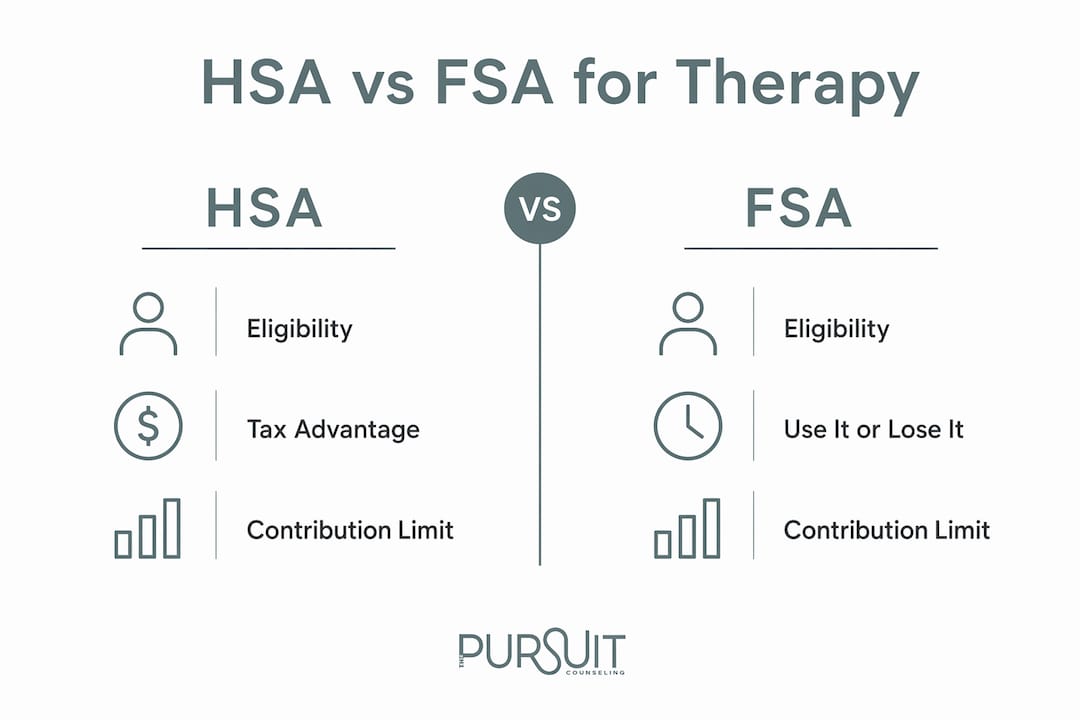
The HSA’s triple tax advantage is the real differentiator. Contributions go in pre-tax, the balance can grow through investments tax-free, and withdrawals for qualified expenses are also tax-free. An FSA gives you the contribution and withdrawal benefit but no investment growth.
For therapy specifically, an HSA rewards patience. If you are in an intensive treatment phase, an FSA’s front-loaded availability (the full annual amount is accessible on January 1) can be useful for covering a concentrated block of sessions early in the year.
Tax implications and documentation when using your HSA for therapy
The tax savings from paying therapy with pre-tax HSA dollars can be substantial depending on your federal and state tax bracket, including possible savings on FICA taxes when contributions run through payroll. On ,000 in annual therapy costs, that is a real and meaningful reduction in what you actually pay.
Documentation is where people get tripped up. A credit card receipt alone does not satisfy IRS requirements. Here is what you need:
- An itemized superbill with the date of service, CPT code (e.g., 90834 for a 45-minute individual session, 90837 for a 60-minute session), provider name, license number, and diagnosis code
- Proof of payment such as a bank or credit card statement
- An EOB from your insurer if insurance applied to the claim
Keep these records indefinitely. The IRS has no statute of limitations on HSA audits when records are missing, and because there is no reimbursement deadline, you may be filing claims years after the original expense.
Pro Tip: Ask your therapist for a superbill at the end of each month rather than after every session. It is easier to manage, and most licensed providers generate them routinely.
Common misconceptions and expert insights on HSAs for therapy
A few persistent myths cost people real money.
Myth: You need a prescription for therapy to qualify. You do not. A clinical diagnosis documented in your provider’s records is sufficient. Your therapist will typically assign a diagnosis code on your superbill, which serves as the documentation of medical necessity.
Myth: Only in-person therapy qualifies. Telehealth with a licensed provider is equally eligible. Online platforms that use licensed therapists and provide proper receipts are fully covered.
Myth: A declined HSA card means the expense is ineligible. Not so. Declined transactions often result from a provider’s merchant category code, not from any problem with your eligibility. Pay out of pocket and submit for reimbursement. The expense is still covered.
The most underused strategy is what financial advisors sometimes call the “HSA loophole”: pay for therapy out of pocket now, let your HSA balance compound in investments, and reimburse yourself later with tax-free dollars. There is no deadline. A receipt from 2024 is just as valid in 2030.
Using your HSA alongside insurance is also worth doing. Your insurer covers its portion, and your HSA covers the remaining copay, coinsurance, or deductible. Your entire out-of-pocket share comes from pre-tax dollars.
How to find and verify if a therapy provider accepts HSA payments
Most licensed therapists accept HSA payments in one form or another, even if they do not advertise it. The question is really about how they prefer to process payment.
Start by asking directly: “Do you accept HSA debit cards, or do you provide superbills for reimbursement?” Any licensed provider who gives you a proper superbill is effectively HSA-compatible, whether or not they swipe your card. If you are using a telehealth platform, check the platform’s payment FAQ before enrolling, since policies can change.
When finding a qualified therapist in Georgia, verify that the provider holds an active state license (LCSW, LPC, LMFT, PhD, PsyD, or MD/DO). An unlicensed counselor or coach does not meet the IRS standard, regardless of how the receipt is formatted. For practice management compliance questions, resources like the Paisli compliance blog cover HSA payment processing for mental health providers in detail.
Strategies for tracking and managing therapy-related HSA expenses
Good recordkeeping is the difference between a smooth reimbursement and a stressful audit. A few habits make it easy.
Create a dedicated folder, physical or digital, for therapy expenses only. Every superbill, receipt, and EOB goes there immediately after the session. Apps like Expensify or your HSA administrator’s own mobile app can photograph and categorize receipts in real time, so nothing gets lost.
Track your cumulative HSA spending against your annual contribution limit. If you are approaching the limit mid-year, consider whether to pay remaining sessions out of pocket and reimburse later, allowing your balance to stay invested longer. Log travel expenses separately: mileage to and from therapy at the IRS medical mileage rate, parking fees, and tolls all qualify and add up over a year of weekly sessions.
Potential limitations and caps on therapy expenses covered by HSAs
There is no IRS-imposed dollar cap on how much of your HSA you can spend on therapy. The only ceiling is your account balance and your annual contribution limit (,400 individual / ,750 family in 2026). If your therapy costs exceed your HSA balance, you pay the remainder out of pocket or with insurance.
A few real limitations do apply. Couples therapy without a clinical diagnosis does not qualify, regardless of how the receipt is worded. Coaching, even from a licensed therapist operating in a coaching capacity rather than a clinical one, typically does not meet the IRS standard. And if you withdraw HSA funds for a non-qualified expense, you owe income tax on the amount plus a 20% penalty.
One structural limit worth knowing: you cannot contribute to an HSA unless you are enrolled in a qualifying High Deductible Health Plan. If you lose HDHP coverage, your existing balance remains yours and can still be used for qualified expenses, including therapy. You simply cannot add new contributions until you re-enroll in an eligible plan.
Ready to put your HSA to work for real change?

At The Pursuit Counseling, we work with high-performing professionals, executives, and leaders across Georgia who are ready to do the hard, meaningful work of growth. Our evidence-based treatments, including EMDR, neurofeedback, DBT, and Gottman Method couples therapy, are delivered by licensed clinicians and qualify as HSA-eligible medical expenses. Whether you are managing anxiety, processing trauma, or navigating the weight of leadership, your HSA can help make that investment more affordable.
Explore our leadership counseling for executives and couples counseling services to see how The Pursuit Counseling can support you. We provide superbills upon request so your reimbursement process is straightforward from day one.
Key Takeaways
HSA funds cover licensed therapy for diagnosed mental health conditions with no prescription required, and the tax savings can reach 25–45% of your total therapy costs depending on your bracket.
| Point | Details |
|---|---|
| Therapy is HSA-eligible | Licensed mental health treatment for a diagnosed condition qualifies under IRS Publication 502. |
| Three payment methods | Pay by HSA card, reimburse after paying out of pocket, or delay reimbursement to let funds grow. |
| Documentation required | Keep superbills with CPT codes, provider license numbers, and diagnosis codes for IRS compliance. |
| HSA beats FSA long-term | HSAs roll over indefinitely, are portable, and offer triple tax benefits; FSAs are use-it-or-lose-it. |
| No dollar cap on therapy | You can spend your full HSA balance on therapy; the only ceiling is your contribution limit. |
Recommended
- Best Trauma Therapy Approaches in 2026 – The Pursuit Counseling
- Why the 12 week year works for people with ADHD
- How To Find A Therapist Who Understands High-Achieving Professionals In Fayetteville, Georgia – The Pursuit Counseling
- How to Talk About Therapy Without Sounding Clinical – The Pursuit Counseling