


Therapy for entrepreneurs is the process of helping business owners and founders manage the psychological and emotional weight of running a company, including stress, burnout, financial anxiety, and identity pressure. Running a business in Georgia means carrying a load that most people around you cannot fully see. 53.5% of small business owners lose sleep over their business regularly, and 71% report moderate to extremely high levels of financial stress. These numbers point to a mental health crisis hiding behind the ambition. Therapy gives you a structured, evidence-based way to address that crisis before it costs you your health, your relationships, or your business.
What causes high stress and burnout among entrepreneurs?
Entrepreneur stress does not come from one source. It compounds across financial pressure, isolation, identity, and the relentless pace of building something from nothing.
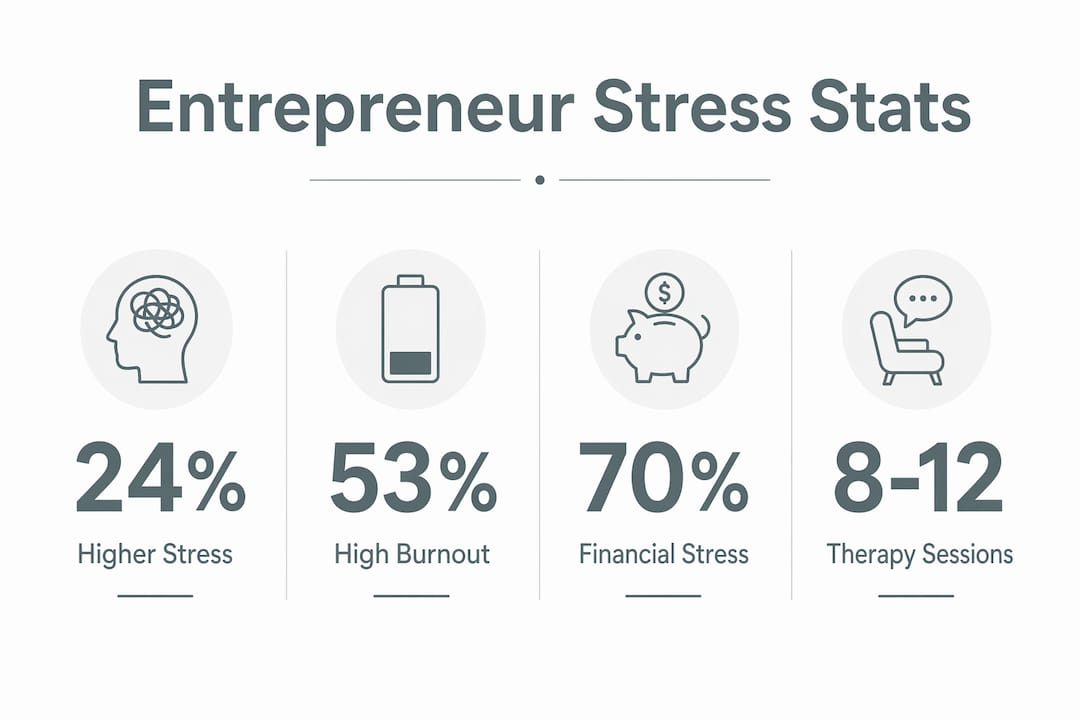
Self-employed individuals carry 24% higher stress levels over six years compared to employed counterparts, with 53% higher cortisol levels at day’s end. Cortisol is your body’s primary stress hormone. Chronically elevated cortisol disrupts sleep, impairs decision-making, and accelerates burnout. That is not a personality flaw. That is biology responding to an environment with no off switch.
The financial dimension hits especially hard. 70% of small business owners report financial management as a major stressor, and 81% say recent years feel more stressful than prior ones. Small business owners also lose an average of 33 working days per year to stress-related productivity loss. That is more than six weeks of capacity evaporating because the mental load became too heavy to carry.

Psychology Today describes what researchers call the “founder paradox”: the same traits that make entrepreneurs successful, including high risk tolerance, obsessive focus, and relentless drive, also make them uniquely vulnerable to burnout. The very wiring that builds a business can quietly destroy the person running it.
Burnout does not arrive all at once. Watch for these early warning signs:
- Deep, persistent exhaustion that sleep does not fix
- Irritability and short fuses with your team, family, or clients
- Cynicism about your own work or the purpose behind it
- Increased errors and poor decisions you would not normally make
- Emotional numbness or detachment from outcomes you once cared about
“Entrepreneurs often dismiss these signs as the cost of ambition. That dismissal is exactly what turns early burnout into full collapse. Catching it early is not weakness. It is the smartest business decision you can make.”
Pro Tip: Set a monthly check-in with yourself using those five warning signs as a scorecard. If you score three or more, treat it as a signal to act, not push through.
How does therapy help entrepreneurs manage mental health challenges?
Therapy works for entrepreneurs because it addresses the specific psychological patterns that drive their stress, not just the surface symptoms. Cognitive Behavioral Therapy (CBT), Acceptance and Commitment Therapy (ACT), and mindfulness-based approaches are the three most evidence-backed methods for entrepreneur mental health challenges.
CBT helps you identify and restructure the thought patterns that fuel anxiety and perfectionism. ACT teaches you to hold difficult emotions without letting them control your behavior. Mindfulness-based approaches reduce cortisol reactivity and improve focus. Each method targets a different layer of the problem, and a skilled therapist will often combine them.
Therapy also directly addresses the founder paradox. Through structured sessions, you learn to recalibrate traits like obsession and risk tolerance so they serve your business without consuming your life. That recalibration is not about becoming less driven. It is about becoming more sustainable.
One of the most underrated benefits of therapy for business owners is the space itself. You get one hour where no one needs a decision from you, no one is watching your confidence level, and no one’s paycheck depends on your answer. That kind of non-judgmental space is rare for founders. It is also where real clarity tends to emerge.
Here is how to find the right therapist as an entrepreneur:
- Look for clinical experience with high performers or executives. A therapist who understands founder culture will not pathologize your ambition.
- Ask directly about their familiarity with burnout, impostor syndrome, and identity-based stress. These are your most likely presenting issues.
- Confirm they use evidence-based methods like CBT, ACT, or EMDR rather than purely supportive talk.
- Consider whether they offer flexible scheduling. Your calendar does not follow a 9-to-5 structure, and your therapist’s availability should reflect that.
- Trust the first session. If you leave feeling more aware of yourself, that is a good sign.
Pro Tip: When you contact a therapist, describe your role as a business owner in your first massage. It helps them assess fit before you even sit down together.
What practical strategies support entrepreneur wellness?
The most effective stress management for entrepreneurs combines professional therapy with daily recovery practices. Therapy sets the foundation. These habits protect it.
Sleep is the most undervalued performance tool you have. Business owner stress directly disrupts sleep for more than half of small business owners, and sleep deprivation compounds every other mental health risk. Protecting seven to nine hours is not a luxury. It is a clinical necessity.
Financial visibility reduces anxiety more than financial success does. Entrepreneurs spend an average of 22 hours per month managing finances. Automation tools and clear financial dashboards reduce that cognitive load and the low-grade dread that comes with financial uncertainty. When you can see your numbers clearly, your nervous system settles.
The table below outlines therapy approaches and their specific benefits for entrepreneurs:
| Therapy approach | Best for | Core benefit |
|---|---|---|
| Cognitive Behavioral Therapy (CBT) | Anxiety, perfectionism, negative self-talk | Restructures thought patterns driving stress |
| Acceptance and Commitment Therapy (ACT) | Emotional avoidance, burnout | Builds psychological flexibility and values clarity |
| Mindfulness-based therapy | Chronic stress, reactivity | Lowers cortisol and improves present-moment focus |
| EMDR | Past trauma affecting current performance | Processes stuck emotional memories at the neurological level |
| Executive coaching combined with therapy | Leadership identity, decision fatigue | Integrates mental health with business performance goals |
Beyond therapy sessions, these practices build daily resilience:
- Exercise at least three times per week. Physical movement is one of the fastest ways to lower cortisol.
- Schedule solitude. Fifteen minutes of quiet, unstructured time each day reduces decision fatigue.
- Set hard boundaries around work hours. Availability without limits is a burnout accelerator.
- Spend time in nature. Research consistently links outdoor exposure to reduced stress hormone levels.
- Eat regular meals. Skipping meals spikes cortisol and impairs judgment.
Pro Tip: Block your therapy appointment in your calendar the same way you block a board meeting. Canceling it when things get busy is exactly backwards. The busier you are, the more you need it.
How do you start therapy as an entrepreneur?
Starting therapy feels harder than it is. The first step is simply deciding that your mental health is a business asset worth protecting. That reframe matters. Founders who treat therapy as professional development rather than crisis management show up differently and get more from it.
Finding the right fit in Georgia is straightforward. Thepursuitcounseling works specifically with high-achieving founders and executives who need a therapist who understands the weight of leadership, not just the clinical symptoms. Services are available across Georgia, including Fayetteville and Peachtree City.
Early sessions typically focus on mapping your specific stress patterns, identifying where your coping strategies are working, and setting clear goals. You will not spend the first month rehashing your childhood. You will spend it building self-awareness about the patterns that are costing you right now.
Here is what to expect in the first 90 days:
- Sessions 1–3: Stress pattern identification, goal setting, and building trust with your therapist
- Sessions 4–8: Active work on the primary presenting issue, whether anxiety, burnout, or identity pressure
- Sessions 9–12: Skill consolidation, relapse prevention, and integration into your leadership role
Reducing the stigma around seeking help starts with you. When Georgia founders normalize therapy, they give their teams permission to do the same. That cultural shift is one of the most powerful leadership moves you can make.
Why Therapy Is Essential for Sustainable Entrepreneurship
Therapy for entrepreneurs is the most direct path to sustainable performance because it addresses the psychological root causes of burnout, not just the symptoms.
| Point | Details |
|---|---|
| Stress is structural, not personal | Self-employed individuals carry 24% higher stress than employees, driven by financial pressure and isolation. |
| The founder paradox is real | Traits like obsession and risk tolerance build businesses and also accelerate burnout without intervention. |
| Evidence-based methods work | CBT, ACT, mindfulness, and EMDR each target specific entrepreneur mental health challenges effectively. |
| Daily habits protect therapy gains | Sleep, exercise, financial clarity, and hard boundaries sustain the progress made in sessions. |
| Early action changes outcomes | Catching burnout signs early and starting therapy before crisis is the highest-leverage move a founder can make. |
What I’ve learned working with founders in Georgia
I have sat across from some of the most capable people in Georgia, founders who built real things, led real teams, and quietly fell apart behind closed doors. The pattern is almost always the same. They waited too long. They told themselves the exhaustion was temporary. They believed that needing help meant something was wrong with them rather than with the load they were carrying.
The founder paradox is not a metaphor. It is a clinical reality I see every week. The drive that got you here is the same drive that will grind you down if you do not learn to work with it rather than against it. Therapy does not dull that edge. It sharpens it by giving you the self-awareness to use it deliberately.
What I find most encouraging is how quickly high performers respond to the right therapeutic approach. Entrepreneurs are not resistant to change. They are resistant to approaches that feel irrelevant to their actual lives. When therapy speaks their language and addresses their real pressures, they move fast. They apply insights the way they apply business lessons, with urgency and intention.
The mental fitness work that strengthens your leadership also strengthens your relationships, your decision-making, and your ability to stay in the game for the long run. That is not a soft benefit. That is a competitive advantage.
— Adam
Thepursuitcounseling works with Georgia entrepreneurs
Running a business in Georgia takes everything you have. Thepursuitcounseling offers leadership counseling for high performers who need more than generic stress advice. The work here is grounded in neuroscience, neuropsychology, and evidence-based treatments including EMDR, Neurofeedback, and Gottman Method approaches. Whether you are managing small business owner burnout, high-functioning anxiety, or the identity pressure that comes with leading a growing company, this is a space built for you.
Thepursuitcounseling serves founders, CEOs, and business owners across Georgia, including Fayetteville and Peachtree City. If you are ready to treat your mental health with the same seriousness you bring to your business, reach out to Thepursuitcounseling and take the first step.
FAQ
What is therapy for entrepreneurs?
Therapy for entrepreneurs is structured mental health support designed to address the specific stressors founders face, including burnout, financial anxiety, impostor syndrome, and identity pressure tied to their business role.
How common is burnout among small business owners?
53.5% of small business owners lose sleep over their business regularly, and 71% report moderate to extremely high financial stress. These figures reflect a widespread burnout risk across the small business community.
What therapy methods work best for entrepreneur stress?
Cognitive Behavioral Therapy, Acceptance and Commitment Therapy, mindfulness-based approaches, and EMDR are the most effective methods for entrepreneur stress management. Each targets a different layer of stress, from thought patterns to nervous system regulation.
How long does therapy take to show results for business owners?
Most entrepreneurs notice meaningful shifts within 8–12 sessions when working with a therapist experienced in high-performer stress. Early sessions focus on pattern identification, and later sessions build sustainable coping skills.
Is therapy different for entrepreneurs than for other clients?
Therapy for business owners addresses unique pressures like financial risk, leadership isolation, and identity fusion with the business. A therapist with experience in executive and founder stress will tailor the approach to those specific dynamics rather than applying a generic framework.