


Yes, online therapy is a legitimate, often effective option for executives when clinical fit and privacy are confirmed first. A CDC survey found that only a minority of surveyed clinicians had sought mental health care, citing time and confidentiality as the main obstacles, the exact barriers teletherapy is built to reduce. Start by reviewing a clinician’s licensure and asking direct questions about privacy before your first session.
TL;DR:
- Teletherapy is highly effective for addressing leadership stress, burnout, and decision fatigue, provided the clinician is licensed in your state and understands executive needs.
- Video sessions offer flexibility for frequent travel and can include asynchronous messaging, but are limited in managing complex psychosis, safety risks, or severe substance withdrawal.
- Differentiate therapy from coaching by assessing if issues involve clinical symptoms like mood or relationships, rather than performance or leadership skills alone.
- Ensure your clinician has experience with high-pressure roles, verifies privacy protections, and provides a clear emergency plan before starting sessions.
- Long-term success relies on a strong clinician-client fit, with teletherapy maintaining consistency over time, but some conditions still benefit from in-person care.
Table of Contents
- What executive online therapy provides
- What the research says about teletherapy, and where it stops working
- Therapy or coaching: how to pick the right lane
- How to choose an online therapist who gets it
- What to expect in your first online session
- Why The Pursuit Counseling and Adam Glendye fit this work
- Connecting therapy to how you actually perform
- Handling a crisis when your therapist is on a screen
- Paying for therapy without leaving a paper trail
- What holds up over time, and what does not
- What experienced clinicians wish executives knew
- Book a confidential consult with The Pursuit Counseling
- Sources
- FAQ
What executive online therapy provides
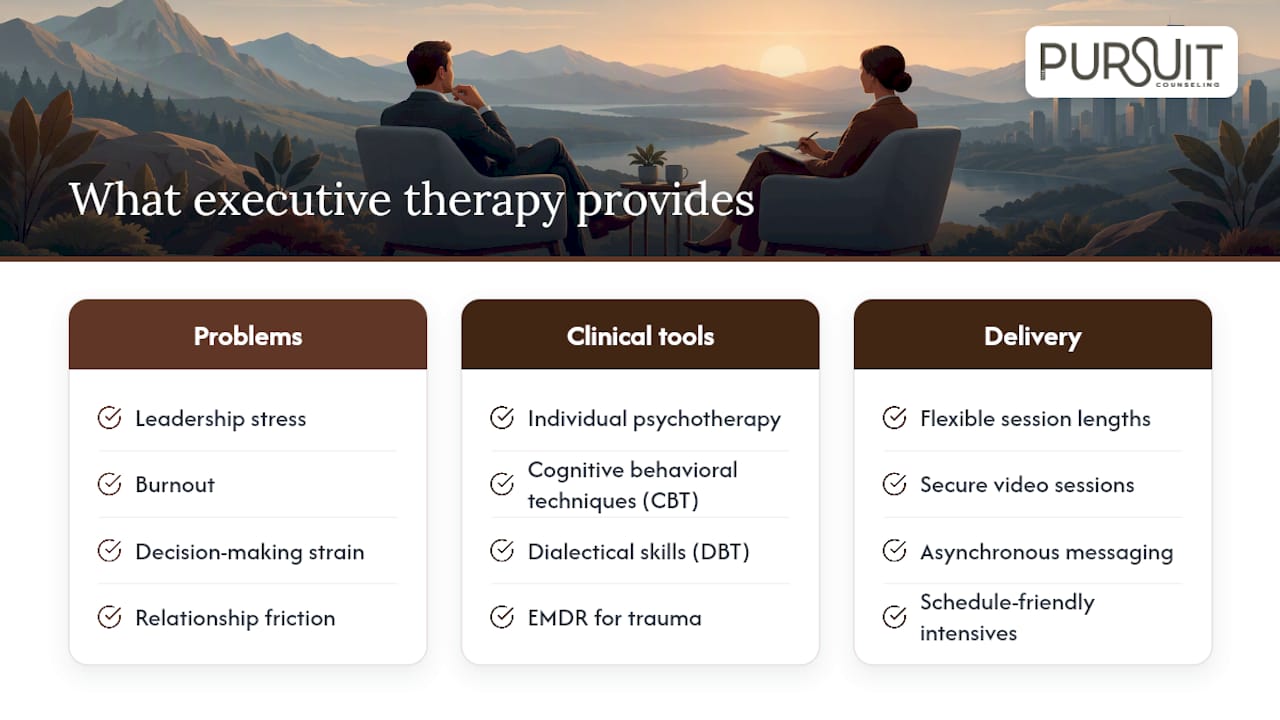
Leadership does not create a unique mental illness, but it does create a specific weight: constant decision fatigue, isolation at the top, strained relationships at home, and a body that has forgotten what rest feels like; addressing these challenges is key to supporting mental health at work. Online therapy for executives typically addresses leadership stress, burnout, decision-making strain, relationship friction, disrupted sleep, anxiety, and, when relevant, a clinician’s screening for substance use as a coping tool. None of these require slowing down to solve. They require the right kind of attention.
The clinical tools behind good executive therapy are not exotic. Individual psychotherapy remains the foundation, often paired with cognitive behavioral techniques for restructuring the thought patterns that fuel overwork, or DBT skills for regulating the intensity that comes with high-stakes roles. When trauma is part of the picture, EMDR is used where clinically indicated. Some practices add neurofeedback as an adjunct tool for attention and regulation. For executives who cannot fit weekly sessions into a travel-heavy calendar, intensives condense the work into fewer, longer blocks.
Delivered online, these approaches adapt without losing structure. Session length can flex around a leader’s schedule rather than a fixed 50-minute slot, secure video replaces the waiting room, and some practices offer asynchronous messaging between sessions for continuity. The format changes. The clinical rigor should not. For a closer look at why performance and title rarely protect against burnout, see why many executives seek therapy.
What the research says about teletherapy, and where it stops working
The evidence for teletherapy is more established than most executives assume. The American Psychiatric Association describes telepsychiatry, delivered by video and in some cases audio, as a format with comparable effectiveness, diagnostic accuracy, and patient satisfaction when properly delivered. That comparability is the whole point: teletherapy is not a lesser substitute, it is a different delivery method for the same clinical work.
Real-world platform data show teletherapy users had significantly higher odds of clinical improvement in depressive symptoms compared with assessment-only users, according to outcomes data published on PMC, with telecoaching also showing favorable cost outcomes for some users. That distinction matters for executives choosing between clinical treatment and performance coaching, a decision covered in the next section.
Teletherapy has real limits. It is generally not the right setting for complex psychosis, acute safety risk, or severe substance withdrawal, situations that call for in-person, higher-acuity care. A competent online clinician should recognize these boundaries and refer out rather than try to manage them remotely. Convenience is a benefit of telehealth, not a reason to choose it when the clinical picture calls for something else.
Therapy or coaching: how to pick the right lane
Confusing these two costs executives time and money. Therapy is clinical assessment and treatment delivered by a licensed professional, aimed at diagnosing and treating conditions like anxiety, depression, or burnout. Coaching is performance-focused. It sharpens decision-making, leadership presence, and strategy, but a coach is not providing clinical treatment, a distinction the American Psychiatric Association draws clearly in its guidance on telehealth roles.
A few cues help you sort which one you need:
- If sleep, mood, or relationships are impaired beyond a rough patch, that points toward therapy, not coaching.
- If the goal is sharper execution or leadership skill with no underlying clinical symptom, coaching may be the better fit.
- If you are unsure, ask a licensed clinician for a brief consult before committing to either path.
Before booking, ask any provider three things: are they licensed, do they keep clinical records, and what happens if symptoms emerge that require treatment beyond their scope. A coach who cannot answer the third question honestly is not the right person for a client showing clinical symptoms.
How to choose an online therapist who gets it
Fit matters more for executives than for almost any other client group, because the wrong clinician will either underestimate the stakes of your role or, worse, tell you to slow down as if that were a viable strategy. A short consult, 10 to 15 minutes, is enough to find out.
- Confirm the clinician is licensed, and licensed in the state where you are physically located during sessions, not just where they practice.
- Ask about documented experience with high achievers, executives, or similarly high-pressure roles.
- Clarify scope: are they providing clinical treatment or performance coaching, and how do they distinguish the two in practice.
- Verify the platform is HIPAA-compliant with a signed Business Associate Agreement, standard guidance from HHS on telehealth technology.
- Ask for written informed consent covering confidentiality limits and emergency procedures.
- Ask what happens if the connection fails mid-session, and whether there’s a documented backup plan.
- Confirm scheduling flexibility, including whether intensives or condensed formats are available for travel-heavy calendars.
Pro Tip: Ask your prospective clinician directly, “What’s your plan if we lose connection during a session?” Their answer tells you more about their preparedness than any credential on a website.
Employer-sponsored EAPs can lower the cost barrier, but they often involve less control over who sees your records and how. Executives who need maximum confidentiality frequently choose private-pay arrangements instead, trading a lower price for tighter control over who has access to their information. For more on vetting a therapist’s fit before booking, see how to find a therapist who understands high achievers.
What to expect in your first online session
The first session is procedural before it is clinical, and knowing that in advance removes most of the friction. Expect these standard steps, outlined in HHS guidance on informed consent for telebehavioral health:
- Written informed consent covering confidentiality limits and how records are kept.
- Identity and location confirmation, since many states require this for legal telehealth practice.
- A documented emergency contact and crisis plan in case of a safety concern during or between sessions.
- Technology instructions, including what happens if the video connection drops.
On your end, a private room, headphones, and a personal device rather than a workplace laptop go a long way toward protecting confidentiality, a point reinforced in HHS guidance on protecting patient privacy. If a clinician determines during intake that your needs exceed what telehealth can safely address, a responsible one will pause and refer you to in-person care rather than proceed anyway.
Why The Pursuit Counseling and Adam Glendye fit this work
Adam Glendye, LPC, CPCS, works specifically with CEOs, founders, and high achievers who need customized therapeutic work for executives, from an executive who understands the demands and won’t ask them to “slow down.” The Pursuit Counseling offers online individual therapy, EMDR trauma work, neurofeedback, and the Executive Experience Program for leaders who need concentrated, structured support rather than an open-ended weekly commitment.
Sessions are private-pay, which keeps records outside the reach of employer-linked insurance systems, and scheduling accommodates the reality of a calendar that does not sit still. The practice’s intensive formats exist for exactly this reason: leaders who need real clinical depth without a six-month weekly commitment.
Connecting therapy to how you actually perform
Executives tend to want proof that therapy is working in terms they already track: sharper decisions, fewer reactive blowups in meetings, better sleep that shows up as clearer thinking the next morning. A good clinician will ask you to name your own markers early on, whether that is fewer sleepless nights before a board meeting, steadier communication with a co-founder, or simply noticing irritability before it becomes a snapped response to a direct report.
This is not the same as clinical outcome tracking, which measures symptom change against diagnostic criteria. It is a practical bridge between the clinical work and the metrics you already use to judge whether something is worth your time. Ask your clinician to check in on these personal markers periodically, not because therapy needs to prove its ROI like a marketing campaign, but because noticing change keeps the work honest.
Be cautious of any provider who promises specific performance gains as an outcome of therapy. Clinical work can support clearer thinking and steadier regulation, but no ethical clinician guarantees a leadership result. The honest version is closer to this: better-regulated executives tend to make decisions from a clearer state, and that shows up in how they lead, even though it is not something therapy can promise in advance.
Handling a crisis when your therapist is on a screen
A genuine crisis, active suicidal ideation, a safety threat, or a severe psychiatric episode, needs more than a video call. Before your first session, a responsible clinician documents a specific emergency plan: your physical location during sessions, the nearest emergency service, and a named emergency contact, standard practice outlined in HHS informed consent guidance.
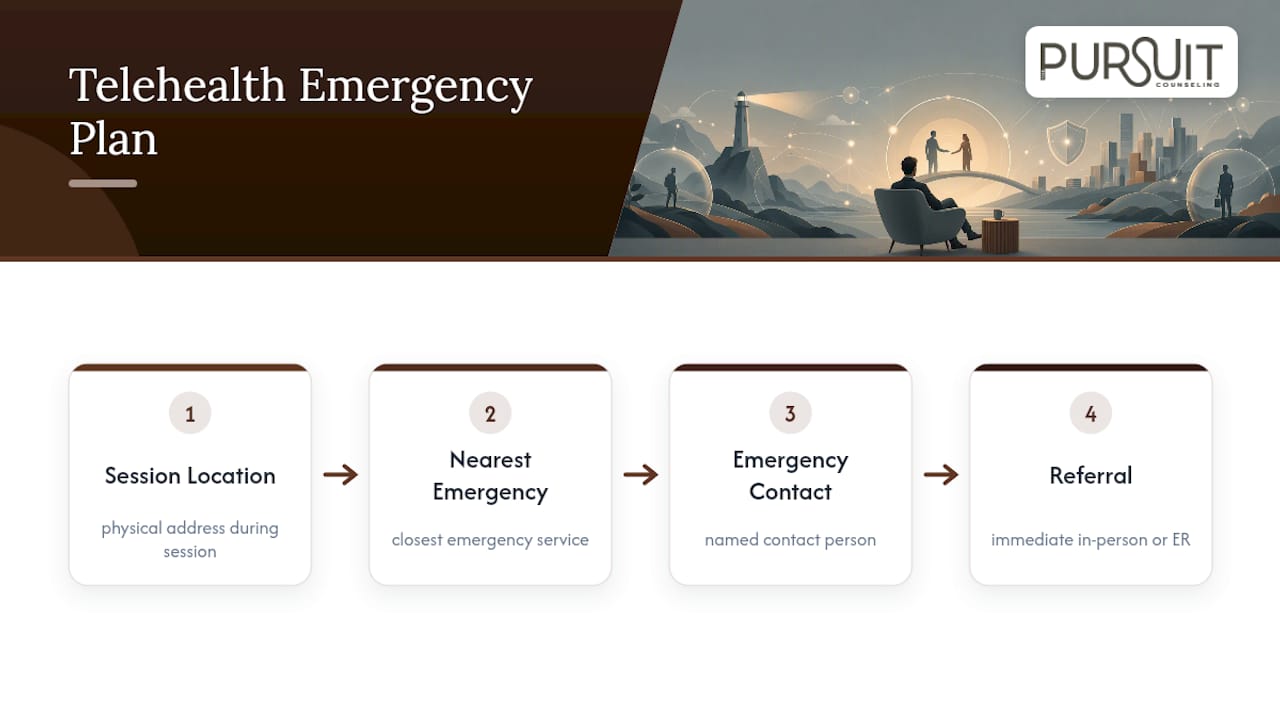
For executives, the added risk is isolation. High-pressure roles often come with an instinct to manage everything alone, including a crisis that needs outside intervention immediately. A telehealth clinician cannot physically intervene, so the plan has to exist in writing before it is needed, not improvised in the moment. If you are in a state where your therapist is not licensed at the time of a crisis, that plan becomes even more important, since their ability to act is jurisdictionally limited.
If a clinician determines during a session that your safety needs exceed what remote care can address, the responsible move is an immediate referral to in-person or emergency care, not continued video sessions. That is not a failure of teletherapy. It is the system working as designed.
Paying for therapy without leaving a paper trail
Most executives choosing online therapy face a real tradeoff between using insurance or an employer-sponsored EAP and paying privately. Insurance and EAPs lower the direct cost, but they typically involve some level of documentation tied to a health record or an employer-linked benefit system, and confidentiality controls vary by plan.
Private-pay arrangements give you more control over who has access to your records, since nothing routes through an insurer or employer system. Pricing varies by provider and service type. As one example, individual therapy sessions commonly range from 5 to 0 per hour depending on the clinician and specialty, while structured programs like an Executive Experience Program run as a flat program fee rather than hourly billing.
Before choosing either path, ask directly what gets documented, who can access those records, and whether the provider will confirm eligibility and cost before your first session. A clinician who cannot answer clearly is not the right choice for someone whose privacy is part of the job.
What holds up over time, and what does not
Teletherapy’s biggest long-term advantage for executives is consistency. A leader who travels four cities in two weeks can keep a standing session by simply changing time zones, not canceling outright. That continuity, more than any single technique, is often what makes sustained progress possible instead of a start-stop pattern that never builds momentum.
The limitation is equally real. Video sessions cannot fully replace the presence of in-person work for certain conditions, and some executives find that a screen adds a layer of distance right when they most need to be fully present. Complex trauma work, in particular, sometimes benefits from in-person EMDR sessions before shifting to a remote maintenance phase. A good clinician will tell you when that shift makes sense rather than defaulting to whatever format is easiest to schedule.
Over months, the format itself becomes less important than the fit between clinician and client. Executives who stick with therapy long enough to see change usually credit the relationship, not the delivery method, for the shift.
What experienced clinicians wish executives knew
You are not going to be told to slow down here, because that advice rarely fits people who are wired to build things. The work is figuring out how to carry the weight without it carrying you, using clinical tools that respect your drive instead of arguing with it. If your judgment, sleep, or relationships are showing strain, a discreet consult is worth the hour.
— Adam Glendye LPC, CPCS
Book a confidential consult with The Pursuit Counseling
Most executives do not need a slower life. They need a therapist who can match their pace without pretending pace is the problem. The Pursuit Counseling offers private-pay, HIPAA-compliant online sessions built around calendars that do not sit still.

- Explore intensive formats if a standing weekly slot does not fit your calendar.
Book a private consult through The Pursuit Counseling to talk through fit before committing to a format.
This article is general information, not a substitute for advice from a qualified doctor. Consult a qualified healthcare professional about your own circumstances before acting on anything here.
Sources
- Telepsychiatry | American Psychiatric Association (Patient Guidance)
- Workforce mental health survey findings | CDC MMWR
- Telehealth
- Real-world outcomes for teletherapy and telecoaching | PMC
FAQ
Is online therapy as effective as in-person therapy for executives?
For many conditions, yes. A systematic review of randomized controlled trials found no significant differences in symptom severity, function, or client satisfaction between telehealth and face-to-face psychotherapy. Fit with the clinician and clarity about scope matter more than the delivery format itself.
What is the difference between executive coaching and therapy?
Therapy is clinical assessment and treatment delivered by a licensed professional, while coaching is performance-focused and does not provide clinical treatment, a distinction the American Psychiatric Association draws in its telehealth guidance. If symptoms are impairing sleep, mood, or relationships, that points toward therapy rather than coaching.
How much does an online therapist for executives cost?
Costs vary widely by provider, specialty, and format. Individual therapy sessions commonly range from 5 to 0 per hour, while structured executive programs are typically priced as a flat program fee rather than billed hourly.
Is my privacy protected in online therapy sessions?
A properly run telehealth practice uses a HIPAA-compliant platform with a signed Business Associate Agreement, per HHS guidance, and documents informed consent before your first session. On your end, using a private space, a personal device, and a secure connection meaningfully reduces the risk of exposure.
When should an executive choose in-person care over teletherapy?
Teletherapy is generally not appropriate for acute safety risk, complex psychosis, or severe substance withdrawal, situations that call for higher-acuity, in-person care. A responsible clinician will identify these limits during intake and refer out rather than continue remote sessions when they are not clinically appropriate.