


Yes. A licensed clinician can deliver full EMDR remotely, and for many clients, online EMDR therapy produces results comparable to sessions in an office. The eight-phase protocol translates well to video, using visual, tactile, or auditory bilateral stimulation instead of an in-person wand or tapper. The exception is high-risk presentations, like active suicidality or severe dissociation, where in-person support remains the safer starting point.
TL;DR:
- Online EMDR is generally as effective as in-person therapy for adult clients with single-incident trauma or anxiety, provided a trained clinician controls pacing and safety.
- Bilateral stimulation during tele-EMDR can be delivered via visual cues, self-tapping, or auditory tones, with clinician oversight being the most critical factor.
- High-risk cases such as active suicidality, severe dissociation, or uncontrolled substance use require in-person sessions due to monitoring and safety needs.
- The first sessions focus on history, stabilization, and practicing BLS, with reprocessing starting around the third session once stability is confirmed.
- Session costs are similar to in-office visits, but online therapy offers greater accessibility and flexibility, with insurance coverage varying by plan and provider.
Table of Contents
- How Online EMDR Therapy Delivers Bilateral Stimulation
- Is Online EMDR as Effective as In-Person Treatment?
- Who Is a Good Fit for Remote EMDR Therapy for Anxiety and Trauma
- What Your First Online EMDR Sessions Look Like
- Setting Up for a Reliable Online EMDR Session
- Vetting a Provider for Remote EMDR Counseling
- How The Pursuit Counseling Approaches Online EMDR
- Cost and Insurance for Online vs. In-Person EMDR
- The Honest Take on Online EMDR
- Ready to Start Online EMDR With The Pursuit Counseling
- Sources
- FAQ
How Online EMDR Therapy Delivers Bilateral Stimulation
Nothing about the eight EMDR phases changes when the session moves to a screen. Your clinician still walks through history-taking, stabilization, and target identification before touching the trauma memory itself. What changes is the delivery of bilateral stimulation, or BLS, the back-and-forth sensory input that helps your brain reprocess a stuck memory.
Clinicians trained in tele-EMDR generally use three approaches:
- Visual BLS: a screen-shared moving dot, bar, or light that your eyes track left to right.
- Self-tap or butterfly hug: you cross your arms and tap your own shoulders in rhythm, guided verbally by your therapist.
- Auditory tones: alternating sounds through headphones, panned left and right in sync with the reprocessing pace.
Your clinician controls the speed, direction, and intensity of BLS in real time, watching your face and body language over video the same way they would across a room. A Frontiers-related study on online EMDR found that clinician control over BLS pacing and modality matters more than which specific tool delivers it. Reprocessing itself, the phase where you actually work through the memory, typically doesn’t begin until your therapist confirms you’re stabilized and ready. That groundwork usually takes a session or two.
Is Online EMDR as Effective as In-Person Treatment?
The research on virtual EMDR is younger than the therapy itself, but the early signal is encouraging. A 2024 review published on PMC concluded that online EMDR follows the same clinical principles as in-office EMDR and has shown feasibility and relative safety across small studies. The catch: high-quality randomized controlled trials are still scarce, and the review calls for more rigorous research before anyone declares full parity.
Several small studies and single-arm trials have reported symptom reductions after online EMDR that are comparable to in-person outcomes for many adult patients, with few adverse events noted in these smaller cohorts.
That’s a real finding, but it comes with real limits. Sample sizes are modest, designs vary, and most of this evidence covers adults with single-incident trauma or moderate PTSD rather than the most complex cases. A separate set of clinical series and trial reports echoes this pattern: consistent improvement, but not yet the volume of data that in-person EMDR has accumulated over three decades.
Safety limitations matter just as much as efficacy data:
- Active suicidal ideation or recent self-harm generally requires in-person evaluation first.
- Severe dissociation can be harder to monitor and interrupt safely over video.
- Active, uncontrolled substance use complicates both stabilization and reprocessing.
Reputable telehealth practices manage this risk with a written safety plan, a local emergency contact on file, and a clear protocol for pausing reprocessing if a session destabilizes. That’s not paperwork for its own sake. It’s the difference between a therapist who’s prepared and one who’s improvising.
Who Is a Good Fit for Remote EMDR Therapy for Anxiety and Trauma
Online EMDR tends to work well for people managing anxiety, single-incident trauma, grief, and performance-related stress, including the kind that shows up in high-pressure careers. If you’re weighing EMDR therapy for anxiety online specifically, that’s one of the better-supported use cases in the current literature. Many PTSD presentations also respond well, particularly when the client is already stable enough to travel to an office but chooses telehealth for convenience.
In-person care is the safer starting point for:
- Active suicidal ideation or recent self-harm.
- Severe or unmanaged dissociation.
- Uncontrolled substance use.
- Very young children, who often need a caregiver physically present to co-regulate BLS.
Accessibility matters too. Remote sessions remove commute time and expand your choice of therapists, which client-facing guidance from Alma points to as one of telehealth’s clearest practical advantages, especially for clients with mobility limitations or rigid work schedules.
What Your First Online EMDR Sessions Look Like
Your first sessions won’t involve reprocessing at all, and that’s by design. Here’s the general sequence:
- History and safety screening. Your therapist reviews your history, current symptoms, and any risk factors before setting a treatment plan.
- Stabilization and BLS practice. You’ll test the bilateral stimulation method (visual, tactile, or auditory) and build coping skills, with no trauma processing yet.
- Reprocessing begins, often around session three to five for single-incident trauma, once your therapist confirms you can tolerate the material.
- Closure and aftercare close every processing session, bringing you back to a calm state before you log off.
Sessions typically run about an hour or more. Ask your therapist how they handle closure if time runs short, and build a buffer afterward. You’ll want quiet time, not a Zoom call straight into a work meeting.
Setting Up for a Reliable Online EMDR Session
Your setup either supports the work or gets in the way of it. A few adjustments make a real difference:
- Device and screen size: a laptop or tablet, positioned at eye level, works better than a phone. EMDRIA’s client guidance notes that larger screens allow for wider eye sweeps, which may enhance visual BLS effectiveness.
- Audio: wired headphones reduce the latency that Bluetooth sometimes introduces, which matters for auditory BLS timing.
- Internet: a wired connection or strong Wi-Fi signal prevents the freezing and lag that can interrupt a reprocessing session mid-wave.
- Privacy: a room with a door that closes, and a heads-up to household members not to interrupt.
- Backup plan: agree on a phone number to call if video drops, and know who your local emergency contact is.
Pro Tip: If visual BLS feels weak or hard to track on your screen, say so. Switching to self-tapping or auditory tones takes seconds and often works just as well.
If privacy at home is a genuine concern, some clients also think through how to structure a private, uninterrupted space the way practical guidance on protecting personal conversations online recommends, applying the same logic to therapy sessions as to any sensitive video call.
Vetting a Provider for Remote EMDR Counseling
Not every therapist who owns a webcam is qualified to run tele-EMDR well. Before booking, verify a few things directly.
- Training: ask whether they completed EMDRIA-approved training or a program through the EMDR Institute, and how much supervised EMDR experience they have.
- Licensing: confirm they’re licensed in the state where you’re physically located during sessions. Telehealth rules require this regardless of where the therapist’s office sits.
- Safety protocols: ask what their plan is if you become highly distressed or dissociate mid-session, and whether they keep a local emergency contact on file.
- Logistics: ask about session length, cancellation policy, and how they bill.
Treat a few answers as immediate red flags: no written safety plan, vague answers about training, or any app claiming its self-guided tool replaces clinician-led reprocessing. EMDR is a clinical protocol, not a mobile feature.
How The Pursuit Counseling Approaches Online EMDR
The therapy practice builds its online EMDR sessions around the same collaborative, evidence-based model used in its Fayetteville, Georgia office, serving clients in several nearby communities. Sessions are led by clinicians like Adam Glendye LPC, CPCS, whose CPCS credential reflects clinical supervision standards beyond a basic license. That matters when you’re trusting someone to guide reprocessing through a screen.
The practice’s approach stays safety-first and collaborative, blending online and in-person sessions when a client’s case calls for it, rather than forcing every client into one delivery format regardless of need.
Cost and Insurance for Online vs. In-Person EMDR
Cost is often the deciding factor between online and in-person EMDR, and the differences are smaller than most people expect. Session length and clinician training drive price more than delivery format does. A tele-EMDR session with a licensed clinician typically costs about the same as an in-office visit, since you’re paying for the same protocol, the same phase-by-phase structure, and the same amount of clinical time.
Where online sessions save money is indirectly: no gas, no parking, no time off work for a commute, and often a wider pool of therapists to choose from, which can mean better fit without a rate premium.
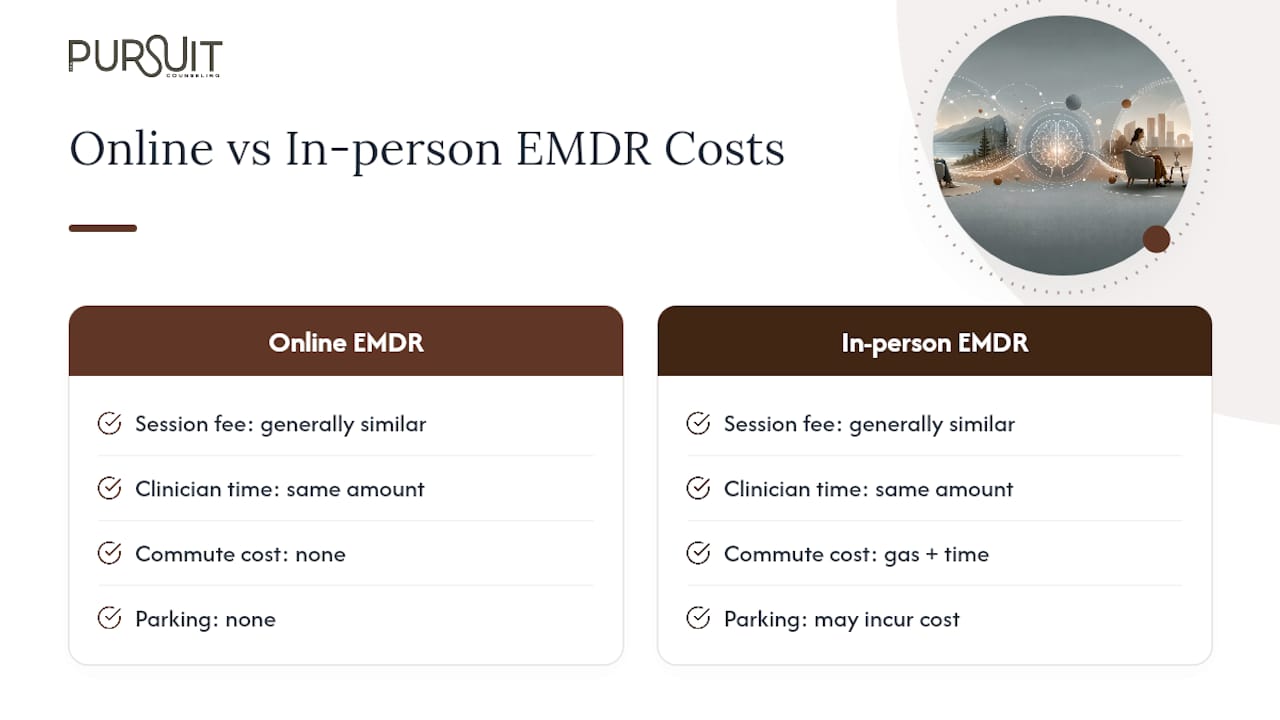
Insurance coverage for EMDR, online or in-person, depends entirely on your specific plan and whether the provider is in-network. Some insurers reimburse telehealth mental health visits at the same rate as in-person visits under parity laws; others apply different rules or session limits. This practice operates on a private-pay model rather than billing insurance directly, meaning pricing is set by the practice rather than an insurer’s fee schedule. If cost is a major factor in your decision, ask directly during your first contact: what a session costs, whether a superbill is available for out-of-network reimbursement, and whether intensive formats offer any different pricing structure than standard weekly sessions.
Don’t assume online means cheaper. Assume it means more flexible, and confirm the dollar figure directly with the provider before you book.
The Honest Take on Online EMDR
Most articles on this topic oversell certainty in one direction or another. Either online EMDR gets treated as a flawless substitute for in-person care, or it gets waved off as a watered-down version because the research base is still thin. Neither holds up.
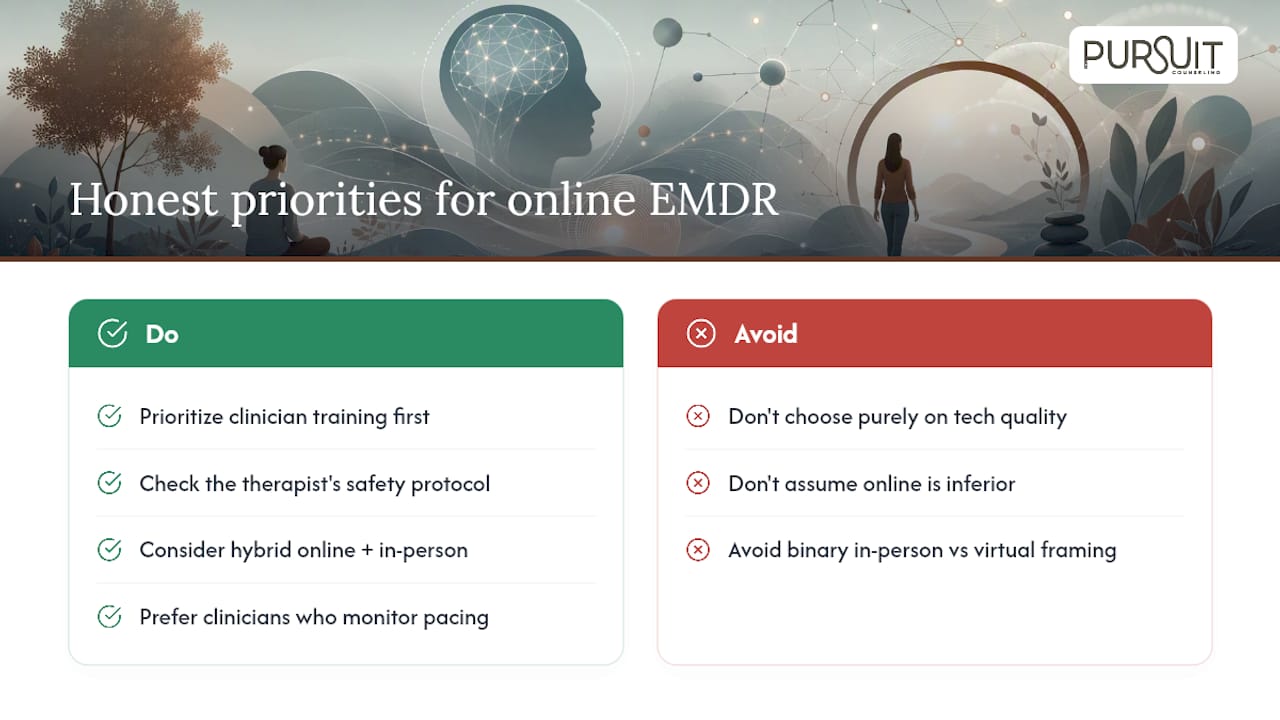
The judgment the evidence actually supports is narrower and more useful: online EMDR, delivered by a trained clinician who controls pacing and monitors you closely, works for a meaningful share of adult clients, particularly those with single-incident trauma, anxiety, or performance-related stress. The conventional advice that fails readers is the binary framing, that you must choose either full in-person treatment or a fully virtual substitute. Real practice is more fluid than that. A clinician might start you online and shift to in-person for a specific reprocessing session if you’re stuck on a particularly heavy memory.
What should you prioritize first? Not the technology. The clinician’s training and their safety protocol, in that order. A skilled therapist with a shaky Wi-Fi connection will still get you further than a mediocre one with perfect video quality.
— Adam Glendye LPC, CPCS
Ready to Start Online EMDR With The Pursuit Counseling
The Pursuit Counseling gives you a clinician-led alternative to app-based EMDR tools that promise reprocessing without a trained human guiding the pace, watching your reactions, or holding a safety plan if things get hard. That distinction is the whole point of trauma work done well.

Getting started takes three steps. First, review the services and specialties page to see how EMDR fits alongside anxiety, trauma, and life-transition support. Second, check the EMDR program page for details on how sessions are structured, online and in-person. Third, book a consult and come prepared with direct questions: what state licensing your clinician holds, what their safety plan looks like if a session gets heavy, and how session structure and cancellation policy work. If you’re unsure what to ask beyond that, this guide to first-session questions covers the basics before you ever log on.
Sources
The clinical claims in this guide lean on a small set of sources worth your own read. The 2024 PMC review is the most rigorous summary of feasibility and safety data available. EMDRIA’s client guide is the most practical, written directly for people preparing for their first tele-EMDR session. The clinical series on PMC shows what real outcome data looks like, warts and all.
This article is general information, not a substitute for advice from a qualified doctor. Consult a qualified healthcare professional about your own circumstances before acting on anything here.
- Your Guide to a Successful Online EMDR Therapy Session: Tips for Clients – EMDR International Association
- Can You Do EMDR Therapy Online? How Does It Work? — Alma
FAQ
Can You Do EMDR Online by Yourself?
No. EMDR is a clinical protocol that requires a trained therapist to guide pacing, monitor your reactions, and manage stabilization and closure. Self-guided apps may offer relaxation tools, but they don’t replace clinician-led reprocessing.
Is It Safe to Do EMDR Therapy Online?
Yes, for most adults with single-incident trauma, anxiety, or moderate PTSD, when a licensed clinician leads the session. A 2024 review found online EMDR feasible and relatively safe in small studies, though people with active suicidality, severe dissociation, or uncontrolled substance use should start with in-person care.
Will Insurance Cover EMDR Therapy?
Coverage depends on your specific insurance plan and whether the provider is in-network, and it can differ for online versus in-person sessions under telehealth parity rules. The Pursuit Counseling operates on a private-pay model, so ask directly about session costs and superbill options for potential out-of-network reimbursement.
Which Online EMDR Platform Is Best?
There’s no single winning platform. What matters more is whether your clinician can reliably deliver visual, tactile, or auditory BLS and maintain video quality good enough to monitor your reactions closely, criteria EMDRIA’s client guidance emphasizes over any specific app or software.