


A therapist is a state-licensed clinician who diagnoses and treats mental health conditions; a life coach is a goal-focused accountability partner who operates outside the healthcare system. Choose therapy when you have clinical symptoms, past trauma, or a crisis. Choose coaching when you are functioning well and need focused momentum.
If you are in crisis right now: call or text 988 (Suicide and Crisis Lifeline) or go to your nearest emergency room. Do not wait for a coaching call.
For everyone else, here is the fast triage:
- Therapy first if you experience persistent anxiety, depression, trauma responses, relationship dysfunction, or anything that impairs daily functioning.
- Coaching first if you are psychologically stable and want to accelerate a specific goal: a promotion, a leadership transition, a performance plateau.
- Both, in sequence or concurrently, when a high performer has cleared the clinical work and wants to build on it. Knowing when those two paths intersect is where the real leverage lives.
Table of Contents
- How a life coach and therapist actually compare
- How to decide which one is right for you
- What to expect in a session: therapy vs coaching
- How costs and insurance coverage differ
- How to vet a provider before you pay
- When to escalate to emergency care
- Key Takeaways
- The case for using both, and knowing which comes first
- What The Pursuit Counseling offers for both paths
- Useful sources for verification and further reading
How a life coach and therapist actually compare
The table below captures the dimensions that matter most when you are making a real decision.
| Dimension | Therapist | Life Coach |
|---|---|---|
| Focus / primary goals | Treat mental health conditions; reduce symptoms; process trauma | Achieve specific goals; build accountability; improve performance |
| Typical issues addressed | Anxiety, depression, PTSD, grief, relationship dysfunction, addiction | Career transitions, leadership development, productivity, life direction |
| Training & credentials | Master’s or doctoral degree + supervised clinical hours + state licensure (LPC, LCSW, LMFT, PsyD, PhD) | Voluntary credentials (ICF: ACC, PCC, MCC; CCE Board Certified Coach); no universal licensing requirement |
| Ability to diagnose | Yes, within scope of licensure | No |
| Session format | Exploratory, process-oriented; may use CBT, EMDR, DBT, or other evidence-based modalities | Action-oriented; goal-setting, accountability check-ins, skill-building |
| Duration / commitment | Weeks to years depending on presenting concerns | Weeks to months; often time-limited by goal |
| Cost & insurance | Varies by provider; insurance frequently covers therapy | Private-pay only; not covered by insurance |
| When to choose | Clinical symptoms, crisis, trauma history, impaired functioning | Stable functioning, specific goal, desire for accountability |
| Red flags | Unlicensed provider claiming to do therapy; no crisis protocol | Promises to “cure” trauma; diagnoses without a license; high-pressure sales |
Verdict: If your pain has a clinical name, you need a therapist. If your problem is a gap between where you are and where you want to be, a coach can close it faster.
How to decide which one is right for you
Start with the clinical triage, then work down.
Step 1: Check for crisis-level symptoms first
Stop and seek immediate clinical care if you are experiencing any of these:
- Suicidal thoughts or self-harm urges
- Active substance crisis or withdrawal
- Severe dissociation or psychotic symptoms
- Inability to care for yourself or dependents
These require a licensed clinician, not a coach. Recognizing these signs before they escalate is the single most important step.
Step 2: Run the clinical symptom check
Ask yourself honestly: Are you experiencing persistent sadness, anxiety, panic attacks, intrusive memories, disordered eating, or relationship patterns that keep repeating despite your best efforts? If yes, therapy is the right starting point. Mental health professional shortages in many U.S. areas mean waitlists can be long, which sometimes pushes people toward coaching prematurely. Resist that shortcut when clinical symptoms are present.
Step 3: Assess functional stability
If you are sleeping, working, and maintaining relationships without significant impairment, coaching is a legitimate and often powerful choice. The question shifts from “What is wrong?” to “What is next?”
Step 4: Ask the provider these questions before you book
- Are you licensed in this state? What is your license number?
- What is your scope of practice, and what will you refer out?
- How do you handle a crisis that emerges mid-engagement?
- Do you carry professional liability insurance?
- For coaches: Do you hold an ICF credential or CCE Board Certification?
Pro Tip: The most effective model for high performers is often therapy first, then coaching once the clinical work stabilizes. Some clinicians, like those at The Pursuit Counseling, are trained to provide both within a clear scope, which removes the coordination burden from you.
What to expect in a session: therapy vs coaching
The experience inside the room, or on the screen, is genuinely different.
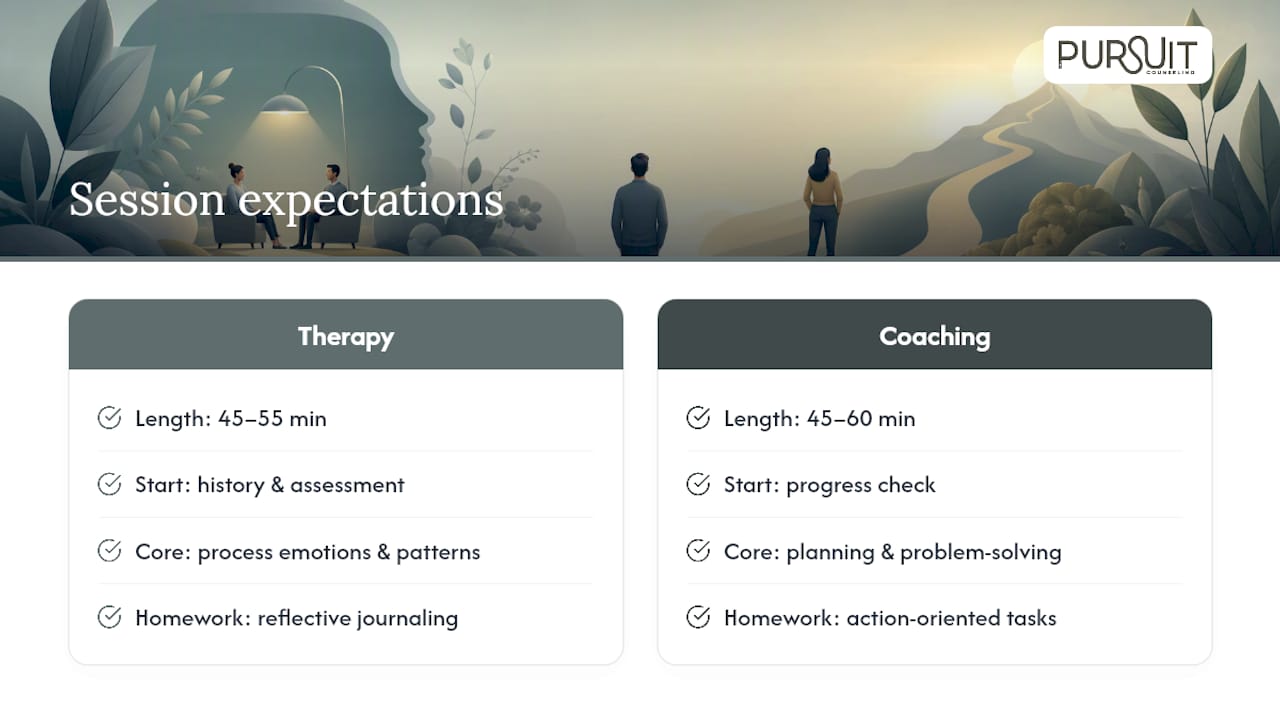
In a therapy session, you will typically spend 45–55 minutes with a licensed clinician. Early sessions focus on history-taking and assessment. Over time, sessions become more exploratory: processing emotions, identifying patterns, and working through evidence-based protocols like EMDR for trauma or CBT for anxiety. Homework tends to be reflective: journaling, thought records, exposure exercises. Communication outside sessions is limited and structured.
In a coaching session, the frame is different from the start. Sessions run 45–60 minutes and open with a progress check on last week’s commitments. The bulk of the time goes to planning, problem-solving, and accountability. Homework is action-oriented: draft the proposal, have the hard conversation, block the calendar. Many coaches communicate between sessions via email or messaging apps, which creates a higher-touch accountability loop.
The pacing differs, too. Therapy often slows down to let something be fully felt before moving forward. Coaching tends to move faster, treating the present moment as the launchpad. Neither is better in absolute terms. They serve different phases of growth.
How costs and insurance coverage differ
Therapy and coaching sit in entirely different financial categories.
Therapy:
- Sessions typically range from 0–0 per hour depending on location, provider credentials, and specialty.
- Insurance frequently covers therapy when a licensed clinician provides a diagnosis; coverage depends on your plan, deductible, and whether the provider is in-network.
- Out-of-network therapy may be partially reimbursable through a superbill submitted to your insurer.
- HSA and FSA funds can typically be used for licensed therapy.
- Georgia-specific insurance rules for therapy are worth reviewing if you are in the state.
Coaching:
- Sessions typically range from 0–0+ per hour; executive and leadership coaches often charge more.
- Coaching is private-pay only. It is not considered healthcare, so insurance does not cover it.
- Some employers offer coaching as a leadership development benefit; check your HR portal.
- HSA/FSA funds generally cannot be used for coaching.
Doctor shortages and long therapy waitlists sometimes push people toward coaching for cost or access reasons. If that is your situation, be honest with yourself about whether coaching is the right clinical fit, not just the available one.
How to vet a provider before you pay
For therapists
- Look up the provider’s license on your state licensing board’s public database.
- Confirm the license is active and has no disciplinary history.
- Ask about their clinical specialty and evidence-based modalities they use.
- Confirm they carry malpractice insurance.
- Ask about their crisis protocol: what happens if you call in distress between sessions?
For coaches
- Ask for their ICF or CCE credential and verify it directly on the credentialing body’s website.
- Ask how many supervised practice hours their training included.
- Request a written scope-of-practice statement.
- Ask what they do if a client presents with clinical symptoms mid-engagement.
- Review their contract for cancellation policies and confidentiality terms.
Red flags that apply to both:
- Promises to “cure” trauma, anxiety, or depression quickly
- Resistance to providing a license number or credential verification link
- High-pressure sales tactics or urgency-based discounts
- No clear referral protocol for clinical emergencies
- Diagnosing a condition without a license
The FTC warns consumers that the coaching market includes financial scams and providers making unsupported health claims. Skepticism is not cynicism here. It is due diligence.
| Verification step | Therapist | Coach |
|---|---|---|
| State license lookup | Required | N/A |
| ICF credential check | N/A | Strongly recommended |
| CCE/BCC verification | N/A | Optional but valuable |
| Scope-of-practice statement | Ask for it | Ask for it |
| Crisis protocol | Required | Required |
| Malpractice insurance | Standard | Ask directly |
When to escalate to emergency care
Some situations move past the therapy-vs-coaching question entirely.
Seek immediate clinical care if you or someone you know is experiencing:
- Suicidal ideation with a plan or intent
- Active self-harm
- Severe dissociation or loss of contact with reality
- Psychotic symptoms (hallucinations, delusions)
- Acute substance withdrawal with physical symptoms
What to do right now:
- Call or text 988 (Suicide and Crisis Lifeline, available 24/7)
- Text HOME to 741741 (Crisis Text Line)
- Call 911 or go to the nearest emergency room for immediate physical danger
An ethical therapist will have a documented crisis protocol and will walk you through it in your first session. An ethical coach will refer you immediately to a licensed clinician if clinical symptoms emerge. If either provider resists these conversations, that resistance is itself a red flag.
Pro Tip: High-performing professionals often delay seeking help because they equate asking for support with weakness. Document your concerns, share them with a trusted clinician, and let the professional make the clinical call. That is not weakness. That is the same discipline you apply to every other high-stakes decision.
Key Takeaways
A therapist treats diagnosable mental health conditions under state licensure; a life coach supports goal achievement in a private-pay, unregulated market, and the right choice depends entirely on your clinical status.
| Point | Details |
|---|---|
| Licensure is the dividing line | Therapists hold state licenses (LPC, LCSW, LMFT, PsyD/PhD); coaches have voluntary credentials at best. |
| Insurance covers therapy, not coaching | Therapy is frequently insurance-eligible; coaching is always private-pay. |
| Crisis requires a clinician | Suicidal ideation, self-harm, or psychosis requires a licensed therapist or emergency services, not a coach. |
| Vet every provider | Verify therapist licenses on state boards; verify coach credentials via ICF or CCE before paying. |
| The Pursuit Counseling | Offers licensed therapy, EMDR, neurofeedback, and executive coaching for high performers in Georgia, in-person and online. |
The case for using both, and knowing which comes first
The debate between therapy and coaching often gets framed as a binary. In practice, for high performers, it rarely is.
What I see consistently is this: the executives, pilots, and leaders who get the most out of coaching are the ones who have already done real clinical work. They have processed the trauma that was driving the perfectionism. They have addressed the anxiety that was masking itself as ambition. Once that foundation is solid, coaching becomes exponentially more effective because there is no clinical weight dragging against the momentum.
The reverse, though, is a real problem. Coaching a person who has unresolved clinical symptoms is like trying to build the second floor of a house before the foundation has set. You can make progress, but the structural instability will surface eventually, usually at the worst possible moment.
What I find most useful is a clear handoff protocol. When a client in a coaching engagement shows signs of clinical distress, the ethical move is an immediate warm referral to a licensed clinician, not a pivot to playing therapist. And when a therapy client has stabilized and is ready to build, integrated coaching and counseling for leaders creates a continuity that neither service alone can match.
The cracks in high performers are not signs of failure. They are where the real work begins. Knowing which kind of professional to bring in at which moment is not a weakness. It is the most strategic decision you can make.

What The Pursuit Counseling offers for both paths
High performers in Georgia do not always fit neatly into one box, and The Pursuit Counseling is built for exactly that reality. The practice offers individual therapy for anxiety and life transitions, trauma treatment through EMDR and neurofeedback, couples therapy, and executive coaching, all under one roof with licensed clinicians who understand the specific pressures of leadership, high-stakes careers, and peak performance.

The model is private-pay and fee-for-service, with both in-person and online sessions available. That means no insurance gatekeeping, no diagnostic labels required to access support, and a clear scope of practice that tells you exactly what you are getting. When therapy is the right starting point, the clinical team handles it with evidence-based precision. When coaching is the right next step, the transition is built into the process rather than left to chance.
If you are ready to figure out which path fits your situation, getting started is straightforward. Schedule a consult, ask the hard questions, and let a licensed clinician help you make the call.
Useful sources for verification and further reading
Use these directly before hiring any therapist or coach.
- https://www.gcu.edu/blog/psychology-counseling/life-coach-vs-therapist-what-are-differences
- Life coaching vs. therapy. Here are the key differences : Shots — Health News : NPR
- consumer.ftc.gov
- coachingfederation.org
- cce-global.org
- coursera.org
- kff.org
- ama-assn.org
This article is general information, not professional medical or mental health advice. Verify current licensing requirements and clinical fit with a qualified professional before making any care decision.