


Impostor feelings show up in the majority of leaders at some point, and they are not proof that you are unqualified for the role you hold. If you feel that gap between how competent people think you are and how competent you feel, the first move is small: name the thought as “impostor feeling” rather than fact, then write down one recent success or ask a colleague for one piece of specific feedback. From there, this guide walks through the warning signs, the strategies that actually work, how the feeling changes as you climb, what your organization can do, and when it is time to talk to a professional.
TL;DR:
- Impostor feelings often persist at all leadership levels and are linked to higher anxiety, depression, and burnout, especially in visible, high-stakes roles.
- Common signs include dismissing praise, overworking, avoiding visibility, micromanaging, and creating lower team psychological safety.
- Strategies such as reframing thoughts, keeping competence journals, and seeking specific feedback help leaders manage impostor syndrome effectively.
- Senior leaders experience a shift in impostor feelings toward doubts about expressing uncertainty, not skill gaps, which can be addressed with decision frameworks and external advice.
- Organizational efforts like modeling vulnerability, building measurable feedback systems, and encouraging openness significantly reduce impostor culture and should complement individual coaching or therapy.
Table of Contents
- What Is Impostor Syndrome in Leaders?
- What Are the Signs of Impostor Syndrome in Leadership?
- How Can Leaders Overcome Impostor Syndrome?
- Does Impostor Syndrome Get Worse With Seniority?
- What Can Organizations Do to Reduce Impostor Culture?
- When Should a Leader Seek Professional Help?
- A Clinical Note on What Actually Changes for Leaders
- How The Pursuit Counseling Supports Leaders Through Impostor Feelings
- Research and Reading
- Sources
- FAQ
What Is Impostor Syndrome in Leaders?
Impostor phenomenon describes the persistent belief that your success is due to luck, timing, or other people’s generosity rather than your own competence, paired with the fear that you will eventually be “found out.” It is not a clinical diagnosis you will find in the DSM. It is a psychological pattern, first named by researchers Pauline Clance and Suzanne Imes in 1978, and it behaves more like a habit of mind than an illness.
That does not make it harmless. Persistent impostor feelings correlate with higher rates of anxiety, depression, and burnout, and the pattern tends to compound rather than fade with success. Leadership roles intensify it for three specific reasons:
- Visibility. Every decision is watched, and mistakes travel faster up an org chart than credit does.
- Judgment under uncertainty. Leaders are paid to decide without complete information, which feels indistinguishable from guessing when self-doubt is loud.
- Promotion triggers. A new title resets the internal scorecard. Skills that felt solid at one level suddenly feel untested at the next.
Executive coaching and evidence-based therapy both treat these patterns effectively when paired with organizational change, according to MIT Sloan Management Review.
What Are the Signs of Impostor Syndrome in Leadership?
Impostor feelings rarely announce themselves directly. They surface as behavior first, and leaders are often the last to connect the dots.
Cognitive signs:
- Discounting praise (“they’re just being nice”) or attributing wins to luck, timing, or a strong team rather than your own decisions.
- Rehearsing worst-case scenarios before meetings where your competence isn’t actually in question.
Behavioral signs:
- Overworking to “prove” a right to the seat, chronic perfectionism, and difficulty delegating even routine tasks.
- Avoiding visibility: skipping opportunities to present, publish, or speak because exposure feels risky.
Team-level effects:
- Micromanagement that slows decisions and signals distrust.
- Lower psychological safety on the team, since a leader who can’t tolerate their own uncertainty rarely tolerates it in others.
A Korn Ferry survey cited by Fortune found 71% of U.S. CEOs report impostor feelings at some point in their careers. That figure alone should reframe how you read your own doubt: it’s a common leadership experience, not a personal defect.
How Can Leaders Overcome Impostor Syndrome?
The goal isn’t to eliminate self-doubt. It’s to stop it from dictating your decisions. These six tactics work in roughly the order most leaders need them, from immediate relief to durable change.
- Reframe the thought, don’t argue with it. Brief cognitive techniques drawn from CBT ask you to separate the automatic thought (“I got lucky”) from the evidence (“I made three specific calls that worked”). Write the reframe down. The act of writing forces specificity that pure reflection skips.
- Keep a competence journal. Log wins, hard calls, and direct feedback weekly. Impostor feelings thrive on vague memory; a written record externalizes proof you can reread on a bad day.
- Run small behavioral experiments. Take one calculated risk you’d normally avoid, like speaking up first in a meeting, and track the actual outcome against your predicted disaster. The gap between fear and result is the data that retrains the pattern.
- Build delegation protocols. Map your team’s skills against your task list and hand off anything someone else can do at 80% of your quality. Overwork born from “proving yourself” is the single most common way impostor feelings quietly damage leadership capacity.
- Join a peer group or hire a coach. Talking with other leaders who carry the same doubt does more to normalize it than any solo exercise. It also gives you a sounding board for decisions you’d otherwise second-guess alone.
- Ask for behavior-specific feedback. Instead of “how am I doing,” ask “what did I do in that negotiation that worked, and what would you change.” Vague praise feeds impostor doubt; specific feedback starves it.
Pro Tip: Set a recurring 15-minute calendar block every Friday to update your competence journal. Momentum matters more than length. Three bullet points a week beats a detailed entry you write twice a year.
Yale’s career development guidance backs a related tactic for leaders in new roles: leaning into curiosity, taking visible notes, and asking structured questions, rather than performing certainty you don’t yet have. Their research on job transitions found this approach reduces impostor-driven anxiety faster than self-reassurance alone.
Does Impostor Syndrome Get Worse With Seniority?
It doesn’t disappear at the top. It changes shape. Junior impostor feelings usually center on skill gaps; senior impostor feelings center on whether it’s acceptable to say “I don’t know” at your level at all, according to Executive Edge Magazine.
Role transitions and judgment-based decisions trigger it more than any actual competence deficit. A newly promoted VP doesn’t suddenly forget how to run a P&L; she starts second-guessing calls that have no clean right answer, and that ambiguity gets misread as personal failure.
The fix starts with a distinction: separate genuine competence doubt from permissible uncertainty. Judgment calls are supposed to feel uncertain. That’s the job, not a symptom.
- Use structured decision frameworks (pre-mortems, decision logs, weighted criteria) so judgment calls rest on process, not gut alone.
- Build a small external peer advisory group, people outside your reporting chain who can pressure-test decisions without office politics.
- Delegate authority explicitly and in writing, so “I don’t know yet” reads as leadership, not as a gap you’re hiding.
What Can Organizations Do to Reduce Impostor Culture?
Individual coping strategies only go so far when the culture around a leader keeps rewarding false certainty. Organizations that take this seriously build systems, not slogans.
- Model “I don’t know” from the top. When senior leaders admit uncertainty and show how they resolve it, that behavior becomes safe for everyone below them.
- Build measurable feedback systems. Vague annual reviews feed impostor doubt. Frequent, specific, behavior-based feedback starves it.
- Sponsor mentorship and affinity groups. These matter especially for leaders who are underrepresented in their role or industry, where impostor feelings often compound with isolation.
- Skip performative programs. A one-off “impostor syndrome workshop” changes nothing if performance reviews still punish visible uncertainty. Invest in the culture and leadership development instead.
Pro Tip: If you run a team, ask each direct report privately: “What’s one thing you think I don’t know is going well?” The answers reveal blind spots faster than any survey, and they build the trust that makes psychological safety real rather than aspirational.
When Should a Leader Seek Professional Help?
Some impostor feelings resolve with journaling and a supportive peer group. Others need a trained clinician, especially when the pattern starts costing you sleep, relationships, or clear decision-making.
Watch for these red flags:
- Persistent impairment: the doubt disrupts your work or personal life most days, not just before a big presentation.
- Burnout symptoms: exhaustion, cynicism, and dropping performance despite working more hours, not fewer.
- Anxiety that doesn’t lift, or decision paralysis on calls you used to make easily.
- Interpersonal harm: the doubt is making you harder to work with, not just harder on yourself.
The Pursuit Counseling works with executives, pilots, physicians, and other high performers through executive coaching and leadership counseling, individual psychotherapy, and EMDR when earlier trauma is fueling the pattern. Neurofeedback is also used to help clients regulate the physiological stress response that keeps impostor thinking loud. An initial session typically maps your specific triggers, distinguishes clinical anxiety from situational self-doubt, and sets a plan that matches the severity of what you’re carrying, whether that’s coaching, therapy, or both. Combining individual clinical tools with organizational feedback loops produces the most durable results, a pattern MIT Sloan Management Review has documented across high achievers broadly.
A Clinical Note on What Actually Changes for Leaders
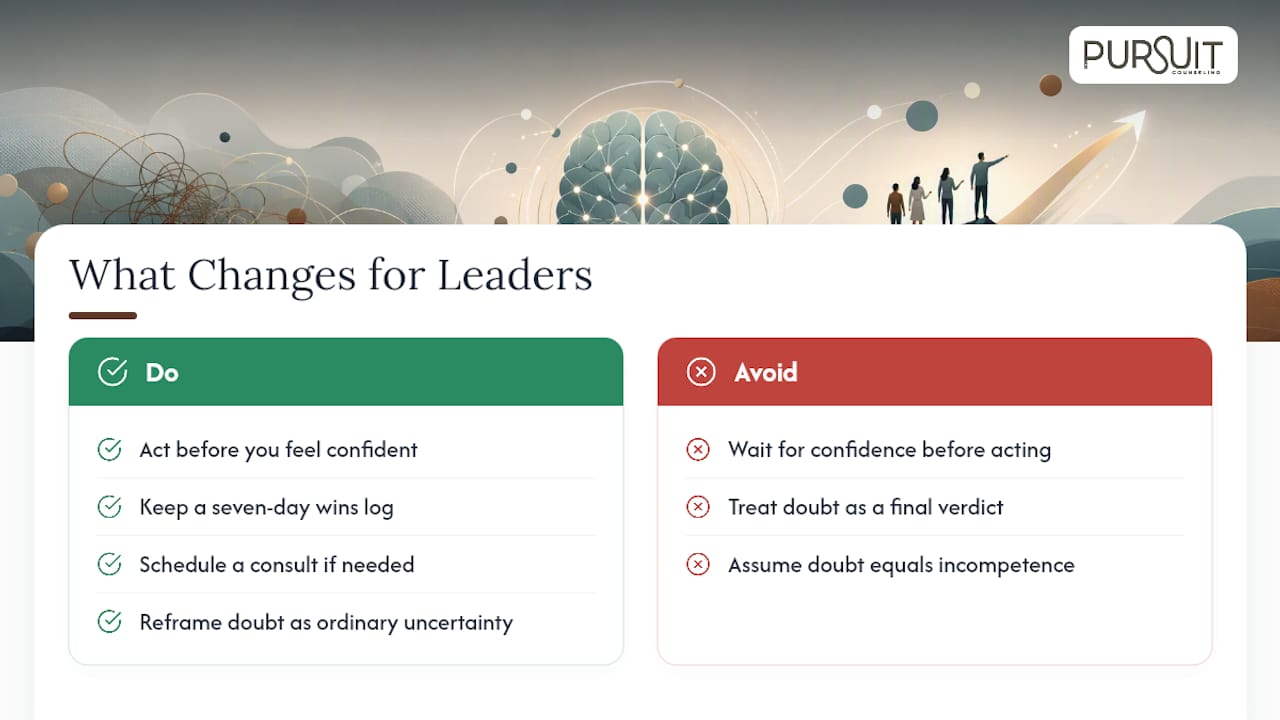
Leaders who work through impostor feelings in coaching or therapy don’t usually report feeling “cured.” They report making faster decisions anyway, doubt and all. That distinction matters more than it sounds. The leaders who improve fastest are rarely the ones with the least self-doubt; they’re the ones who stop treating doubt as a verdict on their competence.
High performance and self-doubt coexist constantly, in boardrooms and cockpits and courtrooms alike. The mistake is waiting to feel confident before acting like a leader. Try this instead: start a seven-day log of specific wins, or if the pattern feels bigger than journaling can touch, schedule a consult and let someone help you sort competence doubt from ordinary uncertainty.
— Adam
How The Pursuit Counseling Supports Leaders Through Impostor Feelings
The Pursuit Counseling is the option built specifically for high performers, not general talk therapy stretched to fit an executive’s schedule. Our approach blends neuroscience-informed methods, EMDR, neurofeedback, and executive coaching, so leaders get both the clinical depth of therapy and the practical, forward-looking structure of coaching in one place.

Leaders who benefit most fall into a few groups: newly promoted executives second-guessing judgment calls, founders and business owners carrying “prove it” pressure, and high performers whose overwork and perfectionism are quietly running them into burnout. A first session maps your specific triggers, distinguishes clinical anxiety from situational self-doubt, and sets goals you can track. If burnout is part of the picture, our counseling for burnout and workplace stress integrates directly with the coaching work. Ready to stop letting doubt run the decision? Book coaching or counseling for leaders and get a plan built around your actual role, not a generic program.
Looking for a therapist or counselor in Fayetteville or Peachtree City, GA? The Pursuit Counseling provides personalized therapy, couples counseling, anxiety treatment, trauma therapy, EMDR, ADHD support, and neurofeedback Brain Mapping for adults, teens, couples, professionals, and families throughout Fayette County and South Atlanta. With a convenient office in Fayetteville, GA, near Peachtree City, Trilith, Tyrone, Senoia, and Newnan, our experienced counselors help clients improve mental health, strengthen relationships, manage stress, and pursue meaningful growth. Schedule a counseling consultation with The Pursuit Counseling today and find the right therapist for you in Fayetteville or Peachtree City, Georgia.
Research and Reading
- UCLA Health: Impostor syndrome and high achievers
- MIT Sloan Management Review: Helping high achievers overcome impostor syndrome
- Fortune: How impostor syndrome sneaks up on high performers
- Executive Edge Magazine: Impostor syndrome in senior leadership
- Yale SOM: Overcoming impostor syndrome in a new job
- Revive Health Therapy: Why evidence-based therapy matters
This article is general information, not a substitute for advice from a qualified doctor. Consult a qualified healthcare professional about your own circumstances before acting on anything here.
Sources
- Impostor syndrome – an inner sense of phoniness – is common among high achievers | UCLA Health
- Impostor Syndrome in Senior Leadership: Why It Doesn’t Disappear, It Changes Shape – Executive Edge Magazine
- How to help high achievers overcome impostor syndrome | MIT Sloan Management Review
- How imposter syndrome sneaks up on high-performing people—and how to beat it | Fortune
- How to Overcome Imposter Syndrome in a New Job – Career Development Yale School of Management
FAQ
What Famous Person Has Talked Openly About Impostor Syndrome?
Public figures across acting, business, and politics have described impostor feelings, and the pattern appears across industries at senior levels, not just among the newly successful, according to Fortune’s reporting on high performers.
What Are the Different Types of Impostor Syndrome?
Researchers commonly describe patterns like the perfectionist, the expert, the natural genius, the soloist, and the superhero, each reflecting a different rule the person holds themselves to for “proving” competence.
What Are the Three C’s of Impostor Syndrome?
Definitions vary across sources, and no single peer-reviewed framework universally defines “three C’s,” so treat any specific list you encounter with caution rather than as a clinical standard.
Does Impostor Syndrome Get Worse the Higher You Rise?
It doesn’t get worse so much as it changes shape, shifting from doubts about skill toward doubts about whether uncertainty is acceptable at your level, per Executive Edge Magazine.
Can Coaching or Therapy Actually Fix Impostor Syndrome?
Coaching and therapy don’t erase self-doubt, but combined with organizational feedback and psychological safety, they measurably reduce how much that doubt controls your decisions, a pattern MIT Sloan has documented, and one The Pursuit Counseling addresses directly through leadership coaching and counseling.