


Typical U.S. executive coaching investments vary widely from moderate amounts for focused sprints to high totals for annual C-suite partnerships, depending on scope and leader level. Per-session rates for mid-market independent coaches generally fall in a moderate range, while executive-level engagements tend to command higher hourly rates. For organizational buyers, the smartest first move is requesting a scoped proposal that separates the base coaching fee from add-ons like assessments, stakeholder interviews, and travel — those extras appear in a minority of engagements and can shift your budget significantly.
Here is what you need to know before you sign anything:
- Short sprint (4–6 sessions): moderate cost range total
- Standard 6-month engagement (biweekly sessions): cost varies significantly depending on coach seniority and contract type
- Annual C-suite retainer: typically a substantial investment reflecting leader level and engagement scope
- Monthly package pricing: usually set at a moderate level for mid-market coaches
- Corporate-sponsored contracts generally have a noticeable premium over individually funded engagements due to additional administrative requirements
Table of Contents
- What do executive coaching rates actually look like across price bands?
- Why do coaches with similar titles charge such different fees?
- Which pricing model actually fits your situation?
- What does a full engagement actually cost? Concrete scenarios
- How do you build a business case and measure ROI?
- How do you evaluate coaches, proposals, and contracts?
- When does executive coaching need clinical backup?
- Key Takeaways
- The real cost of not investing in the right coach
- High-performing leaders deserve more than a generic coaching package
- Useful sources for procurement and further reading
What do executive coaching rates actually look like across price bands?
Price bands in executive coaching reflect differences in credential depth, scope, and complexity of coaching needs. Knowing which band fits your situation keeps you from overpaying for a generalist or underpaying for a problem that needs serious expertise.
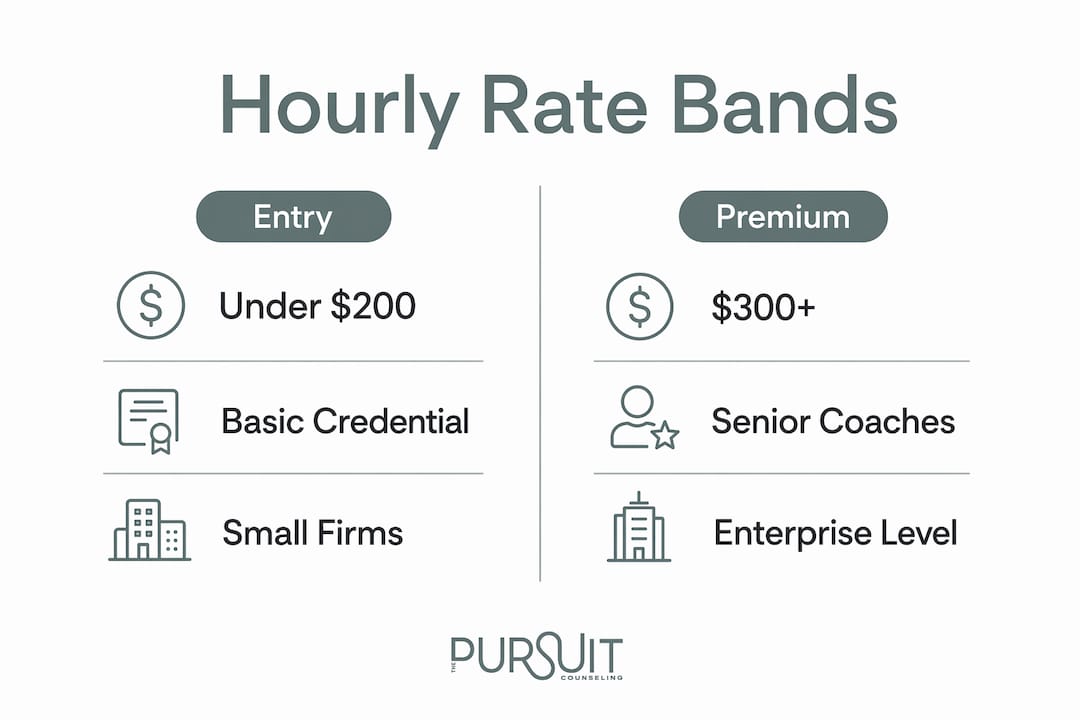
Hourly rate bands and what they signal
| Price Band | Typical Hourly Rate | Best For | Credential / Experience |
|---|---|---|---|
| Entry | Under 0 per hour | Individual contributors, new managers | Non-certified or ACC in training |
| Established | 0–0 per hour | Mid-level managers, directors | ICF ACC or PCC, 3–7 years |
| Senior | 0–0 per hour | VPs, SVPs, senior leaders | ICF PCC or MCC, 8–15 years |
| Elite | Over 0 per hour | C-suite, board-level, complex transitions | ICF MCC, former C-suite, niche domain |
Sample engagement packages
What you actually pay depends less on the hourly rate and more on the package structure. Most coaches bundle sessions, prep time, and a baseline assessment into a single engagement fee. Here is how the three most common formats break down:
- Starter sprint (3 months, 6 sessions): typically costs ,500–,500 and includes an intake assessment and session summaries. Good for a specific leadership challenge or onboarding transition.
- Standard engagement (6 months, 12–16 biweekly sessions): generally falls in the ,000–,000 range depending on coach level and scope. Usually adds a 360-degree feedback tool, mid-point check-in, and a written development plan. This is the most common format for director-to-VP-level leaders.
- Extended annual partnership (12 months, 20–30+ sessions): typically ranges ,000–,000+ and reflects comprehensive services. Includes stakeholder interviews, ongoing measurement, and often travel for in-person intensives. Designed for C-suite leaders or enterprise-wide programs.
Enterprise leadership firms typically charge substantially more than boutique rates due to program infrastructure and reporting requirements. An independent coach with equivalent credentials will almost always cost less per session — the trade-off is less institutional support and fewer built-in deliverables.
Why do coaches with similar titles charge such different fees?
Two coaches can both call themselves “executive coaches,” hold the same credential, and quote you fees that differ by 0 per hour. That gap is not random. Several concrete factors drive it, and understanding them helps you evaluate whether a higher quote reflects real added value or just positioning.
Credential and experience level
ICF credential tiers influence pricing, with higher credentials generally associated with notable price premiums compared to non-certified coaches. The ICF credential standards require documented coaching hours, mentor coaching, and a performance evaluation — so the premium is not just a marketing signal. It reflects verified competency. Former C-suite executives who coach peers often price at the high end of the senior or elite band regardless of credential level, because their domain credibility is the product.
Scope and deliverables
The base session fee rarely tells the whole story. Add-ons that commonly inflate the final invoice include:
- 360-degree assessments (e.g., Hogan, EQi-2.0, Leadership Circle Profile): 0–,500 per assessment
- Stakeholder interviews (3–6 interviews with direct reports or peers): ,000–,000 per round
- Between-session support (email, brief calls, document review): sometimes bundled, often billed separately
- Travel for in-person intensives: billed at cost or at a day rate (,500–,000+)
- Extended stakeholder reporting for corporate sponsors: adds administrative overhead
Buyer type and firm type
Corporate-sponsored coaching generally costs more than self-funded coaching due to additional organizational requirements. Geography also plays a role: coaches based in Atlanta, New York, or San Francisco typically price higher than those in smaller markets, though remote delivery has compressed that gap considerably.
Pro Tip: Ask every coach to itemize their proposal into base fee, assessment costs, travel, and any between-session support charges before you compare quotes. You cannot compare two proposals that bundle costs differently.
Which pricing model actually fits your situation?
The format you choose shapes your flexibility, your budget predictability, and how much administrative overhead you carry. None of these models is universally better — the right one depends on what you are trying to accomplish and how your procurement process works.

Hourly billing
You pay for each session as it occurs, with no long-term commitment. This works well when the scope is undefined, when you are piloting a coach before committing to a full engagement, or when an executive needs occasional support rather than a structured program. The downside is that hourly billing creates no incentive for the coach to front-load preparation or invest in between-session work. It also makes budgeting harder because the total cost is open-ended.
Per-engagement packages
A fixed fee covers a defined set of sessions, deliverables, and a timeline. This is the most common model for director-to-C-suite engagements. Packages give both parties a clear scope, make it easier to measure outcomes, and protect the buyer from scope creep. The risk is paying for sessions that do not get used if the engagement ends early — so cancellation terms matter here.
Monthly retainer
The coach is available on an ongoing basis for a fixed monthly fee, typically covering a set number of sessions plus ad-hoc support. Retainers suit C-suite leaders who need consistent access and whose challenges evolve unpredictably. They also work well when coaching is embedded in a broader leadership development program. The trade-off is cost: retainers are the most expensive model per month, and they require discipline to use the access you are paying for.
Hybrid and team/group pricing
Some engagements combine a package for individual sessions with a retainer for team facilitation or group coaching. Group coaching (4–8 leaders in a cohort) typically costs 0–,500 per person per session, making it a cost-effective option for developing a leadership bench without individual-coaching budgets for each person. Hybrid models are worth negotiating when you have both individual and team development needs in the same fiscal year.
What does a full engagement actually cost? Concrete scenarios
These scenarios are designed to be dropped into a budget spreadsheet. Session counts and totals reflect typical market structures; actual quotes will vary by coach, geography, and corporate vs. individual payer.
Scenario breakdown by leader level
-
Individual contributor or new manager (3-month sprint)
Six sessions, biweekly cadence, one intake assessment. No stakeholder interviews. Total: ,000–,500. Effective per-session rate including assessment: 0–,250. Best suited to a first-time manager or a high-potential employee preparing for a promotion. -
Director or mid-senior leader (6-month standard engagement)
Twelve to sixteen sessions, biweekly cadence, one 360-degree assessment, written development plan, and one mid-point stakeholder check-in. Total: ,000–,000 for an established-band coach; up to ,000 for a senior-band coach on a corporate contract. This is the most common engagement structure organizations fund. -
VP or SVP (6–9 month engagement)
Sixteen to twenty sessions, one 360-degree assessment, two rounds of stakeholder interviews, and a formal progress report for the sponsor. Total: ,000–,000. At this level, the coach’s sector experience and ability to navigate organizational politics become as important as coaching methodology. -
C-suite or CEO (annual partnership)
Twenty to thirty sessions over twelve months, comprehensive assessment battery, quarterly stakeholder interviews, in-person intensives (2–4 per year), and board-level reporting. Total: ,000–,000+. Focused sprints for C-suite transitions (4–6 sessions) run ,500–,500 when the scope is narrow, but sustained partnerships at this level rarely stay under ,000.
| Leader Level | Sessions | Timeline | Typical Total | Key Deliverables |
|---|---|---|---|---|
| New manager | 6 | 3 months | ,000–,500 | Intake assessment, session notes |
| Director/VP | 12–16 | 6 months | ,000–,000 | 360 assessment, development plan |
| SVP/Senior leader | 16–20 | 6–9 months | ,000–,000 | 360, stakeholder interviews, progress report |
| C-suite/CEO | 20–30+ | 12 months | ,000–,000+ | Full assessment battery, intensives, board reporting |
When assessments and stakeholder work are included, the effective per-session rate may be notably higher than the base session fee. A coach quoting 0 per session with a ,000 assessment and two rounds of stakeholder interviews at ,500 each is effectively billing closer to 0 per session on a twelve-session engagement. Always calculate the all-in cost before comparing proposals.
How do you build a business case and measure ROI?
Getting budget approval for executive coaching is easier when you frame it the way finance leaders think: cost of the problem versus cost of the solution. Coaching is not a perk. At the director level and above, the cost of a failed leader or an avoidable departure dwarfs the cost of a well-scoped engagement.

Budget template items
Build your internal budget request around these line items:
| Budget Item | Typical Range | Notes |
|---|---|---|
| Base coaching fee | ,000–,000 | Varies by level and engagement length |
| Assessments | 0–,500 | 360s, psychometric tools |
| Stakeholder interviews | ,000–,000 | Per round |
| Travel and in-person intensives | ,500–,000+ | If applicable |
| Administrative/procurement overhead | a moderate percentage of the base fee | For corporate contracts |
| Contingency (add-ons) | a contingency is prudent | Some engagements incur unforeseen costs |
A simple ROI example
Consider a VP-level leader earning 0,000 annually. A failed hire or avoidable departure at this level typically costs 50–200% of annual salary in recruiting, onboarding, and lost productivity. A ,000 coaching engagement that improves retention by one year generates a conservative return of 0,000 or more in avoided costs alone. The ROI of executive coaching also shows up in measurable performance metrics: promotion readiness, 360-degree score improvements, and reduced direct-report turnover.
Procurement checklist
Finance and HR will ask for these before approving a coaching contract:
- Defined deliverables and reporting cadence (monthly or quarterly progress reports)
- Measurement methodology (pre/post 360, behavioral anchors, stakeholder ratings)
- Liability and professional insurance documentation
- Cancellation and rescheduling policy with specific notice periods
- Data handling and confidentiality terms (especially if clinical overlap is possible)
- Termination-for-convenience clause with a pro-rated refund structure
- Travel reimbursement terms (actual cost vs. day rate)
How do you evaluate coaches, proposals, and contracts?
A strong proposal is not the same as a strong coach. Here is a practical workflow for comparing options without getting lost in credentials and sales decks.
Step-by-step evaluation checklist
- Scope clarity: Does the proposal define the number of sessions, timeline, deliverables, and what happens if sessions are unused?
- Credential verification: Is the coach ICF-credentialed? At what level (ACC, PCC, MCC)? Verify directly at coachingfederation.org.
- Relevant sector experience: Has the coach worked with leaders in your industry or at your organization’s complexity level?
- Sample deliverables: Can they share a redacted development plan or progress report format?
- References: Will they provide two or three references from engagements at a similar leader level?
- Measurement approach: How will progress be tracked and reported to the sponsor?
Interview questions that reveal fit
- “Walk me through how you handled a coaching engagement where the leader was resistant or the sponsor’s goals conflicted with the coachee’s goals.”
- “What assessments do you use, and how do you integrate the data into the coaching work rather than just reporting it?”
- “How do you handle a situation where a leader discloses something that falls outside the scope of coaching — a mental health concern, a substance issue, or a crisis?”
- “What does your cancellation policy look like, and how have you handled early terminations in the past?”
Red flags in proposals
- Vague deliverables (“ongoing support,” “regular check-ins”) with no defined frequency or format
- Assessment fees listed as “TBD” or excluded from the proposal entirely
- No cancellation clause or a policy that forfeits the full fee on any cancellation
- Coaches who cannot name the specific assessment tools they use or explain their coaching methodology
- Proposals that bundle travel costs into the base fee without a cap
Contract terms to negotiate
- Termination for convenience: You should be able to exit with 30 days’ notice and receive a pro-rated refund for unused sessions.
- Travel reimbursement: Specify actual cost with receipts, not an open-ended day rate.
- IP and data handling: Who owns the assessment data, session notes, and development plans?
- Confidentiality scope: What gets reported to the sponsor, and what stays between coach and coachee?
- Rescheduling policy: How many reschedules are allowed, and what is the notice window before a session is forfeited?
When does executive coaching need clinical backup?
Coaching and therapy are not the same thing, and the distinction matters for both the leader’s wellbeing and your organization’s liability. A skilled coach knows where their scope ends. The problem is that many leaders arrive at coaching carrying weight that belongs in a clinical setting, and neither the coach nor the organization has a clear plan for what happens next.
The coaching-therapy boundary
Coaching focuses on performance, goals, and behavioral change in a functioning leader. Therapy addresses clinical conditions: depression, anxiety disorders, trauma, substance misuse, and other diagnosable concerns. The two can run in parallel, but they should not be confused. A coach who tries to process trauma or manage a mental health crisis without clinical training is operating outside their scope, regardless of how well-intentioned they are.
Common scenarios that warrant a clinical referral alongside or instead of coaching:
- Persistent burnout that does not respond to workload adjustments or coaching interventions (consider burnout recovery counseling as a parallel track)
- Suicidal ideation, self-harm, or expressions of hopelessness that go beyond normal stress
- Untreated trauma that surfaces during coaching conversations and disrupts the work
- Substance misuse that is affecting performance and is not being addressed elsewhere
- Severe anxiety or depression that impairs the leader’s ability to engage in the coaching process
How integrated coaching and clinical support changes scope and cost
When coaching and clinical services run together, the engagement structure changes. Sessions may be split between a coach and a licensed clinician. Confidentiality terms become more complex: clinical records carry legal protections (HIPAA) that standard coaching notes do not. Contracts should explicitly define which provider holds which records, what gets shared with the organizational sponsor, and under what conditions the clinical provider can communicate with the coach.
Cost implications: adding a clinical track typically adds 0–0 per clinical session on top of the coaching fee. For leaders dealing with trauma, the addition of evidence-based treatments like EMDR therapy can accelerate progress in ways that extend the coaching engagement’s effectiveness rather than competing with it. If you are working with a provider who offers both tracks under one roof, clarify upfront how the two scopes are billed, documented, and reported.
For leaders weighing coaching versus clinical counseling, the clearest signal is this: if the presenting issue is a goal or a behavior, coaching is the right tool. If it is a condition, clinical care comes first.
This article is general information, not professional advice. Confirm the right approach for your specific situation with a qualified clinician or coaching professional.
Key Takeaways
Executive coaching costs in the U.S. range from ,500 for a focused sprint to ,000 or more for an annual C-suite partnership, and the right investment depends on leader level, scope, and whether clinical support is part of the picture.
| Point | Details |
|---|---|
| U.S. price ranges | Sprints run ,500–,500; standard 6-month engagements ,000–,000; annual C-suite retainers ,000–,000+. |
| Primary cost drivers | ICF credential level (MCC adds 60–100%+ over non-certified), firm type, corporate vs. individual payer, and add-on deliverables. |
| Best-fit pricing model | Hourly for pilots; packages for defined engagements; retainers for C-suite leaders needing ongoing access. |
| Budget and procurement | Include a 15–20% contingency for add-ons; always itemize base fee, assessments, travel, and stakeholder work separately. |
| The Pursuit Counseling | Offers executive coaching integrated with clinical services (EMDR, neurofeedback) for high-performing leaders in Georgia. |
The real cost of not investing in the right coach
Most organizations underestimate the cost of a poorly matched coaching engagement. They focus on the invoice and miss the larger number: the cost of a leader who plateaus, burns out, or exits because the support they received was generic rather than targeted.
The shift happening in 2026 is worth paying attention to. Coaching is moving away from credential-only pricing toward domain-specific expertise. A coach who understands the specific pressures of a CFO navigating a merger, or a physician-executive managing clinical and administrative demands simultaneously, commands a higher rate and delivers a stronger return. That premium is not overhead. It is precision.
Where organizations consistently get this wrong is in treating coaching as a reward rather than a clinical-grade intervention for leadership performance. The leaders who need coaching most are often the ones whose performance problems look like attitude issues or communication failures on the surface. Underneath, there is frequently something clinical: untreated anxiety, unprocessed trauma from a previous role, or burnout that has crossed from stress into a diagnosable condition. A coach without clinical awareness will work around those issues indefinitely. A coach with clinical training, or one who works alongside a clinician, will address the root.
For individual leaders considering self-funding: the calculus is straightforward. A ,000 engagement that accelerates a promotion by twelve months pays for itself many times over. The harder question is whether the coach you are considering has the depth to actually move the needle, or whether you are paying for accountability and encouragement that a good mentor could provide for free.
High-performing leaders deserve more than a generic coaching package
The leaders who walk through the doors at The Pursuit Counseling are not looking for a motivational speaker with a coaching certification. They are executives, pilots, attorneys, and founders who are already performing at a high level and want to go further — or who are carrying something that is quietly limiting them and need someone who can see both the performance layer and what is underneath it.

What makes The Pursuit Counseling different from a standard coaching engagement is the integration of clinical depth with executive coaching. When a leader needs more than goal-setting and accountability, the team brings in neuroscience-backed tools: neurofeedback for focus and regulation, EMDR for processing what is getting in the way, and evidence-based frameworks drawn from neuropsychology. For Georgia-based leaders, both in-person and online sessions are available. For organizations evaluating a coaching investment, a scoped discovery call is the right first step: you will leave with a clear picture of what the engagement would include, what it would cost, and how progress would be measured. Book a consultation to get started.
Useful sources for procurement and further reading
These sources back the key figures used in this article and are suitable for internal procurement validation.
-
ICF Global Coaching Study — The International Coaching Federation’s primary market research on coaching industry size, practitioner demographics, and client outcomes. Useful for benchmarking and internal business case materials.
-
ICF Credentials and Standards — The definitive source for verifying ACC, PCC, and MCC credential requirements. Use this to confirm a coach’s credential status before signing a contract.
-
Executive Coach Rates 2026: What to Pay + How to Price — Source for the mid-market per-session range (0–0) and ICF credential premium data (ACC 10–25%, PCC 30–50%, MCC 60–100%+) used in the price bands and cost drivers sections.
-
Executive Coaching Rates 2026: What Coaches Charge & What to Pay — Source for the 6-month engagement range (,000–,000) and the corporate premium data (30–50% above individual-funded rates).
-
Executive Coaching Costs 2026: Rates, Formats, and ROI Data (JRG Partners) — Source for the projected 0–0 global average hourly rate for executive-level engagements and the finding that approximately 20% of engagements incur unforeseen add-on costs.
-
Executive Coaching Cost: 2026 Rates, Fees & ROI Guide (Stratos Coaching) — Source for engagement structure price ranges (sprints ,500–,500; transitions ,500–,000; annual partnerships ,000–,000+) and the enterprise firm premium (2–3x boutique rates).
-
SHRM: The ROI of Executive Coaching — Society for Human Resource Management perspective on measuring coaching return, useful for HR and finance leaders building an internal business case.
-
The Pursuit Counseling: Leadership Counseling for Executives and High Performers — Publisher’s own E-E-A-T asset describing the integrated coaching and clinical model, available for procurement teams verifying provider credentials and scope.