


A short, structured exercise practiced regularly beats a single deep conversation every time. Couples who set aside 10 to 20 minutes, pick one clear exercise, and repeat it weekly see faster gains in connection and conflict repair than couples who wait for the “right moment” to hash things out. That’s the core finding behind decades of work from the Gottman Institute, whose stress-reducing conversation and Love Maps exercises remain some of the most tested tools in couples work, alongside the Thomas-Kilmann Conflict Model, which maps out when collaboration beats compromise.
Here’s your plan for tonight:
- Pick one to three exercises from the list below, matched to what you need most right now (connection, repair, or problem-solving).
- Set a timer for 10 to 20 minutes. No phones, no multitasking, one neutral location.
- Agree on two ground rules before you start: no interrupting, and either partner can call a pause if things get heated.
If you only have five minutes, do a stress-reducing check-in tonight. If you have twenty, run a full active listening round. Research on structured communication training, including studies reviewed on PMC, links this kind of repeated, low-stakes practice to real drops in conflict escalation. The exercises below give you the full toolkit, step by step.
Key Takeaways
Short, structured communication exercises practiced consistently produce faster, more durable improvements in couples’ connection and conflict repair than infrequent deep talks.
| Point | Details |
|---|---|
| Start small tonight | Pick one exercise, set a 10 to 20 minute timer, and agree on two ground rules before you begin. |
| Match exercise to goal | Use active listening for feeling unheard, problem-solving maps for recurring arguments. |
| Frequency matters more than length | Daily connection exercises and weekly skill-building outperform occasional long conversations. |
| Know the red flags | Threats, active addiction, ongoing infidelity, or suicidal ideation mean it’s time to call a clinician, not run another exercise. |
| Professional support accelerates plateaus | The Pursuit Counseling offers couples therapy and intensives for couples whose self-practice has stalled. |
Table of Contents
- Couples Communication Exercises for Connection, Repair, and Problem-Solving
- How to Structure a Practice Session at Home
- Which Communication Exercise Fits Your Situation?
- Why These Exercises Work: The Research Behind the Practice
- Common Mistakes That Stall Progress
- Printable Worksheets to Practice at Home
- A Clinician’s Note on Practicing These Exercises
- When Self-Practice Isn’t Enough: Working With a Couples Therapist
- Sources
- FAQ
Couples Communication Exercises for Connection, Repair, and Problem-Solving
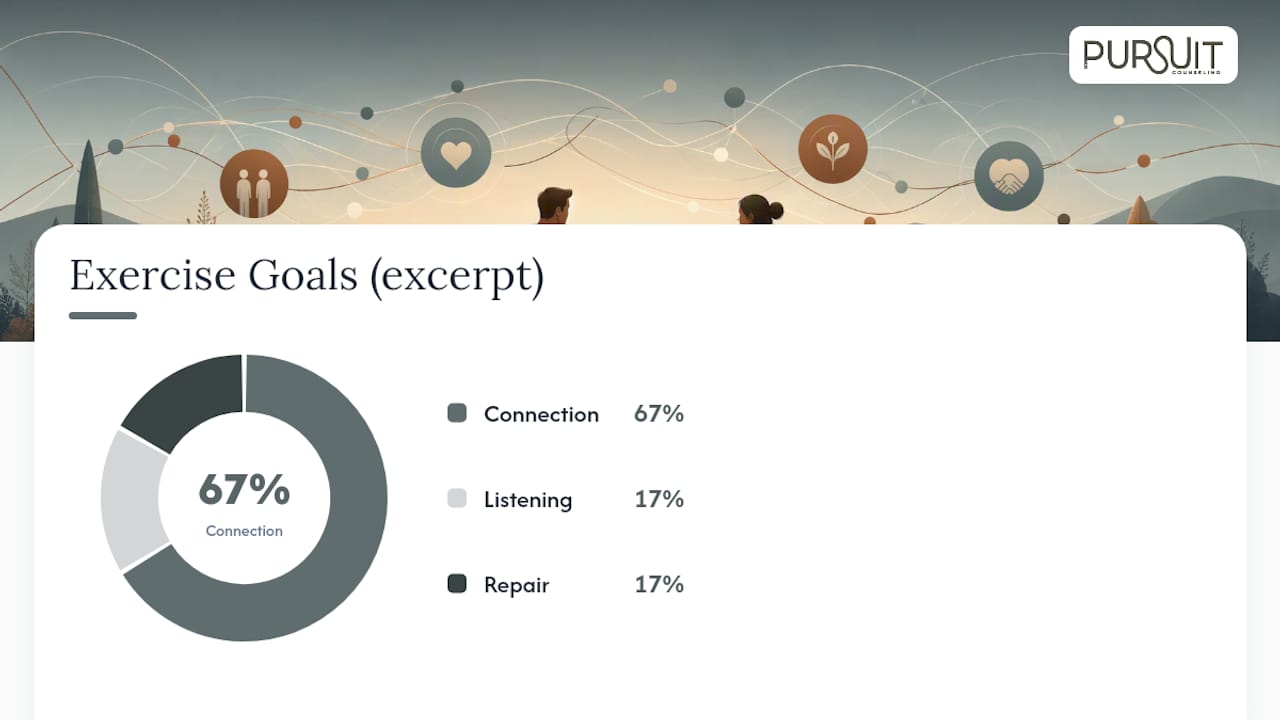
These twenty exercises cover the five goals that matter most in relationship work: building connection, practicing repair after conflict, strengthening listening skills, offering validation, and solving problems together. Each one includes a time estimate, the exact steps, a one-line prompt you can use immediately, and a way to level it up once it feels easy. Work through a few, not all twenty at once. Pick based on what your relationship needs this week.
1. The Stress-Reducing Conversation
Goal: connection. Time: 15 minutes. Frequency: daily.
Sit facing each other, device-free. One partner talks about a stressor outside the relationship (work, family, traffic) for seven minutes while the other only listens, no problem-solving, no advice. Switch. Prompt: “What was the most stressful part of your day?” This exercise, drawn from Gottman’s research, works because it keeps outside pressure from leaking into your relationship. Level-up: add one specific appreciation about how your partner handled that stressor.
2. Love Maps
Goal: connection. Time: 20 minutes. Frequency: weekly.
Take turns asking open-ended questions about each other’s inner world, hopes, fears, current stresses, that you might not already know the answer to. Prompt: “What’s something you’re worried about that we haven’t talked about?” Pause the game if either partner starts feeling interrogated rather than curious.
3. Active Listening Round
Goal: listening. Time: 10 minutes. Frequency: weekly, or after any disagreement.
One partner speaks for three minutes uninterrupted. The listener then reflects back what they heard before responding: “What I heard you say was…” Only after an accurate reflection does the listener get to respond. Prompt: “Tell me what’s been on your mind this week.” Stop if the listener keeps correcting instead of reflecting; that’s a sign to slow down and try again.
4. The ‘I’ Statement Rewrite
Goal: repair. Time: 10 minutes. Frequency: after conflict.
Each partner rewrites one complaint from the recent argument using “I feel ___ when ___ happens” instead of “You always…” Read the rewritten version aloud. Prompt: “I felt dismissed when my update got cut off.” Variation: have your partner repeat your statement back before responding.

5. Turning Toward Bids
Goal: connection. Time: 5 minutes. Frequency: daily.
Notice one small bid for attention your partner made today (a comment, a sigh, a joke) and name it out loud: “I noticed you seemed excited about that email.” Small, consistent noticing builds the kind of friendship Gottman’s research ties to conflict resilience.
6. The Two-Minute Gratitude Round
Goal: connection. Time: 2 minutes. Frequency: daily.
Each partner names one specific thing the other did that day that they appreciated. Not “thanks for everything,” but “thank you for texting me when you were running late.” Use this as a warm-up before harder exercises if one partner seems resistant to diving straight into conflict work.
7. The Repair Attempt Script
Goal: repair. Time: 15 minutes. Frequency: after a fight, once things have cooled.
Each partner writes down one thing they wish they’d said differently and one thing they need to feel better. Trade papers, read silently, then discuss one item each. Prompt: “One thing I wish I’d done differently was…”
8. Validation Practice
Goal: validation. Time: 10 minutes. Frequency: weekly.
One partner shares a frustration. The listener’s only job is to find something true in the complaint and name it, even if they disagree with the conclusion. Prompt: “That makes sense that you’d feel that way given how the morning went.” Stop and switch to active listening if the listener starts arguing instead of validating.
9. The Collaborative Problem-Solving Map
Goal: problem-solving. Time: 20 minutes. Frequency: weekly, or when a recurring issue resurfaces.
Write the problem at the top of a page. Each partner lists their underlying interest, not their position, then brainstorm three solutions together before picking one to try for a week. This mirrors the Thomas-Kilmann collaborating style, which works best when both the relationship and the outcome matter.
10. Twenty Questions for Deeper Knowing
Goal: connection. Time: 15 minutes. Frequency: monthly.
Pick five questions from a relationship question deck or write your own (“What’s a fear you haven’t told me about?”). Answer honestly, no fixing, no follow-up debate. Great for newer couples building a foundation.
11. The Time-Out Signal
Goal: repair. Time: as needed. Frequency: whenever flooding starts.
Agree in advance on a word or hand signal either partner can use to pause a heated conversation for 20 minutes. Set a time to resume; don’t just walk away indefinitely. This single tool prevents more damage than almost any other exercise on this list.

12. Weekly State-of-the-Union Meeting
Goal: problem-solving. Time: 30 minutes. Frequency: weekly.
Structured agenda: five minutes of appreciation, ten minutes reviewing logistics (calendar, money, chores), ten minutes discussing one open issue, five minutes planning something fun together.
13. The Feelings Wheel Check-In
Goal: listening. Time: 10 minutes. Frequency: 2 to 3 times a week.
Using a feelings wheel (printable, see below), each partner names one specific emotion from the day beyond “fine” or “tired.” Prompt: “Today I felt ___ because ___.”
14. Reflective Paraphrase Drill
Goal: listening. Time: 10 minutes. Frequency: weekly, especially for couples who talk past each other.
Take turns making a statement, then the listener paraphrases it in their own words before responding. Repeat three rounds each. This builds the habit active-listening research consistently links to reduced escalation.
15. The Can I… Request
Goal: problem-solving. Time: 5 minutes. Frequency: as needed.
Instead of a vague complaint, practice framing a need as a direct, specific request: “Can I ask you to text me when you’ll be more than 20 minutes late?” Small requests land better than accumulated resentment.
16. Appreciation Letters
Goal: connection. Time: 15 minutes writing, 10 minutes sharing. Frequency: monthly.
Each partner writes a short letter describing a specific memory or quality they appreciate, then reads it aloud. Especially useful for long-term partners who’ve fallen into logistics-only conversations.
17. The Fair Fighting Contract
Goal: repair. Time: 20 minutes. Frequency: once, then revisit quarterly.
Together, write down three rules you both agree to during conflict (no name-calling, no bringing up past fights, one topic at a time). Sign it. Reference it before your next hard conversation.
18. Perspective-Taking Swap
Goal: validation. Time: 15 minutes. Frequency: after a disagreement that felt unresolved.
Each partner argues the other’s side of a recent disagreement for two minutes. Fairness looks different depending on where you’re standing, and this drill makes that visible fast.
19. The Daily Highs and Lows
Goal: connection. Time: 5 minutes. Frequency: daily, ideally at dinner or bedtime.
Share the best and hardest part of your day, no commentary required from your partner unless asked. Simple, low-pressure, and easy to sustain even during busy weeks.
20. Blended Family Check-In
Goal: problem-solving. Time: 20 minutes. Frequency: weekly.
For couples navigating stepfamily dynamics, review one parenting or logistics decision together using the collaborative problem-solving map above, keeping the focus on the couple’s shared approach rather than individual parenting styles.
Pro Tip: If an exercise ever feels like a setup to “win” an argument, stop. The goal is understanding, not scoring points. Exercises used as weapons do more damage than no exercise at all.
A few notes before you start:
- Pause any exercise if either partner’s heart rate spikes or voice gets sharp; that’s flooding, and no exercise works while flooded.
- Daily exercises (stress-reducing conversation, gratitude round, highs and lows) build the friendship that buffers conflict.
- Weekly exercises (state-of-the-union, validation practice) build skills.
- After-conflict exercises (repair script, ‘I’ statement rewrite) should wait until both partners are calm, not mid-fight.
How to Structure a Practice Session at Home
The exercise matters less than the container you put it in. A well-run five-minute check-in beats a chaotic 45-minute “talk” every time.
Three session templates to start with:
- The 5-minute check-in. One minute of settling in (phones away, sit down together), three minutes for the exercise itself, one minute to name one thing that felt good about the conversation.
- The 20-minute practice session. Two minutes reviewing ground rules, 15 minutes for the exercise (active listening, validation practice, or collaborative problem-solving), three minutes closing with appreciation.
- The 45-minute repair session. Five minutes cooling in separate spaces if needed, 10 minutes each partner sharing using ‘I’ statements, 15 minutes collaborative problem-solving, five minutes agreeing on one concrete next step.
Ground rules that make or break these sessions:
- Phones in another room, not just face down.
- No interrupting until the other person says “I’m done.”
- Use ‘I’ statements instead of “you” accusations.
- Either partner can call a time-out using your agreed signal.
- Pick a neutral spot, not the bedroom, not standing in the kitchen mid-chore.
Run connection exercises daily, skill-building exercises weekly, and repair exercises specifically after conflict, never scheduled preemptively as a way to avoid talking about what actually happened. If one partner seems resistant to sitting down for a full session, don’t force the 20-minute version. Start with the two-minute gratitude round instead. Resistance usually softens once the stakes feel lower.
Which Communication Exercise Fits Your Situation?
Different goals call for different tools, and matching the wrong exercise to the wrong moment is why some couples give up on “communication exercises” altogether after one bad attempt.
| Goal | Recommended Exercises | Session Length |
|---|---|---|
| Connection | Stress-reducing conversation, Love Maps, daily highs and lows | 5 to 20 minutes |
| Repair after conflict | Time-out signal, repair attempt script, ‘I’ statement rewrite | 10 to 15 minutes |
| Listening | Active listening round, reflective paraphrase drill | 10 minutes |
| Validation | Validation practice, perspective-taking swap | 10 to 15 minutes |
| Problem-solving | Collaborative problem-solving map, weekly state-of-the-union | 20 to 30 minutes |
Quick rules of thumb:
- Feeling unheard more than angry? Start with active listening, not problem-solving.
- Outside stress (work, money, family) bleeding into your relationship? Run the stress-reducing conversation before anything else.
- Same argument keeps resurfacing? You’re likely stuck in positions instead of interests. Try the collaborative problem-solving map.
- New couples benefit most from Love Maps and Twenty Questions, since you’re still building the knowledge base these exercises draw on.
- Long-term partners often need the weekly state-of-the-union more than daily connection work, since logistics tend to crowd out emotional check-ins after years together.
- Blended families should weight problem-solving exercises heavier, since so much conflict centers on shared decisions rather than personal disclosure.
Why These Exercises Work: The Research Behind the Practice
None of this is guesswork. The Thomas-Kilmann Conflict Model identifies five conflict strategies, avoiding, accommodating, competing, compromising, and collaborating, and research from Harvard’s Program on Negotiation points to collaboration as the strongest option when both the relationship and the outcome matter, because it surfaces the interests hiding underneath a position. That’s the logic behind the problem-solving map above.
Perspective matters more than most couples realize. Negotiation research shows people perceive fairness differently because of ordinary psychological egocentrism, not bad faith. Asking how your partner sees a situation works better than trying to correct their view of it.
There’s also no single “right” conflict style. Studies on conflict-management approaches find that strategic flexibility, shifting between styles depending on the moment, outperforms rigidly sticking to one approach, whether that’s always compromising or always avoiding. Emotional regulation and active listening matter more than which label fits your fighting style.
The clinical evidence backs the format, too. Structured communication training, active listening, reflective dialogue, ‘I’ statements, planned time-outs, shows up in controlled studies reviewed on PMC as linked to better communication and less escalation in couple samples. And conflict itself isn’t the enemy. Handled with validation and a little lightness, disagreement can become a genuine growth point rather than something to avoid.
Fairness looks different depending on where you’re standing. The productive move isn’t correcting your partner’s version of events. It’s asking how they got there.
A quick safety note: these exercises are built for everyday friction, not for situations involving violence, active affairs, addiction, or a mental health crisis. Those need a licensed clinician, not a worksheet.
Common Mistakes That Stall Progress
Most couples don’t fail at these exercises because the tools don’t work. They fail because of how the tools get used.
The mistakes that show up most often:
- Over-correcting. Turning every conversation into a formal exercise until spontaneity disappears entirely.
- Lecturing during “listening” exercises. Using the listener’s silence as a captive audience instead of genuinely reflecting back what you heard.
- Weaponizing the exercise list. Pulling out “the rules” mid-fight to prove your partner is doing it wrong.
- Skipping the warm-up. Jumping straight into repair work without a gratitude round or check-in first, especially when one partner is already resistant.
- Doing it once and quitting. Expecting a single 20-minute session to undo years of a communication pattern.
Fixes for each:
If one partner withdraws mid-exercise, shorten the session and add a two-minute gratitude round before trying again next time. If lecturing creeps in, add a hard rule: the listener can only speak to reflect, never to respond, until both partners have had a turn. If the exercise list starts feeling like ammunition, pause entirely for a week and return to daily connection exercises only.
Red flags that mean it’s time to stop self-practicing and call a clinician:
- Threats or physical intimidation during any exercise.
- Active addiction affecting either partner’s ability to engage safely.
- Ongoing infidelity that hasn’t been disclosed or addressed.
- Suicidal ideation or expressions of self-harm.
If any of these show up, rebuilding trust after a serious violation or working through infidelity recovery requires professional support, not a home exercise. A couples intensive can also accelerate progress when self-practice has plateaued after weeks of genuine effort.
Pro Tip: If you notice the same fight resurfacing three sessions in a row despite using the right exercise, that’s usually a sign you’re treating a symptom. The real issue is underneath it, and that’s exactly what a clinician-guided session is built to find.
Printable Worksheets to Practice at Home
You don’t need to memorize any of this. Print it, or save it to your phone, and pull it out when you need structure.
- Active Listening Sheet: A three-column template (speaker’s statement, listener’s reflection, speaker’s confirmation) for the active listening round and reflective paraphrase drill.
- Stress-Reducing Conversation Template: Two timed columns with prompts like “What’s stressing you outside us?” to guide the daily check-in.
- Problem-Solving Worksheet: A one-page map with sections for “the problem,” “my interest,” “their interest,” and “three possible solutions,” built for the collaborative problem-solving exercise.
- Fair Fighting Contract Template: A simple fill-in form for the three rules you and your partner agree to before your next hard conversation.
Clinicians can hand these worksheets out as homework between sessions, or use them live to slow down a couple who tends to escalate quickly. If you want a version that’s already built into structured session work, couples counseling sessions typically fold these same templates into guided practice.
A Clinician’s Note on Practicing These Exercises
These exercises aren’t a substitute for therapy, but they’re not a lesser version of it either. In session, we use almost every tool on this list, active listening drills, the stress-reducing conversation, structured problem-solving maps, as scaffolding for deeper work. What changes with a clinician in the room is pacing and safety. We slow things down when flooding starts and catch patterns couples can’t see from inside the argument.
What I’d want you to know before you start tonight: consistency beats intensity every time. A couple that does the two-minute gratitude round daily for a month will out-progress a couple that has one intense three-hour conversation and then stops. Steady practice, even five minutes a night, rewires how safe conflict feels over time. That’s the whole philosophy behind how we approach disagreements in session.
When Self-Practice Isn’t Enough: Working With a Couples Therapist
Self-practice gets you far. It doesn’t get every couple all the way there, and that’s not a failure, it’s just a signal. When you’ve tried these exercises consistently for a few weeks and the same conflict keeps resurfacing, or when a conversation reliably tips into flooding before either partner can use a time-out, that’s the moment to bring in a clinician.
The Pursuit Counseling works with couples using the same evidence base behind this article, Gottman Method techniques, structured conflict work grounded in the Thomas-Kilmann model, and trauma-informed approaches like EMDR when past wounds keep resurfacing mid-argument. For couples who’ve stalled on their own or are facing something bigger than a communication gap, no progress despite real effort, safety concerns, or deep attachment injuries, a couples intensive compresses months of weekly work into a focused, guided timeframe.
If tonight’s exercise goes well, keep going on your own. If it doesn’t, or if you already know you need more than a worksheet can give you, getting started with counseling is a straightforward first step: book an intake, and a clinician will help you figure out whether weekly sessions or an intensive format fits your situation better.
Sources
- 10 communication exercises for couples — The Gottman Institute
- PMC article (NCBI) on communication and couple interventions
- Conflict resolution skills — HelpGuide
This article is general information, not a substitute for advice from a qualified doctor. Consult a qualified healthcare professional about your own circumstances before acting on anything here.
FAQ
How Often Should Couples Practice Communication Exercises?
Daily for connection exercises like the stress-reducing conversation or gratitude round, weekly for skill-building exercises like validation practice, and after conflict for repair exercises like the time-out signal.
What’s the Best Communication Exercise for Couples Who Just Started Arguing More?
Start with the active listening round to address feeling unheard, then move to the collaborative problem-solving map if the same disagreement keeps resurfacing.
Can These Exercises Replace Couples Therapy?
They work well for everyday friction and skill-building, but concerns involving safety, infidelity, or repeated stalled progress call for a licensed clinician, such as the couples therapy and intensives offered at The Pursuit Counseling.
How Long Should a Practice Session Last?
Anywhere from five minutes for a daily check-in to 45 minutes for a full repair session after conflict; shorter, consistent sessions tend to outperform occasional long ones.
What Are Clear Signs We Need Professional Help Instead of Self-Practice?
Threats or physical intimidation, active addiction, ongoing undisclosed infidelity, or suicidal ideation are red flags that require a clinician’s involvement right away, not another home exercise.