
Mild burnout tends to ease within a few weeks of real rest and lifestyle changes. Moderate to severe burnout usually takes several months, and chronic burnout can run a year or longer. The single biggest factor isn’t willpower or how tired you feel today. It’s whether the conditions that caused the burnout actually change. If you’re experiencing severe symptoms, thoughts of self-harm, or a total functional collapse, don’t wait for a timeline. Reach out for professional help now.
TL;DR:
- Mild burnout typically resolves within 2 to 12 weeks with rest and lifestyle adjustments, while moderate to severe burnout may require three to six months for recovery.
- Recovery duration varies greatly depending on individual support systems, workplace changes, and biological factors like stress hormone regulation, making precise timelines unpredictable.
- Signs of progressing from partial to full recovery include stable sleep, improved focus, and regained sense of purpose, with structural and workplace changes accelerating long-term healing.
- Returning to full work capacity too soon often leads to relapse unless workload and role expectations are explicitly renegotiated beforehand.
- Seeking professional help is urgent if severe symptoms like suicidal thoughts, functional collapse, or physical health crises occur, as treatment includes therapy and possible trauma-focused approaches.
Table of Contents
- What Burnout Is (And What It Isn’t)
- How Long Does Burnout Recovery Actually Take?
- What Does Burnout Recovery Actually Look Like Week by Week?
- What Speeds Up or Slows Down Burnout Recovery?
- When Should You Seek Professional Help for Burnout?
- Why Do People Relapse After Burnout Recovery?
- Your First Week, First Month, and Beyond: A Recovery Checklist
- What Clinicians Wish You Knew About Burnout Recovery
- How The Pursuit Counseling Supports Your Recovery Timeline
- Sources
- FAQ
What Burnout Is (And What It Isn’t)
The World Health Organization classifies burnout as an occupational phenomenon in the ICD-11, not a medical diagnosis on its own. That distinction matters more than most people realize. Burnout results specifically from chronic workplace stress that hasn’t been successfully managed. It has three core dimensions: energy depletion or exhaustion, growing mental distance or cynicism toward your job, and a drop in professional efficacy.
Before you can guess at your recovery timeline, you need an honest read on severity. Ask yourself:
- Energy depletion: Are you exhausted even after a full night’s sleep or a weekend off?
- Cognitive fog: Can you hold a complex thought, plan ahead, or read a report without rereading the same paragraph three times?
- Cynicism and detachment: Have you gone numb to work that used to matter to you, or started dreading interactions you once enjoyed?
- Functional impact: Is this showing up in missed deadlines, snapped relationships, or physical symptoms like chest tightness or stomach issues?
Burnout differs from acute stress in duration. Stress spikes and resolves. Burnout is stress that’s been left unaddressed for months, and it’s accumulated. It also differs from major depression, though the two often overlap and can be hard to tell apart without an evaluation. Depression tends to color every part of life with hopelessness. Burnout is more often confined to the work domain, at least at first, before it bleeds outward.
How Long Does Burnout Recovery Actually Take?
Here’s the range clinicians actually use, and it’s wider than most headlines suggest.
Mild burnout: 2 to 12 weeks. You catch it early, before exhaustion becomes chronic. Rest, boundary-setting, and a lighter load are often enough.
Moderate to severe burnout: 3 to 6 months. This is the zone where most people land once they finally admit something is wrong, according to clinical guidance on burnout recovery.
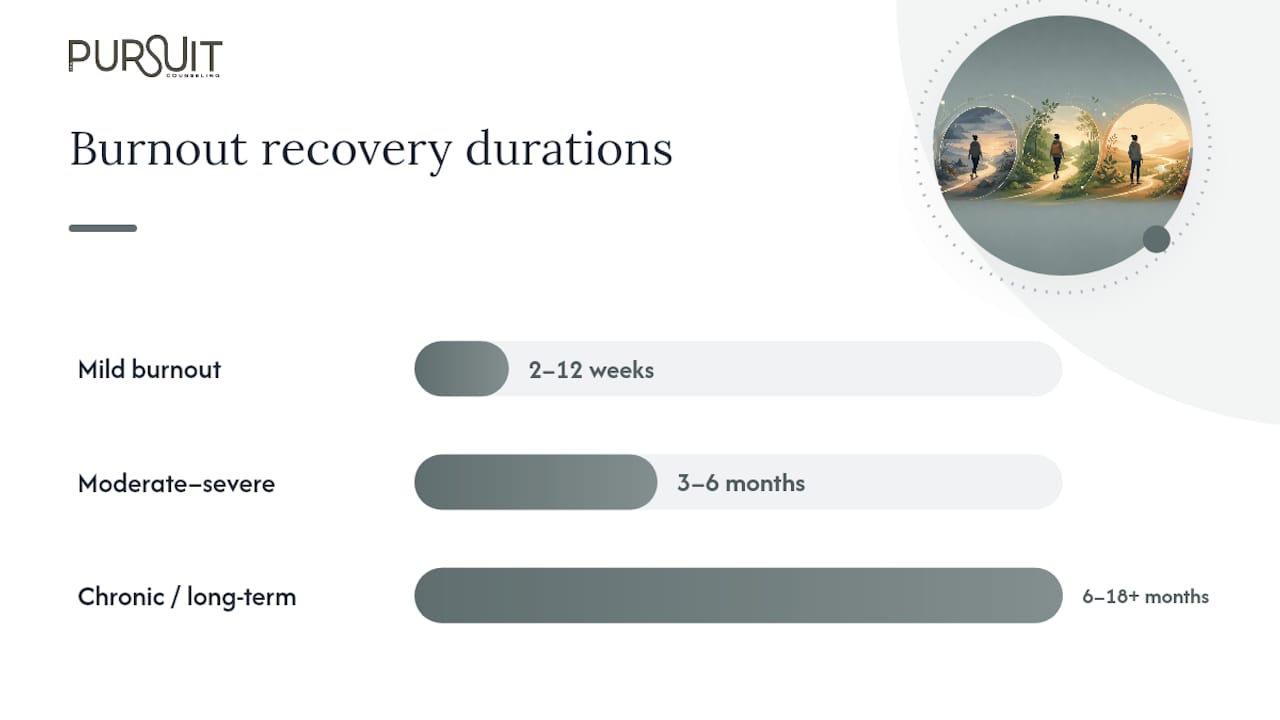
Chronic or long-term burnout: 6 to 18 months, sometimes several years. This applies when burnout has gone unaddressed for a year or more, or when it’s tangled up with trauma, depression, or a workplace that never changes.
Pro Tip: Don’t chase a single “recovery date.” Track markers instead: is your sleep predictable again? Can you concentrate for a full hour without your mind sliding off task? Has any sense of purpose or curiosity returned, even in small doses? Those three, sleep, sustained attention, and reconnection to meaning, tell you more than any calendar.
Partial recovery looks like feeling functional again, less like a live wire, more able to get through a workday. Full recovery means the exhaustion doesn’t creep back the moment you’re under normal pressure again. That’s an important line, because a lot of people mistake the first for the second, and then wonder why they crash again three months later.
Variability here is the rule, not the exception. Two people with identical job titles and nearly identical symptoms can heal at very different speeds depending on their support systems, their biology, and whether their actual working conditions shift. A single-number answer to “how long will this take me” doesn’t exist, and anyone who gives you one confidently is oversimplifying.
What Does Burnout Recovery Actually Look Like Week by Week?
Recovery doesn’t move in a straight line, but it does move in recognizable stages. Here’s what tends to happen at each one.
-
Weeks 1 through 4: acute rest and risk management. This stage is about damage control, not productivity. Priorities: sleep, reducing immediate demands, and screening for any safety risk (severe depression, suicidal ideation, substance misuse). Energy may tick up slightly, but don’t mistake that for readiness to resume full load. This is the stage where people most often self-sabotage by going back too soon.
-
Weeks 5 through 12: consolidation. Sleep starts stabilizing. Attention improves enough that you can read something longer than a text message. This is the phase where the temptation to “test the waters” at work peaks, and it’s also the phase where pushing too hard undoes weeks of progress.
-
Months 4 through 12 and beyond: cognitive and emotional re-engagement. Working memory and sustained focus start returning, often on a slower clock than your energy did. Emotional re-engagement, actually caring about your work again, tends to lag even further behind. Structural changes to your role or workplace matter more here than any individual coping skill.
-
Long-term: maintenance and relapse prevention. “Full” recovery is realistic, but it’s rarely permanent by default. It holds when the underlying triggers, workload, autonomy, recognition, have actually shifted.
The biological piece explains a lot of this lag. Chronic stress dysregulates the HPA axis, the system that governs your stress hormone response, and that system can take months to normalize even after the external stressor eases. That’s why you can feel emotionally “fine” for a few weeks and then still hit a wall of fog or fatigue out of nowhere. If you’re still having to function at work during this window, a staged approach for high-functioning burnout can help you pace the load without pretending you’re fully recovered before you are.
What Speeds Up or Slows Down Burnout Recovery?
Some of what determines your timeline is biological. Some of it is habit. And some of it is entirely outside your control until you change it.

On the biology side, sleep and circadian regularity do more heavy lifting than almost anything else. Restorative movement, walking, swimming, easy cycling, supports recovery, while jumping into high-intensity training too early can add physiological stress on top of an already taxed system.
On the behavior side, three traps show up constantly among high performers:
- Optimizing rest. Turning downtime into another achievement, tracking sleep scores, scheduling “mindful” activities back to back, and never actually letting your nervous system stand down.
- Decision overload. Making dozens of small choices all day keeps your stress response engaged even when the tasks themselves feel minor.
- Productive resting. Reading work emails “just to stay on top of things” during what’s supposed to be recovery time.
On the workplace side, negotiated change matters more than almost any individual coping strategy. Occupational-health follow-up studies show relapse is common when people return to unchanged working conditions, while structural changes, workload redistribution, clearer role boundaries, adjusted expectations, meaningfully cut that risk. Context outside the office matters too; broader life stressors affect professional functioning in ways that can either compound or ease a recovery timeline.
When Should You Seek Professional Help for Burnout?
Some signs mean don’t wait, don’t self-monitor, get evaluated now:
- Suicidal thoughts or a sense that life isn’t worth continuing
- Complete functional collapse, unable to work, care for yourself, or maintain basic relationships
- Severe, sustained sleep disruption lasting weeks
- Panic attacks, chest pain, or other physical symptoms that could signal a medical emergency
Outside of those red flags, evidence-based treatment for burnout usually centers on cognitive behavioral therapy (CBT) and behavioral activation, both of which help rebuild the structure and thought patterns burnout erodes. A competent clinician will also screen for comorbid depression or anxiety, since burnout rarely arrives alone, and may bring in adjunctive approaches depending on what’s driving the exhaustion. For clients dealing with underlying trauma that’s fueling the burnout cycle, EMDR often addresses what talk therapy alone can’t reach, and neurofeedback can support the kind of sustained attention recovery that takes the longest to return naturally.
Pro Tip: A first appointment for burnout typically follows three phases: assessment (what’s driving this, and how severe is it), stabilization (sleep, safety, immediate load reduction), and then skills plus structural change (therapy tools paired with real conversations about your workload). If a provider skips straight to “just relax more” without assessing severity first, that’s a sign to look elsewhere. If you’re unsure whether your situation has crossed the threshold, this guide on when burnout requires professional support walks through the decision point in more detail, and a closer look at which therapy approach fits high-functioning burnout can help you evaluate options.
Why Do People Relapse After Burnout Recovery?
The most common relapse pattern is predictable: someone starts feeling better around week six or eight, mistakes that for full recovery, and returns to their exact previous workload. Within weeks, symptoms come back, often harder than before, because nothing about the underlying conditions changed.
- Negotiate workload changes explicitly before you’re back at 100%, not after you’ve already burned out again.
- Set a boundary script in advance: “I can take this on if we drop X” is easier to say calmly before you’re in crisis mode than during one.
- Build a monitoring plan: check in weekly on sleep, focus, and irritability, and treat two bad weeks in a row as a signal to return to therapy, not a personal failure.
Pro Tip: Write your relapse warning signs down while you’re recovering, when you can see them clearly, not during the fog of round two. Future you will thank present you for the head start.
Your First Week, First Month, and Beyond: A Recovery Checklist
You don’t need a complicated plan. You need a short one you’ll actually follow.
- First week: Protect sleep like it’s a medical appointment. Drop one obligation entirely, even a small one. Schedule a check-in with a therapist or doctor, don’t wait until you “have time.”
- First month: Defend blocks of uninterrupted thinking time on your calendar. Reintroduce activity gradually, walks before workouts. Have at least one direct conversation with your manager or family about what needs to change.
- Ongoing: Run a monthly recovery audit, energy, focus, mood, and adjust from there. Keep periodic clinician check-ins even after you feel better. Protect restorative time the same way you’d protect a client deadline.
If you’re short on bandwidth even for this, a scaled-down starting plan focuses on the two or three moves that matter most when you genuinely have no time to spare. And a step-by-step recovery workflow can give you a structure to follow if you do better with a written framework than a loose checklist.
What Clinicians Wish You Knew About Burnout Recovery
Recovery isn’t linear, and that surprises almost everyone. A good week followed by a rough one doesn’t mean you’re failing. It usually means your nervous system is recalibrating, not regressing.
Early improvement is the trickiest part. Energy tends to return before concentration or emotional engagement does, so people feel “fixed” at week five and go back to full speed, only to crash by week eight. The clearest predictor of a durable recovery isn’t how motivated someone feels. It’s whether they negotiate an actual change to their workload before returning. One client I think of often improved steadily for two months, hit a wall when she resumed her old schedule, and only stabilized for good after her manager agreed to redistribute two major accounts. The therapy didn’t change. Her working conditions did.
— Adam
How The Pursuit Counseling Supports Your Recovery Timeline
Not every stage of burnout needs the same tool. Short-term stabilization, sleep, immediate load reduction, safety screening, calls for focused counseling early on. If trauma is fueling the exhaustion, EMDR often reaches what conventional talk therapy can’t touch. If cognitive fog and sustained attention are the last symptoms hanging on, neurofeedback supports that slower biological recovery clock directly. And if the real problem is a workload or role that hasn’t changed, executive coaching addresses the structural piece that determines whether recovery actually holds.
A first appointment at The Pursuit Counseling starts with an honest assessment of where you are on this timeline, not a generic wellness checklist. From there, care is built around the staged roadmap: stabilize first, then rebuild attention and engagement, then address the structural changes that keep burnout from returning. If you’re ready to find out where you stand, getting started with counseling is the direct next step, and if workplace stress specifically is driving the exhaustion, counseling for burnout and workplace stress is built around exactly that.
Sources
For the clinical definition, see the WHO’s occupational phenomenon classification. For biological recovery timelines, the NCBI review on chronic stress explains the HPA-axis lag. HelpGuide and Cleveland Clinic offer practical, clinician-reviewed recovery steps worth bookmarking.
This article is general information, not a substitute for advice from a qualified doctor. Consult a qualified healthcare professional about your own circumstances before acting on anything here.
- What Does Burnout Feel Like and How to Recover
- Burn-out an occupational phenomenon (WHO)
- Neuroendocrine consequences of chronic stress (NCBI/PMC)
FAQ
What is the 42% rule for burnout?
The “42% rule” is a popular heuristic from consumer health guides suggesting a percentage of your day should go toward recovery activities beyond sleep. It lacks strong research backing, so treat it as a rough reminder to prioritize rest rather than a validated clinical guideline.
What should you do during burnout recovery?
Prioritize sleep, reduce your workload where possible, and get an assessment from a therapist or doctor if symptoms are moderate to severe. Add graded activity and boundary-setting once you’ve stabilized, and avoid rushing back to full capacity before attention and mood have caught up with your energy.
How can you tell if you’re burned out?
Look for the WHO’s three markers: persistent exhaustion, growing cynicism or detachment from your work, and a noticeable drop in your effectiveness, especially if these have lasted for weeks rather than days.
How long does it take to physically recover from burnout?
Mild cases often ease within 2 to 12 weeks, moderate to severe cases typically take 3 to 6 months, and chronic burnout can take 6 to 18 months or longer. Physical energy usually returns before cognitive sharpness and emotional engagement do, so expect recovery to feel uneven rather than steady.