


Inattentive-type ADHD in adults is a presentation focused on attention regulation, organization, and follow-through, with little or no hyperactivity. Adults with this presentation meet the DSM-5 symptom threshold but often go years without a diagnosis because the symptoms look like distraction or laziness rather than a clinical pattern. If this sounds like you, the next step is a formal evaluation with an ADHD-aware clinician. Bring concrete examples of missed deadlines, forgotten commitments, or half-finished projects. Screening tools like the Adult ADHD Self-Report Scale (ASRS) can help structure that first conversation, and clinics like Cleveland Clinic outline the process well.
Understanding the Path Forward for Inattentive ADHD
Inattentive ADHD in adults responds best to a combination of accurate diagnosis, medication when appropriate, and consistent external systems rather than any single fix.
| Point | Details |
|---|---|
| Definition matters | Inattentive ADHD centers on focus, organization, and follow-through, with little or no hyperactivity. |
| Diagnosis requires history | Adult diagnosis needs childhood-onset symptoms, impairment in two or more settings, and adjusted adult thresholds. |
| Treatment works best combined | Stimulant or non-stimulant medication paired with CBT, coaching, or neurofeedback produces the strongest functional gains. |
| Underdiagnosis hits women hardest | Daydreaming and masking cause many women to be diagnosed later, after anxiety or burnout develops. |
| The Pursuit Counseling offers a next step | Its ADHD program pairs clinical assessment with coaching and neurofeedback for adults across Georgia. |
Table of Contents
- What Makes Inattentive ADHD Different From Other Types?
- What Does Inattentive ADHD Look Like in Adults?
- What Causes Inattentive ADHD, and Who Is at Risk?
- How Is Inattentive ADHD Diagnosed in Adults?
- What Treatments Actually Help Adults With Inattentive ADHD?
- How Do You Manage Inattentive ADHD Day to Day?
- Why Is Inattentive ADHD Missed in Women?
- When Should You Get Evaluated for ADHD?
- What Should You Ask Your Clinician About ADHD Treatment?
- Does Inattentive ADHD Look the Same Across Different Adults?
- How Does Inattentive ADHD Affect Work Performance?
- How Does Inattentive ADHD Affect Relationships?
- What Is the Long-Term Outlook for Adults With Inattentive ADHD?
- How Do Diet, Exercise, and Sleep Affect Inattentive ADHD?
- A Publisher’s Note on Living With Inattentive ADHD
- How The Pursuit Counseling Supports Adults With Inattentive ADHD
- Sources
- FAQ
What Makes Inattentive ADHD Different From Other Types?
Inattentive ADHD centers on how your brain manages focus, not how much you fidget. The hallmark isn’t bouncing off the walls. It’s a mind that drifts mid conversation, loses the thread of a task three steps in, and struggles to convert intention into action. That’s a fundamentally different daily experience than the hyperactive presentation, and it often hides in plain sight.
The defining features tend to cluster around four areas:
- Attention regulation: difficulty sustaining focus on tasks that aren’t inherently interesting
- Organization: trouble managing time, materials, and multi-step projects
- Follow-through: starting things with energy but rarely finishing them
- Internal restlessness: a quieter, slower cognitive tempo instead of visible hyperactivity
Combined-type ADHD layers hyperactive-impulsive symptoms on top of this pattern, while the purely hyperactive-impulsive presentation shows up with far less of the inattentive fog described above.
What Does Inattentive ADHD Look Like in Adults?
The core symptom list hasn’t changed much since childhood. What’s changed is the setting: instead of missed homework, it’s missed invoices, forgotten anniversaries, and a car full of unread mail. Cleveland Clinic identifies a consistent cluster of inattentive symptoms in adults, including careless mistakes, trouble sustaining attention, appearing not to listen, chronic disorganization, and losing items you use every day.
Here’s how those symptoms typically show up in daily life:
- Careless mistakes at work. You reread an email three times and still send it with the wrong attachment.
- Trouble sustaining attention on long tasks. A 90-minute report becomes four separate sittings spread across two days.
- Appearing not to listen. A partner asks you a question, you nod, and thirty seconds later you have no idea what they said.
- Failing to follow through. You start a home project, get halfway through, and it sits unfinished for months.
- Chronic disorganization. Your desk, inbox, and car all look like separate archaeological digs.
- Losing items constantly. Keys, phone, badge, the same three things, on a weekly loop.
- Distractibility by minor stimuli. A notification, a noise in the hallway, a passing thought, and the task you were doing is gone.
- Forgetfulness in daily activities. You forget to pay a bill you had every intention of paying.
- Time blindness. Fifteen minutes and ninety minutes feel identical until a deadline is suddenly right on top of you.
At work, this often means you’re the person who does excellent work under pressure but can’t get started early enough to avoid that pressure. At home, it might mean stacks of unopened mail or a project list that never shrinks. Behind the wheel, time blindness and distractibility show up as chronic lateness or near misses when your mind wanders at a red light. Left unaddressed, these patterns chip away at deadlines, finances, and the trust of people who rely on you.
What Causes Inattentive ADHD, and Who Is at Risk?
ADHD is a brain-based, heritable condition, not a character flaw or a discipline problem. Genetics account for a large share of the risk, and the condition tends to run in families.
Several factors raise the likelihood of an inattentive presentation:
- A first-degree relative (parent or sibling) with ADHD
- Perinatal factors, including low birth weight or prenatal exposure to nicotine or alcohol
- Co-occurring neurodevelopmental conditions, such as learning disorders
- Untreated childhood ADHD that persisted quietly into adulthood, often because inattentive symptoms were mistaken for shyness or daydreaming
Rule-outs matter. Sleep apnea and thyroid dysfunction both mimic inattentive symptoms closely enough that a competent evaluation has to screen for them before confirming an ADHD diagnosis. Skipping this step is one of the more common evaluation mistakes.
How Is Inattentive ADHD Diagnosed in Adults?
Diagnosis requires a structured clinical interview, evidence of symptoms before age 12, functional impairment in at least two settings, and adjusted symptom thresholds for adults. The National Institute of Mental Health notes that adults and adolescents over 16 need fewer symptoms to meet criteria than younger children do, reflecting how compensatory habits mask the underlying pattern over time.
A thorough evaluation typically moves through these steps:
- Intake interview covering current symptoms, work history, and relationship impact
- Standardized rating scales, most commonly the ASRS or an ADHD Rating Scale
- Collateral history from a parent, partner, or old report cards to confirm childhood onset
- Medical review to rule out sleep apnea, thyroid dysfunction, and medication side effects
- Screening for comorbidities, especially anxiety and depression, which frequently overlap
- Neuropsychological testing, when the clinical picture is unclear or another condition is suspected
Bring these names up with your clinician:
- Adult ADHD Self-Report Scale (ASRS)
- ADHD Rating Scale (ADHD-RS)
- Any prior school records or performance reviews showing a long-standing pattern
Online quizzes have a place here, but only as a starting point. They flag a pattern worth investigating; they cannot diagnose anything on their own. A real evaluation also has to differentiate ADHD from anxiety, depression, and sleep disorders, since all four can produce the same foggy, distracted presentation from the outside.
What Treatments Actually Help Adults With Inattentive ADHD?
Multi-modal care outperforms any single intervention. Medication, psychotherapy or coaching, structured skills training, and lifestyle changes each address a different piece of the problem, and combining them produces the biggest functional gains. A clinical review of adult ADHD treatment confirms stimulants remain first-line, with behavioral strategies adding measurable benefit on top of medication alone.
Medication classes and how they compare:
| Medication class | Examples | Typical role | Tolerability notes |
|---|---|---|---|
| Stimulants: methylphenidate-based | Concerta, Ritalin | First-line for most adults | Fast-acting; can affect appetite or sleep |
| Stimulants: amphetamine-based | Adderall, Vyvanse | First-line alternative | Longer duration for some patients |
| Non-stimulant: atomoxetine | Strattera | Second-line or when stimulants are contraindicated | Slower onset, several weeks to full effect |
| Non-stimulant: alpha agonists | Guanfacine | Adjunct, especially with anxiety overlap | Can cause drowsiness |
| Non-stimulant: viloxazine | Qelbree | Newer alternative for stimulant-sensitive patients | Still building a longer track record |
A practical treatment sequence looks like this:
- First-line: a trial of stimulant medication with monitoring during dosage adjustments
- Alternative: non-stimulant options when stimulants cause intolerable side effects or conflict with a substance use history
- Adjunctive: CBT adapted for ADHD to target planning and procrastination directly
- Adjunctive: executive coaching to build external systems around real-world tasks
- Adjunctive: neurofeedback for attention regulation, best framed as a supplement rather than a standalone fix, since evidence is still developing
Expect medication titration to take several weeks, with dosage adjustments guided by symptom tracking rather than a single follow-up visit. Therapy and coaching gains tend to build more gradually, often over several weeks of consistent practice.
Pro Tip: Medication treats the neurological piece, but it rarely undoes years of workaround habits on its own. Pairing it with coaching and concrete external systems, like a shared calendar or a body double for focused work, tends to produce the most durable improvement.
How Do You Manage Inattentive ADHD Day to Day?
Small systems beat willpower almost every time. Motivation is unreliable for anyone, but it’s especially unreliable when your brain treats effortful attention as something to avoid.
A few strategies consistently help:
- Time-block your calendar instead of relying on memory for what comes next
- Set external reminders for anything with a deadline, since internal alarms don’t fire reliably
- Stack new habits onto existing ones, like reviewing tomorrow’s calendar right after brushing your teeth
- Use body doubling, working alongside someone else, even virtually, to anchor focus
- Declutter with checklists instead of trying to “get organized” in one sweeping effort
Pro Tip: Body doubling works because it borrows someone else’s steady presence to counteract your own attention drift. Even a silent video call with a coworker can turn a task you’ve avoided for a week into one you finish in 20 minutes.
For deeper, structured approaches, executive function skills training and The Pursuit Counseling’s ADHD program both build on these basics with more individualized planning.
Why Is Inattentive ADHD Missed in Women?
Inattentive symptoms are quieter than hyperactive ones, so they draw far less attention from teachers, parents, and eventually employers, especially in girls and women. CHADD notes that daydreaming and internal distraction get overlooked while disruptive behavior gets flagged and referred.
- Common female presentation: daydreaming, internalizing struggles, high-effort masking to appear on top of things
- Downstream effects: anxiety, depression, and burnout from years of overcompensating
Duke’s ADHD research center confirms that women often show more inattention than hyperactivity, which delays diagnosis well into adulthood for many patients.
When Should You Get Evaluated for ADHD?
Get evaluated when inattentive symptoms are damaging your work, relationships, or your ability to keep coping day to day.
Watch for these signals:
- Repeated missed deadlines or performance warnings at work
- Safety incidents, especially near misses while driving
- Mood symptoms that are getting worse, not better
- Increasing reliance on alcohol or other substances to manage stress
If you’re experiencing thoughts of self-harm, severe depression, or symptoms of psychosis, seek immediate local emergency care rather than waiting for a scheduled evaluation.
What Should You Ask Your Clinician About ADHD Treatment?
The evidence supports a clear hierarchy: stimulant medication has the strongest efficacy data, CBT adapted for ADHD adds meaningful functional benefit on top of medication, and neurofeedback remains a reasonable adjunct with more limited, still-developing evidence. No single intervention should be presented as a cure on its own.
Bring these questions to your first appointment:
- What does my childhood history suggest about symptom onset before age 12?
- Which comorbidities, like anxiety, depression, or sleep apnea, need to be ruled out first?
- What medication options fit my health history and lifestyle?
- How will we monitor progress and adjust dosage over time?
- Would therapy or coaching add value alongside medication?
- Am I a reasonable candidate for neurofeedback as an adjunct?
- How often should we reassess the plan?
- Bring a partner, family member, or close coworker’s observations if possible. Collateral history often reveals patterns you’ve normalized and stopped noticing yourself.
Does Inattentive ADHD Look the Same Across Different Adults?
Inattentive ADHD doesn’t present identically across every background, and that variation affects how quickly people get diagnosed. Cultural norms around attentiveness, respect, and quiet compliance can mask symptoms in some communities, where a daydreaming child or a “spacey” adult is read as polite rather than symptomatic. That framing can follow someone for decades before anyone considers ADHD as an explanation.
Socioeconomic status shapes access to evaluation just as much as it shapes the symptom picture. Private-pay assessments, neuropsychological testing, and ongoing specialist care all carry real costs, and adults without flexible insurance or disposable income often go undiagnosed simply because a formal workup was never financially realistic. Instead, many develop workaround habits, extra caffeine, rigid routines, constant lists, without ever getting a name for why those workarounds were necessary in the first place.
Language and healthcare access add another layer. Screening tools like the ASRS were developed and validated primarily in English-speaking, Western populations, which means symptom descriptions don’t always translate cleanly across languages or cultural expressions of distraction and forgetfulness. A clinician unfamiliar with these variations may misread genuine impairment as a communication gap, or vice versa.
None of this changes the underlying neurology. It changes who gets recognized, how fast, and how much support surrounds them once they are. That’s part of why an ADHD-aware clinician who asks detailed, individualized questions matters more than a generic checklist ever could.
How Does Inattentive ADHD Affect Work Performance?
Inattentive ADHD tends to hit knowledge work the hardest, precisely where sustained, self-directed focus matters most. Meetings where your mind drifts, projects that stall halfway through, and inboxes that pile up into their own kind of anxiety are all common, everyday consequences rather than rare exceptions.
Performance reviews often reflect this unevenly. You might get praised for creative problem-solving under pressure and criticized in the same breath for missing routine deadlines. That contradiction confuses managers and employees alike, because it looks like inconsistent effort rather than a consistent neurological pattern. Struggling with deadlines is one of the most common workplace complaints tied to inattentive ADHD, and it rarely responds to more willpower or another motivational talk.
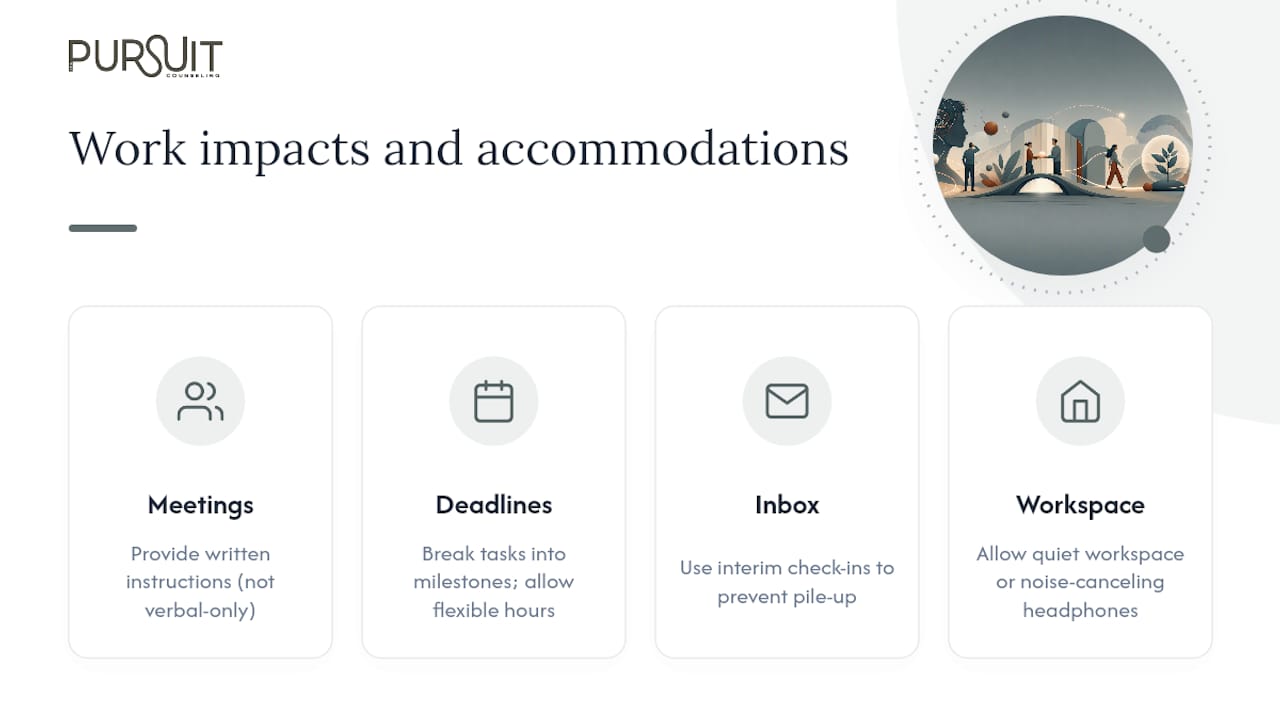
Reasonable accommodations make a measurable difference. Written instructions instead of verbal-only briefings reduce the “appearing not to listen” problem. Broken-down project milestones with interim check-ins catch drift before a deadline is missed entirely. A quieter workspace, or permission to use noise-canceling headphones, cuts down on the minor-stimuli distractibility that derails focused work. Flexible scheduling around your natural energy peaks, rather than a rigid 9-to-5 expectation, often produces better output than forcing focus at the worst possible hour.
Disclosure is a personal decision, not a requirement, but formal accommodations under workplace disability protections generally require documentation from a diagnosing clinician. That’s one more practical reason a real evaluation, not just a self-assessment, matters if workplace friction is a driving concern.
How Does Inattentive ADHD Affect Relationships?
Inattentive ADHD shows up in relationships as a pattern that partners often misread as indifference. Zoning out during a conversation, forgetting plans, or missing emotional cues aren’t signs of not caring. They’re symptoms of an attention system that struggles to sustain focus even when the stakes matter deeply.
Over time, this creates a familiar and painful dynamic. The partner without ADHD starts to feel like a project manager, repeating themselves, tracking shared responsibilities, and absorbing the mental load the other partner’s brain can’t consistently hold. Resentment builds on one side; shame builds on the other, especially once the partner with ADHD recognizes the pattern but still can’t seem to break it through effort alone.
Friendships and family relationships follow a similar arc on a smaller scale. Forgotten birthdays, late arrivals, and half-finished promises accumulate into a reputation for unreliability that rarely matches the person’s actual intentions or affection.
Understanding the neurological basis for this pattern, rather than treating it as a values problem, tends to open the door to real repair. Couples counseling approaches like the Gottman Method can help partners rebuild trust once ADHD is named and addressed directly, rather than fought over indirectly through years of low-grade frustration.
What Is the Long-Term Outlook for Adults With Inattentive ADHD?
The long-term outlook for adults with inattentive ADHD is genuinely encouraging when the condition is identified and managed. This isn’t a life sentence of missed deadlines and frayed relationships. It’s a pattern that responds well to the right combination of treatment and structure.
Several factors shape how well someone does over time. Early and accurate diagnosis matters enormously, since years of unexplained struggle tend to compound into secondary anxiety and depression that then need their own treatment. Consistency with medication and therapy matters just as much as the initial diagnosis; sporadic treatment produces sporadic results. Strong external support, whether a partner, a coach, or a structured workplace, buffers the days when internal systems alone aren’t enough.
Adults who build durable external systems, calendars, checklists, accountability partners, tend to report far more stability than those relying on medication in isolation. The 12 Week Year framework is one example of a structured system that plays to ADHD strengths rather than fighting against them.
Untreated, inattentive ADHD tends to compound quietly: missed opportunities, strained relationships, and chronic low-grade stress accumulate over years rather than announcing themselves all at once. Treated, most adults find a version of daily life that finally feels workable rather than like a constant uphill effort.
How Do Diet, Exercise, and Sleep Affect Inattentive ADHD?
Diet, exercise, and sleep hygiene won’t replace medication or therapy, but they meaningfully shape how well both work. Think of them as the foundation the rest of the treatment plan sits on.
Sleep deprivation mimics and worsens inattentive symptoms almost perfectly, foggy focus, forgetfulness, and irritability all overlap heavily with poor sleep. Adults with ADHD frequently struggle with sleep onset in the first place, sometimes because a racing, understimulated mind resists winding down, creating a frustrating cycle where the disorder disrupts the very sleep that would help manage it. A consistent bedtime and a wind-down routine free of screens can meaningfully improve next-day focus. Shifts like daylight saving time tend to hit this population harder than most, disrupting an already fragile rhythm.
Exercise has one of the more immediate effects available. Aerobic activity boosts dopamine and norepinephrine, the same neurotransmitter systems that stimulant medications target, which is part of why a brisk walk or a run before a demanding task often sharpens focus for an hour or two afterward.
Diet plays a smaller but real supporting role. Stable blood sugar, achieved through regular meals rather than skipped ones, avoids the energy crashes that make sustained attention even harder. None of this substitutes for a real treatment plan, but it removes some of the friction that makes medication and therapy work harder than they need to.
A Publisher’s Note on Living With Inattentive ADHD
Clients often arrive years into managing symptoms alone, relieved to finally have a name for the pattern. Medication helps, but it rarely works in isolation. The adults who do best combine treatment with structure and support built around their actual life, not a generic template.
How The Pursuit Counseling Supports Adults With Inattentive ADHD
Reading about inattentive ADHD is one thing. Getting an individualized plan that accounts for your actual work schedule, relationships, and history is another, and that’s the gap The Pursuit Counseling is built to close for adults across Georgia, in person and online.
The practice’s ADHD program combines clinical evaluation with practical coaching, so you’re not left with a diagnosis and no next step. Neurofeedback offers an evidence-informed adjunct for attention regulation, useful alongside medication rather than instead of it. Executive coaching rounds out the approach by building the external systems that make treatment gains stick in daily life, at work and at home.
If missed deadlines, scattered focus, or strained relationships have you wondering whether inattentive ADHD explains the pattern, schedule a consultation with The Pursuit Counseling and start with a real, individualized assessment.
Sources
- Inattentive ADHD: What It Is, Symptoms & Treatment
- Inattentive Women with ADHD – CHADD
- ADHD in Adults: 4 Things to Know – National Institute of Mental Health (NIMH)
- FAQs about ADHD in Girls and Women | Duke Department of Psychiatry & Behavioral Sciences
This article is general information, not a substitute for advice from a qualified doctor. Consult a qualified healthcare professional about your own circumstances before acting on anything here.
FAQ
What Does Inattentive ADHD Look Like in Adults?
It looks like chronic disorganization, missed deadlines, losing everyday items, and appearing distracted even during important conversations, without the visible hyperactivity seen in other presentations.
Can a Person With Inattentive ADHD Live a Normal Life?
Yes. With an accurate diagnosis and a combination of medication, therapy or coaching, and consistent external systems, most adults manage symptoms well and build stable, satisfying careers and relationships.
What Are the Core Symptoms of Inattentive ADHD in Adults?
Core symptoms include careless mistakes, trouble sustaining attention, appearing not to listen, poor follow-through, disorganization, losing items, distractibility, forgetfulness, and time blindness.
What ADHD Symptoms Get Overlooked Most Often?
Time blindness and “directed attention” fatigue, the exhaustion of forcing focus on effortful tasks, are frequently missed because they look like procrastination rather than a neurological pattern. Programs like The Pursuit Counseling’s ADHD program specifically address these less obvious symptoms alongside the more recognizable ones.