


ADHD burnout is executive-function collapse brought on by chronic overwork, masking, and compensation, and it hits women especially hard because so much of that compensation happens invisibly. If you’re exhausted in a way sleep doesn’t fix, forgetful in ways that scare you, and starting to feel numb toward things you used to care about, the fix isn’t more willpower. It’s dropping nonessential demands now, protecting real rest, and getting professional support if the shutdown feels severe or unsafe.
TL;DR:
- Women with ADHD experience burnout more often due to masking, emotional labor, late diagnosis, and ongoing caregiving roles that increase cognitive load.
- The burnout cycle involves overcompensation, temporary success, escalating effort, system collapse, and repeated recovery, often with minimal warning signs.
- Recovery requires reducing demands, protecting sleep, supporting the nervous system, and rebuilding executive functions through external tools and clinical support.
- Healing can take weeks to months depending on the severity, with severe cases needing immediate professional intervention for safety concerns.
- Self-management helps in early stages, but persistent or severe burnout signals the need for ADHD-informed therapy and medical support.
Table of Contents
- What Is ADHD Burnout, and How Is It Different From Regular Burnout?
- Signs and Symptoms of ADHD Burnout in Women
- Why Women With ADHD Burn Out More Often
- The ADHD Burnout Cycle: How It Develops and Repeats
- Your Recovery Kit: A Paced Approach to Healing ADHD Burnout
- How Long Does ADHD Burnout Recovery Take?
- When ADHD Burnout Needs Professional Help
- How The Pursuit Counseling Approaches ADHD Burnout Recovery
- A Note on Pacing and Permission to Rest
- Get Support for ADHD Burnout Recovery
- Sources
- FAQ
What Is ADHD Burnout, and How Is It Different From Regular Burnout?
ADHD burnout is what happens when the brain’s executive systems, the ones that manage planning, time, working memory, and emotional regulation, run past capacity for too long. Unlike occupational burnout, which the World Health Organization defines as a syndrome caused specifically by chronic workplace stress, ADHD burnout can be triggered by any environment demanding sustained self-management: a job, a household, a relationship, even a hobby that used to feel effortless.
The mechanism is different, too. Depression tends to flatten interest and mood evenly across the board. ADHD burnout is patchier. You might still care intensely about the things that matter to you while being completely unable to answer an email or start the laundry. Research on ADHD and occupational strain ties this pattern to deficits in time management, organization, and working memory that quietly raise cognitive load year after year until something gives.
A few distinguishing features:
- ADHD burnout often improves somewhat with reduced demands alone; clinical depression usually doesn’t.
- It frequently follows a period of intense masking or overcompensation, not just stress.
- Symptoms can fluctuate hour to hour depending on stimulation, interest, and structure.
- It coexists with, rather than replaces, the underlying ADHD traits driving it.
Signs and Symptoms of ADHD Burnout in Women
Symptoms build quietly because masking hides the early warning signs, even from the woman experiencing them. By the time burnout is obvious to other people, it has usually been building for months.
Cognitive signs tend to surface first:
- Words you know well suddenly feel out of reach mid-sentence.
- Tasks that used to take twenty minutes now take two hours, or don’t get finished.
- Decision fatigue sets in over choices that used to be automatic, like what to eat.
- Working memory drops, so you walk into a room and forget why.
Emotional signs usually follow:
- Irritability that feels disproportionate to the trigger.
- A flat, disconnected feeling toward people and activities you normally enjoy.
- Shame spirals after small mistakes that wouldn’t have bothered you a year ago.
- Crying more easily, or the opposite: feeling numb when you expect to feel something.
Physical and behavioral signs often show up last, once the body starts protesting:
- Chronic fatigue that doesn’t resolve with a normal night’s sleep.
- Sensory sensitivity spikes, noise and light feel louder and brighter than before.
- Withdrawing from social plans that once felt easy.
- Basic self-care, showering, meals, appointments, starts slipping.
Field studies on ADHD symptoms and occupational fatigue consistently find that time-management and organization difficulties correlate with higher reported exhaustion, which tracks with what many women describe: the burnout doesn’t announce itself, it accumulates in the gaps between tasks nobody sees you struggling with.
Pro Tip: If you’re not sure whether what you’re feeling is burnout or “just a bad week,” track it for five days. Burnout tends to persist and worsen; a bad week tends to lift once the immediate stressor passes.

Why Women With ADHD Burn Out More Often
Several overlapping forces make ADHD burnout more common, and more hidden, in women than in men.
- Masking and emotional labor. Women with ADHD frequently learn to hide symptoms early, often before diagnosis, and that constant self-monitoring adds a second full-time job on top of whatever they’re actually doing. Research on emotional dysregulation in ADHD links this kind of chronic compensation directly to exhaustion and functional collapse, and notes women disproportionately carry both the masking and the emotional labor that keeps relationships and households running.
- Late or missed diagnosis. Many women aren’t diagnosed until adulthood, sometimes not until a child’s evaluation prompts their own. Years of unexplained struggle, often mislabeled as anxiety or a personality flaw, mean the coping strategies built in that gap are usually the wrong ones.
- Caretaking and role strain. Whether it’s children, aging parents, or a partner, caretaking responsibilities still fall disproportionately on women, and ADHD’s executive-function demands don’t pause for that role. Managing someone else’s schedule while your own executive function is already stretched thin accelerates the burnout timeline considerably.
- Hormonal modulation. Estrogen fluctuations across the menstrual cycle, postpartum period, and perimenopause can worsen attention, working memory, and emotional regulation, meaning ADHD symptoms, and the burnout risk that follows, aren’t static across a woman’s life.
The ADHD Burnout Cycle: How It Develops and Repeats
ADHD burnout rarely arrives as a single event. It’s a cycle, and recognizing which stage you’re in is the first real step toward breaking it.
- Overcompensation. You notice you’re falling behind, so you push harder: more lists, more caffeine, more late nights, more masking in front of others.
- Temporary success. The extra effort works, for a while. This stage is dangerous because it reinforces the belief that pushing harder is sustainable.
- Escalating cost. The effort required to maintain the same output keeps climbing. Sleep shortens. Small errors creep in. Emotional reactions get bigger.
- Executive-function collapse. The system that was compensating simply stops. Tasks that were manageable last month become impossible. This is the burnout point most women recognize by name.
- Partial recovery, then repeat. Without changing the underlying demands, a few days of rest brings just enough function back to restart the cycle at stage one, usually with less reserve than before.
Workplace demands and home demands interact here in a way that’s easy to miss. A woman might reduce work hours to recover, only to have the freed-up time absorbed instantly by household or caregiving tasks that were piling up. The cycle doesn’t break because the total demand never actually drops. Coping strategies like overworking through the collapse phase, or numbing out with scrolling and avoidance, feel like relief but mainly delay the reckoning and deepen the next crash.
Your Recovery Kit: A Paced Approach to Healing ADHD Burnout
Recovery works best when it targets both sides of the equation: lowering demand and rebuilding capacity at the same time. Clinical guidance on ADHD burnout recovery is consistent on this point: rest alone rarely resolves burnout if the underlying load stays the same.
Start by cutting demand, not by resting harder.
- Pick three to five nonnegotiable priorities and let everything else drop for now, even things that usually matter to you.
- Stop masking wherever it’s safe to do so. Tell a trusted friend, partner, or manager that you’re running on empty.
- Say no to new commitments for at least a few weeks, even good ones.
Support your nervous system daily.
- Protect a consistent sleep window; ADHD often disrupts circadian rhythm, and seasonal shifts like daylight saving time can make this worse.
- Build in low-stimulation rest, not just screen time, which can feel restful but keeps the nervous system activated.
- Move your body in a way that doesn’t require willpower to start, a walk outside beats a structured workout you’ll skip.
Rebuild executive scaffolding.
- Use timers and external checklists instead of relying on memory or motivation.
- Template repeated decisions (meals, outfits, routines) so fewer choices drain your day.
- Change the environment before changing the person: visible reminders, fewer steps between you and the task, less friction everywhere you can remove it.
Bring in clinical support.
- A therapist familiar with ADHD can help separate burnout symptoms from co-occurring anxiety or depression and build a plan that fits your actual life, not a generic template. The Pursuit Counseling’s therapy approaches for burnout recovery blend several of these methods rather than relying on one.
- If you’re on ADHD medication, or have never tried it, this is a reasonable time to review options with a prescriber; burnout itself can make stimulant medication feel less effective.
- EMDR and neurofeedback are increasingly used as adjuncts, not replacements, for talk therapy and skills work, particularly when trauma or attentional dysregulation are compounding the burnout.
Pace deliberately. Recovery isn’t a straight line, and pushing back to full speed on one good day is the single most common way women re-trigger the crash they just climbed out of.
Pro Tip: Track two or three concrete daily anchors instead of relying on how you “feel.” Something like the number of five-minute tasks completed, or hours awake without feeling overwhelmed, gives a clearer signal than mood alone, which burnout distorts in both directions.
For readers with almost no bandwidth to spare, small entry-level strategies for starting to heal without free time can be a more realistic starting point than an ambitious overhaul.
How Long Does ADHD Burnout Recovery Take?
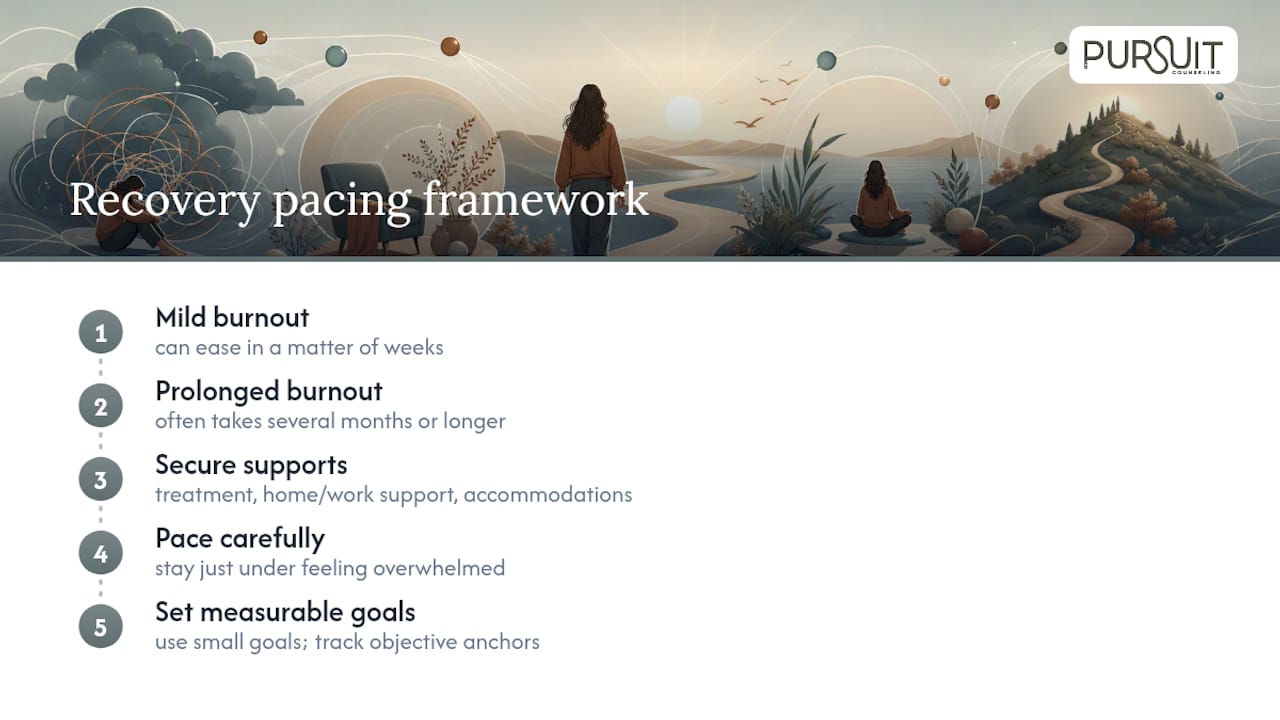
Mild burnout caught early can ease in a matter of weeks once demands drop and rest returns. Burnout that’s gone on for months or years, layered with masking, caretaking, and untreated symptoms, often takes several months to meaningfully resolve, and some capacity may take longer still to rebuild.
Recovery speed depends heavily on whether the person gets treatment, has real support at home and work, and can secure accommodations that actually reduce load rather than just rearranging it. The safest pacing rule: stay just under the point where you feel overwhelmed, use small measurable goals instead of vague ones, and track objective anchors rather than trusting mood alone, since burnout skews perception in both directions.
When ADHD Burnout Needs Professional Help
Some signs mean it’s time to move past self-management and get clinical support directly.
- Thoughts of suicide or self-harm, at any intensity, require immediate help. Contact the 988 Suicide & Crisis Lifeline right away.
- Severe shutdown that prevents basic functioning, missed work, skipped meals, inability to leave the house, for more than a few days.
- Self-neglect around hygiene, medication, or safety that’s out of character.
- Burnout that isn’t improving despite genuinely reduced demands over several weeks.
An ADHD-informed therapist or psychiatrist can help distinguish burnout from a co-occurring anxiety disorder, depression, or trauma response, since these frequently overlap and complicate each other. Guidance on when burnout crosses the line into needing professional support covers this decision in more depth.
How The Pursuit Counseling Approaches ADHD Burnout Recovery
The Pursuit Counseling builds a plan around the individual rather than a single protocol, starting with an assessment that separates ADHD-driven exhaustion from overlapping anxiety, depression, or trauma.
- Individualized treatment plans built from a full clinical picture, not a checklist.
- EMDR for trauma or chronic stress responses tangled up with the burnout.
- Neurofeedback to support attentional regulation and calm an overactivated nervous system.
- CBT and executive coaching to rebuild practical skills and daily structure.
- Both telehealth and in-person sessions across Georgia, so care fits around an already depleted schedule.
A first visit typically starts with a conversation about what’s been happening, what’s already been tried, and where the load can realistically come down first.
A Note on Pacing and Permission to Rest
Recovery from ADHD burnout is rarely a straight climb back to where you were. It dips, plateaus, and sometimes backslides for reasons that have nothing to do with effort. That’s not failure. That’s how depleted systems repair.
Give yourself permission to cut load before you feel like you’ve “earned” it. One small ritual worth trying today: pick a single task you’d normally push through and simply don’t do it. Notice what happens. Usually, nothing bad does.
— Adam
Get Support for ADHD Burnout Recovery
If reading this feels like looking in a mirror, the next step doesn’t have to be another self-help article. The Pursuit Counseling works specifically with high-performing women whose ADHD has outpaced their coping strategies, combining an ADHD-focused program with EMDR, neurofeedback, and executive coaching built around your actual schedule, not a generic template.

A first conversation is low-pressure: what’s been happening, what you’ve already tried, and where load can come down first without your life falling apart in the process. Sessions are available in-person and via telehealth across Georgia. If you’re in crisis or having thoughts of self-harm, contact the 988 Suicide & Crisis Lifeline immediately rather than waiting for an appointment. Otherwise, getting started with counseling takes just a few minutes, and a partner resource on why pushing through burnout backfires is worth reading if you need convincing that rest isn’t the same as giving up.
Sources
- Burn‑out an occupational phenomenon — International Classification of Diseases (WHO)
- PMC11007411 (peer-reviewed article)
- PMC7287898 (peer-reviewed article)
- Attention-Deficit/Hyperactivity Disorder (NIMH)
This article is general information, not a substitute for advice from a qualified doctor. Consult a qualified healthcare professional about your own circumstances before acting on anything here.
FAQ
What Is ADHD Burnout?
ADHD burnout is executive-function collapse caused by chronic overwork, masking, and compensation, distinct from occupational burnout because it stems from managing ADHD symptoms rather than workplace stress alone, as ADDA outlines.
What Are the Signs of ADHD in Adult Women?
Common signs include chronic disorganization, emotional sensitivity, forgetfulness, difficulty starting or finishing tasks, and internal restlessness that often gets mislabeled as anxiety, per NIMH’s overview of adult ADHD symptoms.
What Are the Characteristics of High-Functioning ADHD in Women?
High-functioning ADHD in women often looks like external competence built on exhausting internal compensation, heavy masking, perfectionism, and a level of daily effort that isn’t visible until burnout forces it to the surface.
What Are Some Life Hacks for Women With ADHD?
Externalize memory with timers and checklists, template repeated decisions like meals and routines, reduce environmental friction around tasks, and track a couple of objective daily anchors instead of relying on how motivated you feel.
How Do I Know If I Need Professional Help for ADHD Burnout?
If burnout persists despite reduced demands, involves self-neglect, or includes any thoughts of self-harm, it’s time to contact an ADHD-informed therapist or, in a crisis, the 988 Suicide & Crisis Lifeline immediately.