


Nervous system dysregulation is a popular phrase for a real experience: your body keeps reacting as if something is wrong, or keeps shutting down, long after the demand has passed. It is not a formal diagnosis. It is a description of a stress response that has lost its flexibility, and it usually points to something specific that can be understood and treated, such as chronic stress, burnout, anxiety, trauma, or ADHD.
If you are a person who holds a lot together, this may sound familiar. You perform. You answer the email, fly the leg, run the meeting, get the kids to practice. Then you lie awake with a pounding heart, or you sit on the couch unable to feel much of anything. That is worth taking seriously, and this guide is written for intelligent adults who want the plain version.
Key takeaways
- “Dysregulation” is a description, not a diagnosis. It names a pattern: your system stays stuck in high alert or low energy and struggles to return to steady ground.
- Two broad states show up. Too much (hyperarousal) looks like racing thoughts, irritability, and panic. Too little (hypoarousal) looks like numbness, fog, and shutdown. Many people swing between them.
- Sleep, movement, caffeine, and breathing help, but they support professional care rather than replace it, especially when trauma or anxiety is underneath.
- This article is education, not assessment. Only a licensed clinician who sits with you can say what is driving your symptoms.
Table of Contents
- What nervous system dysregulation actually means
- The window of tolerance, in plain terms
- Hyperarousal and hypoarousal: what each one feels like
- Signs of a dysregulated nervous system
- Why it happens
- Why optimism and willpower are not enough
- What helps: steps you can start this week
- How long does it take?
- When self-help is not enough
- Our perspective at The Pursuit Counseling
- Working with us
- FAQ
- Sources
What nervous system dysregulation actually means
Your autonomic nervous system runs the things you do not think about: heart rate, breathing, digestion, and the shift between mobilizing and resting. The sympathetic branch is the fight-or-flight gas pedal. The parasympathetic branch is the rest-and-digest brake.
In wellness language, dysregulation means the system struggles to move efficiently between those states. Clinically, researchers often look at heart rate variability (HRV), the small beat-to-beat changes in your pulse that reflect how flexibly your body adjusts. A meta-analysis of people with PTSD found significantly lower resting HRV measures than in healthy controls, a sign of autonomic inflexibility. A separate overview of the biology of posttraumatic stress describes how chronic activation of the stress response can lead to long-lasting changes in the nervous and endocrine systems.
Two honest caveats. First, a lower HRV on a wearable is not a diagnosis, and the research above studied people with PTSD, not everyone who feels frayed. Second, the internet sometimes presents “reset your nervous system” as a quick fix. Your system is not a router. It responds to what has happened to you, what is happening now, and how much recovery you get in between.
The window of tolerance, in plain terms
The most useful picture we know is the window of tolerance, a concept from psychiatrist Daniel Siegel. Imagine a band of arousal in which you can think clearly, feel what you feel, and stay connected to the people in front of you. Inside the window, a hard day is hard but workable.
Push above the window and you get hyperarousal. Drop below it and you get hypoarousal. Stress, exhaustion, and old injuries tend to narrow the window, so smaller things push you out of it. That is why you can handle a real emergency calmly and then come undone over a dishwasher.
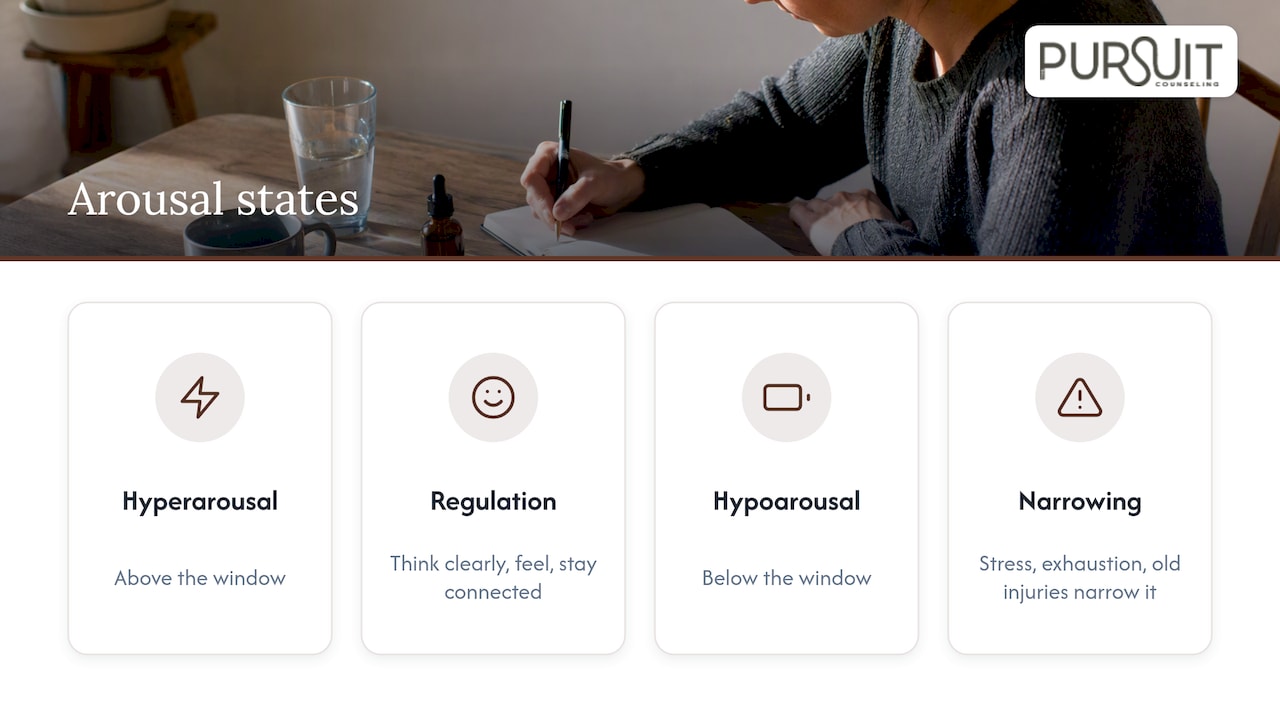
The goal of good care is rarely a life without stress. It is a wider window and a faster route back.
Hyperarousal and hypoarousal: what each one feels like
| Hyperarousal (too much) | Hypoarousal (too little) | |
|---|---|---|
| Body | Racing heart, tight chest, jaw clenching, restlessness | Heaviness, low energy, feeling cold or slowed down |
| Mind | Racing thoughts, hypervigilance, trouble focusing | Fog, blankness, trouble finding words |
| Emotion | Irritability, panic, dread, anger that arrives fast | Numbness, flatness, detachment |
| Behavior | Overworking, snapping, scanning for problems | Withdrawing, procrastinating, going through the motions |
| Sleep | Wired but tired, waking at 3 a.m. | Sleeping a lot and still unrested |
Most people we talk with do not live in one column. A founder runs hot for six weeks, then crashes for a weekend and calls it laziness. A mother holds the family together all week and goes blank by Friday night. The swing itself is the signal.
Signs of a dysregulated nervous system
No single sign proves anything. Look for clusters that persist for weeks and interfere with how you live:
- You startle easily or feel on edge with no clear reason.
- You cannot wind down, even when everything on the list is done.
- You feel emotionally flat, or tears and anger come out of proportion.
- Your sleep is broken or unrefreshing.
- Your body hurts in ways that do not match any injury: tension headaches, stomach trouble, a clenched chest.
- You rely more on caffeine to start and on alcohol or scrolling to stop.
- Small decisions feel enormous, and focus slips.
- Closeness feels like too much, or you pull away from people you love.
Many of these overlap with anxiety, depression, ADHD, burnout, thyroid problems, and sleep disorders. That overlap is exactly why self-diagnosing from a list is risky. Physical symptoms like a racing heart or chest tightness deserve a medical evaluation first. If you ever have chest pain, trouble breathing, or thoughts of harming yourself, call 911 or 988 (the Suicide & Crisis Lifeline) rather than reading further.
Why it happens
There is rarely one cause. The common ones we see in adults who are used to carrying a lot:
Chronic stress without recovery. Stress is your body’s physical and emotional response to new or challenging situations, and the response is meant to end. When the demands never stop, it does not.
Trauma, big and small. A single frightening event, years of unpredictability in childhood, a hard season in a marriage, or a career with real danger can all teach the body to stay braced. Pilots, first responders, and veterans know this one well.
Anxiety. The National Institute of Mental Health describes generalized anxiety disorder as a persistent feeling of anxiety or dread that interferes with daily life, distinct from ordinary worry. It is common: the CDC reports that about 19% of U.S. adults, roughly 1 in 5, have been diagnosed with an anxiety disorder.
ADHD. A brain that struggles with executive function often lives in a state of constant effort. Over time that effort looks like dysregulation, especially in women who were diagnosed late and spent years compensating.
Burnout. Long stretches of high output with low recovery wear down the very systems that bring you back to baseline.
Why optimism and willpower are not enough
High performers often try to think their way out. Stay positive. Push through. It makes sense, because it has worked in other parts of life.
The research is less flattering to that approach. A meta-analysis in Health Psychology tested whether trait well-being relates to physical reactivity and recovery after a stressor in healthy adults. The practical takeaway we draw from it: recovery is a capacity you build, not a mood you maintain. Your body needs real downshifts, not a better attitude.
What helps: steps you can start this week
These are supports, not cures. They work best alongside care, and they work best when you do them before you are in crisis.
Give the basics a fair trial
The CDC’s guidance on managing stress points to 7 or more hours of sleep, regular physical activity, and less caffeine as habits that support treatment for stress and anxiety, and it recommends adults build up to 2.5 hours of physical activity a week. Pick one. If sleep is the weakest link, protect a fixed wake time for two weeks before changing anything else.
Some people also look at nutrition and supplements as part of the picture. If that is you, supplements for anxiety are worth researching with a clinician or pharmacist first, particularly if you take any medication.
Use your breath to slow the body down
Slow breathing with a longer exhale is a simple way to nudge your body toward the brake pedal. Try inhaling for four counts and exhaling for six to eight, for two to five minutes. If it makes you more anxious or lightheaded, stop and try something else, such as pressing your feet into the floor and naming five things you see.
Move on purpose
A brisk walk after a hard meeting does more than another cup of coffee. Hyperaroused people often need movement to discharge energy. Hypoaroused people often need gentle movement to wake the body up. Match the dose to your state.
Build in real recovery
Think of the way an endurance athlete trains: hard efforts, then deliberate recovery. If your calendar has the first and none of the second, your body will schedule the second for you. Block recovery the way you block a board meeting.
Let someone else steady you
Nervous systems regulate in company. A calm friend, a partner who can sit with you without fixing, or a therapist who stays steady while you say the hard thing all count. If your closest relationship is part of the strain, that is worth addressing directly rather than managing alone.
How long does it take?
Honestly, it depends, and anyone who gives you a number for a nervous system reset is selling something. Small changes in sleep and movement can make evenings feel different within a couple of weeks. Skills practiced consistently usually take longer to settle in, and some treatments take weeks to show their effect. If the pattern is rooted in trauma, expect a process with a clinician, not a hack.
When self-help is not enough
See a professional when symptoms last more than a few weeks, when they cost you sleep, work, or relationships, when you are using alcohol or other substances to cope, or when something traumatic is underneath. Start with a medical check if you have physical symptoms, because thyroid problems, heart rhythm issues, and sleep apnea can mimic or amplify these patterns.
Several kinds of treatment are well supported, and which fits depends on what is going on:
- Trauma-focused therapy. The 2023 VA/DoD guideline recommends specific trauma-focused psychotherapies, including Cognitive Processing Therapy, EMDR, and Prolonged Exposure, over medication as the primary treatment for PTSD.
- Cognitive and skills-based therapy for anxiety and burnout. These target the automatic thought patterns and habits that keep the alarm on. DBT-style skills are especially useful for emotions that move fast.
- Treatment for ADHD that addresses body and mind. Research on ADHD points to a long-term, multifaceted approach rather than a single fix.
- Neurofeedback and brain mapping, which some people use to see and train patterns in brain activity, alongside therapy.
No one tool is usually enough alone. You are building a plan, not buying a product.
Our perspective at The Pursuit Counseling
We work with complicated, capable people: pilots, executives, founders, busy moms, teen athletes, creatives. Almost none of them walk in saying “dysregulation.” They say they are tired in a way sleep does not touch. They say they are short with the people they love. They say they used to love the work.
We think of it the way an ultramarathoner thinks of the pain cave. Everyone who does something hard ends up there at some point. The question is whether you have the skill and the company to get through it, and whether you stop to look at the cracks the experience reveals rather than paper over them. Those cracks are information. They usually point to something that deserves care: an old injury, a body that never got to stand down, a pace no one can hold.
So we start with understanding, not a protocol. We separate education from assessment: articles like this one inform, but only a conversation, and where appropriate testing, tells us what is happening in your case. Then we build a plan with you, drawing on EMDR for trauma, skills-based work for anxiety and emotion, ADHD-focused treatment, neurofeedback, and experiential work like adventure therapy when sitting in a chair is not the right fit. We offer sessions in person in Fayetteville and online, and we do not promise outcomes. We promise to take your story seriously and to work alongside you.
— Adam Glendye LPC, CPCS
Working with us
If you are in Fayetteville, Peachtree City, Senoia, Tyrone, or anywhere in South Atlanta, or you prefer online sessions, here is what the first steps can look like:
- Neurofeedback brain mapping is described on our programs page. We do not publish a price there, so ask when you reach out.
We are private-pay, which means we do not work through insurance. If you are not sure which of these fits, start with a conversation. You do not need the right vocabulary to begin. You only need to be willing to say what has been happening.
About 14% of U.S. adults received counseling or therapy from a mental health professional in 2024. Asking for help is common among people who carry a lot, and it is rarely the weakness it feels like at 2 a.m.
FAQ
Is nervous system dysregulation a real medical condition?
It is not a formal diagnosis. It is a descriptive term for a stress response that stays stuck in high alert or shutdown. The underlying patterns are real and are associated with conditions like PTSD and anxiety disorders, so a clinician will usually look for the specific condition behind your symptoms.
What are the first signs of a dysregulated nervous system?
Common early signs are trouble winding down, easy startling, irritability, broken sleep, emotional numbness, and unexplained body tension. One sign alone means little. A cluster that lasts weeks and affects your work or relationships is a reason to talk with a professional.
How do I regulate my nervous system quickly?
Slow breathing with a longer exhale, a brisk walk, and grounding through the senses can ease a moment of high alert. They calm the moment rather than address the cause. If the pattern keeps returning, therapy for the underlying stress, anxiety, or trauma is the more lasting route.
Can therapy help with a dysregulated nervous system?
Yes, for many people. Trauma-focused approaches such as EMDR, skills-based therapies, and treatment for ADHD or anxiety all target the patterns behind dysregulation. We cannot promise a specific result, but a good therapist will help you build a plan and track whether it is working.
Is a nervous system reset possible in a weekend?
A good weekend of rest can help you feel better, but it will not undo months or years of strain. Lasting change usually takes steady practice and, when trauma or anxiety is involved, professional support. Intensive formats can speed up the work for some people, though they still require preparation and follow-up.
Sources
- Posttraumatic Stress Disorder and Alterations in Resting Heart Rate Variability: A Systematic Review and Meta-Analysis
- Nervous and Endocrine System Dysfunction in Posttraumatic Stress
- Managing Stress, CDC
- Mental Health Conditions & Care, CDC
- Generalized Anxiety Disorder, NIMH
- Health Psychology meta-analysis on well-being and stress reactivity
- 2023 VA/DoD Clinical Practice Guideline synopsis for PTSD
- Evidence-based interventions for ADHD