


Medical professional burnout is a diagnosable occupational syndrome built from three parts: emotional exhaustion, depersonalization, and a shrinking sense of professional accomplishment. It is not a personal failing or a motivation problem. Nearly 46% of health workers reported feeling burned out often or very often in 2022, up sharply from 32% in 2018, and the evidence is clear that the fastest, most durable fixes happen at the organizational level, not through another wellness app pushed onto an already exhausted workforce.
TL;DR:
- High burnout rates persist among primary care physicians, emergency clinicians, and nurses, especially in understaffed, high-pressure settings with low autonomy.
- Workplace bullying and high job stress significantly increase burnout risk, with bullying having an odds ratio as high as 15 in some studies.
- Organizational changes like staffing improvements, documentation reduction, and anti-bullying policies are more effective long-term than individual resilience strategies.
- Symptoms of burnout include emotional exhaustion, depersonalization, and reduced efficacy, but they differ from depression, which affects all life areas equally.
- Regular monitoring of staffing levels, error rates, and burnout scores can help organizations address burnout proactively before clinical safety is compromised.
Table of Contents
- Understanding Medical Professional Burnout and Where It Stands Today
- What Actually Drives Burnout in Doctors, Nurses, and Other Clinicians
- Recognizing Symptoms of Burnout and Telling It Apart From Depression
- How Burnout Puts Patients and Health Systems at Risk
- Reducing Physician Burnout: What Leaders Can Actually Change
- Managing Burnout Day to Day and Knowing When to Get Professional Help
- Where to Find Validated Tools and Confidential Support
- A Clinical Perspective on Treating Burnout Without Losing Hope
- Support Built for the Demands of Medical Work
- Sources
- FAQ
Understanding Medical Professional Burnout and Where It Stands Today
Burnout in healthcare is not a mood. It is measurable, and the numbers have been trending in the wrong direction for years before ticking down slightly in the most recent data.
The CDC’s VitalSigns report found that 46% of health workers said they felt burned out often or very often in 2022, compared to 32% in 2018. That’s not a modest shift. It’s a 14 percentage point jump in four years, spanning a period that included a global pandemic, mass staffing shortages, and a wave of early retirements among experienced clinicians.
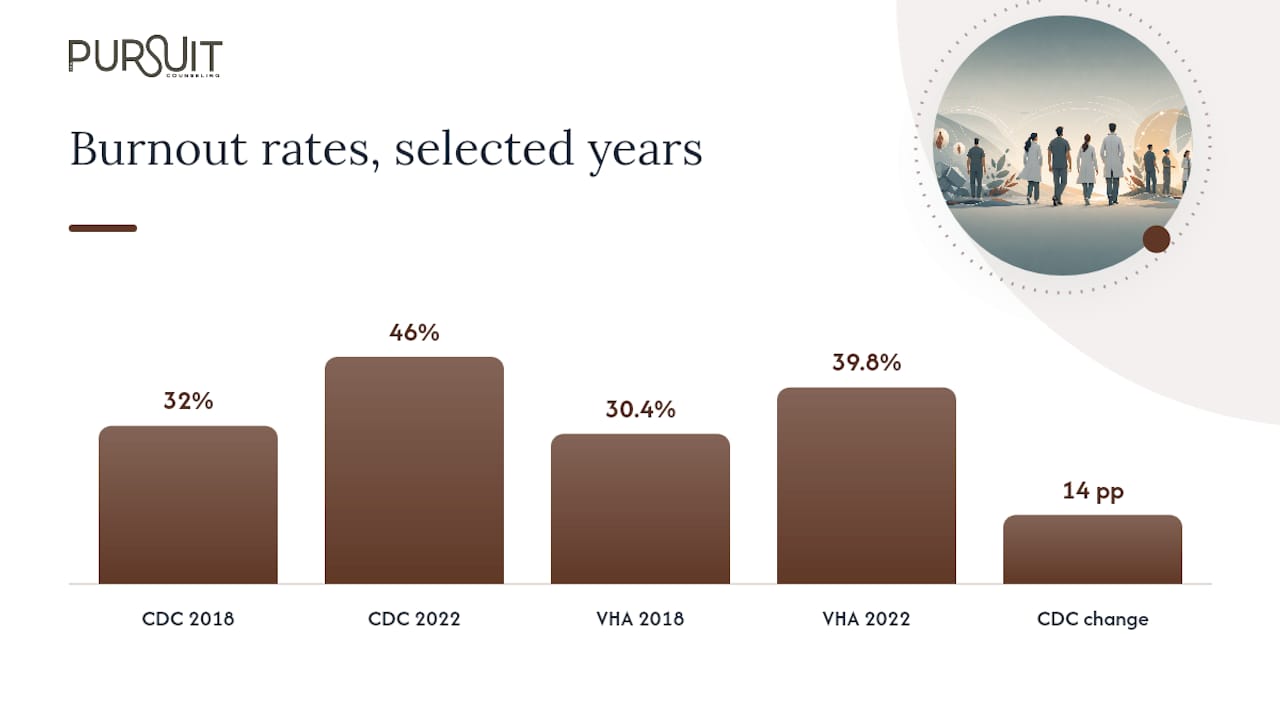
A closer look at the trend: Large health systems have tracked this in even finer detail. Veterans Health Administration data published in JAMA Network Open found burnout climbing from 30.4% in 2018 to 39.8% in 2022, then easing to 35.4% in 2023 as the public health emergency wound down. Primary care physicians fared worse across the same window, with reported rates ranging from 46.2% to 57.6% depending on the year and the survey instrument used.
Burnout does not distribute evenly across the profession. A few patterns show up again and again in the data:
- Primary care and emergency medicine consistently report some of the highest burnout rates, largely tied to volume, time pressure, and administrative load.
- Nurse burnout symptoms tend to cluster around chronic understaffing, physically taxing shift patterns, and moral distress from short staffing on the floor.
- Inpatient settings generally show higher burnout than outpatient or telehealth roles, where clinicians have more control over pacing and scheduling.
- Trainees and early-career physicians report high exhaustion scores, often tied to long hours combined with low decision-making authority.
The pandemic didn’t create healthcare worker stress from scratch. It accelerated a problem that workforce researchers had already flagged for over a decade, then left a partial, uneven recovery in its wake. Some systems that invested early in staffing and scheduling reforms have seen rates drop closer to pre-pandemic levels. Others, especially those that treated burnout as a communications problem rather than an operations problem, are still stuck near their 2022 peak.
What Actually Drives Burnout in Doctors, Nurses, and Other Clinicians
The causes of burnout in doctors and nurses aren’t mysterious anymore. A 2023 global systematic review and meta-analysis put actual numbers on what clinicians have been saying for years, and the size of some of these effects should reframe how leadership teams prioritize fixes.
Statistic callout: Workplace bullying carries an odds ratio of 4.05 to 15.01 for burnout, and high job stress carries an odds ratio of 4.21 (95% CI 1.62–10.94, p = 0.003), according to the same meta-analysis. Put plainly, a clinician working under a hostile supervisor or in a chronically high-stress unit is several times more likely to burn out than a peer in a healthier environment. Bullying isn’t a soft-skills footnote. It’s one of the strongest predictors in the entire literature.
Beyond bullying and stress, a handful of occupational risk factors show up repeatedly:
- Administrative and EHR burden. Documentation requirements now eat into time that used to go toward patients, and clinicians routinely describe the electronic health record as the single biggest daily drain on their energy.
- Workload and staffing ratios. Understaffed shifts don’t just increase physical fatigue. They increase the cognitive load of triaging who gets attention first, which wears on decision fatigue over a full shift.
- Low autonomy. Clinicians who have little say over their schedules, caseloads, or clinical decisions report burnout at higher rates than those with more control, even when workload is similar.
- Effort-reward imbalance. When the emotional and physical output required doesn’t match the recognition, compensation, or support received, exhaustion compounds faster.
- Moral distress. Being forced to act (or not act) against your own clinical judgment because of policy, staffing, or resource constraints leaves a particular kind of residue that standard fatigue doesn’t explain.
On the other side of the ledger, the same systematic review identifies protective factors that consistently show up in lower-burnout environments: supportive leadership, adequate staffing, resilience training, and strong peer or social support. None of those are individual willpower interventions. They are structural.
The U.S. Surgeon General’s advisory puts it directly: burnout is primarily a systemic and organizational issue. That reframing matters, because it shifts the question from “what’s wrong with this clinician” to “what’s wrong with this workplace,” and that shift changes which interventions actually get funded.
Recognizing Symptoms of Burnout and Telling It Apart From Depression
The three dimensions of burnout show up differently depending on the person, but the pattern is recognizable once you know what to look for. Emotional exhaustion feels like running on empty even after a full night’s sleep. Depersonalization shows up as cynicism, detachment, or treating patients as cases rather than people. Reduced professional efficacy is the quiet sense that nothing you do matters anymore, even when your clinical performance hasn’t actually slipped.
Supervisors and colleagues often notice behavioral signs before the clinician does: increased irritability, withdrawing from team huddles, calling out sick more frequently, or a once engaged clinician going quiet in meetings.
The Maslach Burnout Inventory remains the most widely used screening instrument, measuring all three dimensions with validated subscales. The Copenhagen Burnout Inventory offers a comparable option, and many organizations now use brief single-item screens as a faster first pass before a fuller assessment.
Here’s where triage gets clinically important: burnout and depression overlap, but they aren’t the same thing. According to clinical guidance differentiating the two, burnout is largely tied to the work context, while depression tends to be pervasive across every domain of life, including relationships, sleep, appetite, and interest in things outside the job. A clinician who feels renewed on vacation but dreads Monday is showing a classic burnout pattern. A clinician who feels flat everywhere, including at home with family, needs screening for depression, not just a lighter schedule.
Pro Tip: If a colleague’s exhaustion doesn’t lift at all during time off, that’s your cue to gently suggest a mental health evaluation rather than assuming a few days away will solve it.
How Burnout Puts Patients and Health Systems at Risk
Clinician exhaustion doesn’t stay contained to the person experiencing it. It leaks into the care they deliver and the system around them.
Burned out clinicians report higher rates of self-reported medical errors and near-miss safety events, a pattern that has been replicated across specialties and care settings. The mechanism isn’t mysterious: depersonalization narrows attention, exhaustion slows reaction time, and reduced efficacy erodes the extra vigilance that catches mistakes before they reach a patient.
Statistic callout: The financial and staffing fallout compounds the clinical risk. Higher burnout tracks with higher turnover, more absenteeism, and steeper recruitment costs to replace clinicians who leave, according to the Surgeon General’s advisory, which frames these losses as a direct consequence of failing to address burnout in doctors and nurses at the systemic level.
There’s also a feedback loop that rarely gets named out loud. Moral distress, from being asked to deliver care you know falls short of what a patient deserves, drives burnout. Burnout then drives more errors and lower quality care. Lower quality care creates more moral distress. Left alone, that loop tightens with every rotation, and it disproportionately affects the clinicians who care the most about doing right by their patients.
Organizations that take this seriously tend to track a small set of leading indicators rather than waiting for an exit interview to find out something was wrong:
- Turnover and voluntary resignation rates by unit and specialty
- Sick call and unplanned absence trends over rolling quarters
- Self-reported burnout scores from validated instruments, tracked year over year
- Near-miss and error reporting rates, paired with staffing ratios at the time of the event
- Time spent in the EHR outside scheduled clinical hours
None of these KPIs require exotic new software. Most large systems already collect the raw data. The gap is usually in whether leadership treats these numbers as a strategic priority or an afterthought buried in an annual report.
Reducing Physician Burnout: What Leaders Can Actually Change
Individual coping strategies help at the margins. They don’t fix a structurally broken shift schedule or an EHR that demands three extra hours of documentation a week. The Surgeon General’s advisory and the broader research base agree on this point: system-level changes produce larger and more sustained reductions in burnout than programs aimed only at individual resilience.
That doesn’t mean individual support has no place. It means the sequencing matters. Fix the workplace first, then support the worker inside it.
Here’s a practical order of operations for leaders who want to move past symbolic gestures:
- Redesign staffing and scheduling before anything else. Adequate staffing ratios and predictable, controllable schedules are two of the strongest protective factors identified in the research, and they’re also the changes clinicians notice fastest.
- Attack the documentation burden directly. Scribes, AI-assisted documentation tools, and team-based task redistribution have been shown to reduce the administrative load that clinicians consistently name as their top daily stressor.
- Build real anti-bullying infrastructure. Given that workplace bullying carries one of the highest odds ratios for burnout in the entire literature, that means anonymous reporting channels, an ombudsperson, and leadership accountability with actual consequences, not a poster in the break room.
- Protect well-being time on the schedule, not around it. Blocking time for peer support, debriefs after difficult cases, or simple recovery breaks only works if it’s built into staffing math, not treated as optional overtime.
- Create confidential reporting and referral pathways. Clinicians need to know that flagging burnout or requesting mental health support won’t show up on a performance review or licensing file.
- Pilot before you scale. Start with one unit or one specialty, measure burnout scores before and after using a validated tool, and expand what actually moves the numbers instead of rolling out a hospital-wide program on faith.
Some of this looks different depending on the role. Nursing schedules benefit enormously from self-scheduling software paired with firm ratio limits, since unpredictability is one of the biggest drivers of nurse burnout symptoms specifically. Trainees need explicit protections around duty hours and a real escalation path when supervision breaks down, since residents and fellows often have the least institutional power to push back on unsafe workloads.
Administrative burden deserves its own callout, because it’s one of the few drivers that’s genuinely solvable with existing tools. Reducing time spent on tasks like prior authorization paperwork alone can free up meaningful clinical hours per week, and that time reclaimed from paperwork translates directly into either more patient contact or genuine recovery time, both of which move burnout scores.
Pro Tip: If your organization is only tracking burnout through an annual all-staff survey, you’re finding out about the fire after the building’s already smoking. Pull smaller pulse checks quarterly, and route the results to unit leaders who can act on them immediately.
Governance matters as much as the interventions themselves. A burnout reduction program without an owner, a budget line, and a reporting structure to senior leadership tends to quietly disappear within eighteen months. The systems seeing real, sustained improvement treat it the way they treat any other quality metric: named leader, quarterly review, and a mandate to adjust course when a pilot doesn’t work.
Managing Burnout Day to Day and Knowing When to Get Professional Help
You can’t schedule-redesign your way through this afternoon’s shift. Some tools work in the moment, even inside a system that hasn’t fixed its structural problems yet.
Micro-rests between patients, even ninety seconds of deliberate breathing before opening the next chart, measurably lower physiological stress markers over a shift. Boundary-setting around after-hours messages and delegation of non-clinical tasks to the right team member both reduce the cumulative load that turns a hard week into a burned-out quarter. None of these fix the underlying system, but they buy margin while advocacy for bigger changes plays out.
Clinicians experiencing what’s often called high-functioning burnout keep performing at a high level while quietly running on empty inside. That’s a specific pattern worth understanding on its own terms, and The Pursuit Counseling has written about how to recover from high-functioning burnout when stepping away from work entirely isn’t realistic.
When self-management stops being enough, evidence-based treatment options exist and work. Cognitive behavioral therapy, mindfulness-based interventions, and structured psychotherapy all have research support for reducing burnout symptoms and treating co-occurring anxiety or depression. For clinicians whose moral distress or exhaustion has reached a severity where weekly sessions feel too slow, therapy intensives offer a concentrated alternative, delivering focused clinical work over a short block of days rather than months, without requiring an extended leave of absence.
| Signal | What it looks like | Suggested next step |
|---|---|---|
| Exhaustion lifts on vacation | Feels better after time off, dreads return | Micro-recovery practices, schedule advocacy |
| Exhaustion persists everywhere | Flat mood at home too, not just at work | Screen for depression and seek professional support |
| High performance, quiet collapse | Still delivering care, privately depleted | High-functioning burnout, evaluate individual therapy |
| Severe moral distress, can’t take leave | Constrained by staffing or role | Consider a therapy intensive |
If you’re unsure which type of support actually fits your situation, The Pursuit Counseling’s guide to counseling services for burned-out professionals breaks down the differences between weekly therapy, intensives, and coaching for clinicians specifically.
Where to Find Validated Tools and Confidential Support
A few resources are worth bookmarking rather than searching for again mid-crisis. The Maslach Burnout Inventory remains the most widely validated screening tool, and the Copenhagen Burnout Inventory offers a solid alternative for organizations wanting a shorter instrument.
- The Surgeon General’s health worker burnout advisory includes organizational toolkits for system-level action.
- CDC VitalSigns publishes updated prevalence data and downloadable graphics for internal presentations.
- SAMHSA’s national helpline offers confidential, free support for clinicians in crisis, available around the clock.
- Most hospital systems maintain a clinician assistance program with confidential referral separate from HR records.
A simple checklist covers the immediate loop: screen with a validated tool, document the pattern over time rather than a single bad week, and route to confidential referral before the exhaustion becomes a licensing or safety issue.
A Clinical Perspective on Treating Burnout Without Losing Hope
Burnout in clinicians is treatable, and I want to say that plainly because so much of the literature reads as grim. What I see in practice is that clinicians recover fastest when two things happen at once: the workplace changes something real, even something small, and the individual gets support for the moral distress they’ve been carrying alone.
The mistake I see most often is treating these as competing priorities, as if advocating for better staffing means you’re not also allowed to go to therapy. Both matter. Push for the systemic fixes your unit needs, and get clinical support for what the work has already cost you. Neither cancels the other out, and clinicians who do both tend to recover faster than those who wait for the system to fix itself first.
— Adam Glendye LPC, CPCS
Support Built for the Demands of Medical Work
Confidential, licensed clinical care built around the specific weight of moral distress and high-functioning burnout, not generic stress-management advice, can provide clinicians more targeted support than general wellness programs.

Sessions focus on what’s actually driving your exhaustion, whether that’s a documentation load that never lets up, a hostile supervisor, or the quiet accumulation of decisions you couldn’t unmake. Both in-person and secure teletherapy options are available, which matters for clinicians whose schedules don’t leave room for a commute across South Atlanta. A first session typically focuses on understanding each client’s specific situation rather than using a generic intake script, and confidentiality is maintained. If a weekly rhythm doesn’t fit your schedule, a therapy intensive delivers concentrated clinical work over a short block of days. Book a first session to start the process, in person in Fayetteville, Georgia or online from anywhere in South Atlanta.
This article is general information, not a substitute for advice from a qualified doctor. Consult a qualified healthcare professional about your own circumstances before acting on anything here.
Sources
- Health Worker Burnout — U.S. Department of Health & Human Services
- Health Workers Face a Mental Health Crisis | CDC VitalSigns
- Healthcare professional burnout — StatPearls (NCBI Bookshelf)
FAQ
How do you fix physician burnout?
Fixing burnout in doctors requires organizational change first, including better staffing ratios, reduced documentation burden, and anti-bullying enforcement, paired with accessible clinical treatment like therapy for individual moral distress and exhaustion.
What is the 42% rule for burnout?
There’s no established clinical standard called the “42% rule” in the peer-reviewed burnout literature; that figure appears to be a misremembered or informal reference rather than a recognized framework, so it’s best to rely on validated prevalence data like the CDC’s instead.
What medical profession has the highest burnout rate?
Primary care physicians report some of the highest burnout rates recorded, with VHA data showing rates as high as 57.6% in certain years, though emergency medicine and nursing also consistently rank near the top.
What profession is most prone to burnout?
Within healthcare, primary care physicians and emergency department clinicians show the highest reported burnout rates, driven largely by high patient volume, documentation burden, and limited schedule control.
Is medical professional burnout the same as depression?
No. Burnout is largely tied to the work context and often improves with time away from the job, while depression tends to be pervasive across every part of life; persistent symptoms outside of work warrant a full mental health evaluation.