

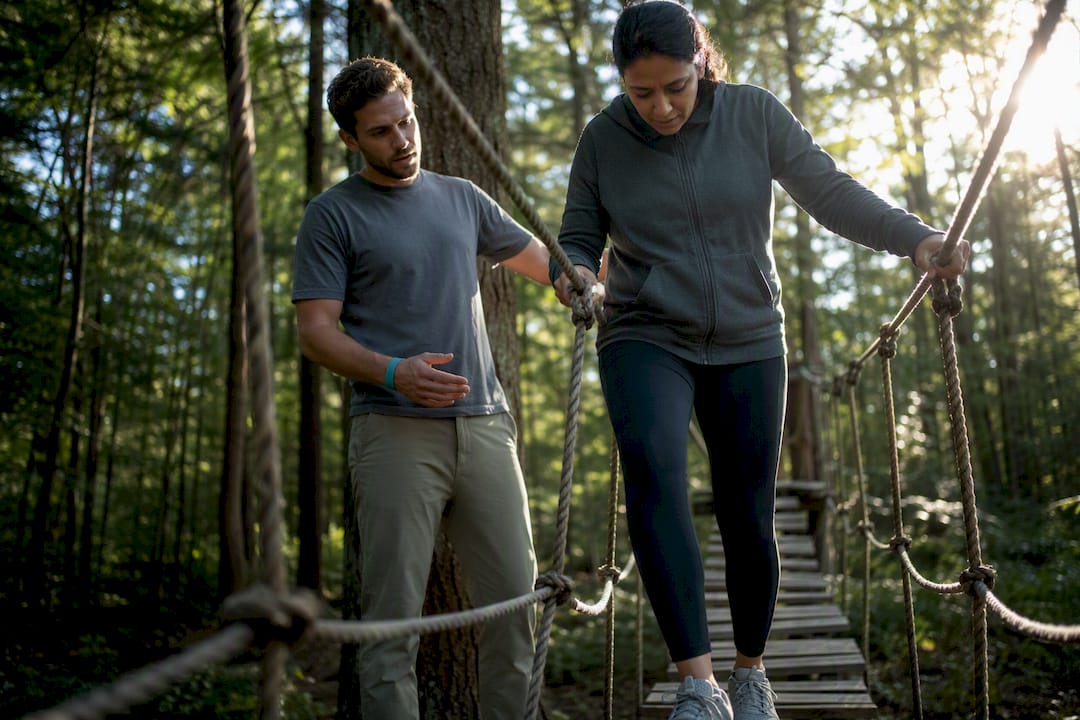
Adventure therapy works. When trained clinicians deliver it, it measurably reduces anxiety, builds resilience, and strengthens self-esteem, with a meta-analysis of nearly 3,000 participants showing greater positive change than control conditions and many gains holding at 3 to 6 months. It also plays a meaningful supporting role in addiction recovery. Some counseling practices integrate these methods alongside evidence-based treatments like EMDR and neurofeedback for adults who need more than a couch and a conversation.
TL;DR:
- Effectiveness depends on trained clinicians choosing specific activities and guiding reflection to ensure lasting psychological change.
- Short-term improvements, especially in anxiety reduction and resilience, are well-supported by research but require ongoing reinforcement to sustain long-term.
- Programs must include proper clinical screening, safety protocols, and integration with existing care to maximize benefits and prevent harm.
- Adventure therapy is most beneficial for adolescents at risk, adults managing anxiety or depression, and recovery groups, but is unsuitable for those with unstable mental health or serious medical issues.
- The quality of the facilitator’s credentials and the structure of processing afterward are more important than outdoor setting or activity type alone.
Table of Contents
- The Core Adventure Therapy Benefits Backed by Research
- How Adventure Therapy Actually Creates Change
- What the Evidence Actually Shows
- Who Benefits Most, and Who Should Be Cautious
- How to Evaluate an Adventure Therapy Program
- Where Adventure Therapy Fits Into Real Clinical Care
- Do the Benefits of Adventure Therapy Actually Last?
- The Real Limitations Nobody Advertises
- What the Research Actually Tells You to Prioritize
- Ready to Explore Adventure Therapy With Clinical Support?
- Sources
- FAQ
The Core Adventure Therapy Benefits Backed by Research
Adventure therapy is a clinical treatment model, not a weekend of recreation. It uses structured outdoor and experiential challenges, guided by a trained therapist, to produce psychological change that talk therapy alone sometimes struggles to reach. The benefits show up across several distinct domains, and each one has research behind it.
- Reduced anxiety, stress, and depressive symptoms. A meta-analysis focused on anxiety-related disorders (12 studies, nearly 2,100 participants) found a mean effect size of SMD = -0.56 for symptom reduction—a meaningful clinical signal for adventure therapy’s effect on anxiety.
- Resilience and expanded coping capacity. Graded physical and emotional challenges, like navigating a ropes course or completing a demanding hike, teach the nervous system that discomfort is survivable and often lead to something on the other side.
- Improved self-efficacy and self-esteem. Mastering a task you didn’t think you could finish rewires how you see yourself, not just what you believe you can do.
- Stronger social skills and group trust. Group problem-solving under mild stress, followed by facilitated reflection, builds cohesion faster than months of small talk in a waiting room.
- Support for addiction recovery. Adventure-based programs often improve engagement and motivation, giving people in recovery a tangible skill set for relapse prevention beyond relying on willpower.
- Physical health and mindfulness gains. Nature exposure lowers cortisol and restores attention, according to reviews of forest-therapy research.
- Sharper problem-solving under pressure. Real consequences, even low-stakes ones like losing your footing on a trail, train the brain to make decisions when it’s uncomfortable, a skill that transfers directly to high-pressure jobs and relationships.
How Adventure Therapy Actually Creates Change
The benefits above don’t happen by accident. They come from five deliberate mechanisms clinicians build into every session.
- Prescriptive activity selection. A therapist chooses the challenge to match a specific goal, trust repair, exposure to fear, tolerance for uncertainty, rather than picking whatever’s fun.
- The experiential learning cycle. Participants act, then reflect on what happened, then transfer that insight to daily life. Skipping the reflection step is why some outdoor programs get results and others don’t.
- Nature exposure. Time outdoors supports stress physiology and attention recovery, part of why a hike can calm a mind that therapy in an office chair sometimes can’t reach.
- Eustress. Manageable, positive stress stretches a person’s coping range without overwhelming it, the psychological equivalent of lifting slightly heavier weights each week.
- Facilitated group processing. The activity itself is only half the treatment. What clinicians and participants unpack afterward is where the real behavioral shift happens.
Pro Tip: If a program skips the debrief conversation after the activity, it’s recreation, not therapy. The processing is where the clinical value lives.
What the Evidence Actually Shows
The research base for adventure therapy is stronger than most people assume, though it comes with real limits. A meta-analysis of adventure therapy outcomes covering nearly 3,000 participants found adventure-based groups achieved greater positive change than alternative treatment or no treatment, with many short-term improvements sustained at 3 to 6 month follow-up.
The Numbers: A separate meta-analysis of 12 studies (N = 2,083) reported a mean effect size of SMD = -0.56 for anxiety symptom reduction, a moderate-to-large clinical effect by conventional standards.
Systematic reviews of experiential and outdoor therapies confirm reductions in symptoms and improved functioning, but note that much of this research skews toward adolescent populations, so generalizing to adults requires some caution. The caveat that matters most for anyone evaluating a program: outcomes depend heavily on clinician training. This is a behavioral-health intervention delivered outdoors, and the Association for Experiential Education offers certification standards worth checking before you enroll in anything.
Who Benefits Most, and Who Should Be Cautious
Adventure therapy tends to help adolescents at risk, adults managing anxiety or depression, trauma survivors, people in substance-use recovery, and high performers looking to build resilience under real conditions rather than hypothetical ones.
- It’s generally not appropriate for anyone with unstabilized severe mental illness or recent suicidal ideation without additional psychiatric support in place.
- Serious medical limitations, cardiac conditions, mobility restrictions, unmanaged seizure disorders, need clearance before physical activity begins.
- Any legitimate program should require clinical screening, medical clearance where relevant, and a clear emergency protocol before the first session.
How to Evaluate an Adventure Therapy Program
Not every outdoor program labeled “therapy” actually is one. Before committing time or money, run through this checklist.
- Ask about clinician credentials. Confirm the facilitator holds a behavioral-health license and relevant certification, not just outdoor-guide experience.
- Check the clinical structure. Group size, session duration, staff-to-client ratio, and what follow-up care looks like after the program ends all matter.
- Verify safety protocols. Medical screening, informed consent, and a documented emergency plan should exist for every activity offered.
- Confirm how it integrates with ongoing care. Ask whether the program coordinates with your existing therapist or physician, and get clear on fees and payment policy upfront.
Where Adventure Therapy Fits Into Real Clinical Care
The Pursuit Counseling builds adventure and equine therapy into treatment alongside EMDR, neurofeedback, and counseling intensives, rather than offering it as a standalone activity. Clinicians select experiences to match specific therapeutic goals, then follow up through ongoing sessions. One example of this in practice is detailed in how The Pursuit integrates movement-based healing.
Do the Benefits of Adventure Therapy Actually Last?
Short-term gains are well documented, but the honest answer on durability is more nuanced. The meta-analytic data showing improvement retained at 3 to 6 months is encouraging, though it’s a narrower window than most people assume when they hear “long-term benefits.”
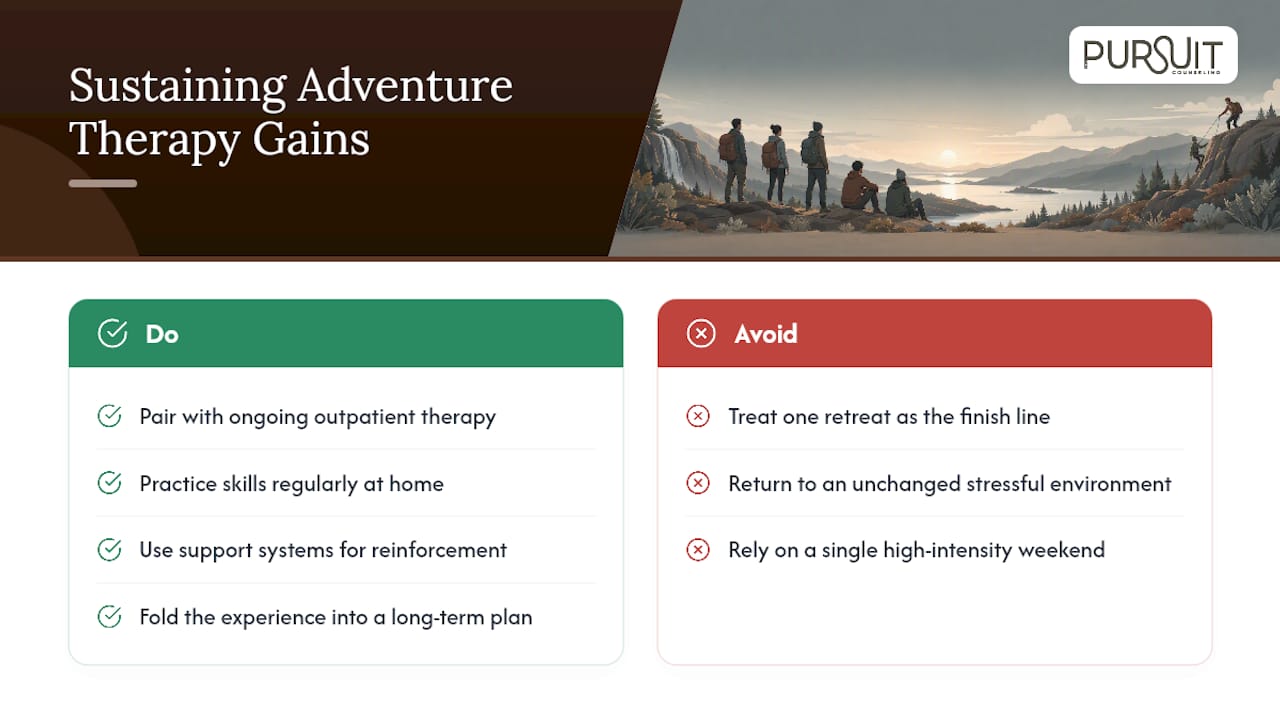
What sustains the change isn’t the ropes course itself. It’s whether the insight gained during the experience gets reinforced afterward, through continued therapy, a home practice, or a support system that keeps the new coping skill alive. Someone who completes a single high-intensity adventure weekend and returns to an unchanged environment, the same stressors, the same isolation, the same untreated anxiety, will likely see benefits fade faster than someone who folds the experience into ongoing clinical work.
This is why programs that pair adventure therapy with standard outpatient treatment tend to outperform one-off retreats. The activity creates a breakthrough moment; the follow-up care is what makes that moment stick. Resilience built in a single afternoon on a challenge course is real, but resilience maintained over years comes from repetition, not a single peak experience. Think of it less like a vaccine and more like physical training: the first session builds capacity, but only continued practice keeps that capacity from atrophying.
Adults juggling careers, families, or recovery timelines should treat adventure therapy as a catalyst within a longer plan, not a finish line.
The Real Limitations Nobody Advertises
Adventure therapy isn’t a universal fix, and pretending otherwise does readers a disservice. Cost is a genuine barrier. Multi-day intensive programs can run considerably more than standard outpatient sessions, and access to qualified programs varies widely by region.
Physical demands exclude some participants outright. A person managing chronic pain, a cardiac condition, or significant mobility limitations may not be a candidate for certain activities, even when the underlying mental-health need is exactly the kind adventure therapy addresses well.
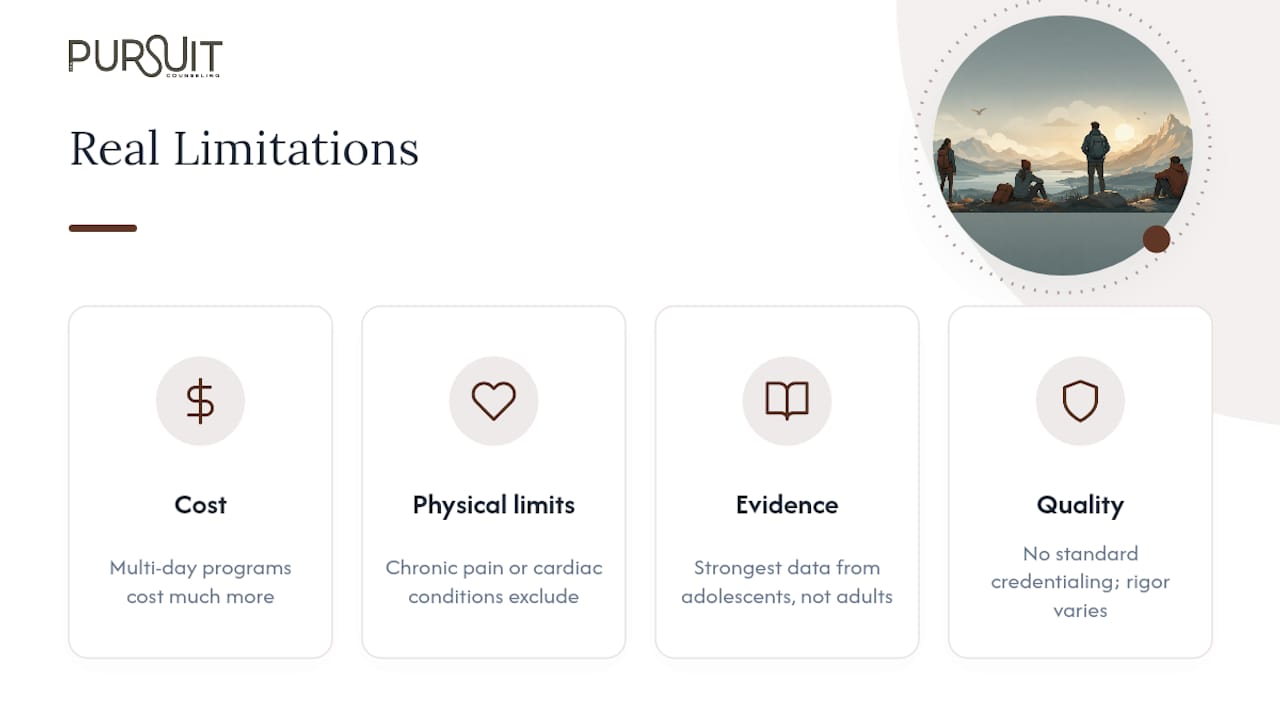
The research gap matters too. Much of the strongest evidence comes from adolescent and youth populations, which means adults are often extrapolating from data that wasn’t built around their age group or life circumstances. That doesn’t invalidate the approach, but it does mean claims of guaranteed outcomes should be treated skeptically.
Finally, quality control across the field is inconsistent. Because “adventure therapy” isn’t a single regulated credential, the difference between a clinically rigorous program and a recreational retreat wearing a therapeutic label can be significant. A poorly facilitated program, one that skips screening or skips the reflective processing step, can leave a vulnerable participant worse off, not better. That’s the strongest argument for checking credentials before signing up, not after.
— Adam Glendye LPC, CPCS
What the Research Actually Tells You to Prioritize
Here’s what stands out after looking at the evidence closely: the outdoor setting gets most of the attention, but the clinician behind it is what actually determines whether adventure therapy works. A ropes course facilitated by someone without behavioral-health training is recreation with good marketing. The same activity, run by a licensed clinician who selected it for a specific therapeutic reason and debriefs it properly afterward, is a legitimate treatment with measurable effect sizes behind it.
The conventional wisdom oversells the setting and undersells the structure. People searching for adventure therapy often picture the zip line or the hike, when the actual mechanism doing the work is the reflection conversation that follows it. Skip that conversation, and you’ve had a nice day outdoors. Include it, and you’ve had a session with clinical weight.
If you’re evaluating this for yourself or someone you love, prioritize the credentials first, the activity second. Resilience research backs the idea that adversity handled with support builds durable strength, not adversity alone. The work on resilience under real pressure echoes this: it’s the processing and the support system around the hard moment that turns struggle into growth, not the hardship by itself.
Ready to Explore Adventure Therapy With Clinical Support?
If you’ve read this far, you already know the difference between a guided hike and a clinically structured intervention. The Pursuit Counseling integrates adventure and equine therapy with EMDR, neurofeedback, and counseling intensives, so the outdoor experience is one piece of a coordinated treatment plan rather than a standalone event.

For adults navigating anxiety, low self-esteem, or substance-use recovery, that integration matters. It means the insight from a challenging outdoor experience gets reinforced in the therapy room, not left to fade on its own. If you’re ready to talk about whether this approach fits your situation, getting started with counseling is the next step, and it starts with a conversation, not a commitment.
Sources
Verify the claims here directly: the adventure therapy meta-analysis, the anxiety-focused meta-analysis, AEE certification standards, and the SAMHSA national helpline for urgent support.
This article is general information, not a substitute for advice from a qualified doctor. Consult a qualified healthcare professional about your own circumstances before acting on anything here.
- A meta-analysis of adventure therapy outcomes and moderators
- Evaluating the Effectiveness of Adventure Therapy in Anxiety‐Related Disorders: A Meta‐Analysis
- Systematic review / evidence synthesis on experiential/outdoor therapies (PMCID PMC8953618)
- Can forest therapy enhance health and well-being? (Harvard Health Blog)
FAQ
What is adventure therapy and what are its benefits?
Adventure therapy is a clinical treatment model using guided outdoor and experiential challenges to reduce anxiety, build resilience, improve self-esteem, and support addiction recovery, with a meta-analysis of nearly 3,000 participants showing greater improvement than control groups.
What is the success rate of wilderness therapy?
There’s no single universal success rate, but controlled trials show many participants retain resilience and self-esteem gains at short-term follow-up, and research skews toward adolescent populations, so results vary by program and individual.
What is the main difference between wilderness therapy and adventure therapy?
Wilderness therapy typically involves extended, immersive outdoor living as the primary treatment setting, while adventure therapy uses shorter, structured activities like ropes courses or hikes chosen by a clinician to target a specific therapeutic goal.
What are the benefits of adventure in general?
Beyond formal therapy, engaging in challenging outdoor activity supports stress reduction, sharper problem-solving under pressure, and improved mood through nature exposure, mechanisms that overlap directly with what makes clinical adventure therapy effective.
How long do the benefits of adventure therapy last?
Meta-analytic data shows many gains hold at 3 to 6 month follow-up, though lasting change depends heavily on whether the experience is reinforced through ongoing therapy or support afterward.