

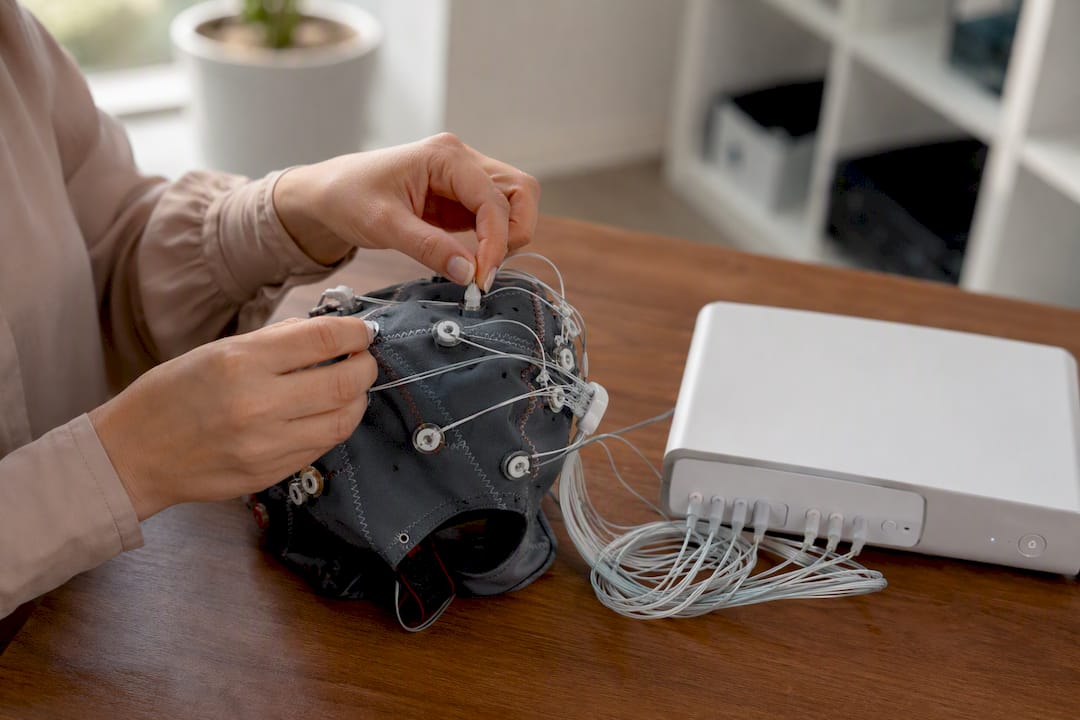
If you search online for information about neurofeedback, you will quickly find two very different messages.
One side may tell you neurofeedback can help with everything from ADHD and anxiety to trauma, sleep, depression, focus, and performance.
The other side may tell you the research is weak, the effects are placebo, or neurofeedback simply does not work.
The reality is more complicated.
Neurofeedback has been studied for decades, and there is a substantial body of scientific literature examining its effects on brain activity, attention, executive functioning, PTSD, depression, cognitive performance, motor learning, and other areas.
At the same time, the research does not support saying that neurofeedback works for everyone, works equally well for every condition, or should replace other forms of treatment.
At The Pursuit Counseling, we believe people should be able to look at the research and make informed decisions without hype.
So what does the research actually tell us?
First: Neurofeedback Is Not One Single Treatment
One of the most important things to understand is that the term neurofeedback describes several different approaches.
Research may involve:
- EEG neurofeedback
- qEEG-guided neurofeedback
- Z-score neurofeedback
- slow cortical potential training
- frequency-band training
- functional connectivity neurofeedback
- real-time fMRI neurofeedback
Researchers may also be studying completely different goals.
One study may look at working memory in children with ADHD, while another examines PTSD symptoms, sustained attention, depression, burnout, or athletic motor performance.
That means asking, “Does neurofeedback work?” is a little like asking, “Does exercise work?”
The answer depends on the type of training, what outcome is being measured, who is receiving the training, and what it is being compared against.
A foundational review published in 2016 provides a broad overview of neurofeedback systems, methodology, and clinical applications:
Neurofeedback: A Comprehensive Review on System Design, Methodology and Clinical Applications
The authors reviewed a large range of neurofeedback applications while also noting that the scientific evidence was not yet conclusive across all clinical conditions.
That remains an important distinction.
Does Neurofeedback Work for Everyone?
No.
One of the most interesting areas of neurofeedback research looks at something called neurofeedback learning.
The basic idea is simple.
During neurofeedback, the goal is for a person to learn how to influence certain patterns of brain activity. But researchers have repeatedly found that not everyone learns this equally well.
A systematic review examining predictors of neurofeedback outcomes reported that a meaningful percentage of participants had difficulty learning successful self-regulation.
The researchers also found that people who were more successful at learning to regulate the targeted brain activity often experienced better outcomes.
You can read that review here:
Predictors of Neurofeedback Training Outcome: A Systematic Review
This is important because it challenges the idea that neurofeedback is something simply “done to” the brain.
Learning may be an important part of the process.
It also means individual responses can vary.
What Does the Research Say About ADHD?
ADHD is one of the most studied areas of neurofeedback.
A 2025 systematic review and meta-analysis examined 17 randomized controlled trials involving 939 children with ADHD.
Researchers specifically evaluated executive functioning.
They reported improvements in areas including:
- working memory
- inhibitory control
- overall executive functioning
The researchers also found that greater total training time appeared to be associated with stronger outcomes in some areas.
Read the study here:
This does not mean neurofeedback “cures ADHD.”
It means that across the studies included in this analysis, researchers found evidence suggesting neurofeedback may improve certain executive-function abilities in children with ADHD.
That is a much more specific—and scientifically responsible—claim.
Can Neurofeedback Actually Change the Brain?
One of the major reasons researchers are interested in neurofeedback is its relationship with neuroplasticity.
Neuroplasticity refers to the brain’s ability to change in response to learning and experience.
A scientific review published in 2021 examined neurofeedback as a tool for cognitive enhancement, intervention, and brain plasticity.
Researchers found evidence that neurofeedback training can influence activity within targeted brain networks.
However, they also raised an equally important question:
Do those brain changes translate into lasting improvements in everyday life?
Read the review here:
Neurofeedback for Cognitive Enhancement and Intervention and Brain Plasticity
This is one of the central questions in modern neurofeedback research.
Changing brain activity is interesting.
Improving someone’s real-world functioning is ultimately more important.
Brain Changes and Behavioral Changes Are Not Always the Same Thing
A study examining sustained attention provides a good example of this distinction.
Participants completed fMRI neurofeedback training targeting attention-related brain networks.
Two months later, researchers found that participants could still regulate some of the targeted neural networks.
In other words, measurable brain changes appeared to remain.
However, the behavioral improvements in sustained attention did not remain at the same follow-up.
Read the study here:
This is an important scientific finding because it shows why neurofeedback outcomes should not be judged solely by changes on a brain scan.
A change in brain activity does not automatically mean a person will experience a lasting improvement in symptoms or daily functioning.
Both need to be evaluated.
What About PTSD and Trauma?
PTSD has become another important area of neurofeedback research.
Studies have investigated whether neurofeedback may help people regulate brain networks associated with hyperarousal, emotional regulation, attention, and trauma responses.
A recent randomized controlled study examined EEG neurofeedback in people with PTSD and found both symptom changes and evidence that participants learned to regulate the targeted alpha brain activity.
The authors described neurofeedback as a potentially useful adjunctive intervention, meaning something that could be used alongside treatments such as psychotherapy.
Read the study here:
Longitudinal Mapping of a Randomized Controlled Trial of EEG Neurofeedback in PTSD
This distinction matters.
Research supporting neurofeedback does not necessarily suggest abandoning psychotherapy or other established treatments.
Instead, researchers are increasingly exploring whether neurofeedback can complement other approaches.
What Does the Research Say About Depression?
Research on neurofeedback and depression is developing.
One preliminary study looked specifically at treatment-resistant depression using functional connectivity neurofeedback.
Participants experienced improvements in depression and rumination scores.
However, the targeted brain connectivity measure did not significantly change.
The study was also extremely small.
Read it here:
This is a good example of what researchers mean by preliminary evidence.
The findings are interesting enough to justify additional research, but they are not strong enough to say that neurofeedback is an established treatment for treatment-resistant depression.
What About Burnout?
Researchers are also beginning to explore neurofeedback outside traditional psychiatric diagnoses.
A 2026 longitudinal feasibility study examined neurofeedback for burnout among tertiary-level academics in South Africa.
Participants receiving neurofeedback experienced reductions in burnout scores, and researchers also reported changes in qEEG measurements.
However, the treated sample was small, and this was a feasibility study rather than a large randomized trial.
Read the study here:
Neurofeedback for Burnout: Longitudinal Feasibility Study
So the accurate conclusion is not:
“Neurofeedback is proven to treat burnout.”
It is:
“Preliminary research suggests neurofeedback may be worth studying further as an intervention for burnout.”
Those statements sound similar, but scientifically they mean very different things.
What About OCD?
Research is also emerging around obsessive-compulsive disorder.
A 2026 review examined neurofeedback interventions for obsessive-compulsive and related disorders.
Researchers found that the current evidence is concentrated primarily on OCD itself and emphasized the need for additional controlled research.
Read the review here:
Again, this represents an area of developing research rather than a settled clinical conclusion.
What About Performance Enhancement?
Neurofeedback research is not limited to mental-health treatment.
Researchers have studied neurofeedback in healthy adults to determine whether people can improve attention, athletic performance, motor skills, and other cognitive abilities.
A recent review examining three decades of motor-behavior research found that many studies reported improvements in motor performance.
However, evidence for long-term motor learning was less consistent.
Read the review here:
This distinction between performance and learning is important.
A person may perform better immediately after training without necessarily demonstrating that the improvement will remain over time.
How Much Neurofeedback Research Is Actually Out There?
More than many people realize.
A 2024 bibliometric analysis examined 3,626 neurofeedback publications and mapped how the field has developed over several decades.
Researchers identified major areas of study including:
- ADHD
- cognitive performance
- mental health
- real-time fMRI neurofeedback
- stroke rehabilitation
- emotion regulation
- brain-computer interfaces
You can explore that article here:
This tells us something important.
The statement that “there is no research on neurofeedback” is inaccurate.
There is a substantial research literature.
However, the amount of research is not the same thing as the quality of evidence.
Three thousand publications do not automatically prove that neurofeedback is effective for every clinical problem.
Researchers still have to examine the quality of individual studies.
Why Do Sham-Controlled Studies Matter?
One of the strongest criticisms of neurofeedback is that some improvements may come from factors other than neurofeedback itself.
For example:
- expectancy
- attention from a clinician
- sitting quietly several times each week
- motivation
- practice effects
- placebo responses
- engagement with technology
This is why researchers use sham-controlled studies.
In a sham neurofeedback condition, participants may receive feedback that looks real but is not actually based on the brain signal being targeted.
If real neurofeedback significantly outperforms sham neurofeedback, it strengthens the argument that the training itself is responsible for the change.
If both groups improve equally, researchers have to ask whether nonspecific factors are driving the results.
Some neurofeedback studies demonstrate advantages over sham or active controls.
Others do not.
That inconsistency is one of the reasons neurofeedback remains an active area of scientific investigation.
What About Brain Maps?
Another important distinction involves qEEG Brain Mapping.
A qEEG measures electrical activity at different locations across the scalp and compares patterns in that activity.
A Brain Map can help clinicians identify patterns that may inform neurofeedback training.
However, a Brain Map is not the same thing as a psychiatric diagnosis.
For example, a qEEG should not independently be used to tell someone:
“You have ADHD.”
“You have PTSD.”
“You have depression.”
Mental-health diagnoses require broader clinical assessment.
The National Institute on Aging provides a useful discussion of how clinicians should think about cognitive assessments and the evidence supporting assessment tools:
Cognitive Assessment Considerations: Understanding the Evidence
Assessment data can provide useful information.
It should still be interpreted within a larger clinical context.
So, Does Neurofeedback Work?
The most accurate answer is:
Sometimes, for some people, for some outcomes—and the evidence is stronger in certain areas than others.
The current literature supports several important conclusions.
Neurofeedback can produce measurable changes in brain activity.
Some randomized controlled trials and meta-analyses report improvements in symptoms and cognitive performance.
Evidence appears particularly interesting in areas such as ADHD executive functioning and PTSD.
Other areas—including depression, burnout, OCD, and cognitive enhancement—remain promising but less established.
Not everyone successfully learns neurofeedback regulation.
Sham-controlled research sometimes finds meaningful advantages for neurofeedback and sometimes does not.
And measurable changes in brain activity do not always translate into lasting behavioral improvement.
That is a far more nuanced answer than either:
“Neurofeedback is scientifically proven to fix your brain.”
or
“Neurofeedback has no scientific support.”
Neither statement accurately reflects the research.
Our Approach at The Pursuit Counseling
At The Pursuit Counseling, we believe informed consent includes understanding both what research supports and what remains uncertain.
We use qEEG Brain Mapping and neurofeedback as tools—not as promises.
A Brain Map may help us better understand patterns of brain activity and guide individualized neurofeedback training.
Neurofeedback may be one part of a larger approach that can also include counseling, medical care, sleep, exercise, nutrition, stress management, medication, and other appropriate supports.
Our goal is not to convince everyone that they need neurofeedback.
Our goal is to help people understand their options, ask good questions, and decide whether exploring neurofeedback makes sense for them.
Curious About Your Own Brain?
You do not have to have a diagnosis to be curious about how your brain is functioning.
A qEEG Brain Map can provide information about patterns of brain activity related to attention, regulation, processing, and other areas.
At The Pursuit Counseling, we offer Brain Mapping and neurofeedback services for individuals interested in learning more about their brain and exploring whether neurofeedback may be appropriate for their goals.
Schedule a Brain Map consultation with The Pursuit Counseling to learn more about your options and whether neurofeedback may be a good fit for you.
This article is for educational purposes only and is not intended to diagnose, treat, cure, or prevent any medical or mental-health condition. Neurofeedback outcomes vary, and the strength of scientific evidence differs depending on the condition, protocol, and outcome being studied.