

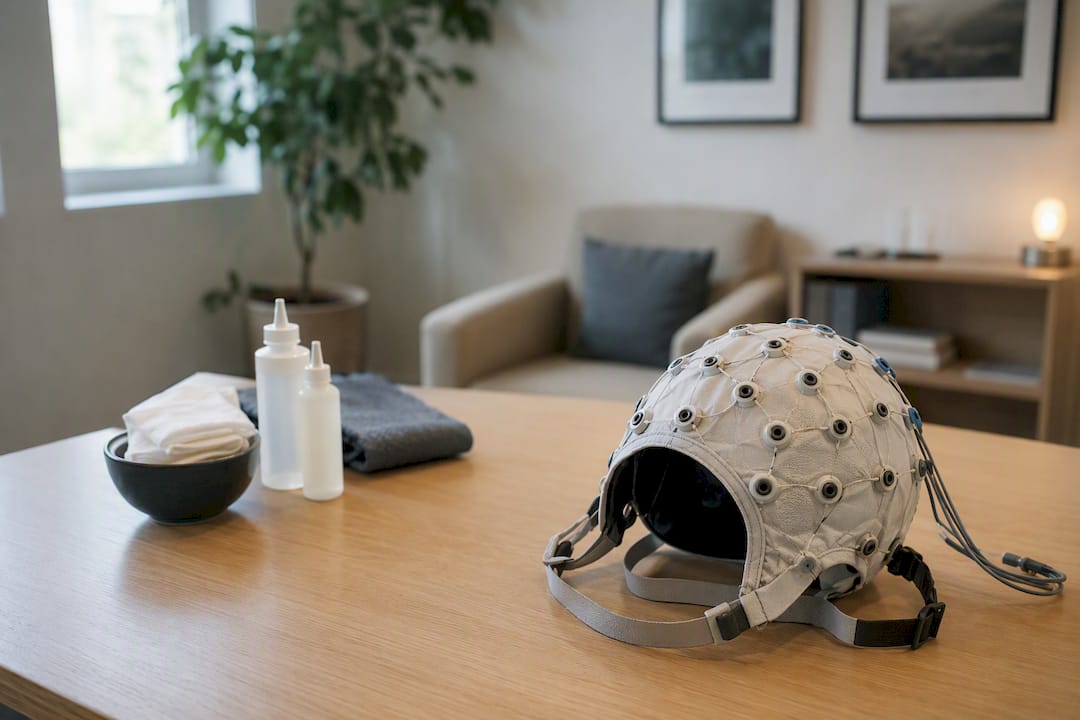
Neurofeedback can produce clinically meaningful drops in depressive symptoms for some people, especially when the protocol targets specific brain circuits like the reward system or amygdala rather than generic training. It works best as an adjunct alongside therapy or medication, not as a standalone cure. Depression remains one of the leading causes of disability worldwide, which is exactly why researchers keep pushing on treatments like this one.
Here is the honest bottom line, distilled from the strongest trials available right now:
- A 10-session mechanism-targeted protocol produced an average 8-point drop in depression severity scores and a meaningful remission rate in a recent pilot.
- fMRI-based approaches targeting the amygdala show moderate-to-large effect sizes in systematic review data.
- EEG-based approaches show real but more variable results, largely because protocols differ study to study.
The honest takeaway: if you have residual symptoms after medication or talk therapy, neurofeedback is worth raising with your clinician as a next step, not a replacement for what you’re already doing.
Key Takeaways: Understanding Neurofeedback for Depression
Neurofeedback works best as a mechanism-targeted adjunct therapy, producing meaningful symptom reduction primarily when protocols specifically target circuits like the amygdala or reward system rather than generic brainwave training.
| Point | Details |
|---|---|
| Effect sizes vary by target | fMRI-NF targeting the amygdala shows effect sizes up to 1.50 in review data; generic protocols show smaller pooled effects. |
| Recent pilot data is encouraging | A 10-session reward-system protocol produced an 8-point HDRS-17 drop and a meaningful remission rate with 77% completion. |
| Evidence quality remains mixed | Small samples and inconsistent control designs mean results don’t generalize cleanly across every protocol. |
| Best candidates are specific | Treatment-resistant depression and residual anhedonia after standard treatment respond most consistently. |
| The Pursuit Counseling offers a measurement-first option | Clinician-delivered neurofeedback paired with EMDR and psychotherapy for adults across Georgia. |
This article is general information, not a substitute for advice from a qualified doctor. Consult a qualified healthcare professional about your own circumstances before acting on anything here.
Table of Contents
- How Effective Is Neurofeedback for Depression, According to the Research?
- EEG-NF vs. fMRI-NF: How Do They Actually Work?
- How Many Neurofeedback Sessions Does Depression Treatment Typically Take?
- Who Benefits Most From Neurofeedback, and What Are the Limits?
- What Should You Look for in a Neurofeedback Provider’s Approach?
- How Do You Vet a Neurofeedback Provider Before Booking?
- What I Tell Patients Considering Neurofeedback
- Ready to Explore Neurofeedback as Part of Your Treatment Plan?
- Sources
- FAQ
How Effective Is Neurofeedback for Depression, According to the Research?
The evidence for neurofeedback for depression is real but uneven, and that unevenness is the story. Systematic reviews and meta-analyses generally report small-to-moderate pooled effects on depressive symptoms, with one meta-analytic review of bio- and neurofeedback approaches explicitly flagging heterogeneity across studies as a reason to interpret pooled numbers cautiously.
The picture brightens considerably when researchers narrow the target. A systematic review of fMRI-based neurofeedback covering 26 studies found clinical effect sizes ranging from Cohen’s d of 0.38 to 1.50, with the largest gains showing up when protocols trained patients to regulate activity in emotion-processing regions like the amygdala. That is a wide range, and it matters: a d of 0.38 is modest, while 1.50 is a large effect by most clinical standards.
The most concrete recent data point comes from a 2025 multicenter pilot using reward-system neurofeedback. Participants who completed the 10-session protocol averaged an 8-point reduction on the Hamilton Depression Rating Scale, and a substantial share achieved remission. Of 49 adults screened, most completed the full protocol, reflecting good treatment tolerability.
- Pooled meta-analytic effects: small to moderate across mixed protocols.
- fMRI-NF targeting the amygdala: effect sizes up to 1.50 in review data.
- Prism pilot: 8-point HDRS-17 reduction, a meaningful remission rate, 77% completion.
The consistent caveat across every review: small samples, inconsistent control conditions, and protocol heterogeneity make it hard to generalize a single number to every patient. An EEG-focused review makes the same point from a different angle, calling for longer follow-up periods before anyone declares a specific EEG protocol superior.
EEG-NF vs. fMRI-NF: How Do They Actually Work?
Neurofeedback runs on a closed loop. A device reads your brain activity in real time, translates it into a signal you can see or hear, and your brain gradually learns to shift that activity toward a healthier pattern, the same way you’d learn to hit a target by watching where your last shot landed. Two technologies dominate the research, and they read the brain very differently.
EEG-based neurofeedback (EEG-NF) measures electrical activity through scalp electrodes. It is affordable, portable, and has excellent temporal resolution, meaning it catches fast-changing brain states well. Common EEG-NF targets for depression include frontal alpha asymmetry and high-beta down-training. The tradeoff is spatial resolution: EEG struggles to pinpoint activity in deep brain structures.
fMRI-based neurofeedback (fMRI-NF) tracks blood flow changes tied to neural activity, giving it far better spatial precision. That precision is why fMRI-NF protocols can target structures EEG cannot reliably reach, particularly the amygdala and reward-system circuitry implicated in low motivation and anhedonia, the loss of pleasure that often persists even after mood lifts.
- EEG-NF: cheaper, portable, strong timing precision, weaker spatial targeting.
- fMRI-NF: expensive, clinic-bound, strong spatial targeting, better for deep structures.
- Reward-system and amygdala targeting: linked to some of the largest reported effect sizes.
Pro Tip: Ask any provider which specific brain region or network their protocol targets. “We train your brainwaves” is not an answer. “We target amygdala reactivity” or “we train reward-circuit responsiveness” is.
How Many Neurofeedback Sessions Does Depression Treatment Typically Take?
Most current protocols run shorter than people expect. The multicenter pilot using reward-system neurofeedback used 10 sessions over roughly five weeks, delivered twice weekly on nonconsecutive days. That pacing gives the brain time to consolidate each session’s learning before the next one.
- Sessions 1 to 3: Baseline calibration; most people report no noticeable mood shift yet.
- Sessions 4 to 7: This is where measurable movement on outcome scales like the HDRS-17 and the Snaith-Hamilton Pleasure Scale (SHAPS) tends to emerge.
- Sessions 8 to 10: Consolidation, when patients typically start applying self-regulation strategies outside the clinic.
Your own engagement matters as much as the technology. Outcomes track closely with how actively patients practice the mental strategies they learn in-session between appointments.
Who Benefits Most From Neurofeedback, and What Are the Limits?
Neurofeedback tends to help a specific kind of patient most: someone with treatment-resistant depression, someone dealing with residual anhedonia after medication has otherwise lifted their mood, or someone motivated enough to show up for a multi-week commitment and practice regulation strategies between sessions.
The limitations are just as important to name plainly.
- Studies remain small, with samples often in the dozens rather than hundreds.
- Protocols vary widely between research groups, making head-to-head comparison difficult.
- Sham and control conditions differ from trial to trial, which weakens confidence in pooled results.
On safety, the picture is reassuring. Reviews consistently describe neurofeedback as low-risk and noninvasive, especially compared with more intensive interventions. Reported downsides are mild and transient: session fatigue, mild eye strain from screen-based feedback, or occasional frustration when self-regulation feels slow to click. No major reviews report serious adverse events.
The practical hurdle is usually cost and access rather than safety. fMRI-based protocols require expensive equipment and specialized staff, and insurance coverage for neurofeedback varies widely and often excludes it entirely, which pushes many clinics toward private-pay models.
What Should You Look for in a Neurofeedback Provider’s Approach?
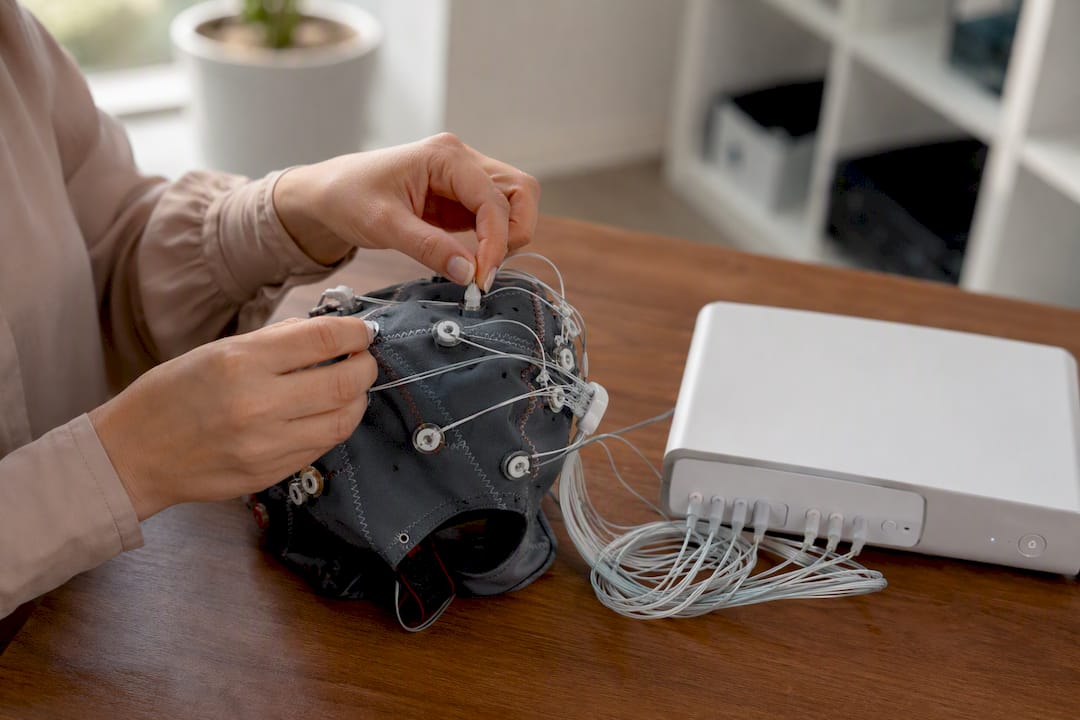
Clinicians who take neurofeedback seriously don’t run a one-size-fits-all protocol. Many use quantitative EEG (qEEG) mapping or other biomarker data to identify which specific circuits look dysregulated before designing a plan, an approach clinical guidance on neurofeedback explicitly recommends over generic training.
Quality indicators worth checking for:
- Published or documented outcome data, not just testimonials.
- Use of validated protocols referenced in peer-reviewed literature.
- Pre- and post-treatment measurement using standardized scales.
- Licensed clinicians overseeing the protocol, not unsupervised technicians.
The Pursuit Counseling builds its neurofeedback services around this same principle: measurement first, personalization second, and clinical oversight throughout, an approach that mirrors what the ADHD-focused neurofeedback protocols at The Pursuit Counseling also apply.
Pro Tip: Before starting, ask directly for your baseline and expected follow-up scores on a validated scale like the HDRS or PHQ-9. A provider who can’t discuss measurement isn’t tracking whether the treatment is actually working.
How Do You Vet a Neurofeedback Provider Before Booking?
Choosing a provider deserves the same scrutiny you’d apply to picking a surgeon, not a spa day. Run through this before committing:
- Check credentials. Confirm the clinician is licensed and has specific neurofeedback training, not a weekend certification.
- Ask what the protocol targets. A specific answer (amygdala reactivity, reward-circuit responsiveness) beats a vague one (“brainwave balance”).
- Request outcome data. Ask how they measure progress and whether they can show aggregate results from past patients.
- Clarify the timeline. How many sessions, how often, and what does realistic improvement look like by session 8 versus session 20?
- Ask about cost and insurance up front. Get a total estimate before starting, since coverage varies significantly by plan.
Red flags to walk away from: guarantees of a cure, proprietary claims with no published backing, or a provider who can’t describe how they’ll measure your progress. For a broader look at how this modality applies beyond depression, the team at iMind Mental Health Solutions outlines similar considerations for anxiety and ADHD.
What I Tell Patients Considering Neurofeedback
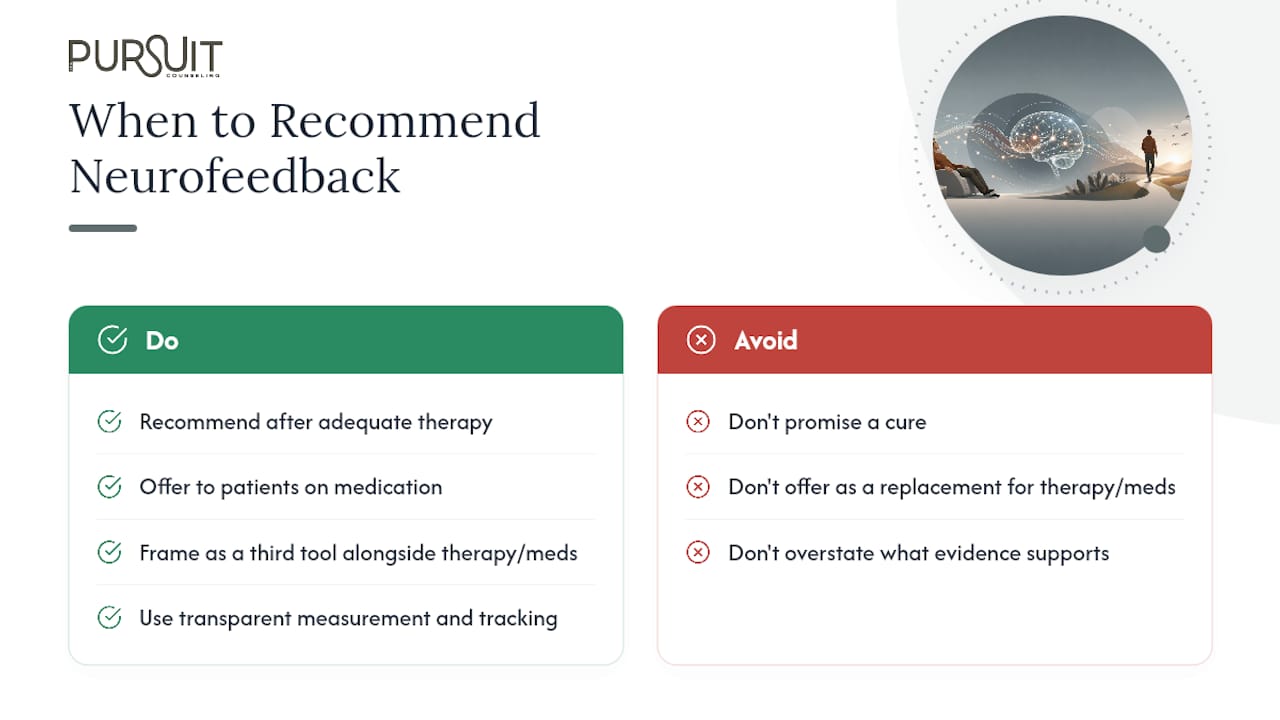
I recommend neurofeedback most often for people who’ve done the work in therapy, who may even be on medication, and who still feel a stubborn flatness that nothing seems to touch. That residual anhedonia is where mechanism-targeted training earns its place, not as a replacement for therapy or medication but as a third tool alongside them.
The ethical line matters here: no clinician should promise a cure. What we can promise is transparent measurement, honest expectations, and informed consent about what the evidence actually supports.
Ready to Explore Neurofeedback as Part of Your Treatment Plan?
If you’ve read this far, you already know neurofeedback isn’t a gimmick or a guaranteed fix. It’s a measured, mechanism-targeted tool that works best in the hands of a clinician who tracks outcomes and personalizes protocols instead of running the same generic session for everyone.
The Pursuit Counseling delivers exactly that kind of clinician-led, measurement-first neurofeedback for adults and high performers across Georgia, integrating it with evidence-based approaches like EMDR and traditional psychotherapy rather than offering it as an isolated gadget treatment. If residual symptoms have outlasted your current treatment plan, the next step is a straightforward one: schedule an initial consultation to talk through whether neurofeedback fits your situation, and get a realistic timeline before you commit to a single session.
Sources
- Reward System EEG–fMRI-Pattern Neurofeedback for Major Depressive Disorder with Anhedonia: A Multicenter Pilot Study
- Efficacy of bio- and neurofeedback for depression: meta-analytic findings
- Neurofeedback as an adjunctive treatment for depression: review findings
FAQ
What is the downside of neurofeedback?
The main downsides are mild and transient, like session fatigue or eye strain, plus practical barriers such as cost and inconsistent insurance coverage rather than serious safety risks.
What are some effective coping skills for depression?
Structured approaches like cognitive behavioral techniques, physical activity, and consistent sleep routines are well-supported coping strategies, and many clinicians pair these with adjunct treatments like neurofeedback for people with residual symptoms.
How much does one session of neurofeedback cost?
Costs vary significantly by clinic, equipment type (EEG versus fMRI), and location, so it’s best to request a full estimate for your specific protocol before starting, as noted in the provider guidance above.
What is the best form of therapy for depression?
No single therapy works for everyone; evidence-based psychotherapy, medication, and adjuncts like neurofeedback each show benefit, and combining approaches under a licensed clinician’s guidance, such as through The Pursuit Counseling, tends to outperform any single method alone.