

Executive coaching reliably produces measurable improvements in leadership behavior, goal attainment, self-efficacy, and resilience — and the evidence behind those claims is stronger than most leaders realize. Meta-analytic research across randomized controlled trials reports an overall weighted effect size of Hedges’ g ≈ 0.43, with behavioral outcomes showing the largest gains. That is a moderate, meaningful effect by social-science standards, comparable to well-established workplace interventions.
Here is what the research says you can expect:
- Behavioral change: The strongest and most consistent finding across meta-analyses. Leadership behaviors shift more reliably than attitudes or personality traits.
- Goal attainment: Coaching tied to specific, measurable goals produces reliable improvements in self-directed progress, supported by both RCT and systematic-review evidence.
- Self-efficacy and resilience: RCT-focused meta-analyses report positive effects on coping, well-being, and self-regulation alongside performance outcomes.
- Organizational ROI: Commissioned ROI studies report substantial returns for some engagements, though methods vary widely and attribution is rarely clean.
The bottom line: A well-designed coaching engagement, with clear goals and rigorous measurement, produces moderate-to-strong behavioral change in leaders. The evidence is not perfect, but it is consistent enough to justify the investment when you measure it properly.
Key Takeaways
Executive coaching produces moderate, measurable behavioral change in leaders when goals are specific, measurement is rigorous, and coach quality is high (Hedges’ g ≈ 0.43 across RCT meta-analyses).
| Point | Details |
|---|---|
| Behavioral change is the strongest outcome | Meta-analyses show behavioral outcomes exceed attitudinal or personality changes in effect size. |
| Measure before you start | Pre/post 360s, Goal Attainment Scaling, and KPIs triangulated together produce credible ROI evidence. |
| Coach quality drives variance | ICF-credentialed coaches with structured goal-setting produce more consistent results than uncredentialed alternatives. |
| Coaching and therapy are not the same | Leaders with clinical-level stress or trauma need counseling support alongside or before coaching, not instead of it. |
| The Pursuit Counseling integrates both | Neuroscience-informed coaching combined with counseling support is available for leaders in Georgia who need more than a standard coaching engagement. |
Table of Contents
- What executive coaching is — and what it is not
- How coaching actually produces change in leaders
- The specific benefits coaching delivers, backed by evidence
- Who gains the most from executive coaching
- Which coaching format fits your situation
- What a coaching engagement actually looks like
- How to measure coaching outcomes and calculate ROI
- When coaching may not work, and what poor coaching looks like
- What the research actually says: meta-analyses and key findings
- How The Pursuit Counseling approaches executive coaching
- Ready to put the evidence to work for your leadership
- Sources
- FAQ
What executive coaching is — and what it is not
Executive coaching is a structured, one-on-one developmental partnership between a trained coach and a leader, focused on improving specific behaviors, capabilities, and performance outcomes within a professional context. It is forward-looking by design. The coach does not tell you what to do. They use questions, feedback, and behavioral experiments to help you see your own patterns more clearly and change the ones that are holding you back.
That distinction matters because executive coaching is frequently confused with four adjacent practices:
- Mentoring: A mentor shares their own experience and advice. A coach stays neutral, focuses on your goals, and does not prescribe solutions based on their career path.
- Therapy or counseling: Therapy addresses psychological health, trauma, and emotional disorders. Coaching assumes a psychologically functional baseline and focuses on professional performance and growth. The two can complement each other, but they are not interchangeable.
- Training: Training delivers content and skills to a group. Coaching is individualized and builds on what you already know, targeting the specific gaps that matter for your role.
- Consulting: A consultant diagnoses organizational problems and recommends solutions. A coach develops your capacity to solve problems yourself.
Forbes frames coaching as a personalized professional development process comparable to hiring a personal trainer for your career — someone who holds you accountable to a plan built around your specific goals, not a generic curriculum.
Pro Tip: If you are dealing with burnout, unresolved trauma, or a mental health concern that is affecting your performance, coaching alone is not the right starting point. A resource like When High Performance Isn’t Enough explains why many high-performing leaders benefit from combining coaching with counseling support before or during a coaching engagement.
How coaching actually produces change in leaders
Coaching drives behavior change through a combination of targeted goal-setting, structured feedback loops, and disciplined reflection — not through inspiration or advice alone. The mechanism is more deliberate than most leaders expect.
Self-awareness is the foundational lever. Leaders who understand how their behavior lands on others make better decisions and adapt faster. Coaching builds that awareness systematically, using 360-degree feedback, direct observation, and reflective questioning to surface blind spots that peers and direct reports rarely name out loud.
The core behavioral and cognitive pathways coaching activates:
- Goal-setting: Rooted in Locke and Latham’s goal-setting theory, coaching translates vague developmental intentions into specific, measurable behavioral targets with clear timelines.
- Feedback and 360 data: Structured feedback from multiple raters gives leaders an external mirror. The coach helps interpret patterns and prioritize which behaviors to change first.
- Behavioral rehearsal: Coaches design low-stakes practice opportunities — role plays, pre-mortems, structured conversations — so new behaviors get tested before high-stakes situations.
- Cognitive-behavioral activities: Reframing unhelpful thought patterns (perfectionism, catastrophizing under pressure, imposter-syndrome loops) reduces the cognitive drag that limits performance.
- Psychosocial support: The coaching relationship itself provides a confidential space to process the emotional weight of leadership, which reduces isolation and increases resilience.
Pro Tip: The fastest way to accelerate transfer from session to workplace is to assign yourself one specific behavioral experiment before each session ends. Not a reflection task. An experiment: “I will give direct feedback to one team member this week and observe the response.” That single habit closes the gap between insight and action faster than any amount of in-session work.
The specific benefits coaching delivers, backed by evidence
The strongest measurable outcomes from executive coaching cluster around behavioral change, goal attainment, and well-being — with effect sizes ranging from small-to-moderate across RCT-based meta-analyses. Here is what the evidence actually supports, mapped to outcome type.
| Benefit | Typical measures | Representative evidence | Effect strength |
|---|---|---|---|
| Leadership behavior change | 360 ratings, observer assessments | RCT meta-analysis (Hedges’ g ≈ 0.43) | Moderate; strongest outcome category |
| Goal attainment | Goal Attainment Scaling (GAS), self-report | RCT and systematic review literature | Moderate; consistent across studies |
| Self-efficacy | Validated self-efficacy scales | RCT-focused meta-analysis (p̂ ≈ 0.42) | Small-to-moderate |
| Well-being and resilience | Validated well-being scales, stress measures | RCT meta-analysis | Small-to-moderate |
| Coping and self-regulation | Behavioral and self-report measures | RCT-focused meta-analysis | Small-to-moderate |
| Organizational performance/ROI | Business KPIs, retention, engagement | Commissioned ROI studies | Variable; attribution is complex |
A few important nuances the table cannot capture:
- Behavioral outcomes consistently outperform attitudinal ones. Coaching changes what leaders do more reliably than how they feel about their work or their stable personality traits.
- Heterogeneity is real. Effect sizes vary considerably across studies, which means the average figure masks both high-performing and low-performing engagements. Coach quality and goal clarity are the biggest moderators.
- Organizational ROI claims require scrutiny. Some commissioned studies report multi-hundred percent returns, but measurement methods and attribution approaches differ sharply. Treat those figures as directional, not definitive, unless you can replicate the measurement model.
Statistic to anchor your expectations: The RCT meta-analysis published in PMC found an overall Hedges’ g of 0.43 (95% CI 0.35–0.50) — a moderate effect that held across multiple outcome categories, with behavioral outcomes showing the largest individual gains.
Who gains the most from executive coaching
The leaders who get the most from coaching share a common profile: they are already performing, they face a specific developmental challenge, and they are willing to be honest about what is not working. Coaching is not remediation. It is acceleration.
Primary beneficiary groups and the situations that trigger the most measurable gains:
- CEOs and C-suite leaders: Isolation at the top is real. An external coach provides the candid, confidential feedback that no direct report will give. The focus is typically on strategic communication, board relationships, and decision-making under uncertainty.
- Senior leaders in role transitions: Moving from functional expert to enterprise leader, or from a domestic role to a global one, requires a different behavioral repertoire. Coaching compresses that learning curve.
- High-potential managers: Organizations invest in coaching for high-potentials to accelerate readiness for senior roles. The ROI here is retention as much as development.
- Leaders driving organizational change: Organizational change demands that leaders model new behaviors before their teams will adopt them. Coaching builds that behavioral credibility faster than training programs.
- Leaders with identified blind spots: When 360 data surfaces a consistent pattern — micromanagement, avoidance of conflict, poor executive presence — coaching provides a structured path to change it.
Leaders hire coaches not because they lack basic skills but to master complex role dynamics where an external perspective accelerates solutions. That framing matters. If you approach coaching as a fix for a deficiency, you will underuse it. If you approach it as a strategic investment in a specific capability gap, you will get far more from it.
Which coaching format fits your situation
The most common formats are one-on-one executive coaching, team coaching, peer coaching, and specialty-focused coaching (emotional intelligence, behavioral, or transition-focused). Each fits a different need and budget.
- One-on-one executive coaching: The most evidence-supported format. Highly individualized, confidential, and focused on the specific leader’s goals. Best for senior leaders with complex, high-stakes developmental needs.
- Team coaching: Focuses on collective dynamics, decision-making patterns, and team effectiveness rather than individual behavior. Useful when the team itself is the unit of change.
- Peer coaching: Structured peer-to-peer coaching within a cohort. Lower cost, builds internal coaching culture, but requires facilitation and accountability structures to produce consistent results.
- Emotional intelligence (EI) coaching: Targets self-awareness, empathy, emotional regulation, and social skills. EI-focused coaching is particularly effective for leaders whose 360 data shows interpersonal or communication gaps.
- Behavioral coaching: Draws on cognitive-behavioral frameworks to change specific, observable behaviors. Well-suited to leaders with identified patterns (perfectionism, avoidance, reactive communication) that are limiting their effectiveness.
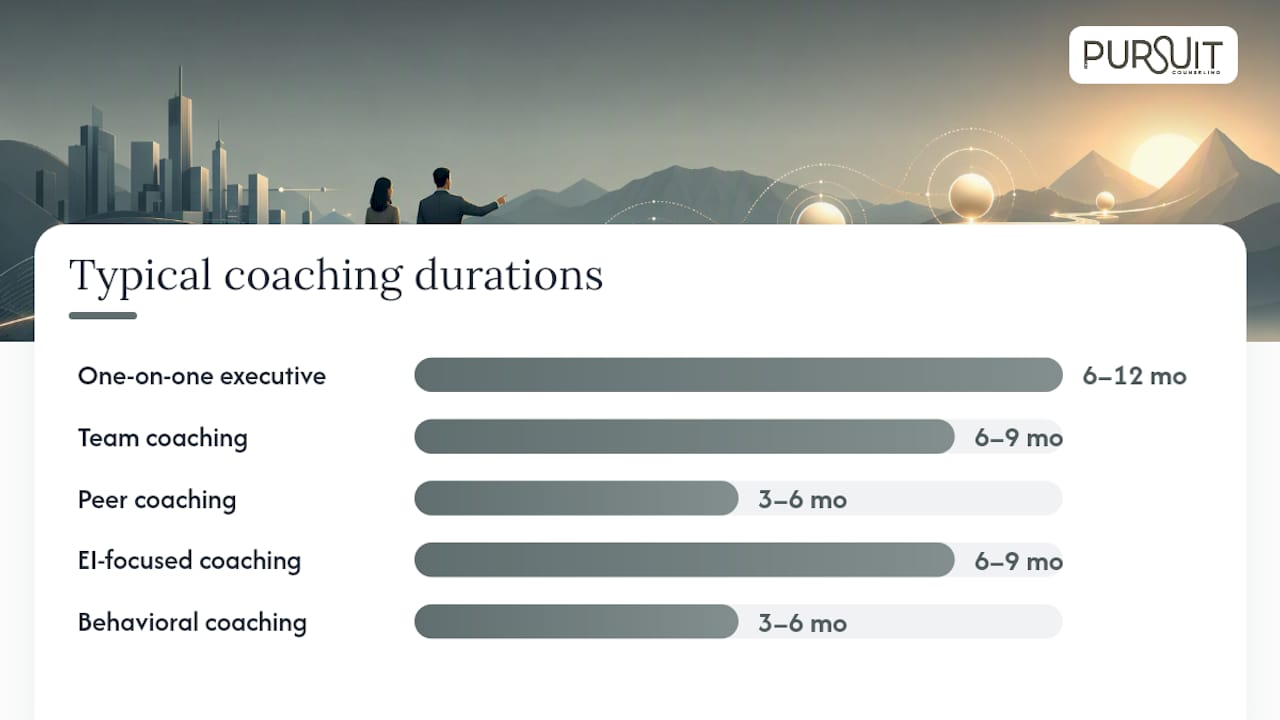
| Format | Best for | Typical duration | Measurement complexity |
|---|---|---|---|
| One-on-one executive | Senior leaders, C-suite, transitions | 6–12 months | Moderate (360, GAS, KPIs) |
| Team coaching | Leadership teams, culture change | 6–9 months | High (team and individual metrics) |
| Peer coaching | High-potential cohorts | 3–6 months | Moderate (goal attainment, peer ratings) |
| EI-focused coaching | Leaders with interpersonal gaps | 6–9 months | Moderate (validated EI scales, 360) |
| Behavioral coaching | Specific behavior change targets | 3–6 months | Lower (behavioral observation, KPIs) |
In-person coaching tends to build rapport faster, but virtual delivery produces comparable outcomes when the relationship is well-established. Internal coaches offer cost efficiency and organizational context; external coaches offer objectivity and confidentiality. For senior leaders, external is almost always the stronger choice.
What a coaching engagement actually looks like
A well-designed executive coaching engagement follows a clear arc: assessment, goal-setting, structured sessions, action plans, and follow-up. That sequence is not bureaucratic. It is what separates engagements that produce measurable change from ones that produce interesting conversations.
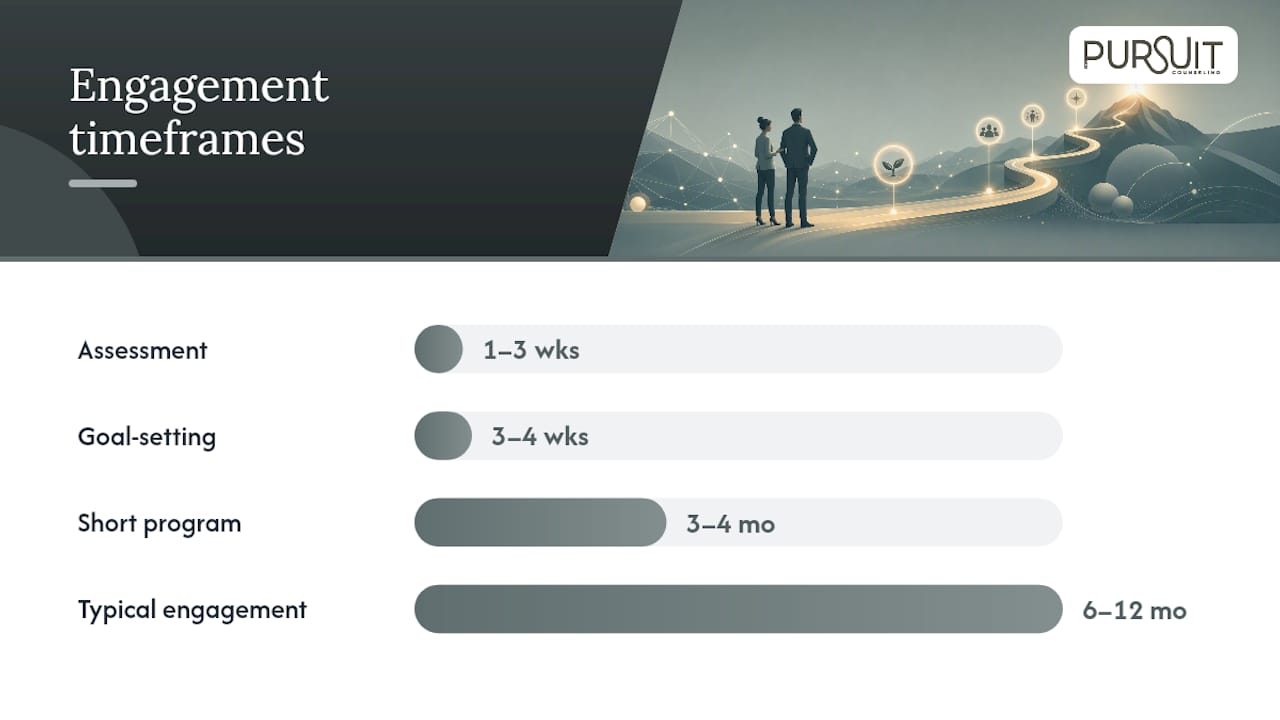
- Assessment (weeks 1–3): The coach gathers 360 feedback, conducts stakeholder interviews, and administers validated instruments (personality, EI, leadership style). This establishes a behavioral baseline and surfaces the gaps worth targeting.
- Goal-setting (weeks 3–4): Coach and leader co-create 2–4 specific, measurable behavioral goals tied to business outcomes. Goals are documented and shared with a sponsor (typically the leader’s manager or HR partner) to create organizational accountability.
- Coaching sessions (months 1–6+): Sessions typically run 60–90 minutes, once or twice per month. Each session reviews progress on behavioral experiments, addresses emerging challenges, and sets the next experiment.
- Action plans and behavioral experiments (ongoing): Between sessions, the leader implements specific behavioral changes in real work situations. These are the actual mechanism of change — not the sessions themselves.
- Mid-point review (month 3–4): A structured check-in with the sponsor and coach to assess progress against goals, recalibrate if needed, and confirm organizational alignment.
- Closing assessment and follow-up (month 6–12): Post-coaching 360 or goal attainment review measures change against the baseline. A sustainability plan identifies how gains will be maintained without the coach.
Most engagements run 6–12 months. Shorter programs (3–4 months) can produce targeted behavioral change on a narrow goal; longer ones are appropriate for complex developmental needs or significant role transitions.
Pro Tip: Build a milestone review at month 3 into every engagement contract before you start. Leaders who wait until the end to evaluate progress often discover the goals drifted. A mid-point review keeps the work anchored to the original business case and gives you time to course-correct.
For a clear picture of what this investment costs, the executive coaching cost guide at The Pursuit Counseling breaks down current rates and what drives price variation.
How to measure coaching outcomes and calculate ROI
Start with pre/post measures, 360 feedback, objective KPIs, and a comparison group where feasible. That combination gives you the triangulated evidence base that separates a credible ROI claim from a testimonial.
Recommended metrics and when to use each:
- 360-degree behavioral ratings: Best for capturing leadership behavior change from multiple perspectives. Administer at baseline and 6–12 months post-coaching. Use the same rater pool for comparability.
- Goal Attainment Scaling (GAS): A validated, individualized measure that scores progress against the specific goals set at the start of the engagement. Highly sensitive to coaching-specific outcomes.
- Validated self-report scales: Well-being, self-efficacy, and resilience scales (e.g., the General Self-Efficacy Scale) provide standardized, comparable data across cohorts.
- Business KPIs: Retention of direct reports, engagement scores, promotion rates, and revenue metrics tied to the leader’s scope. These are the hardest to attribute to coaching alone but the most compelling to senior stakeholders.
- Qualitative stakeholder feedback: Structured interviews with the leader’s manager and direct reports at close of engagement. Useful for capturing behavioral change that quantitative measures miss.
| Metric | Instrument | Timing | Interpretation guidance |
|---|---|---|---|
| Leadership behavior | 360 assessment | Baseline + 6–12 months | Compare rater scores pre/post; look for consistent shifts across rater groups |
| Goal attainment | Goal Attainment Scaling | Ongoing + close | Scores indicating goal exceeded; track across all goals |
| Self-efficacy | General Self-Efficacy Scale | Baseline + close | Standardized norms allow benchmarking against broader populations |
| Well-being | Validated well-being scale | Baseline + close | Useful for leaders in high-stress transitions; track alongside performance |
| Business impact | KPI dashboard | Quarterly | Attribute cautiously; use comparison group or pre/post trend analysis |
Studies that tie coaching to specific goals and organizational KPIs report stronger evidence of value. The absence of agreed outcome metrics across the field is one of the main reasons ROI comparisons across organizations are so difficult to make.
Pro Tip: Never rely on a single measure. Self-report scales are susceptible to social desirability bias; 360 ratings can reflect relationship dynamics as much as behavior change; KPIs are affected by market conditions. Triangulate at least three data sources, and document your measurement plan before the engagement starts — not after.
When coaching may not work, and what poor coaching looks like
Coaching has moderate evidence overall, but it is sensitive to coach quality, goal alignment, and measurement rigor. A poorly designed engagement does not just fail to produce results — it can actively waste time and erode trust in the development process.
Red flags that predict a low-return engagement:
- Untrained or uncredentialed coaches: Coaches without recognized credentials (look for ICF Professional Certified Coach or Master Certified Coach designation) are not held to consistent ethical or methodological standards.
- No measurable goals: If the engagement begins without documented, specific behavioral goals, there is no mechanism for accountability and no basis for evaluating outcomes.
- Lack of organizational sponsorship: Coaching that happens in isolation from the leader’s manager and HR partner rarely transfers to the workplace. Organizational context is not optional.
- No transfer plan: Sessions that produce insight without behavioral experiments and a sustainability plan generate awareness without change.
- Coaching when therapy is needed: If a leader is dealing with clinical-level anxiety, depression, or unresolved trauma, coaching will not address the root cause. A combined approach — or a referral to a qualified therapist — is the appropriate path.
- Coaching as punishment: Assigning coaching to a leader as a consequence of poor performance, without their genuine buy-in, almost never works. Motivation to change is a prerequisite, not a byproduct.
Pro Tip: When vetting a coach, ask for three things: their credential level (ICF PCC or MCC), their approach to goal-setting and measurement, and a description of how they handle situations where a client may need clinical support rather than coaching. A coach who cannot answer all three clearly is not ready for senior-level work.
What the research actually says: meta-analyses and key findings
The academic evidence on executive coaching effectiveness has grown substantially over the past two decades, and the picture is more nuanced than either enthusiasts or skeptics tend to acknowledge.
Key statistic: The RCT-based meta-analysis published in PMC found an overall Hedges’ g of 0.43 (95% CI 0.35–0.50) across behavioral, attitudinal, and personal-characteristic outcomes — a moderate effect that held across multiple study designs, with behavioral outcomes showing the largest gains.
| Study/review | Design | Key finding | Practical implication |
|---|---|---|---|
| RCT meta-analysis (PMC) | Meta-analysis of RCTs | Hedges’ g ≈ 0.43; behavioral outcomes largest | Behavioral goals produce the most reliable change |
| Burt and Talati RCT synthesis | RCT-focused meta-analysis | Pooled p̂ ≈ 0.42; positive effects on performance, well-being, coping | Broad outcome categories show consistent small-to-moderate gains |
| Systematic review (ScienceDirect) | Systematic review | High heterogeneity; calls for methodological rigor | Context and coach quality moderate outcomes significantly |
Systematic-review evidence consistently highlights heterogeneity across studies, which is the honest caveat every leader should hold alongside the positive effect sizes. Coaching works on average, but the variance around that average is wide. The moderators that matter most:
- Coach skill and training: The single largest driver of outcome variance. Credentialed, experienced coaches produce more consistent results.
- Goal specificity: Engagements with clear, measurable behavioral goals outperform those with vague developmental intentions.
- Internal vs. external coach: External coaches tend to produce stronger outcomes for senior leaders, likely because confidentiality and objectivity are harder to maintain with internal coaches.
- Program design: Longer engagements with structured follow-up and organizational integration outperform short, isolated programs.
- Evidence gaps: Organizational-level outcomes (team performance, culture change, business results) remain understudied relative to individual outcomes. The evidence is thinner there, not absent.
How The Pursuit Counseling approaches executive coaching
At The Pursuit Counseling, we believe coaching should deliver measurable behavioral change — not just insight. That means every engagement starts with a clear baseline, specific goals, and a measurement plan that lets you see what is actually shifting.
What makes the approach at The Pursuit Counseling distinct for leaders:
- Neuroscience-informed methods: Coaching is grounded in neuropsychology and behavioral science, drawing on how the brain actually forms and changes habits under stress.
- Integration with counseling: For leaders whose performance is affected by anxiety, burnout, or unresolved stress, coaching and counseling for leaders can be combined in a single, coordinated engagement — something most coaching-only providers cannot offer.
- Emotional intelligence focus: EI development is built into the coaching framework, not treated as an add-on, because self-awareness and relational skill are the behavioral levers that move the needle fastest for most senior leaders.
- Measurable goals from session one: Every engagement at The Pursuit Counseling begins with documented behavioral goals and a measurement approach, so you are never guessing whether the work is producing results.
Pro Tip: The most useful first step is not a coaching session — it is an assessment. A structured intake that maps your current behavioral patterns, identifies your highest-leverage development targets, and establishes a measurement baseline gives you a roadmap before the real work begins. Ask about the leadership counseling approach at The Pursuit Counseling to see how that assessment process works.
Ready to put the evidence to work for your leadership
The research is clear enough: a well-structured coaching engagement produces real behavioral change in leaders who are ready to do the work. What separates the engagements that deliver from the ones that disappoint is not the coach’s credentials alone — it is the combination of clear goals, rigorous measurement, and a coach who can hold both the professional and the human being in the room at the same time.
The Pursuit Counseling offers coaching and counseling for leaders that integrates neuroscience-informed coaching with clinical counseling support — a combination that matters most when high performance and personal wellbeing are both on the line. Whether you are navigating a role transition, working through a 360 that surfaced a hard truth, or simply ready to close the gap between where you are and where your leadership needs to be, the process starts with a conversation.
Review the executive coaching cost guide to understand current investment ranges, then reach out to schedule an initial consultation. The first step is a structured assessment — not a sales call.
Sources
- The effects of executive coaching on behaviors, attitudes, and personal characteristics: a meta-analysis of randomized control trial studies – PMC
- The unsolved value of executive coaching: A meta-analysis of outcomes using randomised control trial studies
- The ROI of Executive Coaching | American University, Washington, DC
- A systematic review of executive coaching outcomes: Is it the journey or the destination that matters the most?
- What self-awareness really is, and how to cultivate it – Harvard Business Review
- What is executive coaching? – Robert Walters insights
- What Is Executive Coaching And Why Should You Engage A Coach? – Forbes
FAQ
Who benefits most from executive coaching?
Senior leaders in role transitions, CEOs navigating isolation at the top, high-potential managers preparing for greater responsibility, and leaders driving organizational change tend to show the strongest gains. The common thread is a specific developmental challenge paired with genuine motivation to change.
What is the goal of executive coaching?
The primary goal is measurable behavioral change that improves leadership effectiveness in a specific context. Well-designed engagements target 2–4 specific behavioral goals tied to business outcomes, tracked through 360 feedback and Goal Attainment Scaling.
How effective is executive coaching?
RCT-based meta-analyses report a moderate overall effect (Hedges’ g ≈ 0.43), with behavioral outcomes showing the largest gains. Effectiveness varies significantly based on coach quality, goal specificity, and organizational integration.
What makes executive coaching different from leadership training?
Training delivers standardized content to groups. Executive coaching is individualized, focused on the specific leader’s behavioral gaps, and produces change through accountability and behavioral experimentation rather than content delivery. The two work best in combination, not as substitutes.
How does The Pursuit Counseling approach executive coaching?
The Pursuit Counseling integrates neuroscience-informed coaching with clinical counseling support, starting every engagement with a structured assessment and documented behavioral goals. This combined model is particularly suited to high-performing leaders in Georgia whose development needs span both professional performance and personal resilience.