


Pick the coach whose operating experience matches the altitude of the role you’re stepping into. That single rule outperforms every other selection criterion, including credentials, methodology, and price. Altitude match — whether a coach has actually held a seat at or above your level — is the highest-signal predictor of fit for senior leaders.
Here’s how to start the process in the next 48 hours:
- Define three specific outcomes you want from coaching (board presence, decision speed, P&L accountability, succession readiness).
- Schedule two discovery calls with coaches sourced from peer referrals or the ICF coach finder.
- Request an anonymized case summary from each candidate before the call.
- Plan to finalize your selection within two to four weeks: research five to eight options, shortlist three to four, run chemistry calls, check references, and sign a contract.
Table of Contents
- What is executive coaching and who benefits most?
- How to choose an executive coach: a practical checklist and process
- How do you verify a coach’s credentials and real experience?
- What should you ask in the discovery call and trial session?
- What does executive coaching cost and how long does it take?
- When should coaching be combined with counseling or therapy?
- How do you measure coaching success and know when to stop?
- Key Takeaways
- The case for choosing a coach who can handle what’s underneath
- The Pursuit Counseling offers integrated coaching and clinical support for leaders
- Useful sources and further reading
What is executive coaching and who benefits most?
Executive coaching is a structured, one-on-one engagement focused on behavior change, decision-making quality, and measurable business outcomes. It is not training, which delivers content to groups. It is not mentoring, which transfers the mentor’s experience and advice. And it is not therapy, which addresses clinical symptoms and psychological history. Coaching works in the present and near future: what you are doing, what is getting in the way, and what needs to change.
The leaders who get the most from it tend to share a few characteristics:
- First-time C-suite executives who need to shift from functional expert to enterprise leader.
- Senior leaders taking on a new P&L, a board-facing role, or a cross-functional mandate for the first time.
- High performers who have plateaued and can’t identify why from the inside.
- Leaders preparing for succession or a significant organizational transition.
- Executives whose 360 feedback consistently surfaces the same blind spot, year after year.
If what you need is clinical support for anxiety, depression, or unresolved trauma affecting your performance, coaching alone is not the right starting point. The distinction between coaching and counseling matters practically, not just theoretically. More on that in a later section.
How to choose an executive coach: a practical checklist and process
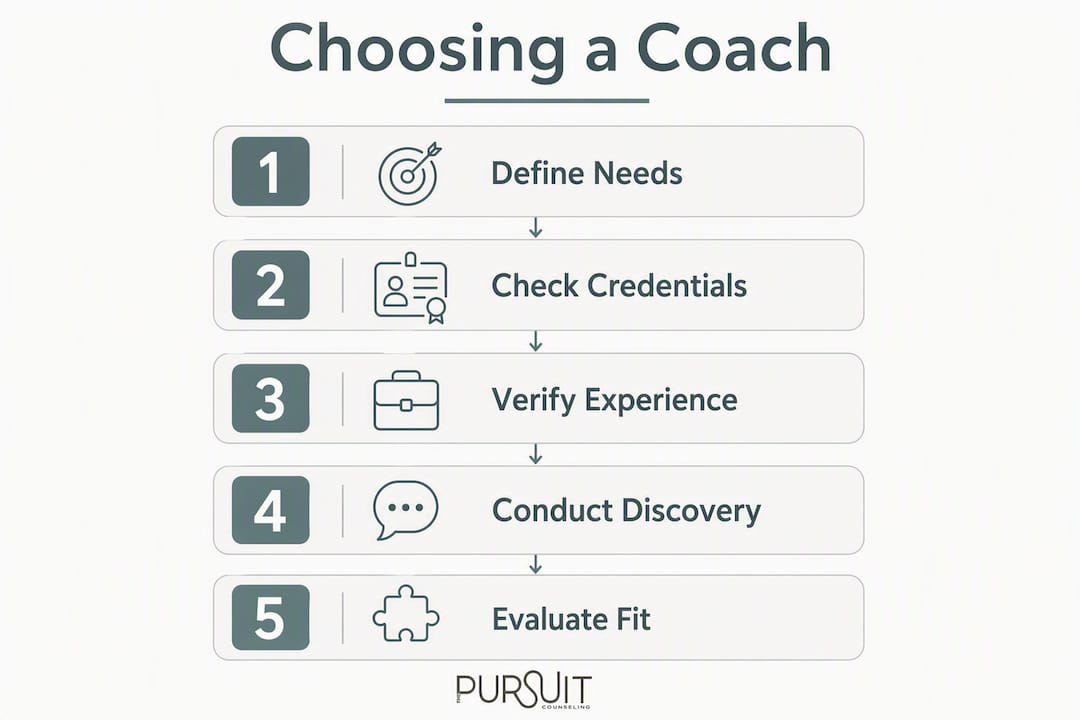
The selection process has five steps. Work through them in order, and you will have a defensible shortlist within two to four weeks.
Step-by-step selection process
- Define your outcomes first. Write down three to five specific, measurable goals before you speak to a single coach. “Improve my leadership” is not a goal. “Reduce the time from decision to execution on strategic initiatives by 30 days” is.
- Source candidates through referrals and directories. Ask peers at your level, your board, or your CHRO. Supplement with the ICF coach finder and curated directories. Avoid coaches who cold-contact you.
- Run a 30–60 minute working discovery call. Treat it as a mini coaching session, not a sales call. A strong coach engages the specifics of your situation within the first 20 minutes.
- Check references at the same altitude. Ask for one or two past clients who held a comparable role. Speak to them directly.
- Negotiate and sign a written engagement agreement before any work begins. Scope, cadence, deliverables, success metrics, confidentiality terms, and a 30-day recalibration checkpoint should all be in writing.
Your selection checklist
Use this before shortlisting any coach:
- Clarity on goals: Can you articulate three specific outcomes? Can the coach reflect them back accurately?
- Altitude match: Has the coach held a seat at or above your level? Can they name roles, timeframes, and accountabilities?
- Measurable outcomes: Does the coach insist on defining success metrics before starting?
- Chemistry: Do you feel challenged and respected, not just comfortable?
- Contracting: Will the coach provide a written agreement covering scope, confidentiality, and measurement?
Red flags to walk away from
- Vague outcome language (“we’ll work on your presence”) with no willingness to define metrics.
- Refusal to provide references or case summaries, citing blanket confidentiality.
- Overreliance on a proprietary “system” or “method” that can’t be explained in plain language.
- Pressure to commit after a single call.
- Pricing so low it signals the coach has no senior-level track record.
Common selection mistakes include prioritizing the lowest cost, accepting the first coach after one call, and skipping reference checks entirely. Each one tends to produce an ineffective engagement.
How do you verify a coach’s credentials and real experience?
Credentials are a hygiene check, not a hiring decision. The ICF credential levels run from ACC (entry-level) to PCC (the professional standard for executive work) to MCC (master/elite). For C-suite or senior leadership work, PCC or MCC is the preferred baseline. The EMCC (European Mentoring and Coaching Council) offers a parallel framework. Neither credential tells you whether the coach has ever sat in a seat like yours.

The real validation work looks more like a resume review than a credential check.
| Signal to request | What to look for | Red flag |
|---|---|---|
| Roles held | Named titles, organizations, timeframes, and P&L or headcount accountability | Vague “senior leadership experience” with no specifics |
| Anonymized case summaries | Outcomes tied to a role at your level or above | Generic success stories with no context |
| References | Past clients at comparable altitude willing to speak | Refusal or “all clients are confidential” with no exceptions |
| Coaching training | ICF-accredited program, named institution, hours logged | Self-certified or credential-free |
| Engagement structure | Written agreement, defined metrics, review cadence | Month-to-month with no defined outcomes |
Ask directly: “What seats have you actually held?” Expect a resume-style answer with named roles, timeframes, and accountabilities. A coach who responds with a summary of “years of experience” without specifics is telling you something.
Reference questions worth asking
When you speak to a past client, focus on three things:
- “Did the coach understand the political and organizational complexity of your role, or did the advice feel generic?”
- “How did the coach handle a moment when you pushed back or resisted a hard truth?”
- “Would you hire this coach again for a higher-stakes engagement?”
Specific, confident answers signal a coach who delivered. Hedged or vague answers signal the opposite.
What should you ask in the discovery call and trial session?
The discovery call is your audition, not theirs. Treat the first conversation as a working sample: a strong coach will ask pointed questions about your specific role, your specific challenge, and the specific constraints you’re operating under. If the call feels like a pitch, it probably is one.
Priority questions to ask the coach
- “Walk me through a recent engagement at my level. What were the presenting issues, and what changed?”
- “How do you structure the first 90 days of an engagement?”
- “What does success look like at six months, and how do we measure it?”
- “How do you handle a client who resists the work or avoids hard conversations?”
- “What’s your approach when a client’s goals shift mid-engagement?”
What a strong trial session looks like
A useful first session is specific, not generic. The coach:
- Asks questions that require you to think, not just describe.
- Offers a working hypothesis about what might be getting in your way.
- Stays curious rather than jumping to advice.
- Closes with a concrete next step tied to your stated goal.
Post-session evaluation
After the call, rate the coach on these four dimensions before your memory softens:
- Listening quality: Did they track what you said and build on it, or did they pivot to their framework?
- Context fluency: Did they understand your industry, organizational structure, and role complexity?
- Specificity: Were their observations and suggested next steps specific to your situation?
- Challenge: Did you feel stretched, or just validated?
If three of four are strong, put the coach on your shortlist. If listening quality is weak, remove them regardless of credentials.
What does executive coaching cost and how long does it take?
Pricing varies significantly by coach type, engagement structure, and seniority level. The table below reflects typical U.S. ranges for different coach tiers.
| Coach type | Per-session rate | Engagement cost | Best for |
|---|---|---|---|
| Boutique senior coach | 0–0 | ,500–,000 | VP to C-suite transitions |
| Independent prior-executive coach | 0–0 | ,500–,000 | Board-facing, politically sensitive work |
| C-suite / enterprise coaching | ,500–,000+ per month | ,000–,000 | CEO, C-suite, succession |
| Platform or cohort-based | Varies (often lower) | ,500–,000 | Scale, consistent cadence, mid-level leaders |
Coaching platforms are built for scale and consistent cadence. Independent coaches provide the depth and political sensitivity that senior leaders need for high-stakes, board-facing, or organizationally complex work. For C-suite engagements, budget for deliverables that go beyond sessions: stakeholder interviews, 360 assessments, and sponsor reporting are standard at that level and rarely included in lower-cost hourly arrangements; for biotech executives, see our detailed guide on executive biotech workflow optimization for sector-specific coaching needs.
Pro Tip: Never compare coaches on hourly rate alone. A 0-per-session coach who delivers a structured engagement with 360 data, stakeholder interviews, and written milestones often costs less per outcome than a 0-per-session coach who runs open-ended conversations indefinitely.
Contract terms to insist on
- Defined scope: number of sessions, cadence, included assessments or stakeholder interviews.
- Confidentiality terms: what is shared with sponsors, what stays private.
- Cancellation and pause clauses.
- A 30-day recalibration checkpoint with written review.
- Measurement: how success is defined and who evaluates it.
Timeline and what to expect
Coaching outcomes follow a predictable arc when the engagement is structured well:
- 60–90 days: Baseline assessment complete, goals confirmed, first behavior changes visible to the leader. Sponsor check-in recommended.
- 3–6 months: Measurable shifts in targeted behaviors. Direct report feedback, 360 data, or stakeholder input should show movement.
- 6–12 months: Business-level outcomes visible: decision speed, board presence, retention of key reports, delivery of a prioritized initiative.
Coaches who hedge on measurable outcomes or avoid naming hard truths tend to under-deliver for senior leaders. Insist on 90-day metrics and checkpoints from the start.
For a detailed breakdown of current U.S. pricing by engagement type, the executive coaching cost guide at The Pursuit Counseling covers rates and buyer considerations in depth.
When should coaching be combined with counseling or therapy?
Coaching and clinical support are not competing options. For some leaders, they are sequential. For others, they run in parallel. Knowing which applies to you is one of the most important decisions in the process.
Signs that counseling should come first or alongside coaching
- Persistent anxiety or depression that affects concentration, decision-making, or interpersonal functioning.
- A history of trauma that surfaces under organizational stress (conflict, authority dynamics, high-stakes presentations).
- Substance use, sleep disruption, or physical symptoms tied to work pressure.
- A pattern of self-sabotage that coaching alone has not shifted in previous engagements.
Coaching works on behavior and performance. Therapy works on the underlying architecture. When the architecture is compromised, coaching tends to stall. High-performing executives often reach a ceiling not because of skill gaps but because unresolved clinical issues are running in the background.
Practical integration guidelines
If you are working with both a coach and a therapist simultaneously:
- Establish role clarity in writing: the coach addresses performance and behavior; the clinician addresses clinical symptoms and history.
- Agree on what, if anything, is shared with organizational sponsors. Coaching progress notes may be shared; clinical records almost never should be.
- Use a brief information-sharing agreement between providers if they are different practitioners, so neither is working blind.
- Build a single measurement plan that tracks both clinical and performance outcomes.
Pro Tip: When both services are running simultaneously, schedule a brief joint check-in at 60 days to confirm the two providers are aligned on goals and not inadvertently working at cross-purposes. This one step prevents most integration failures.
If you are unsure whether you need coaching, counseling, or both, the coaching and counseling for leaders overview at The Pursuit Counseling walks through the decision framework clearly.
This section provides general information, not clinical or professional advice. Consult a licensed clinician to determine the appropriate level of care for your specific situation.
How do you measure coaching success and know when to stop?
Measurement is not optional. Coaches who connect behavior change to business metrics are better positioned to demonstrate ROI and retain sponsor support. If your coach resists defining KPIs, that resistance is itself a data point.
Sample KPIs tied to business impact
- Board or stakeholder feedback scores on executive presence (pre/post 360).
- Decision cycle time on a defined category of strategic decisions.
- Retention rate of direct reports over the engagement period.
- Delivery status of a specific initiative the leader owns.
- Upward and peer feedback on communication clarity and conflict navigation.
Review cadence
| Checkpoint | What to evaluate | Who is involved |
|---|---|---|
| 30 days | Goals confirmed, working relationship functional, baseline data collected | Leader and coach |
| 90 days | Early behavior shifts visible, sponsor check-in, recalibrate if needed | Leader, coach, sponsor (optional) |
| 6 months | Measurable outcome progress, 360 or stakeholder input reviewed | Leader, coach, sponsor |
| 12 months | Full ROI review, decision to extend, close, or transition to a new coach | Leader, coach, sponsor, HR |
Exit criteria and governance
End the engagement when:
- Defined outcomes have been achieved and documented.
- The engagement has plateaued and recalibration has not produced movement.
- The leader’s role or organizational context has shifted significantly enough to require a different coach profile.
Bring in a different coach when the current coach’s altitude or sector experience no longer matches the leader’s new challenges. This is not a failure. It is good governance. A written engagement agreement with a clear close clause makes this conversation straightforward rather than awkward.
Key Takeaways
The single most important rule for selecting an executive coach is altitude match: choose a coach who has held a seat at or above your level and can define success in writing before the engagement begins.
| Point | Details |
|---|---|
| Altitude match comes first | Ask coaches to name specific roles, timeframes, and accountabilities they have held. |
| Define outcomes before you search | Write three measurable goals before your first discovery call; coaches who can’t reflect them back are not the right fit. |
| Run the discovery call as a test | A strong coach engages the specifics of your situation within 20 minutes; a weak one pitches their method. |
| Budget for the full engagement | C-suite coaching with 360 assessments and stakeholder interviews typically runs ,000–,000; hourly-only arrangements rarely cover those deliverables. |
| The Pursuit Counseling integrates both | For leaders who need coaching and clinical support together, The Pursuit Counseling offers an integrated model with EMDR, neurofeedback, and executive coaching in Georgia. |
The case for choosing a coach who can handle what’s underneath
Most selection guides stop at credentials and chemistry. Here’s what they miss: the leaders who struggle most with coaching are not the ones who picked the wrong methodology. They are the ones who picked a coach who could not handle the full weight of what they brought into the room.
Senior leaders carry a particular kind of load. The pressure of decisions that affect hundreds of people. The loneliness of a role where candor from peers disappears. The accumulated weight of years of performing at a level that leaves little room for uncertainty. A coach who has only ever coached, and never led, can work with the surface of that. They can help you structure your communication or manage your calendar. What they often cannot do is sit with you in the harder conversation, the one where the performance issue is downstream of something older and heavier.
This is not an argument against coaching. It is an argument for choosing a coach who knows where their lane ends and who is not afraid to say so. The best coaches I have seen work with senior leaders are the ones who ask the harder questions early, who notice when the presenting issue is not the real issue, and who have the experience and the humility to refer when the work exceeds their scope.
Altitude match matters. So does the coach’s capacity to be honest with you when the honest thing is uncomfortable. Those two qualities together are rarer than any credential.
The Pursuit Counseling offers integrated coaching and clinical support for leaders
For leaders who need more than a performance conversation, The Pursuit Counseling provides something most coaching practices cannot: a genuinely integrated model that pairs executive coaching with evidence-based clinical services, including EMDR, neurofeedback, and neuropsychology-informed treatment, all under one roof.

The initial engagement starts with a thorough assessment of both performance goals and clinical factors, so the recommended structure reflects what you actually need, not a default package. If coaching alone is the right fit, that’s what you get. If the assessment surfaces clinical factors affecting your performance, those are addressed directly, with a measurement plan that tracks both streams. Sessions are available in person in Georgia and via telehealth, with scheduling designed for leaders who do not have flexible calendars.
If you are ready to find out whether an integrated approach fits your situation, book a consultation with The Pursuit Counseling to get started.
Useful sources and further reading
These are the primary sources used to build this guide. Each one offers something specific for leaders who want to go deeper.
- How to Choose an Executive Coach | Stratos Coaching — The most operationally specific guide available on altitude match, written engagement definitions, and reference-checking protocols. The source for the “what seats have you actually held?” framework.
- How to Choose an Executive Coach in 2026 | Chiefviews — Covers ICF credential levels, selection process steps, common mistakes, and KPI-based measurement. Useful for first-time buyers of executive coaching.
- How to Choose an Executive Coach: 8 Questions to Ask | Forbes — A practical interview question set from Forbes, useful for structuring the discovery call.
- How to Choose an Executive Coach: Remember the 5 C’s | Forbes — A framework-based approach to evaluating coaches across five dimensions; useful as a secondary filter after altitude and outcomes.
- How to Pick the Right Executive Coach | The Treasurer — A practitioner-level perspective on coach selection from a finance and governance angle; useful for CFOs and treasury leaders.
- How to Choose the Right Executive Coach | Roberta Matuson — Covers the platform vs. independent coach distinction and when each model fits. Practical for HR leaders buying coaching at scale.
- The No-Fail Guide to Choosing the Right Executive Coach | Ivy Exec — A structured toolkit approach with emphasis on chemistry and working style; useful for leaders who have had a poor coaching experience before.
- Finding Your Perfect Match: Selecting the Right Coach | CFAR — Organizational psychology perspective on coach selection; useful when the coaching is organizationally sponsored rather than self-initiated.
- How to Choose a Leadership Coach | Advantage Performance Group — Covers leadership coaching specifically, with guidance on aligning coach selection to organizational development goals.
- Coaching and Counseling for Leaders | The Pursuit Counseling — Overview of integrated coaching and clinical services for leaders, including when to combine coaching with therapy and how the assessment process works.
Recommended
- Coaching and Counseling for Leaders – The Pursuit Counseling
- Executive Coaching Cost: 2026 Rates and Buyer’s Guide – The Pursuit Counseling
- Executive Therapist for CEOs, Founders & High Achievers | Adam Glendye
- Emotional Intelligence Coaching for Executives and High Performers – The Pursuit Counseling