


Prioritize three skills above everything else: physiological calming (diaphragmatic breathing or grounding), emotion labeling, and cognitive reappraisal. Use this script the moment you feel overwhelmed: Stop. Breathe. Reflect. Choose. That four-step sequence, outlined by Harvard Health, is your immediate reset. It pauses the automatic reaction, creates space for deliberate choice, and works whether you’re in a boardroom, a cockpit, or a difficult conversation at home.
The three skills to learn first:
- Diaphragmatic breathing — slows heart rate and activates the parasympathetic nervous system within 60–90 seconds
- Emotion labeling — naming what you feel (“I notice I’m angry”) reduces amygdala reactivity and creates a gap between stimulus and response
- Cognitive reappraisal — reframing the meaning of a situation shifts your emotional response before it escalates
These aren’t soft skills. They’re the core of what the UCSF Emotion Regulation Skills manual calls the foundational goals: identify and label emotions, reduce emotional vulnerability, and reduce emotional suffering through teachable practice. Gross’s process model of emotion regulation — the most cited framework in the field — maps exactly where each of these skills intervenes, from situation selection all the way to response modulation.
If you’re already in crisis, skip to the TIPP protocol in Section 3. If you want to understand why these skills work before you practice them, Section 5 covers the neuroscience. And if self-help isn’t enough, Section 7 explains when to bring in professional support. The Pursuit Counseling integrates DBT skills, EMDR, and neurofeedback for high-performing adults who need more than a breathing exercise.
Pro Tip: Don’t wait for a crisis to practice. The Stop‑Breathe‑Reflect‑Choose script works best when you’ve rehearsed it during low-stakes moments first.
Table of Contents
- What are the core emotion regulation skills and how do you practice them?
- How do you use these skills in the moment and build them over time?
- Which technique should you use for each emotional state?
- Why do these skills work? The neuroscience and clinical models behind them
- What gets in the way of practicing emotion regulation, and how do you fix it?
- When should you get professional help for emotion dysregulation?
- Key Takeaways
- Why the conventional wisdom on emotion regulation misses the most important thing
- Ready for guided, measurable support with emotion regulation?
- Authoritative resources to go deeper
Navigating Your Guide to Emotion Regulation Skills
Emotion regulation is the capacity to influence which emotions you experience, when you experience them, and how you express them. It’s a learnable skill set, not a fixed personality trait. The goal isn’t suppression. It’s flexibility: being able to feel fully without being controlled by what you feel.
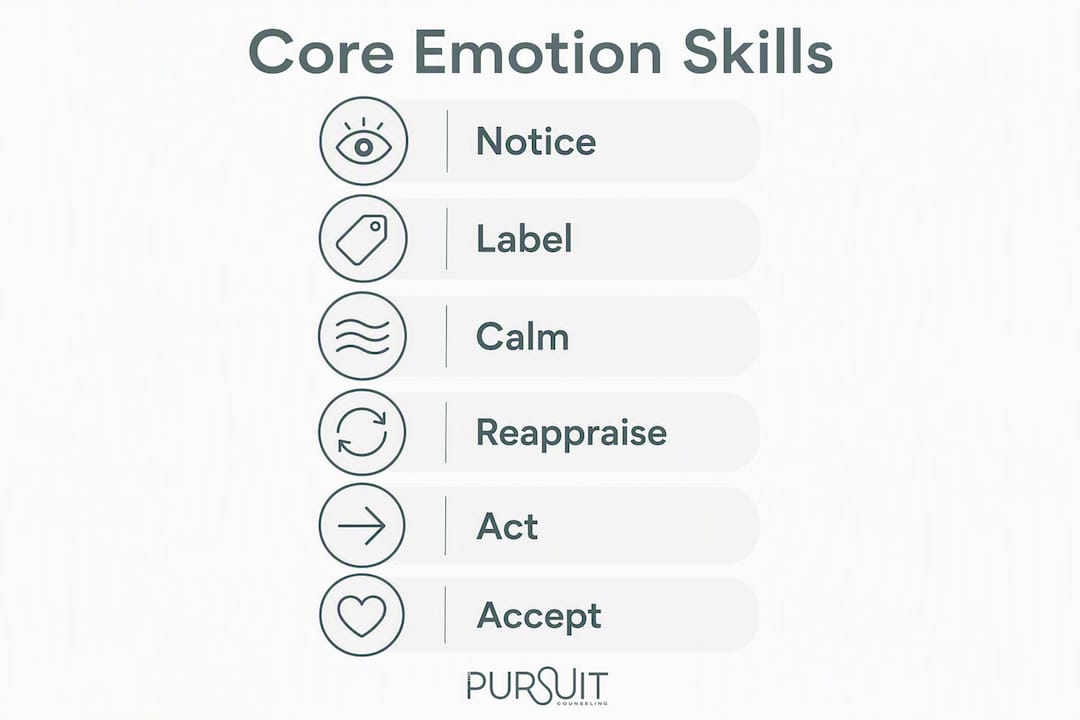
Mindful noticing and emotion labeling
The first move in any regulation sequence is awareness. Before you can change an emotion, you have to see it clearly.

Affect labeling — saying or writing “I notice I feel anxious” rather than just being anxious — has measurable down-regulation effects on threat circuitry, according to DBT Tools. The act of naming creates a small but real gap between stimulus and response. That gap is where choice lives.
Practice script:
- Pause and scan your body for physical sensations (tight chest, clenched jaw, shallow breath).
- Name the emotion with specificity: not just “bad” but “frustrated,” “humiliated,” or “anxious.”
- Say it internally or aloud: “I notice I’m feeling [emotion].”
- Notice the sensation without trying to fix it for 10–15 seconds.
Building granularity in your emotional vocabulary matters. The more precisely you can name what you feel, the more targeted your regulation response can be.
Physiological regulation techniques
When arousal is high, the body needs to come down before the mind can think clearly. These are bottom-up tools — they work through the nervous system, not through thinking.
- Box breathing (4-4-4-4): Inhale 4 counts, hold 4, exhale 4, hold 4. Repeat 4–6 cycles.
- 4-7-8 breathing: Inhale 4 counts, hold 7, exhale 8. Activates the vagal brake quickly.
- 5-4-3-2-1 grounding: Name 5 things you see, 4 you hear, 3 you can touch, 2 you smell, 1 you taste. Anchors attention to the present moment.
- Progressive muscle relaxation (PMR): Tense each muscle group for 5 seconds, release for 10. Move from feet to face.
- Brief intense exercise: 60 seconds of jumping jacks or running in place burns off adrenaline when other tools aren’t accessible.
Each of these targets the physiological arousal that makes cognitive tools ineffective. Calm the body first. Then think.
Cognitive reappraisal

Reappraisal means changing the meaning you assign to a situation, not the situation itself. It’s the most studied cognitive emotion regulation strategy and one of the most effective for long-term wellbeing.
Reframing prompts to use in the moment:
- “What else could this mean?”
- “Is this as permanent as it feels right now?”
- “What would I tell a close friend in this exact situation?”
- “What’s the most realistic outcome here, not the worst-case one?”
Decatastrophizing is a specific form of reappraisal: you challenge the catastrophic interpretation and replace it with a more accurate, proportionate one. It doesn’t require toxic positivity. It requires accuracy.
DBT-derived skills: TIPP and ACCEPTS
DBT is especially effective for people with marked emotional dysregulation because it provides a structured, teachable set of skills. Two of the most practical for crisis moments are TIPP and ACCEPTS.
TIPP (Temperature, Intense exercise, Paced breathing, Progressive muscle relaxation) is a physiological crisis kit:
- Temperature: Hold ice cubes, splash cold water on your face, or submerge your wrists. Cold activates the dive reflex and slows heart rate fast.
- Intense exercise: 20–30 minutes of vigorous movement, or even a 60-second burst, discharges sympathetic activation.
- Paced breathing: Slow the exhale to longer than the inhale (e.g., inhale 4, exhale 6).
- Progressive muscle relaxation: As described above.
ACCEPTS is a distress-tolerance tool for riding out a crisis without making it worse: Activities, Contributing, Comparisons, Emotions (opposite), Pushing away, Thoughts (distraction), Sensations. Each letter is a category of distraction strategy to use when the situation can’t be changed right now.
These distress-tolerance tools are crisis-management skills — effective for short-term survival but not substitutes for long-term skill-building.
Opposite action and behavioral activation
Opposite action is a DBT skill built on a simple insight: emotions drive action urges, and acting opposite to that urge changes the emotion itself. Feeling shame urges withdrawal — so you reach out instead. Feeling fear urges avoidance — so you approach. The behavior change comes first; the emotional shift follows.
Opposite action works because emotions are partly maintained by the behaviors they generate. Break the behavioral loop, and the emotion loses fuel.
Behavioral activation applies the same logic to low mood and depression: schedule one small, values-aligned activity and do it regardless of motivation. Motivation follows action, not the other way around.
Acceptance-based practices
Sometimes the most effective regulation move is to stop fighting the emotion. ACT-style willingness means allowing an emotion to be present without acting on it or trying to eliminate it. You observe it, make room for it, and choose your behavior based on your values rather than the emotion’s urgency.
This is not resignation. It’s the recognition that some emotions pass faster when you stop wrestling with them.
How do you use these skills in the moment and build them over time?
In-the-moment protocols
Stop‑Breathe‑Reflect‑Choose (4-step adult protocol):
- Stop — interrupt the automatic reaction. Physically pause, step back, or say “hold on” internally.
- Breathe — take 3–5 slow diaphragmatic breaths to lower physiological arousal.
- Reflect — ask: “What am I feeling? What triggered this? What do I actually want here?”
- Choose — select a deliberate, values-based response rather than reacting from the emotion’s urgency.
This protocol is designed to return you to calm before re-engaging, and it works across contexts — a tense meeting, a conflict at home, a moment of performance anxiety before a high-stakes presentation.
TIPP crisis script (60-second version):
- Grab ice or run cold water over your wrists (Temperature).
- Do 20 jumping jacks or sprint in place (Intense exercise).
- Slow your exhale: breathe in for 4, out for 6 (Paced breathing).
- Tense and release your fists three times (PMR shortcut).
60-second grounding routine:
- Plant both feet flat on the floor.
- Name 5 things you can see right now.
- Take 3 slow breaths, exhaling fully.
- Say your name, the date, and where you are.
Cope Ahead: preparing for known triggers
Cope Ahead is a DBT planning tool for anticipated stressors. Instead of waiting for the trigger to arrive, you rehearse your response in advance.
- Identify the trigger: “My performance review is Thursday and I tend to catastrophize feedback.”
- Plan the response: “I’ll use box breathing before I walk in, label any shame that comes up, and use the reappraisal prompt ‘what else could this mean?’”
- Rehearse mentally: Visualize the scenario and your regulated response in detail.
- Practice the skill in a low-stakes version first: Use the same breathing technique during a minor frustration this week.
A short daily practice schedule
Consistency builds what clinicians call the “window of tolerance” — the range of arousal within which you can function, think, and connect. Self-monitoring and brief progress logs are standard recommendations in clinical programs because they improve both adherence and outcomes.
- Morning (5 minutes): Body scan and emotion check-in. Name your current emotional state with specificity. Set one values-based intention for the day.
- Midday (3–5 minutes): Box breathing anchor. Pause, breathe, and briefly note your arousal level (1–10).
- Evening (5–10 minutes): Reflect on one emotional moment from the day. What triggered it? Which skill did you use or could have used? Log it.
Weekly practice to widen your window of tolerance
Progressive exposure works for emotional regulation the same way it works for physical training: you deliberately practice with slightly more challenging emotional material each week, track your response, and adjust. Pair new skills with existing anchor habits (morning coffee, a commute, a post-workout cooldown) so the practice sticks.
Pro Tip: Match the protocol to your arousal level. If your heart is pounding and your thoughts are racing, start with physiology — breathing, cold water, movement. Cognitive reframing is nearly impossible when the nervous system is in full activation. Calm the body first, then think.
Which technique should you use for each emotional state?
The most effective approach is to match the technique to the specific emotional lever — physiological arousal versus cognitive interpretation. There is no universal tool.
The arousal continuum
| Arousal Level | Primary Goal | First-Line Tool Family | Example Skills |
|---|---|---|---|
| Low (flat, numb, withdrawn) | Activate and engage | Behavioral activation, values-based action | Schedule one activity, opposite action, movement |
| Moderate (tense, worried, irritable) | Stabilize and reframe | Mixed: breathing + cognitive | Box breathing, reappraisal prompts, labeling |
| High (panic, rage, dissociation) | Survive and ground | Physiological (bottom-up) | TIPP, 5-4-3-2-1, cold water, PMR |
Three questions to pick a skill
- How intense is the arousal? If it’s above a 7 out of 10, lead with physiology.
- Is the situation changeable right now? If yes, problem-solve. If no, use acceptance or distress tolerance.
- Is immediate safety at stake? If yes, use TIPP and contact support. If no, proceed with the standard protocol.
Scenario-to-skill mapping
Workplace overwhelm: You’re three deadlines behind and your chest is tight. Start with 4-7-8 breathing (2 minutes), then use the reappraisal prompt “what’s the single most important thing right now?” Narrow the focus before acting. For more stress-reduction strategies that pair with these skills, The Pursuit Counseling’s resource library is worth a look.
Relationship conflict: You feel flooded during an argument. Call a 20-minute timeout (not a withdrawal — a regulated pause), use box breathing, then return with the intention to understand before responding. Arguing effectively requires a regulated nervous system first.
Intrusive memories: Grounding (5-4-3-2-1) anchors attention to the present when the past pulls hard. Follow with labeling: “I notice I’m feeling fear from a memory, not a current threat.” If intrusive memories are frequent and severe, this is a signal that trauma processing — not just coping skills — may be needed.
Performance anxiety: Reappraisal reframe: “This arousal is my body preparing me, not warning me of danger.” Pair with paced breathing 10 minutes before the event. Rehearse the Cope Ahead script the night before.
For caregivers managing a family member’s emotional dysregulation, the same arousal-matching principle applies. Resources on anger and agitation in dementia offer useful parallel guidance for that specific population.
Why do these skills work? The neuroscience and clinical models behind them
Gross’s process model
James Gross’s process model is the dominant framework in emotion regulation research. It maps five points where regulation can intervene:
| Strategy Point | What You’re Changing | Example Skill |
|---|---|---|
| Situation selection | Which situations you enter or avoid | Planning, avoidance (adaptive or maladaptive) |
| Situation modification | Changing the situation itself | Problem-solving, assertiveness |
| Attentional deployment | Where you focus within a situation | Distraction, mindful attention |
| Cognitive change | How you appraise the situation | Reappraisal, decatastrophizing |
| Response modulation | Changing the emotional response directly | Breathing, PMR, suppression |
The model matters because it tells you where to intervene. Reappraisal works at the cognitive change point — before the full emotional response fires. Breathing works at response modulation — after it has. Choosing the wrong point wastes effort.
Neuroscience anchors
Affect labeling reduces amygdala reactivity. That finding, replicated across multiple neuroimaging studies, explains why naming an emotion is not just a soft coping strategy — it’s a direct intervention on the brain’s threat-detection system. The labeling effect works even when the labeling is brief and implicit.
Heart-rate variability (HRV) is a reliable physiological marker of regulation capacity. Higher HRV correlates with better emotional flexibility, stronger parasympathetic tone, and greater resilience under stress. Slow, paced breathing directly increases HRV by activating the vagal brake — the physiological mechanism behind why breathing exercises work.
DBT framework
DBT was developed by Marsha Linehan specifically for people with significant emotional dysregulation. Its four skill modules — mindfulness, distress tolerance, emotion regulation, and interpersonal effectiveness — form a complete system. Mindfulness is the foundation: without the ability to observe your emotional state without immediately reacting to it, none of the other skills land cleanly.
Polyvagal-informed shorthand
Polyvagal theory offers a useful shorthand for clinical practice. When the nervous system is in “ventral vagal” safety mode, you can connect, think, and regulate. When it shifts into “sympathetic” activation (fight-or-flight), cognitive tools become less effective and physiological tools become primary. When it drops into “dorsal vagal” shutdown (freeze, dissociation, numbness), activation-based tools — movement, social engagement, sensory stimulation — are the entry point.
Knowing which state you’re in helps you pick the right tool instead of forcing a cognitive reframe onto a body that isn’t ready for it.
The UCSF Emotion Regulation Skills manual integrates these frameworks into a clinical skills program with worksheets, prevention strategies, and concrete exercises — one of the most comprehensive free clinical resources available.
What gets in the way of practicing emotion regulation, and how do you fix it?
Common obstacles and specific fixes
- “I feel worse when I try to reframe.” You’re probably attempting reappraisal while still physiologically activated. Calm the body first (breathing, grounding), then reframe. Cognitive tools require a regulated nervous system as their foundation.
- “I forget to practice.” Pair the skill with an existing anchor habit: morning coffee triggers a 3-minute body scan; a commute triggers a breathing cycle. Habit stacking beats willpower every time.
- “I dissociate during breathing exercises.” Some people find inward focus destabilizing, especially with trauma histories. Switch to an eyes-open grounding technique (5-4-3-2-1) or use movement instead of stillness. If dissociation is frequent, this is a signal to work with a clinician.
- “I know the skills but don’t use them under pressure.” This is a rehearsal gap, not a knowledge gap. Practice the skill during low-stakes moments — minor frustrations, mild stress — so the neural pathway is already grooved when the high-stakes moment arrives.
- “Nothing seems to be working.” Check the sequencing first: are you using cognitive tools during high arousal? Are you practicing consistently (daily, not just in crisis)? If both are in order and progress is still slow, the underlying driver may be unprocessed trauma or a neurological pattern that self-help can’t reach alone.
Correct sequencing matters
The most common mistake is using the wrong tool at the wrong arousal level. High arousal requires bottom-up tools — breathing, grounding, movement — before cognitive reframing will work. Trying to reappraise during panic is like trying to solve a math problem while sprinting. The sequence is: calm the body, name the emotion, then think.
Daily habit tracker template
Use a simple one-line log each evening:
Date | Skill practiced | Minutes | Trigger noticed | Perceived control (1–10)
Example: March 14 | Box breathing + labeling | 7 min | Pre-meeting anxiety | 6/10
Review weekly. Look for patterns in triggers and track whether perceived control trends upward over two to three weeks. If it doesn’t, adjust the skill or the practice frequency.
When progress is slow
Ramp intensity gradually: add one new skill per week rather than trying to master the full toolkit at once. Increase practice frequency before increasing duration. Use incremental exposure — practice with slightly more emotionally challenging material each week, not just during neutral moments. If you’ve been consistent for four to six weeks and your baseline reactivity hasn’t shifted, it’s time to consider professional support.
When should you get professional help for emotion dysregulation?
Self-help skills are powerful. They’re also not enough for everyone. Some patterns of dysregulation have roots that breathing exercises and reappraisal prompts can’t reach.
Red flags that warrant professional care
- Frequent, severe emotional episodes that impair work, relationships, or daily functioning
- Suicidal thoughts, self-harm urges, or substance use as a primary coping strategy
- Emotional reactivity driven by trauma — intrusive memories, flashbacks, or chronic hypervigilance
- Dissociation, emotional numbness, or a persistent inability to access emotions at all
- Months of consistent self-practice with no measurable improvement
If any of these apply, the skills in this article are still useful — but they work best as adjuncts to professional treatment, not replacements for it.
Evidence-based treatment options
DBT (Dialectical Behavior Therapy): The gold standard for significant dysregulation. Structured skills training in mindfulness, distress tolerance, emotion regulation, and interpersonal effectiveness. Typically delivered in individual therapy plus a skills group. Most effective when dysregulation is pervasive and affects multiple life domains.
CBT (Cognitive Behavioral Therapy): Targets the cognitive patterns — automatic negative thoughts, catastrophizing, core beliefs — that drive emotional reactivity. Highly structured, time-limited, and well-supported by research. Best fit when the primary driver is cognitive distortion rather than physiological dysregulation or trauma.
EMDR (Eye Movement Desensitization and Reprocessing): Processes the stored traumatic memories that fuel chronic dysregulation. When emotional reactivity is trauma-driven, EMDR addresses the source rather than just the surface symptoms. Particularly effective for PTSD, complex trauma, and trauma-related anxiety.
Neurofeedback: A brain-training modality that trains the nervous system toward more regulated states using real-time EEG feedback. Useful when dysregulation has a neurological component — ADHD, trauma-related hyperarousal, anxiety — and when other approaches have plateaued.
Questions to ask a therapist or program
- What specific model or approach do you use for emotion dysregulation?
- How do you measure progress, and how often will we review it?
- What’s the expected time frame for this treatment?
- Do you have training in DBT, EMDR, or neurofeedback?
- What’s the structure — individual sessions only, or a skills group as well?
How The Pursuit Counseling approaches this work
The Pursuit Counseling integrates DBT-based emotion regulation therapy, EMDR, and neurofeedback for high-performing adults in Georgia. The approach is neuroscience-informed and outcome-measured — not generic talk therapy. If trauma-driven dysregulation is part of the picture, EMDR addresses the root. If the nervous system needs retraining, neurofeedback builds that capacity directly. Sessions are available in-person and online, and the practice is private-pay.
Pro Tip: Therapy and self-help skills work best together. The skills in this article give you tools to use between sessions; a skilled clinician helps you identify which tools fit your specific pattern and why.
Key Takeaways
Effective emotion regulation starts with calming the body, then naming the emotion, then choosing a deliberate response — in that order, every time.
| Point | Details |
|---|---|
| Sequence matters | Calm the body first with breathing or grounding before attempting cognitive reappraisal. |
| Label to regulate | Naming an emotion with specificity reduces amygdala reactivity and creates space for choice. |
| Match tool to arousal | Use physiological tools (TIPP, breathing) at high arousal; cognitive tools (reappraisal) at moderate arousal. |
| Track your practice | Log daily: skill used, minutes, trigger, and perceived control (1–10) to measure real progress. |
| The Pursuit Counseling | Offers DBT skills, EMDR, and neurofeedback for high-performing adults in Georgia when self-help isn’t enough. |
Why the conventional wisdom on emotion regulation misses the most important thing
Most articles on this topic hand you a list of techniques and send you on your way. That’s not wrong, but it misses the deeper issue: the problem isn’t usually that people don’t know what to do. It’s that they try to do the right thing at the wrong moment.
Reappraisal is genuinely one of the most effective long-term regulation strategies in the research literature. But if you try to reframe a situation while your heart is pounding at 130 beats per minute, you’re fighting your own nervous system. The cognitive brain goes offline under high physiological arousal. This isn’t a character flaw. It’s basic neuroscience.
The other thing most guides underplay: emotions are data. They’re not problems to be eliminated. Effective regulation means using emotions as information for decision-making rather than directives for impulsive action. That’s a fundamentally different frame than “calm down.” It asks you to get curious about what the emotion is telling you, not just how to make it stop.
For high performers especially, the instinct is to override emotion with willpower or logic. That works — until it doesn’t. The executives, pilots, and professionals I work with often arrive having spent years suppressing rather than regulating. Suppression has a cost: it narrows cognitive flexibility, strains relationships, and eventually breaks down under enough pressure. The skills in this article aren’t about feeling less. They’re about feeling without losing your footing.
One more thing worth saying plainly: if your emotional reactivity has a trauma history behind it, no amount of breathing exercises will fully resolve it. The body holds the pattern. That’s where EMDR and neurofeedback do work that self-help can’t replicate.
Ready for guided, measurable support with emotion regulation?
Self-practice builds real capacity. And sometimes you need a clinician who can see the pattern you can’t, sequence the work correctly, and measure whether it’s actually moving.
The Pursuit Counseling works with high-performing adults, executives, pilots, and professionals in Georgia who are done with generic advice and want a neuroscience-informed approach that actually fits their life. The practice integrates DBT skills training, EMDR for trauma-driven dysregulation, and neurofeedback for anxiety and emotional reactivity — all under one roof, with both in-person and online sessions available. The practice is private-pay, which means the work stays focused on outcomes rather than insurance codes.
If the red flags in Section 7 resonated, or if you’ve been practicing on your own and hit a ceiling, reach out to The Pursuit Counseling to schedule an intake. You can book directly at thepursuitcounseling.com.
This article is general information, not professional mental health advice. If you are experiencing a mental health crisis or suicidal thoughts, contact the 988 Suicide and Crisis Lifeline by calling or texting 988.
Authoritative resources to go deeper
The sources below are the most useful starting points for deeper study, printable worksheets, and clinical reference.
| Resource | What It Offers |
|---|---|
| UCSF Emotion Regulation Skills Manual (PDF) | Full clinical manual with worksheets, prevention strategies, and structured exercises — the most comprehensive free resource available |
| DBT Tools: Emotional Regulation Skills | Practical DBT skill breakdowns, labeling exercises, and affect regulation tools with clinical grounding |
| PositivePsychology: Emotion Regulation Strategies | Evidence-based overview of strategy selection and the mechanism-matching principle |
| PositivePsychology: Emotion Regulation Skills and Exercises | Broader skills guide covering DBT, ACT, and CBT-based approaches with exercises |
| Simply Psychology: Emotional Regulation Skills Guide | Accessible overview of evidence-based techniques with clinical context |
| Harvard Health: Self-Regulation for Adults | Practical adult-focused strategies including the Stop‑Breathe‑Reflect‑Choose protocol |
The UCSF manual is the highest-priority resource here. It’s a full clinical skills program in PDF form, free to download, and the same framework used in structured outpatient programs. If you want printable worksheets to track practice and triggers, start there.
Recommended
- Executive Function Skills for Adults: Practical Strategies – The Pursuit Counseling
- Emotional Regulation Therapy Peachtree City GA: DBT Skills (2026) – The Pursuit Counseling
- Understanding Emotions: Success for Business Leaders – The Pursuit Counseling
- Take Ownership of Your Stress: What High-Performing Men Get Wrong About Resilience – The Pursuit Counseling