
A sexless marriage is clinically defined as one where sexual activity occurs fewer than 10 times per year. If that describes your relationship right now, you are not broken, and you are not alone. Research suggests 10–20% of married couples in the U.S. fall into this category at some point. The distance you feel is real, but so is the path back.
Sexless marriage help is available, and it works. Here are the clearest signs that it is time to act:
- You or your partner feel persistently rejected, resentful, or invisible
- Conversations about intimacy consistently end in avoidance or conflict
- Physical affection outside the bedroom has also disappeared
- One or both of you feel more like roommates than partners
- Emotional disconnection has made the idea of sex feel foreign or anxiety-producing
- Unresolved trauma, depression, or health issues are clearly playing a role
The Pursuit Counseling works with couples in Georgia and online to address exactly these patterns, using evidence-based methods including the Gottman Method and trauma-informed therapy. The first step is understanding what is actually driving the distance.
Table of Contents
- What causes a sexless marriage?
- What lack of intimacy actually does to your brain and body
- How to talk to your partner about the distance between you
- Practical strategies to rebuild intimacy and connection
- How The Pursuit Counseling approaches sexless marriage recovery
- Is a sexless marriage normal?
- What a sexless marriage does to your mental health and self-esteem
- What the long-term outlook actually looks like
- When to stop waiting and seek professional help
- The Pursuit Counseling is ready to help you move forward
- Key Takeaways
What causes a sexless marriage?
Sexual disconnection rarely has a single cause. It usually builds slowly, layer by layer, until the gap feels too wide to cross. Understanding the root causes is the first real move toward closing it.
- Physical health changes. Hormonal shifts, chronic illness, pain conditions, and medication side effects (especially antidepressants and blood pressure drugs) can suppress libido significantly.
- Mental health challenges. Depression, anxiety, and chronic stress are among the most common desire-killers in long-term relationships. They do not just affect mood; they rewire how the body responds to closeness.
- The Avoidant Dynamic. The Gottman Institute describes a cycle where one partner turns away from bids for intimacy, leading progressively to no sex, no touch, and deepening emotional withdrawal. Each rejection makes the next attempt feel riskier.
- Desire mismatch. One partner wants more connection; the other’s libido has faded. When that gap goes unaddressed with honesty and care, it breeds shame and resentment on both sides.
- Life transitions. New parenthood, career pressure, aging parents, and grief all compete for the emotional bandwidth that intimacy requires.
- Unresolved relational conflict. Old wounds that never fully healed create invisible walls. Sex requires vulnerability, and vulnerability requires safety.
- Emotional disconnection. Poor communication and a lack of emotional closeness are among the most common underlying causes of sexual distance. When you do not feel seen, the body follows.
These causes almost always overlap. Addressing one without the others tends to produce only temporary relief.
What lack of intimacy actually does to your brain and body
The nervous system does not distinguish between physical danger and emotional threat. When intimacy disappears from a marriage, the body reads the absence as a signal that something is wrong, and it responds accordingly. Fight, flight, or freeze responses activate in the nervous system, suppressing the very pathways needed for desire, bonding, and arousal.
For women, emotional safety is often a prerequisite for sexual desire, not a bonus. When that safety erodes, the brain’s threat-detection systems stay elevated, making genuine vulnerability feel impossible. For men, repeated rejection can trigger a protective shutdown that looks like indifference but is actually self-preservation.
Both partners end up in a cycle where the body’s protective responses make the very connection they need feel out of reach. This is not a character flaw. It is neuroscience. And it is exactly why nervous system regulation is a core part of effective couples therapy, not just conversation.

How to talk to your partner about the distance between you
Starting this conversation is often the hardest part. Most couples avoid it because the stakes feel enormous and the risk of making things worse feels real. But silence almost always deepens the divide.
- Choose your moment carefully. Do not bring it up in the bedroom, during an argument, or when either of you is exhausted. A calm, neutral setting changes everything.
- Lead with “I” statements. “I miss feeling close to you” opens a door. “You never want to be with me” slams it shut.
- Name your own vulnerability first. Saying “I feel scared to bring this up because I don’t want to hurt you” signals safety rather than accusation.
- Listen without immediately problem-solving. When your partner shares something tender about their body or desire, resist the urge to fix it. Just receive it.
- Acknowledge that both of you are probably carrying something. Fear of rejection, shame, guilt, and grief are common on both sides of this gap.
Pro Tip: Try the TTT approach before any difficult conversation: check the Timing (not when you’re hungry, angry, lonely, or tired), the Turf (a neutral space, not the bedroom), and the Tone (start with appreciation, not accusation). This one shift can change the entire trajectory of the conversation.
Practical strategies to rebuild intimacy and connection
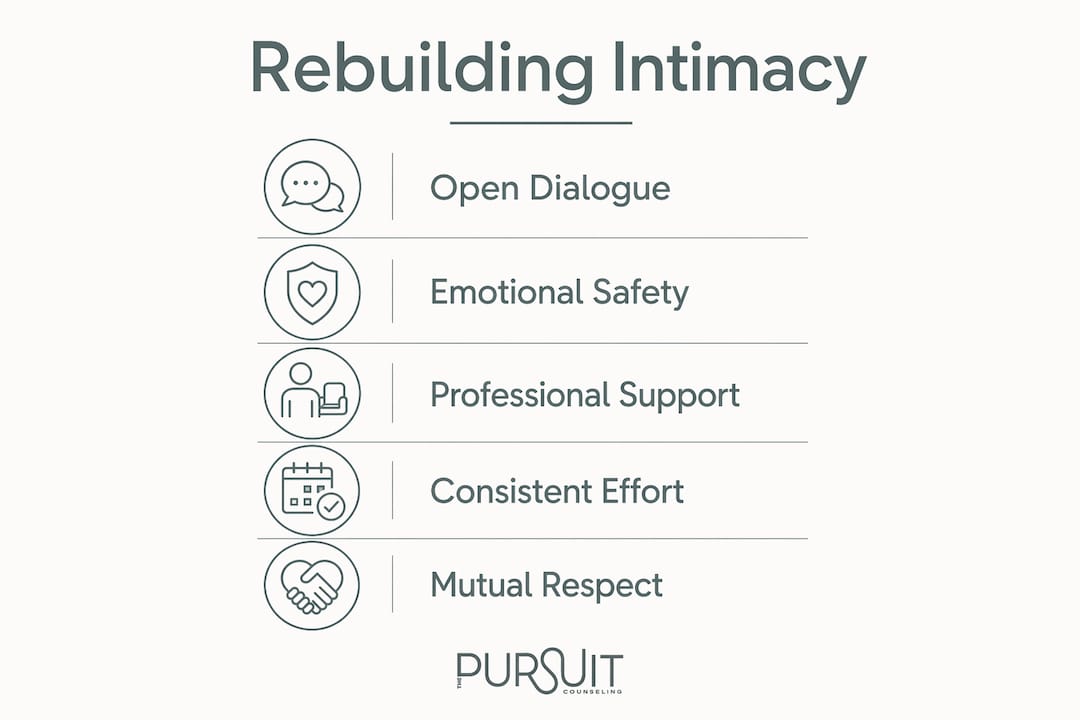
Rebuilding does not start in the bedroom. It starts in the small moments that accumulate into emotional safety.
- Small Things Often. The Gottman Institute’s research points to frequent small positive interactions as the foundation of reconnection. A six-second kiss, a genuine compliment, a hand on the shoulder when passing in the kitchen.
- Consider a sex embargo. Counterintuitively, agreeing to take intercourse off the table temporarily can relieve the performance pressure that blocks desire. It shifts the focus back to connection.
- Try Sensate Focus. Originally developed by Masters and Johnson, this technique uses structured, non-demanding touch exercises to rebuild comfort with physical closeness without the pressure of a specific outcome. You might start with hands and shoulders only, focusing purely on sensation.
- Expand your definition of intimacy. Kissing, cuddling, laughing together, shared rituals, and intimacy exercises that are not goal-oriented all build the foundation on which sexual desire can re-emerge.
- Schedule connection time. It sounds unromantic. It works. What gets protected gets done.
Remember: Sexual desire in long-term relationships is more like a dimmer than a light switch. You can turn it back up, but it takes intention, not just willpower.
The Teammate Dynamic, described by the Gottman Institute, shows that couples who consistently turn toward each other emotionally and physically can reverse the sexless cycle. The direction of that turn matters more than the size of the step.
How The Pursuit Counseling approaches sexless marriage recovery

Professional support is not a last resort. For many couples, it is the most direct route through the pain. Even one or two focused sessions using evidence-based models can disrupt the negative cycles that have taken root.
The Pursuit Counseling uses the Gottman Method, Emotionally Focused Therapy (EFT), and trauma-informed care to work with couples at the level where the real barriers live: attachment injuries, nervous system dysregulation, and the unspoken fears that keep partners from reaching toward each other. These are not just communication tools. They reorganize the emotional bond itself.
Pro Tip: If past trauma is part of the picture, EMDR therapy can process the experiences that are quietly driving avoidance or shutdown in the relationship. Addressing the individual wound often unlocks the couple’s connection in ways that talk therapy alone cannot.
The Pursuit Counseling serves couples in Georgia in person and online, making access straightforward regardless of schedule or location. Couples counseling in Peachtree City and surrounding areas is available, as are intensive formats for couples who want to move faster.
Is a sexless marriage normal?
Yes, far more common than most people admit. Between 10 and 20 percent of married couples in the U.S. report having sex fewer than 10 times a year. The clinical label exists not to shame anyone but to signal that something worth attention is happening. If both partners are genuinely content with low sexual frequency, there is no crisis. The problem arises when one or both partners feel the absence as a loss, a rejection, or a slow erosion of the relationship’s foundation.
Sexlessness often sneaks in gradually through life’s accumulating pressures, not through a single decision. Recognizing it as a pattern, not a verdict, is what makes change possible.
What a sexless marriage does to your mental health and self-esteem
The partner experiencing involuntary sexlessness often carries a quiet grief that is hard to name. Repeated experiences of rejection, even when unintentional, can erode self-worth in ways that extend far beyond the bedroom. Over time, that partner may stop initiating, stop expecting closeness, and begin to feel fundamentally unwanted.
The other partner frequently carries guilt, shame about their own body or desire, and a fear of being seen as broken. Both experiences are painful. Both are valid. And both tend to worsen without honest conversation or professional support. Sexual difficulties in marriage often signal deeper relational needs rather than a lack of love, and treating them as such changes the entire frame of recovery.
What the long-term outlook actually looks like
The outcome of a sexless marriage depends almost entirely on what the couple does with the awareness. Some couples reconnect fully, rebuilding both emotional and physical intimacy through honest conversation, intentional effort, and sometimes professional guidance. Others find a new definition of closeness that works for both of them. A smaller number conclude that the gap reflects a deeper incompatibility.
In Georgia, a sexless marriage is rarely grounds for divorce on its own, but it can support a claim of irretrievable breakdown in a no-fault divorce proceeding. That said, most couples who seek help before reaching that point find more options than they expected.
The couples who tend to do best are the ones who act before resentment calcifies. Early intervention, even brief, produces better outcomes than years of waiting and hoping things improve on their own.
When to stop waiting and seek professional help
Couples wait an average of six years after problems begin before seeking help. That is six years of accumulated distance, unspoken hurt, and missed opportunities to reconnect. The threshold for reaching out should be much lower.
Seek professional support when:
- Conversations about intimacy consistently lead to conflict or shutdown
- Emotional distance has made physical closeness feel impossible to imagine
- One or both partners suspect trauma, depression, or anxiety is driving the pattern
- You have tried to reconnect on your own and the gap keeps returning
- The “roommate feeling” has lasted more than a few months
Differentiation in marriage and secure attachment are skills that can be learned. A licensed therapist who specializes in couples work can teach them in a way that sticks.
The Pursuit Counseling is ready to help you move forward
Real change in a sexless marriage requires more than good intentions. It requires the right support, at the right depth, delivered by people who understand both the neuroscience and the human pain underneath it.
The Pursuit Counseling offers couples and relationship counseling grounded in the Gottman Method, Emotionally Focused Therapy, and trauma-informed care, specifically for couples in Georgia who are ready to stop tolerating the distance and start closing it. Whether you need weekly sessions, a couples intensive, or individual therapy to address what you are each carrying, the work is tailored to where you actually are, not a generic template. Both in-person and online appointments are available. If you are ready to stop waiting, reach out to The Pursuit Counseling today and book your first session.
Key Takeaways
A sexless marriage is a solvable problem when both partners commit to honest communication, intentional reconnection, and, when needed, professional support.
| Point | Details |
|---|---|
| Clinical definition | Fewer than 10 sexual encounters per year qualifies as a sexless marriage. |
| How common it is | Between 10 and 20 percent of married couples in the U.S. report having sex fewer than 10 times a year. |
| Nervous system role | Lack of intimacy triggers fight, flight, or freeze responses that actively suppress desire and bonding. |
| Early intervention wins | Couples wait an average of six years before seeking help; acting sooner produces meaningfully better outcomes. |
| The Pursuit Counseling | Offers Gottman Method, EFT, and trauma-informed couples therapy in Georgia and online for couples ready to rebuild. |