

You know what a lot of people are doing right now?
The same thing they were doing last Friday at 10:00 PM.
Thinking the same thoughts.
Having the same arguments.
Carrying the same worries.
Living inside the same patterns.
And that’s exactly what this blog is about.
Not because people can’t change.
Because most people are trying to create change while standing in the exact same current that carried them here.
If last Friday looked like this Friday,
and this Friday looks like next Friday,
what force enters the story that changes anything?
This Friday night, lets stop our usual routine and find our entertainment in a real life story.
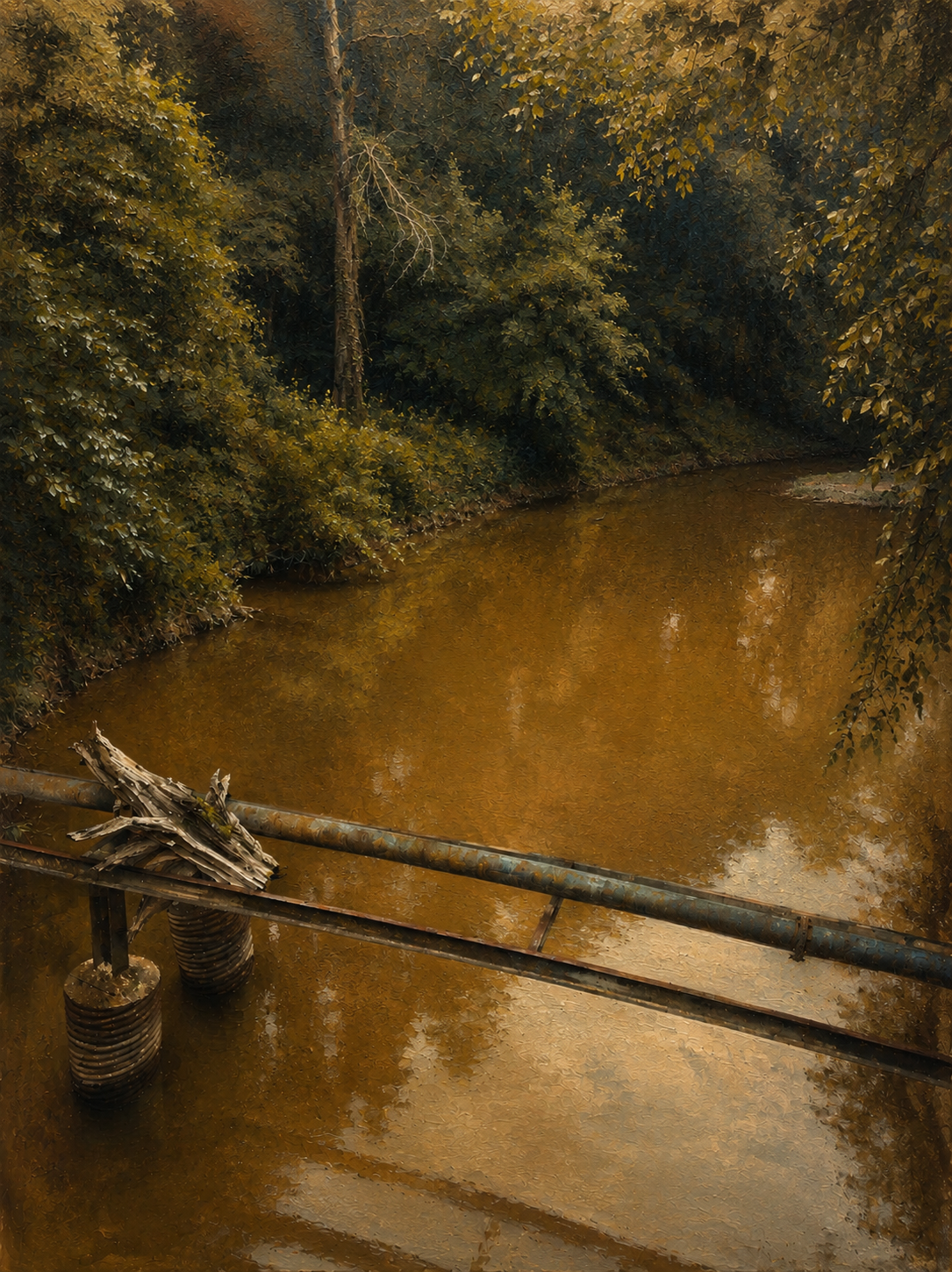
There’s a bridge at the golf course in Fayetteville, Georgia. White Water Golf Club — just past the clubhouse, on the path most people cross without slowing down.
If you stop and look over the railing, you’ll see a stump in the creek below. Not floating. Not resting on the bank. Wedged onto the rusted rails of an old bridge crossing beneath the surface — sitting right where the last flood left it.
It’s been there long enough that most people have stopped seeing it or never noticed in the first place.
I haven’t.
Every time I walk past it I stop,has never been a cleaner model for what keeps people from changing — or what it actually takes to go forward.
|
|
The stump isn’t stuck because it forgot how to float. It’s stuck because something stronger than its ability to move is holding it in place. |
THE THEORY OF CHANGE
Why Trying Harder Doesn’t Work
In behavioral science, a Theory of Change describes the specific mechanism by which transformation happens — not just that change occurred, but the precise conditions that made it possible.
The dominant cultural narrative about change goes like this: you lack motivation, you find it, you act, things improve. Identify the problem, work harder, push through. Most self-help content, most New Year’s resolutions, most internal pep talks operate on this model.
The research, and fifteen years of clinical observation, tells a different story.
A system in equilibrium stays in equilibrium until something external disrupts it. That’s not a metaphor — it’s systems theory, and it describes human behavior with uncomfortable precision. The forces keeping a pattern in place are almost always stronger than the willpower being applied against them. Trying harder inside the same system produces the same result. Different week, same current.
The stump doesn’t need motivation. It needs a flood — a force outside the current system, capable of changing the equation.
|
|
Change doesn’t happen when you finally decide to move. It happens when a new force enters the system. |
WHAT THAT FORCE LOOKS LIKE
External force isn’t one dramatic thing. It doesn’t require a crisis. It requires only this: something that exists outside the pattern, something the pattern cannot predict or absorb back into itself.
A counselor who can name what you can’t see because you’re inside it. A structured intensive that compresses months of circular thinking into concentrated, directed work. A difficult conversation you’ve been postponing. A community that reflects a version of you the current pattern doesn’t. A behavioral change made before you feel ready — because action produces feeling far more reliably than feeling produces action.
None of this is soft. All of it requires showing up before you feel like it. That discipline — not motivation — is what creates the flood.
Motivation is a feeling. Feelings follow action. Waiting to feel ready is the plan that keeps the stump on the rails.
|
|
Discipline gets you moving. Motivation alone leads to stagnation. — Adam Glendye, LPC |
THE SECOND LESSON
Life Is Happening Right Now
Most people who are stuck spend their energy staring at the river — looking backward at who they used to be, what should have happened, what they wish were different. They are waiting for life to resume once the stuck season ends.
The stump isn’t doing that. It’s simply existing where it is. The creek rises and falls. Seasons change. Birds land and leave. Life continues around it whether it moves or not.
This is the second lesson, and the harder one: this season is your life. Not a pause before your life. Not the waiting room before the real thing begins. This chapter — the one you didn’t choose, the one that feels wrong, the one you’re ready to be done with — contains everything you need if you’re willing to stop trying to escape it long enough to understand it.
The goal isn’t to get back to the river. The goal is to understand the rails. What put you here. What’s holding you. What force, if introduced, would change the equation.
THE THREE DIAGNOSTIC QUESTIONS
What’s Actually Keeping You Stuck
In clinical practice, when a client presents with a persistent stuck pattern, I’m not immediately interested in solutions. I’m interested in the mechanics. What is the system? What are the rails? What is the force that could move it?
These three questions are the starting point. They are not journaling prompts. They are a diagnostic. Answer them honestly.
|
01 |
What keeps replaying in your life? The frustration, relationship, fear, pattern, or circumstance that looks remarkably similar to six months ago — or six years ago. Name the thing itself, not the symptom of it. |
|
02 |
What force are you waiting for? More motivation? More confidence? The perfect time? Perfect circumstances? Most people are waiting for a feeling to appear before they act. Identify what you’re waiting for — and whether it’s something that has ever actually appeared. |
|
03 |
What force haven’t you invited into the story yet? A counselor. A difficult conversation. A boundary. A new structure. A truth you’ve been avoiding. Identify the external variable that has not yet entered your system. |
If those questions are hard to answer, you’re not behind. Most people can identify the frustration. Far fewer can identify the force capable of changing the equation. That gap is exactly where the work begins.
THE NEXT CHAPTER INTENSIVE
For the Person Who Knows Something Has to Change
At The Pursuit, we built the Next Chapter Intensive for a specific person: someone standing between who they were and who they’re becoming. Not necessarily in crisis — but aware, sometimes painfully so, that the current chapter has closed and the next one hasn’t taken shape yet.
The intensive is not a general conversation about feeling better. It is structured, concentrated work designed to identify the specific forces keeping you in place — the rails beneath the water you may not even realize are there — and to introduce the forces capable of movement.
Across three sessions of three hours each, we work through:
— What pattern keeps replaying — and why
— What season you’re actually in, and what it’s trying to produce
— What forces have shaped the current pattern and what needs to change
— What your next chapter could look like — specifically, not generally
— A written plan you leave with — not insight, something to act on
Change doesn’t begin when you have everything figured out. It begins when you stop staring at the river and start understanding the rails.
If this blog asked questions you didn’t have clean answers to — that’s not a problem to be embarrassed about. That’s exactly what the Next Chapter Intensive is designed to address.
|
|
The question isn’t how do I get back to the river. The question is what is this season trying to teach me — and what force do I need to invite in to move. |
One day the water at White Water Golf Club will rise high enough to carry that stump downstream. The rails will no longer hold it. Something will shift, and it will move.
The stump doesn’t control when that happens.
You do.
The flood is available. The question is whether you’re willing to stop waiting for it to arrive on its own and start creating the conditions for it.
One step. One conversation. One decision to introduce a new force.
That’s how the stump moves.
That could be a simple conversation.
Book a free 15-minute consult
Or Next Chapter Intensive directly
CLICK HERE to get started.