


Therapy intensives, including EMDR and couples formats, are available across Georgia and offer a concentrated path for adults who want deeper progress on trauma or relationship pain than a weekly fifty-minute session allows. They work best for people who are stable enough to do focused work, have tried therapy before, or want to move through a specific issue rather than manage it slowly. The sections below cover the types, logistics, evidence, and how to prepare.
TL;DR:
- Most intensives in Georgia range from three to eight hours, often spread across one to three days, depending on the complexity of the issue.
- EMDR intensives focus on processing specific memories rapidly, following VA guidelines, with successful treatment often seen after three months of traditional therapy.
- Couples intensives built on EFT or CBCT typically require a therapist with specific training and aim to resolve persistent conflicts or trauma effects within a concentrated timeframe.
- Clients should be stabilized, have coping tools, and a support system in place before scheduling, especially if dealing with severe conditions like active substance use or suicidality.
- Insurance reimbursement is limited for intensives; most clients pay out-of-pocket but can submit superbills for possible partial reimbursement depending on their plans.
Table of Contents
- What makes an intensive different from weekly therapy
- EMDR, couples, and trauma intensives available in Georgia
- Who benefits, who should wait
- Format, scheduling, and what intensives typically cost
- What the research says about EMDR and couples intensives
- Questions to ask before you book, and how to prepare
- Licensing rules for therapists offering intensives in Georgia
- Insurance, reimbursement, and what to expect financially
- Where to find intensive providers across Georgia
- Keeping the progress after the intensive ends
- A clinician’s honest read on intensives
- What booking an intensive with The Pursuit Counseling looks like
- Sources
- FAQ
What makes an intensive different from weekly therapy
An intensive compresses hours of clinical work into a single extended block, sometimes half a day, sometimes spread across two or three consecutive days, instead of stretching it across months of hour-long visits. The pacing changes what becomes possible. Without the constant restart of “catching up” each week, a clinician and client can stay inside a difficult memory or a painful pattern long enough to actually move through it.
People often describe an intensive as compressing months of weekly sessions into a matter of days, and while every case differs, the underlying idea holds: continuity itself is part of the treatment. A single session ends just as the nervous system starts to settle into the work. An intensive gives that settling time room to happen.
Formats vary by provider and need. A half-day block might run three to four hours. A full-day intensive can run six to eight. Multi-day intensives spread the work across two or three mornings or afternoons, often with rest built in between blocks so the mind and body can process what surfaced.
EMDR, couples, and trauma intensives available in Georgia
Georgia providers, including practices around Fayetteville and South Atlanta, offer several intensive formats built around different clinical goals.
- EMDR intensives use extended, focused sessions to work through a specific memory or cluster of memories, following the preparation, targeting, and bilateral stimulation phases described in the VA’s EMDR decision aid, without the week-to-week gap that can slow reprocessing.
- Couples intensives, often built on Emotionally Focused Therapy or Cognitive Behavioral Couple Therapy, give partners several hours together to work through a specific conflict pattern, a betrayal, or the aftermath of trauma that has spilled into the relationship.
- Hybrid trauma intensives blend EMDR with elements of Internal Family Systems or Cognitive Processing Therapy, useful when trauma shows up in fragmented, dissociative, or shame-heavy ways that benefit from more than one lens.
- Experiential adjuncts, such as neurofeedback or adventure therapy, sometimes accompany a core intensive to support nervous system regulation before or after the harder emotional work.
Most Georgia providers offer these in person, though some couples and individual sessions are available by telehealth for the portions that do not require in-office equipment.
Who benefits, who should wait
Intensives tend to help adults who already have some therapy experience, a clear target (a specific memory, a recurring fight, a stuck pattern), and enough stability in daily life to handle a few hours of hard emotional work without falling apart afterward. Couples who are exhausted by circling the same argument for years, or who want faster footing after an affair or a major rupture, are common candidates.
Readiness matters more than motivation alone. Useful markers include steady sleep, at least a few coping tools already in practice, a support person to lean on afterward, and expectations that match reality: an intensive accelerates progress, it does not erase what happened.
Some situations call for a slower approach first. Active severe substance use, acute suicidality, or unmanaged medical conditions that affect concentration or heart rate typically need stabilization before intensive trauma work makes sense. A consult conversation with a clinician is the right place to sort out which category applies.
Format, scheduling, and what intensives typically cost
Packages generally fall into three shapes: a half-day block for a focused single issue, a full single-day intensive for broader trauma or relationship work, and multi-day packages of two or three sessions for more complex histories. Each usually includes an intake or pre-intensive call, the core hours of work, and often a follow-up session to check in afterward.
- Half-day blocks suit a narrow, well-defined target, such as one traumatic memory or one recurring argument.
- Full-day intensives fit broader work, like processing several related memories or resetting a couple’s communication pattern.
- Multi-day packages are typical for complex trauma histories or couples working through infidelity, where the material needs more than one sitting to settle.
Fees vary by clinician training, session length, and whether adjuncts like neurofeedback are included, so a quoted range for one practice will not match another’s.
Under the federal No Surprises Act, self-pay clients who schedule at least three business days ahead are entitled to a written Good Faith Estimate, and if the final bill comes in 0 or more above that estimate, they can dispute it through the Patient-Provider Dispute Resolution process. Ask for that estimate in writing before you book, and expect most practices to require an intake call or paperwork a week or two ahead of the actual intensive date.
What the research says about EMDR and couples intensives
Trauma-focused therapies have a track record that predates the intensive format, and that evidence is what makes the compressed version worth considering rather than just convenient.
Many people who receive Cognitive Processing Therapy, Prolonged Exposure, or EMDR show meaningful symptom improvement after about three months, compared with relatively few who receive no treatment.
That comparison comes from the National Center for PTSD, and it is a large part of why the VA/DoD Clinical Practice Guideline for Management of PTSD prioritizes trauma-focused psychotherapies like EMDR over medication as a first-line approach, while still noting that the right choice depends on patient preference and provider experience.
- Conjoint couple therapy, including EFT, has shown significant pre-to-post gains in relationship satisfaction alongside reductions in PTSD and depression symptoms in clinical samples.
- A systematic review of couple interventions supports EFT and CBCT as evidence-based options for relationship distress, with benefits extending to individual symptoms when trauma is part of the picture.
- Short-term distress during or right after intensive work is common and expected, which is why clinician training matters: look for someone who has completed EMDRIA-approved training and has a clear follow-up plan in place.
Questions to ask before you book, and how to prepare
A few direct questions before booking will tell you more than a website ever can.
- Are you EMDRIA trained or certified, and how many intensives have you run?
- What happens if something difficult surfaces that we do not finish processing that day?
- What is your plan for follow-up care after the intensive ends?
- What does intake look like, and how much stabilization work happens before the intensive itself?
- What is your emergency plan if I am in significant distress after a session?
Most practices require an intake conversation first, partly to confirm readiness and partly to build the coping foundation an intensive builds on. Expect some stabilization work, like grounding techniques or a basic safety plan, before the deeper material gets touched.
Pro Tip: Block out the rest of the day after your intensive. Arrange a ride if you can, skip major decisions, and let yourself rest instead of returning straight to work.
Licensing rules for therapists offering intensives in Georgia
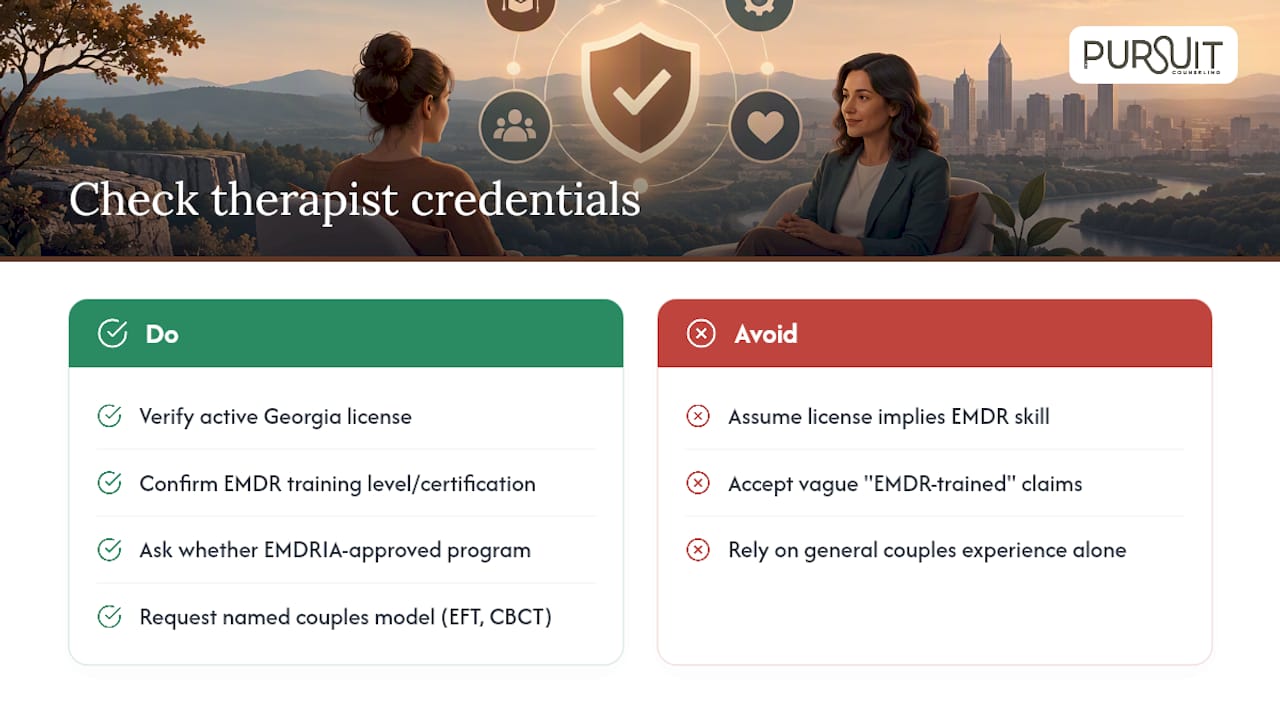
Georgia requires therapists to hold an active state license through the appropriate board, whether that is a Licensed Professional Counselor, Licensed Clinical Social Worker, or Licensed Marriage and Family Therapist, before providing any clinical service, intensive formats included. Licensure alone does not guarantee EMDR competence, though. EMDR is a specialized modality that requires training beyond a general counseling degree.
That is where checking credentials matters more than it might for a standard weekly session. EMDRIA, the professional body overseeing EMDR training standards in the United States, distinguishes between basic EMDR training and full EMDRIA certification, which requires additional consultation hours and case experience. Not every training program that teaches EMDR techniques meets EMDRIA’s approved standard, so verifying a provider’s specific training source is worth the extra few minutes it takes.
For couples intensives, look for training in a named model like EFT or CBCT rather than general couples counseling experience alone, since the intensive format depends on a structured approach that holds up under several concentrated hours rather than one session a week. A therapist offering an intensive should be able to name their specific training, their supervision or consultation background, and how many intensives they have actually run. If they cannot answer clearly, that is useful information in itself.
Insurance, reimbursement, and what to expect financially
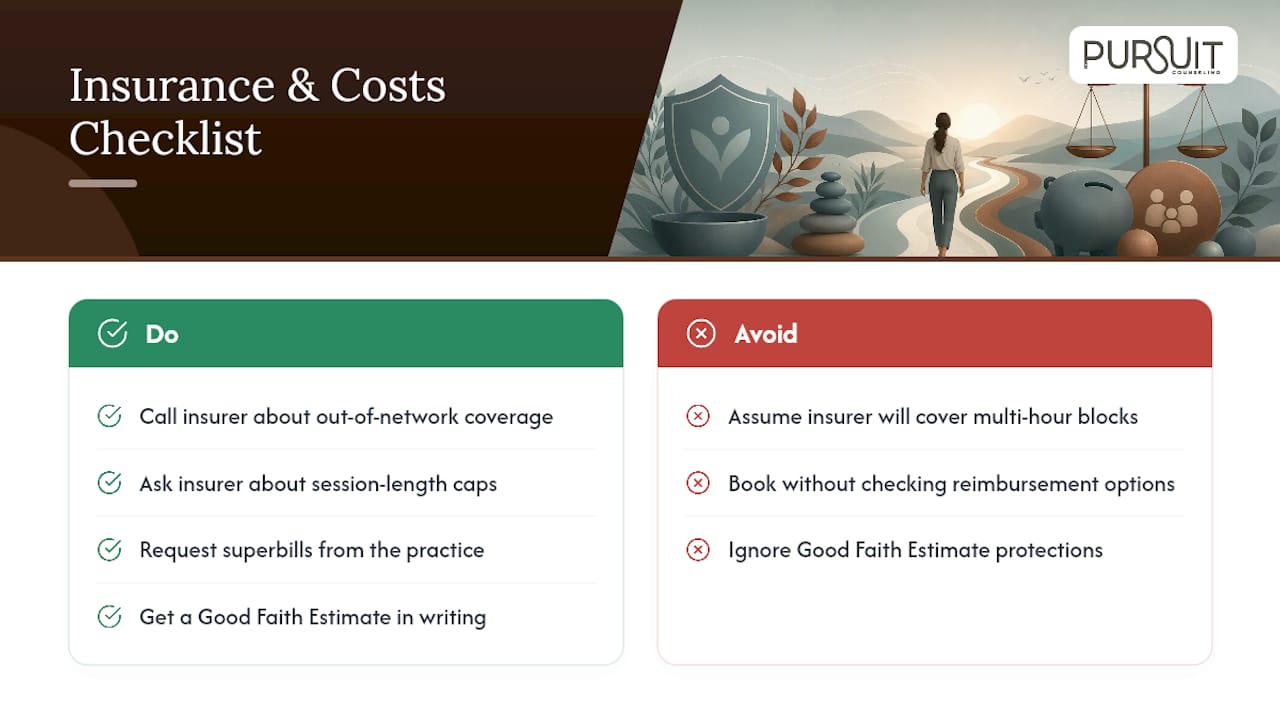
Most intensive therapy programs in Georgia operate on a private-pay basis rather than billing insurance directly, largely because intensives fall outside how insurers typically structure session-based reimbursement. A single eight-hour day does not map cleanly onto a standard 60-minute CPT code, and many insurers will not pre-authorize a multi-hour block the way they might a weekly session.
That does not mean insurance is irrelevant. Many out-of-network plans allow clients to submit a superbill (an itemized receipt with diagnosis and procedure codes) for partial reimbursement, though the amount and process depend entirely on the individual plan. Before booking, it is worth calling your insurer directly and asking whether out-of-network mental health services are reimbursable, what percentage they typically cover, and whether there is a cap on session length they will recognize.
Because most intensives are self-pay, the Good Faith Estimate protections under the No Surprises Act become the more relevant safeguard for Georgia clients, since they guarantee a written cost estimate in advance and a dispute path if the final bill runs 0 or more above that number. Ask any practice directly whether they provide superbills for insurance submission and whether they can walk you through what your particular plan might reimburse.
Where to find intensive providers across Georgia
Therapy intensives are not evenly spread across the state. They tend to cluster around metro Atlanta and its surrounding communities, where enough trained clinicians and demand exist to support the format, though smaller practices in the South Atlanta region, including Fayetteville, Peachtree City, Senoia, Brooks, and Tyrone, also offer them without requiring a drive into the city.
Telehealth has narrowed some of the geographic gap for couples work and consultation calls, even though the core hours of an EMDR or trauma intensive are still usually done in person. If you live outside the metro core, it is worth asking a practice directly whether they offer any hybrid scheduling, such as an intake or follow-up session by video with the main intensive done on-site.
Availability also depends heavily on which specific modality you need. General couples intensives are more widely offered than highly specialized trauma hybrids, and EMDRIA-certified clinicians running true multi-day trauma blocks are a smaller pool than the broader field of licensed therapists who offer some EMDR. If a specific type of intensive matters to you, that is worth confirming by phone rather than assuming from a website description.
Keeping the progress after the intensive ends
The hours spent in an intensive matter, but what happens in the weeks after often determines whether the change holds. Integration is the term clinicians use for the work of carrying insights and nervous system shifts back into ordinary life, and it rarely happens automatically.
A follow-up session within one to two weeks gives a clinician the chance to check what settled and what still needs attention, since intensive work sometimes surfaces material that needs a second pass. Between sessions, simple structure helps: consistent sleep, movement, and at least one person you can talk to honestly about what came up.
Couples in particular benefit from a specific practice or two carried forward from the intensive, whether that is a repair phrase, a way of checking in during conflict, or a scheduled time to talk about harder subjects before they build up. Without some version of ongoing practice, even a strong intensive can fade back into old patterns within a few months. Many providers offer a lighter, less frequent maintenance schedule (once a month, for example) as a bridge between the intensive and full independence.
A clinician’s honest read on intensives
Intensives are not a shortcut, and they are not for everyone. What we see most often is relief mixed with fatigue, sometimes both in the same hour, because concentrated work asks a lot of a person in a short window. The clients who do well are the ones who show up prepared and rested, not the ones expecting a single day to undo years of pattern.
We offer both in-person and telehealth options out of Fayetteville, serving Peachtree City, Senoia, Brooks, Tyrone, and the wider South Atlanta area, and we would rather talk through readiness with you first than book something that is not the right fit yet.
— Adam Glendye LPC, CPCS
What booking an intensive with The Pursuit Counseling looks like
If you have read this far, you already know intensives take real preparation, not just an open afternoon. The Pursuit Counseling offers EMDR trauma therapy and Couples Intensive programs built around that reality, with intake conversations designed to confirm readiness before the deeper work begins, plus neurofeedback available as a regulation adjunct where it fits a client’s needs.

For self-pay clients, we provide a written Good Faith Estimate ahead of scheduling, in line with federal requirements, so there are no surprises about cost before you commit hours of your time and energy. If a couples or EMDR intensive sounds like the right next step, the clearest place to start is our intensives page, where you can see current program options and request a consult to talk through fit before anything is booked.
This article is general information, not a substitute for advice from a qualified doctor. Consult a qualified healthcare professional about your own circumstances before acting on anything here.
Sources
- Know your medical bill rights when not using insurance | CMS
- EMDRIA — EMDR certification requirements
FAQ
Are therapy intensives worth it?
For adults with a specific trauma target or a couple stuck in a repeating pattern, intensives can create faster movement than weekly sessions by giving the work uninterrupted time to settle. Whether it is worth it depends on readiness, cost, and matching the format to your actual situation, which is best sorted out in a consult rather than assumed in advance.
How much do therapy intensives cost?
Costs vary by clinician training, session length, and whether adjuncts are included, so no single figure applies everywhere. A Couples Intensive runs 1,500 USD one-off per each 3 hour intensive, and self-pay clients are entitled to a written Good Faith Estimate before booking under federal rules.
How do therapy intensives work?
An intensive compresses hours of clinical work, sometimes a half day, sometimes spread across multiple days, into a concentrated block instead of separate weekly sessions. For EMDR specifically, that means moving through preparation, memory targeting, and bilateral stimulation phases without the week-long gap between rounds.
Are EMDR intensives safe?
EMDR is one of the trauma-focused therapies prioritized in VA/DoD clinical guidance for PTSD, and short-term distress during processing is common and expected rather than a sign something has gone wrong. Safety depends heavily on working with a clinician who has EMDRIA-approved training and a clear follow-up plan for after the intensive ends.