


If your mind is racing and sleep feels out of reach, a practical step tonight is to get out of bed if you are still awake and alert, do something quiet and low-stimulation, and use a brief grounding exercise or cognitive shuffle to interrupt the loop. If this happens most nights for weeks at a time, cognitive behavioral therapy for insomnia is the treatment clinicians turn to first, and it typically runs 4 to 8 sessions.
Key Takeaways
Cognitive behavioral therapy for insomnia effectively reduces nightly racing thoughts by retraining sleep associations and managing arousal over time.
| Point | Details |
|---|---|
| Nighttime cognitive arousal | Reduced daytime distraction makes pre-sleep mental alertness more noticeable and harder to switch off. |
| Conditioned arousal | Associating your bed with wakefulness sustains a cycle of overthinking and difficulty falling asleep. |
| In-the-moment strategies | Techniques like slow breathing, muscle relaxation, and cognitive shuffling can calm racing thoughts tonight. |
| Structural treatment approach | CBT-I combines stimulus control, sleep restriction, cognitive restructuring, and relaxation for long-term sleep improvement. |
| When to see a professional | Persistent racing thoughts, especially with daily impairment or safety concerns, merit professional evaluation and possibly neurofeedback or medication. |
Table of Contents
- Why your mind often races at night: cognitive arousal, conditioning, and timing
- Evidence-based treatments for persistent racing thoughts
- Practical, night-of strategies to quiet a racing mind
- When racing thoughts suggest something more
- What neurofeedback brain mapping can show about a racing mind
- A clinician’s closing note on racing thoughts
- Where to start if this feels bigger than a bad week
- FAQ
- Sources
Why your mind often races at night: cognitive arousal, conditioning, and timing
Daytime gives your brain a constant stream of input. At night, that input disappears, and whatever you have been avoiding, worrying about, or half processing finally gets room to surface. This is not a character flaw or a sign that something is broken. It is what happens when a busy mind meets a quiet room.
Several things converge at bedtime:
- Reduced distraction lets background cognitive arousal, the mental alertness that was there all along, become noticeable for the first time all day.
- Conditioned arousal builds when the bed becomes associated with lying awake rather than sleeping, so the act of trying to sleep itself triggers more thinking.
- Circadian timing plays a role too: some people are naturally wired toward “eveningness,” feeling more alert and cognitively active later at night regardless of how tired they are.
- Stress, anxiety, and certain mood or attention conditions, including ADHD and bipolar disorder, can heighten this vulnerability, though the pattern looks different in each case.
Racing thoughts at night are common enough to be a defined clinical pattern rather than an isolated complaint. Chronic insomnia affects roughly 10 to 15% of adults, and research using structured racing-thoughts questionnaires found that racing thoughts specifically increase at bedtime in people with sleep-onset insomnia, tracking with insomnia severity independent of general worry or rumination. That distinction matters for treatment: racing thoughts are not just anxious thinking in disguise. They are a measurable form of cognitive arousal with their own targets for intervention.
Evidence-based treatments for persistent racing thoughts
When racing thoughts become a nightly pattern rather than an occasional rough night, the strongest evidence points to one approach. Cognitive behavioral therapy for insomnia, known as CBT-I, is the recognized first-line treatment for chronic insomnia, typically delivered over 4 to 8 sessions. Isolated sleep hygiene tips are not considered an effective standalone treatment, which is worth knowing if you have tried the usual advice and found it thin.
CBT-I combines a few distinct components:
- Stimulus control retrains the bed-sleep association: use the bed only for sleep, and leave it if you are still awake, which breaks the conditioned arousal that builds when bed and wakefulness become linked.
- Sleep restriction therapy limits time in bed to build sleep pressure; it works, but it carries real contraindications, including for people in high-risk occupations or anyone with a history of mania, since reduced sleep can trigger manic episodes.
- Cognitive restructuring identifies and tests unhelpful beliefs about sleep, like catastrophizing about the next day, that fuel pre-sleep anxiety.
- Relaxation training, including breathing and progressive muscle relaxation, supports the other components but is generally less effective on its own than the full multicomponent approach.
A systematic review and clinical practice guideline from the American Academy of Sleep Medicine backs this combination as the standard of care for chronic insomnia in adults, which is part of why clinicians lean on it instead of generic advice.
Pro Tip: Keep a sleep diary for 1 to 2 weeks before your first appointment. It gives a clinician real data on your patterns instead of a rough memory of “bad sleep.”
Practical, night-of strategies to quiet a racing mind
Tonight does not have to wait for a full course of therapy. A few tactics, grounded in the same principles clinicians use, can lower cognitive arousal in the moment.
Start with the room itself: dim the lights, put screens away, and reserve the bed for sleep. If you are lying there awake and alert, get up and do something quiet in low light, like reading something unremarkable or sitting in a dim room, until you feel sleepy again.
From there, a few techniques help in the moment:
- Try abdominal breathing: a hand on your belly, slow inhale through the nose, longer exhale through the mouth, repeated for a few minutes.
- If that feels mechanical, use a paced-breathing pattern, inhaling, pausing, and exhaling slowly.
- Move through progressive muscle relaxation, tensing and releasing muscle groups from your feet up to your face.
- If thoughts keep looping, try cognitive shuffling: picture a neutral, unrelated word, then imagine a simple image for each letter in sequence, which gives the mind something boring enough to let go of the loop.
- Earlier in the evening, spend 5 to 10 minutes journaling or keeping a short “worry log” so the thoughts have somewhere to land besides your pillow.
Stop using bright screens before bed, or at minimum switch to night mode, and keep the room cool and dark.
Pro Tip: If a worry resurfaces after you have already written it down earlier in the evening, remind yourself you already gave it space. You do not owe it a second round at midnight.
When racing thoughts suggest something more
Most racing thoughts at night are situational: stress, a big decision, a day that did not leave room to think. But some patterns point to something that needs a closer look.
- Decreased need for sleep paired with rapid speech, grandiosity, or risky decisions can signal a manic episode, where racing thoughts are a hallmark symptom rather than a passing worry.
- Longstanding, persistent daytime concentration problems alongside nighttime racing thoughts can point toward ADHD, which often benefits from its own evaluation rather than sleep-focused treatment alone.
- Chronic insomnia is clinically defined as difficulty falling or staying asleep at least 3 nights per week for 3 months or longer, and reaching that threshold, or noticing real daytime impairment, is a reasonable point to involve a professional.
- Any safety concerns, including thoughts of self-harm or behavior that feels out of character, warrant immediate professional contact rather than a wait-and-see approach.
A clinician evaluating racing thoughts will typically ask for a sleep diary covering 1 to 2 weeks, screen for mood or attention conditions, and talk through whether CBT-I fits or whether a referral, including to a psychiatrist, makes more sense.

What neurofeedback brain mapping can show about a racing mind
Neurofeedback brain mapping is an assessment tool that looks at patterns of electrical activity in the brain to build a picture of where arousal and attention regulation might be running hotter than they need to. For someone whose mind races at night, a brain map can help identify whether the pattern looks more like generalized hyperarousal, an attention-related profile, or something else, which then informs how a treatment plan gets built.
Neurofeedback itself works by giving the brain real-time feedback on its own activity, with the aim of helping it settle into steadier patterns over repeated sessions. It is not a quick fix delivered in one sitting. It is a structured process that unfolds over a series of sessions, often used alongside talk therapy rather than instead of it.
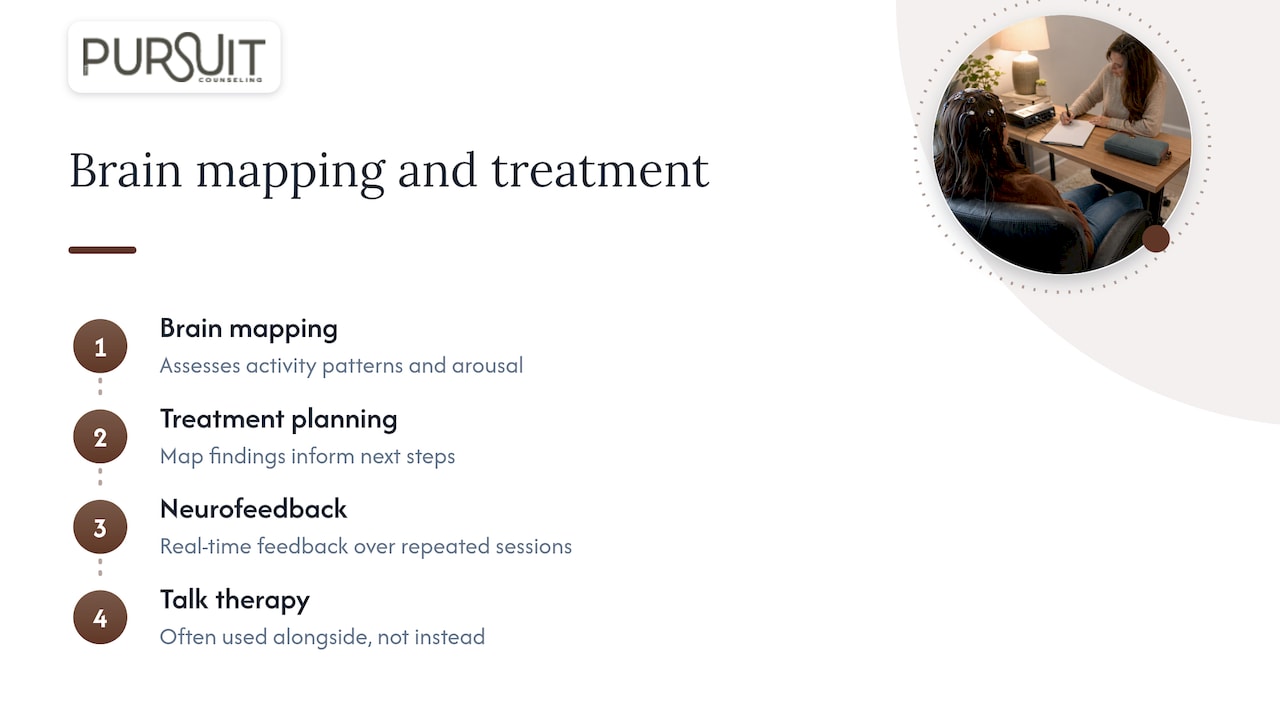
For racing thoughts specifically, this approach can be worth exploring when the pattern feels less like situational stress and more like a brain that runs at a higher baseline of activity most of the time, including during the day. We offer a Neurofeedback Brain Map as part of assessing what is driving that pattern before deciding on next steps.
A clinician’s closing note on racing thoughts
Racing thoughts at night are common, and they respond to treatment, but they are rarely solved by a single trick applied once. That mismatch, between how simple the advice sounds and how stubborn the pattern actually is, is where a lot of people get discouraged and give up too early.
Structured behavioral work, especially CBT-I, reliably reduces pre-sleep cognitive arousal, but it does so over several weeks of consistent practice, not over one good night. If you try the techniques in this piece and notice real change within a couple of weeks, that is a good sign the pattern was manageable with structure alone.
If it does not shift, or if daytime functioning is taking a hit, the next step is straightforward: keep a short sleep diary and bring it to a consult. That single piece of data tends to make the first session far more useful than guessing.
— Adam Glendye LPC, CPCS
Where to start if this feels bigger than a bad week
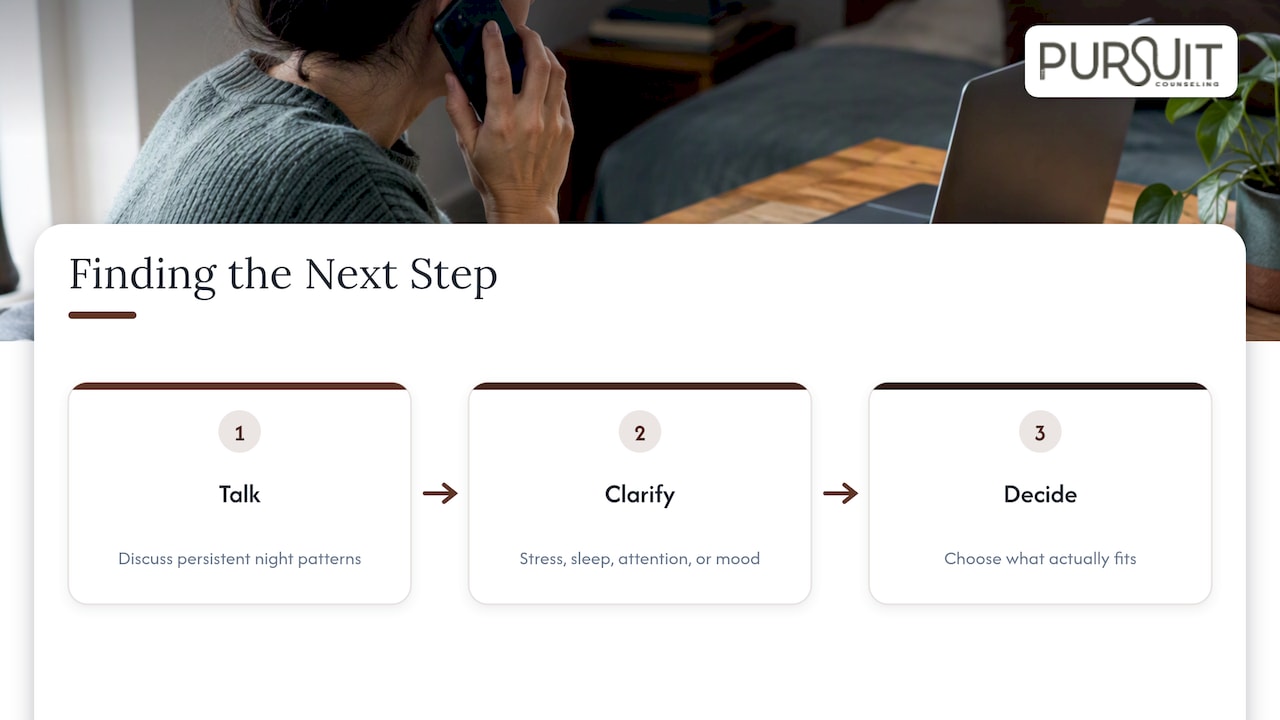
If you have tried the stimulus control, breathing exercises, and worry logs and your nights are still loud, a short conversation with a therapist can clarify whether what you are dealing with is situational stress, a sleep pattern that needs structured behavioral work, or something like ADHD or a mood condition that is showing up at night before it shows up anywhere else.
We work with adults across Fayetteville, Peachtree City, Senoia, Brooks, Tyrone, and the rest of South Atlanta, both in person and online, and we build each plan around what is actually driving your nights rather than a generic sleep checklist. That might mean individual therapy focused on anxiety or racing thoughts, a closer look at attention and focus concerns, or a Neurofeedback Brain Map if your pattern points toward broader hyperarousal that is also affecting your days. If medication is part of what you are weighing alongside therapy, this comparison of therapy and medication for anxiety walks through how the two approaches may compare.
If a chronic pattern has been building for months, the next concrete step is a consult where we talk through your sleep diary and what has already shown up in your days, and decide together what actually fits. You can see current services and reach out through our services and specialties page to get that conversation started.
This article is general information, not a substitute for advice from a qualified doctor. Consult a qualified healthcare professional about your own circumstances before acting on anything here.
FAQ
What does it mean if you have constant racing thoughts at night?
Constant racing thoughts at night usually reflect heightened cognitive arousal, often tied to stress, conditioned wakefulness in bed, or a naturally more alert evening pattern. Research using structured racing-thoughts measures found this pattern is linked to insomnia severity and is distinct from general worry, though persistent cases sometimes point to ADHD or a mood condition worth evaluating.
How do you calm racing thoughts?
In the moment, slow abdominal breathing, progressive muscle relaxation, or a cognitive shuffle exercise can interrupt the loop, alongside getting out of bed if sleep is not coming and you are still awake and alert. For a pattern that repeats most nights, CBT-I addresses the underlying conditioned arousal rather than just the symptom.
Is mind racing at night a symptom of ADHD?
A racing mind at night can overlap with ADHD, particularly when it comes with longstanding daytime concentration difficulties rather than situational stress. An evaluation helps distinguish ADHD-related racing thoughts from insomnia driven by anxiety or conditioned bedtime arousal.
How do I stop my mind from racing while trying to sleep?
Start with stimulus control: use the bed only for sleep, keep the room dark and screen-free, and get up if you are still awake and alert rather than lying there trying harder. If this happens repeatedly, CBT-I offers a structured path built around exactly this problem.