

What is executive burnout treatment, and where can you get it in Georgia?
Executive burnout treatment is specialized, evidence-based care that combines psychiatric support, psychotherapy, and restorative approaches to help high-level professionals recover their mental clarity, emotional resilience, and sustainable performance. It goes well beyond generic stress counseling. The best programs address the nervous system dysregulation, identity strain, and cognitive depletion that make executive burnout so different from ordinary workplace fatigue.
For most Georgia executives, the best care starts close to home. The Pursuit Counseling sees executives, founders, and high performers in person at our Fayetteville office in Fayette County, convenient to Peachtree City, Tyrone, and south metro Atlanta, with secure telehealth available anywhere in Georgia when your schedule doesn’t allow the drive. The right level of care depends on how severe the burnout is and what it is affecting.
| Level of care | Best for | What it usually includes |
|---|---|---|
| Outpatient counseling | Burnout that is affecting sleep, mood, focus, or relationships while you are still working | Regular sessions using approaches such as EMDR, neurofeedback, counseling, and executive coaching |
| Intensive format | Leaders who want concentrated work over a shorter period instead of a weekly cadence | Longer, focused sessions built around a specific goal or transition |
| Psychiatric care | Anxiety, depression, or sleep disruption that may need medication | Evaluation and medication management by a psychiatric provider, often alongside therapy |
| Residential or inpatient care | Burnout that has crossed into substance use, safety concerns, or an inability to function day to day | Structured, round-the-clock care away from work |
What does executive burnout actually look like?
Burnout in executives rarely announces itself cleanly. It tends to accumulate quietly behind a wall of productivity, until one morning the drive is just gone. Recognizing the pattern early is the first step toward doing something about it.
Common signs and symptoms include:
- Persistent physical exhaustion that sleep does not fix
- Emotional detachment from work, colleagues, or family
- Shortened fuse, irritability, or sudden cynicism about your organization
- Difficulty concentrating or making decisions that once felt automatic
- Physical complaints: headaches, GI issues, frequent illness
- Relying on alcohol, food, or other sensory outlets to decompress
The Center for Creative Leadership notes that leaders most often turn to sensory pursuits as stress management, ranging from healthy outlets like running to riskier behaviors like overeating. When those coping mechanisms start running the show, burnout has usually already taken hold.
Three distinct types show up most often in executives:
- Overload burnout: Driven by relentless pace and an inability to say no, this is the most common type among C-suite leaders.
- Under-challenged burnout: Paradoxically common in senior roles where autonomy has been stripped away, leaving capable people bored and disengaged.
- Disillusionment burnout: Emerges when the values that drove someone into leadership no longer match the organization’s reality.
Each type calls for a different recovery path. Treating overload burnout the same way you treat disillusionment burnout rarely works.
How do effective treatment approaches address executive burnout?
Recovery from burnout is not a single intervention. It is a layered process, and the most effective programs build a plan around your specific type, history, and nervous system state.
Evidence-based therapies used in executive burnout recovery:
- Cognitive Behavioral Therapy (CBT): Restructures the thought patterns that keep high performers locked in overwork cycles. CBT is one of the first-line structured approaches clinicians recommend for burnout recovery.
- EMDR (Eye Movement Desensitization and Reprocessing): Addresses the stored trauma and chronic stress responses that often underlie severe burnout, particularly in leaders who have navigated high-stakes crises.
- Neurofeedback: Trains the brain’s electrical activity to shift out of chronic alarm states, restoring the cognitive flexibility executives need to perform.
- Medication management: Board-certified psychiatric providers can assess whether anxiety, depression, or sleep disruption warrants pharmacological support alongside therapy.
- Trauma therapy: Especially relevant when burnout is layered on top of unresolved professional or personal trauma.
Complementary approaches that accelerate recovery:
- Mindfulness and structured reflection practices
- Equine or nature-based therapy, offered at some residential programs
- Executive coaching focused on leadership stress patterns
- Lifestyle medicine: sleep, nutrition, and exercise protocols
Pro Tip: Most executives try to manage their way out of burnout by reorganizing their calendar. That rarely works. According to Forbes, the real shift is from time management to energy management. Until the nervous system moves out of a sustained alarm state, no schedule will hold.
What executive burnout care looks like in Fayetteville, GA
The Pursuit Counseling works with Georgia executives in person at our Fayetteville office, with secure telehealth available across Georgia. Its focus on neuroscience-based methods, including EMDR and neurofeedback, makes it a strong fit for executives whose burnout is rooted in chronic stress and trauma rather than addiction. The executive coaching component is a genuine differentiator for leaders who want to rebuild performance alongside mental health.
If your burnout has crossed into substance use, or you may need medication management or round-the-clock care, a psychiatric provider or a residential program may be the right first step. A counselor can help you sort out which level of care fits before you commit to one.
How do you choose the right executive burnout treatment?
The right program is the one that fits your specific type of burnout, your schedule, and your willingness to engage. A few questions cut through the noise quickly.
Key factors to evaluate:
- Specialization: Does the program have real experience with executives, or is it a general mental health clinic that uses the word “executive” in its marketing?
- Modalities offered: If trauma is part of your story, look for EMDR or trauma-focused therapy. If cognitive fog is your primary complaint, neurofeedback may be worth prioritizing.
- Credentials: Board-certified clinicians and accreditations like Joint Commission matter. They are not just marketing signals.
- Confidentiality: Inpatient programs require you to be physically absent from work. Telehealth and intensive outpatient options protect privacy and schedule flexibility.
- Insurance and cost: Many executive-focused programs are private pay; confirm fees and payment options before your first appointment.
Pro Tip: Ask any prospective program how they address nervous system recovery, not just symptom management. A program that only talks about coping skills is working at the surface. The ones worth your time will have a clear answer about physiological stabilization and how they measure progress.
Burnout recovery timelines vary widely depending on severity, how long the burnout has been building, and what protective factors you already have in place. Getting professional help early shortens that timeline considerably.
The Pursuit Counseling offers a different path for executives
If a residential program feels like too much, too fast, or you want to work with someone who specializes in the psychology of high performance before committing to a residential program, The Pursuit Counseling is worth a direct conversation.

The Pursuit Counseling works with executives, founders, and high performers using EMDR, neurofeedback, and evidence-based counseling designed specifically for the stress patterns that come with leadership. Sessions take place in person at our Fayetteville office, and secure telehealth is available anywhere in Georgia when your schedule doesn’t allow the drive. The focus is not on managing symptoms. It is on restoring the nervous system flexibility that makes sustainable performance possible again. If you are in the pain cave right now, this is a place that understands what put you there and knows how to help you find your way out.
Key Takeaways
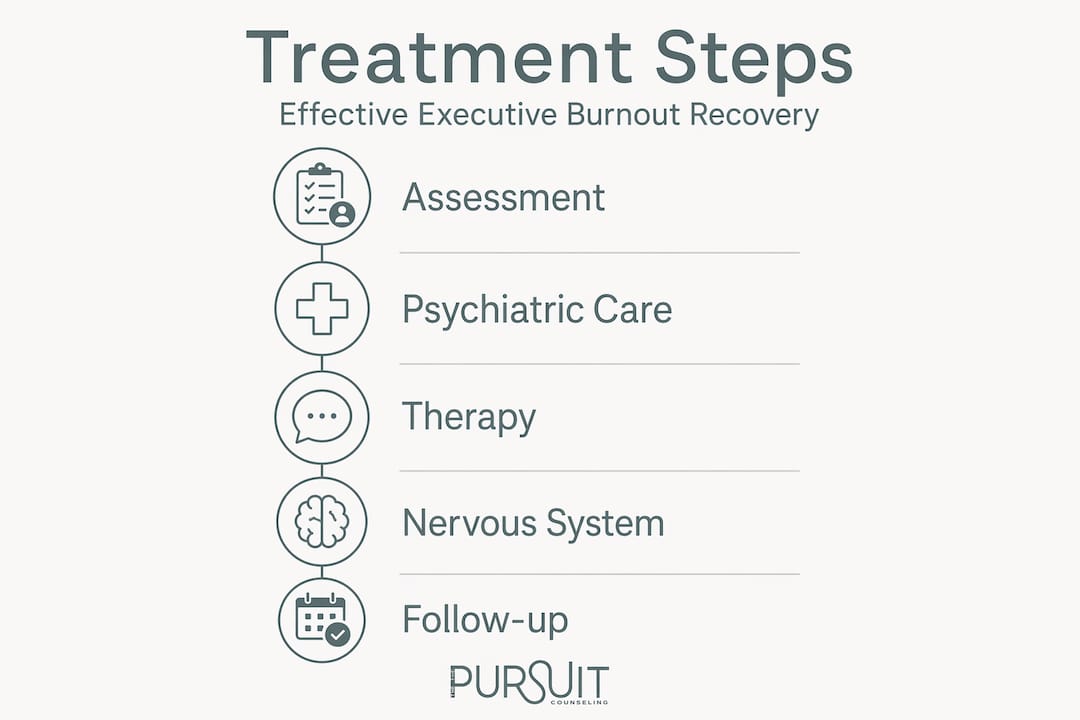
Effective executive burnout treatment combines psychiatric care, evidence-based therapy, and nervous system recovery, with options in Georgia ranging from in-person outpatient counseling to psychiatric care and residential programs.
| Point | Details |
|---|---|
| Three burnout types need different treatment | Overload, under-challenged, and disillusionment burnout each require a distinct recovery approach. |
| Energy management beats time management | Sustainable recovery requires nervous system stabilization, not just schedule reorganization. |
| Credentials and specialization matter | Look for board-certified clinicians, accreditations like Joint Commission, and real executive experience. |
| Ask about cost up front | Many executive-focused programs are private pay, so confirm fees before your first appointment. |
| The Pursuit Counseling suits executives who want neuroscience-based care close to home | EMDR, neurofeedback, and executive coaching in person in Fayetteville, GA, with telehealth available across Georgia. |
Who can help: Daniel Bashta, CIT, supervised by Adam Glendye, LPC, CPCS, works with adults in addiction recovery and brings personal familiarity with recovery and the 12 Steps to his work. He sees clients in person at our Fayetteville, Georgia office. Book a session with Daniel or learn more about addiction and recovery counseling.
Recommended
- Counseling for Burnout Near Me in Fayetteville, GA | The Pursuit Counseling
- What Causes Burnout in Leadership Positions? (2026) – The Pursuit Counseling
- Executive Therapist for CEOs, Founders & High Achievers | Adam Glendye
- Depression Therapy For High-Achieving Professionals In Georgia – The Pursuit Counseling
If this is landing for you, we offer counseling for high-functioning burnout in person in Fayetteville, GA, and by telehealth across Georgia.