

A career change rarely stays at the office. It follows you home, into your sleep, into the way you answer “So, what do you do?” Career transition therapy is counseling built for that moment: it treats the stress, the identity shift and the decision-making as one problem instead of three. At The Pursuit Counseling in Fayetteville, our Life Transitions therapy is for people who want to think clearly about what comes next without pretending the change doesn’t cost them anything.
This article explains what the work is, what happens in a session, how it differs from career counseling, and how to tell whether now is the time.
Key Takeaways
- Career transition therapy addresses both sides of a change: the practical question of what to do next and the emotional weight of leaving, losing or outgrowing a role.
- Professional guidelines from the American Psychological Association treat work satisfaction and workplace stressors as legitimate parts of treatment, not side issues.
- Forced changes, such as layoffs, tend to bring grief, anxiety and loss of identity. Chosen changes can bring doubt of their own.
- Therapy is not an aptitude test or a diagnosis. Education and assessment are different things, and a good therapist says which one you are getting.
- You do not need to be in crisis. Many people start while still employed and still undecided.
Table of Contents
- What career transition therapy actually is
- Why a career change is more than a logistics problem
- Career transition therapy vs. career counseling
- What happens in a session
- When burnout is the real reason you want out
- Signs it may be time
- Who we see, and what that looks like in Georgia
- Ways to work with us
- Our perspective
- FAQ
- Sources
What career transition therapy actually is
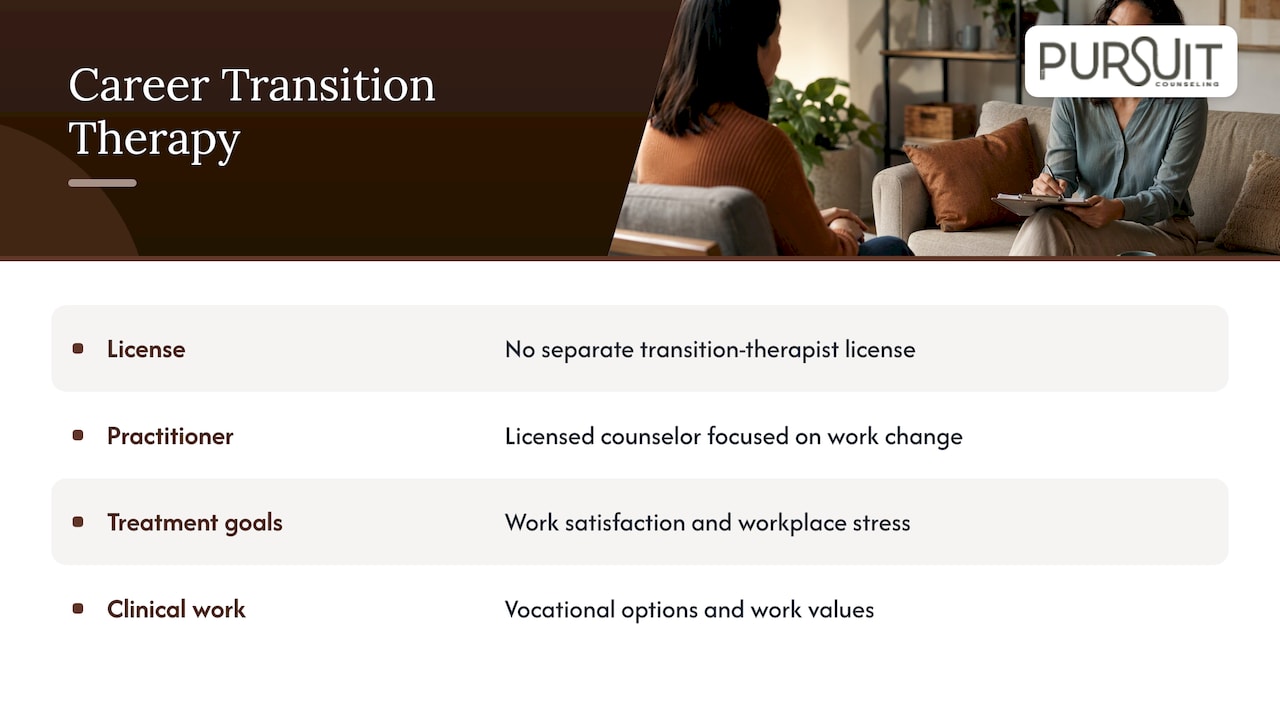
There is no separate license called “career transition therapist.” The phrase describes a focus: a licensed counselor working with you on a change in your working life. That change might be a layoff, a resignation, a pivot into a new field, a promotion that doesn’t feel the way you expected, a sale of your company, or a return to work after time away.
The American Psychological Association has published professional practice guidelines on work and career for clinicians. They describe including work satisfaction and workplace stressors in treatment goals, exploring vocational options, and assessing interests, work values and abilities. They also address underemployment, involuntary unemployment and loss of work, and point clinicians toward low coping resources and threats to personal identity.
Read that list again. Notice how much of it is not about résumés. Work is where many capable adults keep their sense of competence, their schedule, their friendships and their story about who they are. When the job moves, all of that moves with it.
Why a career change is more than a logistics problem
If you are the kind of person who solves problems for a living, you may have tried to solve this one the same way: lists, spreadsheets, a few coffees with contacts. Sometimes that works. Often it stalls, and the stall is not a lack of intelligence. It is that part of the problem is not on the spreadsheet.
Career counselor Barbara Herzog, writing for the National Board for Certified Counselors, reports that people pushed into a change often struggle with loss of identity, grief, situational depression, anxiety or anger, while people who chose the change tend to arrive optimistic and eager. Both groups can use support. They just need different things.
Researchers writing on trauma-informed career counseling note that the chronic stress of a job loss can shift identity in lasting ways, from pulling away from social connections to a dimmer view of future success, and that some workers disengage from the workplace afterward. That is not weakness. It is what a heavy, unplanned loss can do to a person who cared about the work.
You may recognize some of this:
- You are performing confidence in meetings and lying awake at 3 a.m.
- You keep opening job boards and closing them without applying.
- You know what you are leaving but cannot picture what you are moving toward.
- You have achieved the thing you were told to want and feel strangely flat.
- You feel embarrassed about being stuck, because you are usually the one with the answers.
None of these is a diagnosis. They are signals worth taking seriously.
Career transition therapy vs. career counseling
The two overlap, and the difference is mostly one of emphasis.
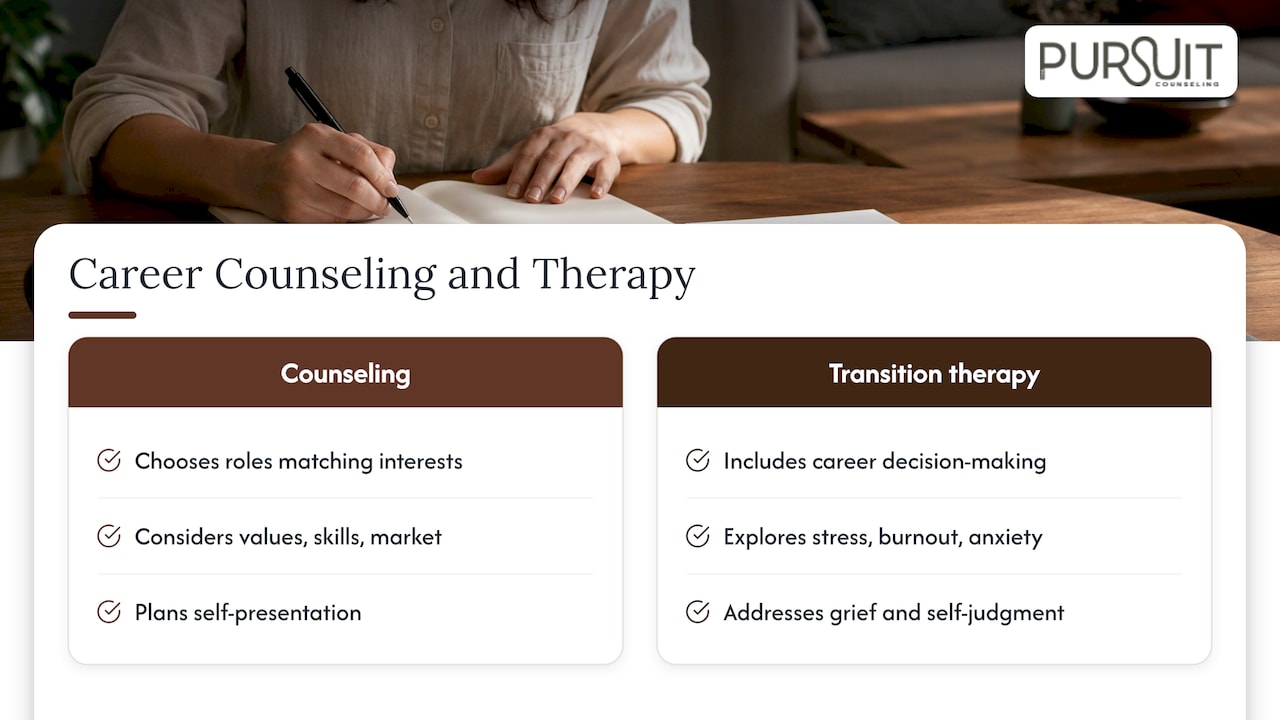
Career counseling centers on the decision: what fits your interests, values and skills, what the market looks like, how to present yourself. Therapy for a career transition includes that thinking but gives equal weight to what the change is doing to you. Stress, burnout, anxiety, grief, relationship strain and old patterns of self-judgment are all in scope.
The APA’s guidelines are written for clinical work with individuals, and they are not meant to direct interventions with organizations or industries. That is a useful boundary. If your question is “Which role should I pursue?” and your body is also telling you something is wrong, the one-person, clinical lens is the one that fits.
Two more distinctions matter to us:
Education is not assessment. Reading about career change, or using an interest inventory, can inform you. A clinical assessment is a formal evaluation by a licensed professional, and it is a different process with a different purpose. Career transition therapy may draw on both, and we will tell you which one we are doing at any given time. Nothing in therapy is a promise of a particular outcome or a substitute for a diagnosis you have not been given.
Therapy is not coaching with a softer name. Coaching generally focuses on performance and goals. Therapy lets us look at why a goal keeps slipping, or why a success lands as emptiness.
What happens in a session
Every therapist works differently, and your sessions will be shaped around you. Still, the professional literature gives a good picture of the ground that is typically covered.
Herzog describes starting by reviewing your goals and concerns, asking open questions, and balancing emotional processing with career exploration, sometimes with between-session homework. She lists approaches such as motivational interviewing, solution-focused work, narrative storytelling about your working life, and cognitive behavioral techniques for harsh, all-or-nothing judgments about your abilities.
In practice, that usually breaks into four threads:
1. Naming what the change cost
You can’t weigh a next step honestly while you are quietly grieving the last one. Early sessions often make room for the loss, the anger, the relief you feel guilty about, and the fear.
2. Getting clear on values and strengths
The APA guidelines point to feedback on vocational assessments and clarifying values and assets as supported interventions for vocational choice. This is where “what do I want” becomes more specific than “something different.”
3. Rebuilding coping resources
The same guidelines recommend bolstering coping resources and reducing the habit of reading a job loss as a verdict on your worth. Sleep, support, boundaries and the stories you tell yourself all live here.
4. Making and testing decisions
Herzog’s list includes developing criteria for choosing targets, learning about prospective careers and looking at how you have solved hard decisions before. Therapy can sit beside the practical work: interviews, networking conversations, a negotiation with a business partner.
If stress has tipped into something heavier, we can address it directly. Our individual counseling for anxiety and life transitions is one route, and trauma-informed counseling for adults is another when a layoff or workplace event has left a mark. The trauma-informed idea, as the researchers put it, is to understand how an experience has affected you, which is not the same as treating a trauma diagnosis. When a treatment for trauma is appropriate, we offer EMDR.
When burnout is the real reason you want out
Some career changes are really escape plans from burnout. That deserves care, because changing the job without changing the pattern can carry the same exhaustion into a new office.
The APA’s “Changing course” feature lists signs that can surface during career transitions, including loss of interest in what you are doing, mistakes and poor judgment, and growing impatience. One published clinical approach to career burnout argues that treatment has to ask why a person chose the career in the first place and what would have to change for work to feel meaningful again.
That question is a good test of whether you need a new job, a new role in the same company, or a different relationship with the work you already do. If burnout is the thread, our page on counseling for burnout and workplace stress explains how we approach it.

Signs it may be time
You do not need to wait for a breaking point. Consider starting when:
- A layoff, restructuring or forced exit has happened, or you can feel one coming. The APA guidelines direct clinicians to pay attention to low coping resources and high stress appraisal in people who have been laid off or are at risk.
- You are weighing a major pivot and the people around you have too many opinions or too much at stake.
- Your performance is fine and your interest is gone.
- Your partner or family is absorbing the strain.
- You are using work, alcohol or constant motion to avoid thinking about the question.
The APA’s feature also notes that most people who make a career transition wish they had done it sooner. That is not a push to jump. It is a reminder that waiting for certainty is its own decision.
If you are ever in crisis or having thoughts of harming yourself, call or text 988, the Suicide & Crisis Lifeline, or go to the nearest emergency room. That comes before any career question.
Who we see, and what that looks like in Georgia
Our practice is in Fayetteville, and we work with clients across Peachtree City, Senoia, Tyrone, Brooks and South Atlanta, in person and online. The people who come to us for transitions are often the ones everyone else leans on: executives and founders, pilots, business owners, busy parents, creatives. Complicated people, in the best sense. Their careers carry a lot of identity, and their changes tend to carry a lot of weight.
Many people describe a change like this as standing at life’s crossroads: the road behind is closed or closing, the roads ahead are not yet visible, and every option comes with a cost. We think that image is right. The pain of that stretch is information. Our work is to help you read it rather than rush past it.
If you want to read more before reaching out, our pages on life transitions counseling in Peachtree City and career change, changing careers with a local counselor and why many executives seek therapy describe how we think about it.
Ways to work with us
We are a private-pay practice. For current details and how out-of-network benefits may apply, contact the office or start with a free 15-minute consult.
Weekly sessions suit most people who want steady support while they are still working through the decision. For some, a concentrated block fits better: you can see the Next Chapter Intensive on our intensives page. Leaders who want a deeper program can look at The Executive Experience.
To see all individual options and book, start on our services and specialties page.

The first step does not need to be a decision about your career. It can be a conversation about what the last few months have been like, and what kind of help would be accurate to that.
Our perspective
We meet a lot of people who are excellent at carrying things. Then a career changes, by choice or by force, and the thing they are carrying turns out to be heavier than the job description ever suggested.
Our view is simple. A career transition is a loss and an opening at the same time, and rushing either half costs you. We would rather help you stay with the hard part long enough to learn from it, and then help you choose from clarity instead of panic.
That is why we pair evidence-based therapy with a collaborative style. You are not a case file. You bring the history, the stakes and the instincts. We bring training, structure and honest reflection. Some people need weekly sessions. Some do better with an intensive. Some need the pace of working outdoors, which is why we also offer adventure therapy. We adapt to the person rather than asking the person to adapt to a program.
We will not promise an outcome, and we will not hand you a diagnosis you did not ask for. We will take your situation seriously, name what we see, and give you a next step that matches where you really are.
Adam Glendye LPC, CPCS
FAQ
Is therapy after a career change only for people who were laid off?
No. Laid-off clients often face grief and loss of identity, while people who chose to change can still face doubt, fear of regret and a sense of starting over. Both are reasonable reasons to talk with a therapist.
Will a therapist tell me what career to pursue?
Not in the sense of handing you an answer. A therapist can help you clarify values, strengths and decision criteria, and can use structured assessments where appropriate. The decision stays yours.
How long does it take?
It depends on what you are carrying and what you want from the work. Some people use a few sessions around a specific decision, while others stay longer to work through burnout or a larger loss. We will talk through what makes sense in the first conversation, and we do not promise a timeline or result.
Do you offer online sessions?
Yes. We see clients in person in Fayetteville and online, which suits people with travel-heavy or unpredictable schedules. For current details and how out-of-network benefits may apply, contact the office or start with a free 15-minute consult.
Sources
- APA professional practice guidelines for integrating the role of work and career into psychological practice
- NBCC: forced career transition, Barbara Herzog, February 2023
- Wright and Chan, integrating trauma-informed care into career counseling, 2022
- APA Monitor, “Changing course,” September 2016
- Treating career burnout: a psychodynamic existential perspective
- When you are at life’s crossroads